“Letter of Intent” Opens Possibility of Flowing Recycled Water to the District’s Service Area | |
|
Earlier this year, the District executed a “Letter of Intent” to participate in the Pure Water Southern California recycled water project being developed by the Metropolitan Water District of Southern California and the Los Angeles County Sanitation Districts. The Project had been known as the Regional Recycled Water Program and has the potential to double the amount of recycled water produced in the area.
The project will take cleaned wastewater and purify it to produce a new source of high-quality water for Southern California. When completed, it will produce up to 150 million gallons of water daily, enough to serve more than 500,000 homes – making it one of the largest water recycling facilities in the world. Purified water from the facility would be delivered through up to 60 miles of new pipelines to the region’s groundwater basins, industrial facilities, and two of Metropolitan’s water treatment plants.
The project is currently in the environmental planning stage. A demonstration facility completed in 2019 at the Sanitation Districts’ Joint Water Pollution Control Plant in Carson allows for testing of the innovative purification process that would be used. The demonstration facility is also open for public tours. The project could be built and in operation within a decade, with the potential for making limited water deliveries at an earlier date. To learn more, visit the project website: http://www.purewatersocal.com/.
| |
|
OPERATIONS &
INFRASTRUCTURE
| |
|
|
SGVMWD Operations and Local Water Delivery Update
The State set the allocation to State Water Contractors such as the District at 5% in March following the driest three-month period in our history from January - March. A 5% allocation means the District will deliver 1,440 AF of water (of its planned 28,800 AF) from the State Water Project to underground storage in the Main San Gabriel Basin. Coupled with ongoing drought and the long-term impacts of climate change, this is a significant impediment to the Valley’s ability to supplement local groundwater supplies.
About 80 percent of the Valley’s water supply is furnished by local groundwater, and the Valley imports about 20 percent of the water we use from northern California and the Colorado River. A 60 percent allocation is needed to meet the demand of our member cities for replacement water. Thus, in years where the allocation dips below that amount, we see the important role that water storage plays.
| |
|
Water Supply Challenges Worsen Across California and the
San Gabriel Valley
| |
|
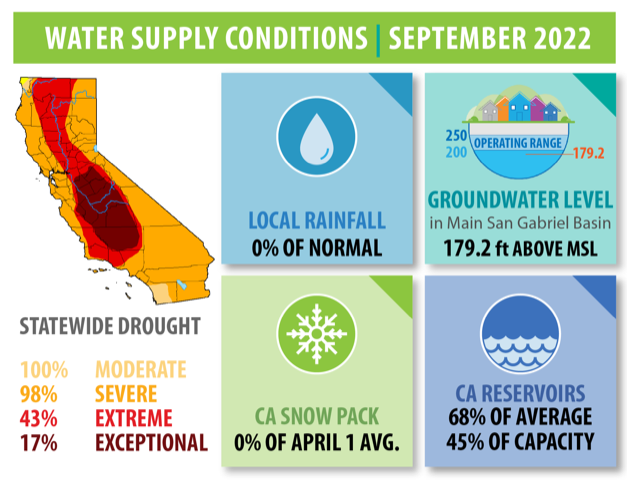
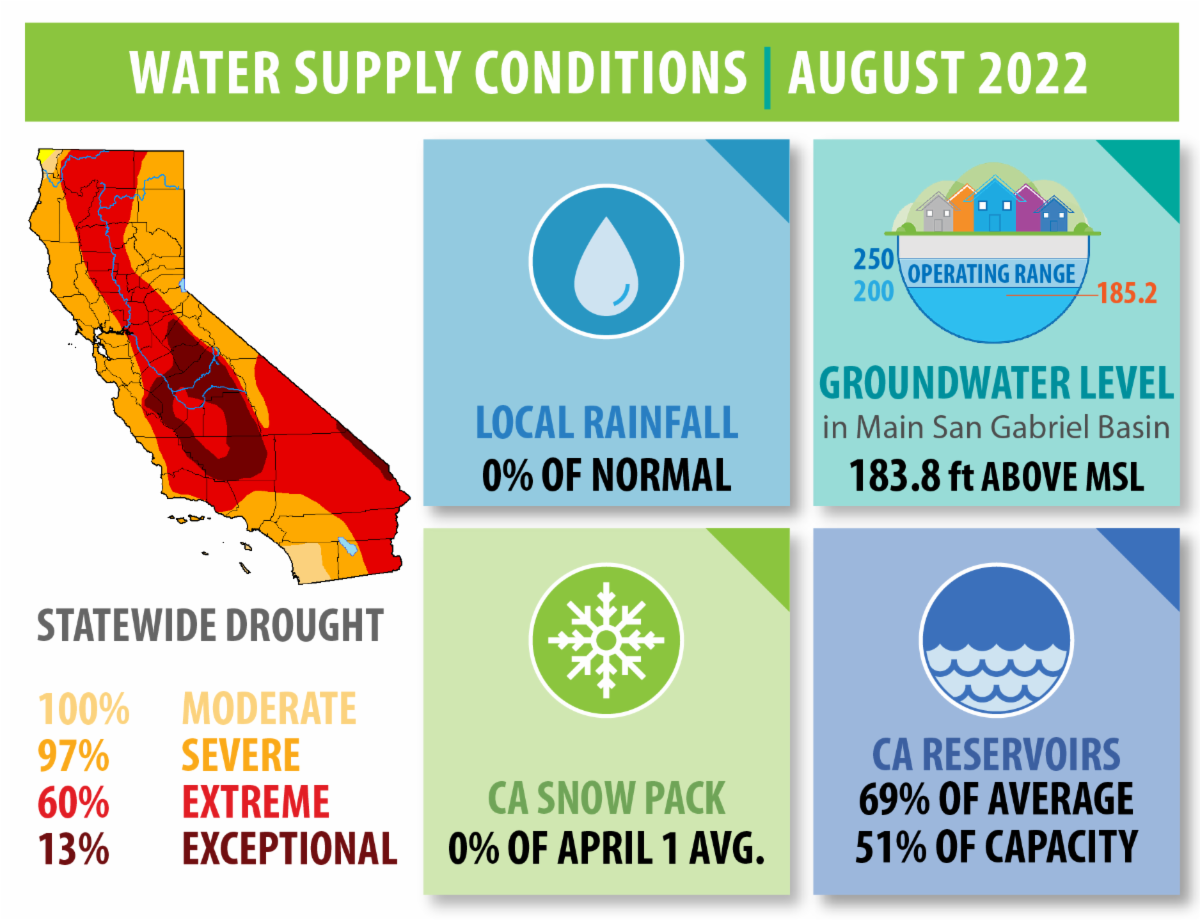
Summary - As shown in the graphics above, water supply conditions remain lower than desired and drought conditions continue to worsen. U.S. Drought Monitor maps reveal 98% of California is classified under severe drought. Groundwater, rainfall, and statewide snow pack and reservoirs, each remain well below desired levels.
Climate change and increasingly warmer temperatures (two degrees hotter, on average, now than 50 years ago) have evaporated precipitation and melted snow pack much faster than in prior years, resulting in less melting snow feeding rivers and reservoirs, and soil moisture drying out before soaking down into the ground.
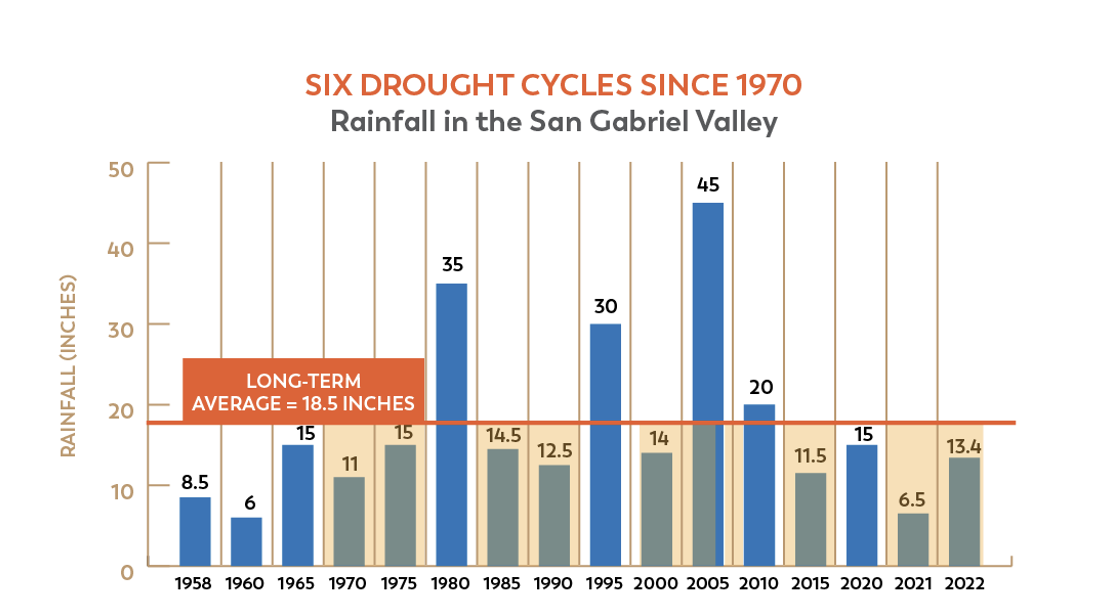
We’ll need multiple above-average rain and snow years to make up the difference. As the updated graph below illustrates, rainfall in the past four years has been below average and drought is common and “normal” in the San Gabriel Valley.
| |
|
In response to these conditions, the Governor issued an executive order in March 2022 calling for local water agencies to implement more aggressive conservation measures. In May, to hasten water savings, the State Water Resources Control Board approved emergency regulations that require local water suppliers, such as the District’s member cities of Alhambra, Azusa, Monterey Park and Sierra Madre, to activate “Level 2” of their local contingency plans to prepare for a water shortage of up to 20%. Nearby water agencies, such as the Metropolitan Water District, have imposed water use restrictions aimed at reducing water use by about 35%.
Please follow guidelines in effect in your city and beware penalties and greater enforcement measures are increasing.
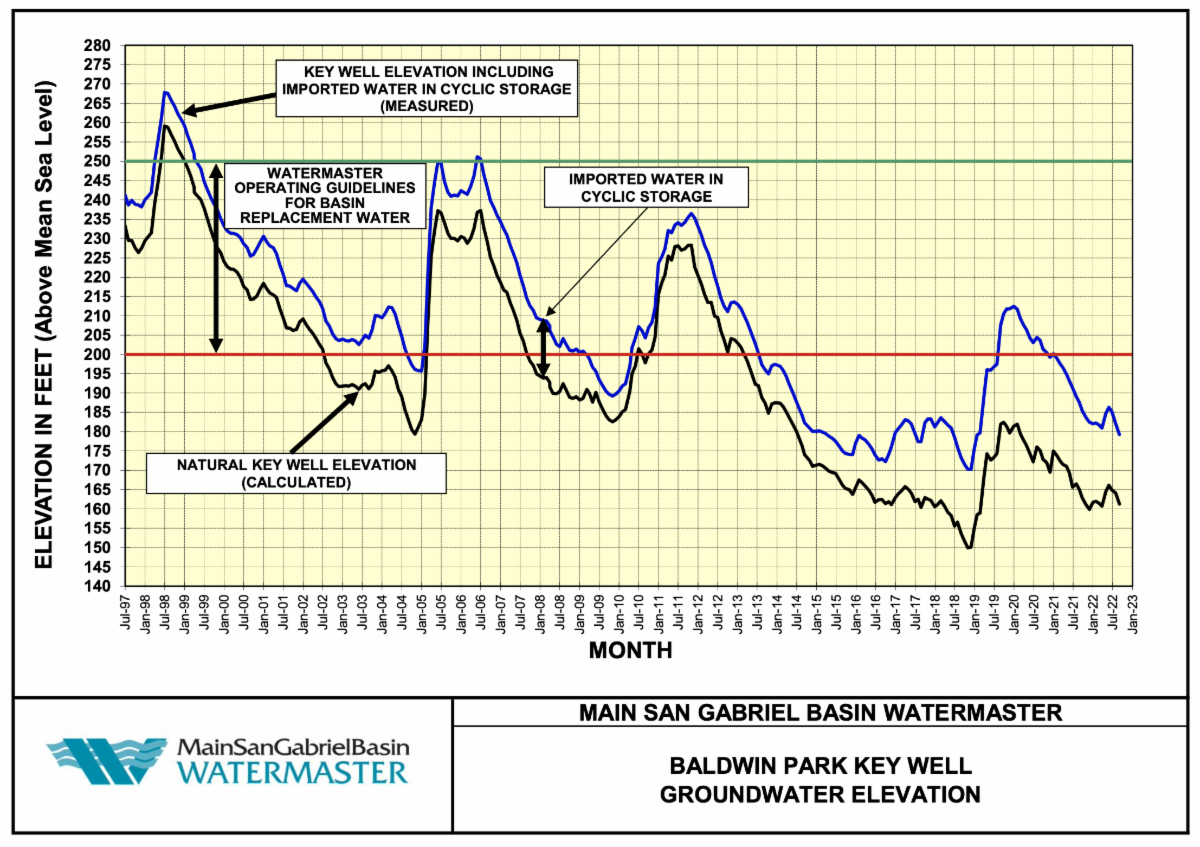
Local Groundwater – in the Main San Gabriel Basin, the “Baldwin Park Key Well” is the indicator of local groundwater levels (see graph – blue line includes cyclic storage; black line does not). As of September 2, 2022, the level declined to 179.2 feet above mean sea level, reduced from 183.8 in mid-July. The Basin has experienced a steady decline in groundwater levels from a high of 212.5 feet above mean sea level in December 2019. The present level is trending downward toward the historic low of 169.4 recorded on November 21, 2018. Watermaster’s operating guidelines for replacement water or “safe yield” is between 200 and 250 feet above mean sea level.
Note: Groundwater use accounts for 41% of California’s total water supply on an average, annual basis, and as much as 58% in a critically dry year. About 85% of public water systems rely on groundwater as their primary supply. Of water diverted and pumped in California, about 80% is used by agriculture and 20% is used by cities and towns.
| |
|
Imported Water – in March 2022, the California Department of Water Resources reduced its allocation of imported water to State Water Contractors such as SGVMWD from zero to 5% (from 15%) due to the record-setting dry conditions from January through March of this year. Imported water is used to supplement local groundwater supplies in the Main San Gabriel Basin. The graph below shows how imported water allocations fluctuate over time and how deliveries have been reduced significantly for three years in succession, hindering our ability to replenish local groundwater supplies.
| |
|
Local Rainfall – the Los Angeles Almanac reports annual rainfall levels from July 1 to June 30 of each year. For the nearby Santa Fe Dam weather station, the total rainfall for the 2021-2022 year was 13.4 inches, 77% of normal (normal is slightly above 17 inches of rain per year), but better than the prior year’s total of 6.49 inches. There has been no measurable rainfall at the station in the months of July or August 2022.
Statewide Snow Pack – as of September 6, 2022, statewide, snowpack was 0% of the April 1 average (snowpack is measured from April 1 to March 31, a 12-month period). April 1 is usually the “high point” for snow accumulation each year.
Note: On average, the Sierra Nevada Mountains snowpack, which is a key source of water banked in reservoirs, supplies about 30% of California’s water needs as it melts in the spring and early summer, feeding reservoirs and the water table, resulting in groundwater.
Statewide Reservoir Levels – statewide, as of July 31, 2022, (the latest data available to us), reservoir levels were at 68% of average and 45% of capacity, reduced slightly from readings in late June. Shasta Lake, the state’s largest reservoir, was at just 38% capacity in late July 2022. Low precipitation levels, high temperatures, hot and dry soil, and high levels of evaporation decreased stormwater runoff from surface levels to replenish both reservoirs and local groundwater supplies.
Note: Every winter, most areas need about 12 inches of rainfall before the ground is saturated enough to get large amounts of runoff into streams and reservoirs. California’s reservoirs generally hold enough water to go one dry year without impacts but begin to empty if a wet year does not follow.
| |
|
OWL Community Grant Program Funding is Unlimited!
| |
|
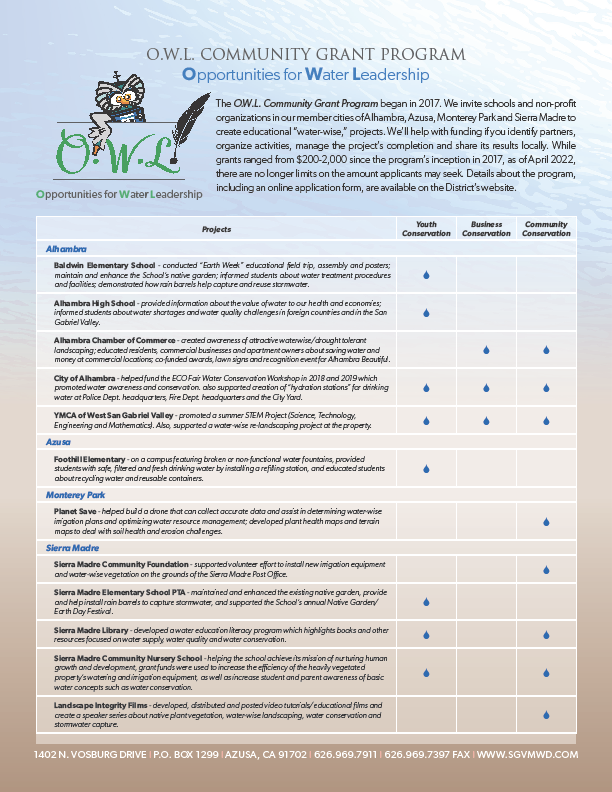
The OWL Community Grant Program seeks to fund and spur creation of local, grassroots-oriented water conservation projects by providing “seed money” to help schools and non-profit groups possessing plans, inspiration, and volunteers. More than $35,000 in grants were funded last fiscal year.
We are very flexible with respect to project approaches and funding levels. In fact, as of April 1, 2022, we no longer have limits on the amount of funds for which schools and non-profit organizations may apply. Charted below is a summary of grants to date. Applying is easy and may be completed online. Contact us if you have any questions at 626-969-7911 or info@sgvmwd.com.
| |
|
Rebate Program – Save Water and Save Money! | |
|
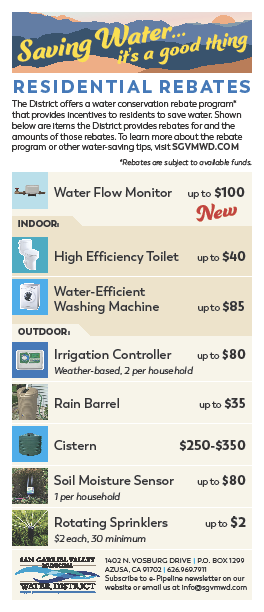
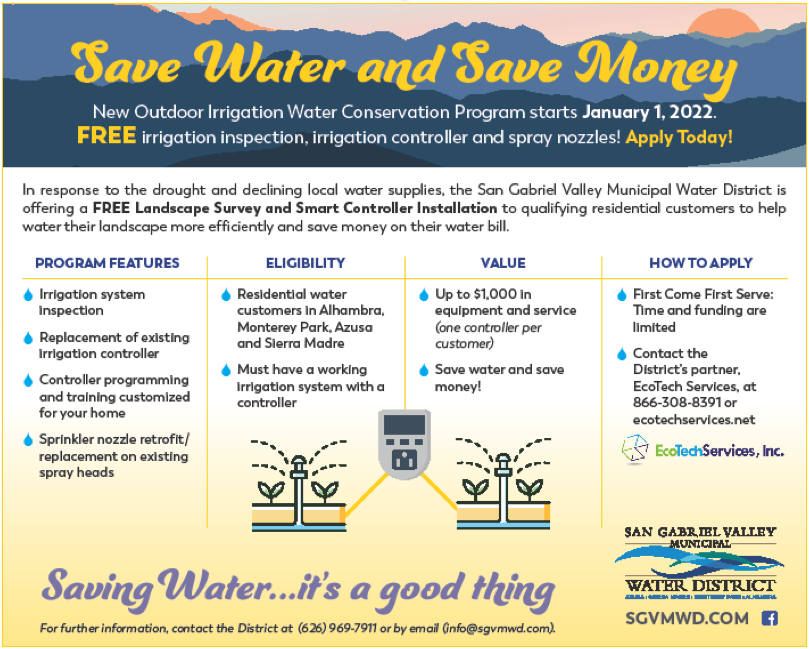
The District has enhanced its water conservation programs to help you save water and money. In the last fiscal year, we provided over $19,000 in residential rebates and more than $95,000 toward residential irrigation program improvements. Our new irrigation system retrofit program features 1) a FREE irrigation system inspection; 2) replacement of an existing irrigation controller with a FREE, new programmed unit; and 3) FREE installation of new sprinkler nozzles on existing pop-up spray heads. The program has a value of up to $1,000 per applicant and funding is limited, so please act as soon as possible. Please review the informational flyers below.
Residents in Alhambra, Monterey Park and Sierra Madre may apply for rebates on the District’s website (www.sgvmwd.com). Residents in all our member cities may apply for the irrigation retrofit program by contacting our partner, EcoTech Services (866-308-8391 or ecotechservices.net).
| |
 | |
The District is renewing its efforts to reach out in-person and on-line to inform and incentivize residents and businesses to save water and to save money voluntarily. Water conservation works and is the cheapest means of saving water. Every drop of water we save is one that does not need to be pumped, stored, treated, imported, transported, recycled, desalinated…or paid for!
New Water-Wise Gardening Tips for Our Member Cities
As Fall approaches, and with it the hope of cooler temperatures and needed rainfall, the District is offering a new water conservation resource for our member cities. Working with information provided by the California Native Plant Society, and their very informative Calscape website (www.calscape.org), the District created water-wise gardening tips customized to meet the unique climates of our four member cities – Alhambra, Azusa, Monterey Park and Sierra Madre.
The gardening tips recommend California Native plants suitable for each city, as well as local nurseries and landscape supply stores at which the plants may be purchased. As more and more residents change out their old, water-intensive lawns and gardens for hardscapes and drought-tolerant vegetation, these tips will save water and save money!
| |
Updated Website and Water Saving Tips and Materials | |
|
The District’s website contains a trove of information related to water supply and water conservation. Our educational materials may be downloaded or printed, and larger quantities for schools may be requested by contacting the District. Our website also provides links to educational videos and other water/conservation websites.
Teachers and schools find the following materials especially helpful in teaching students about conservation:
| |
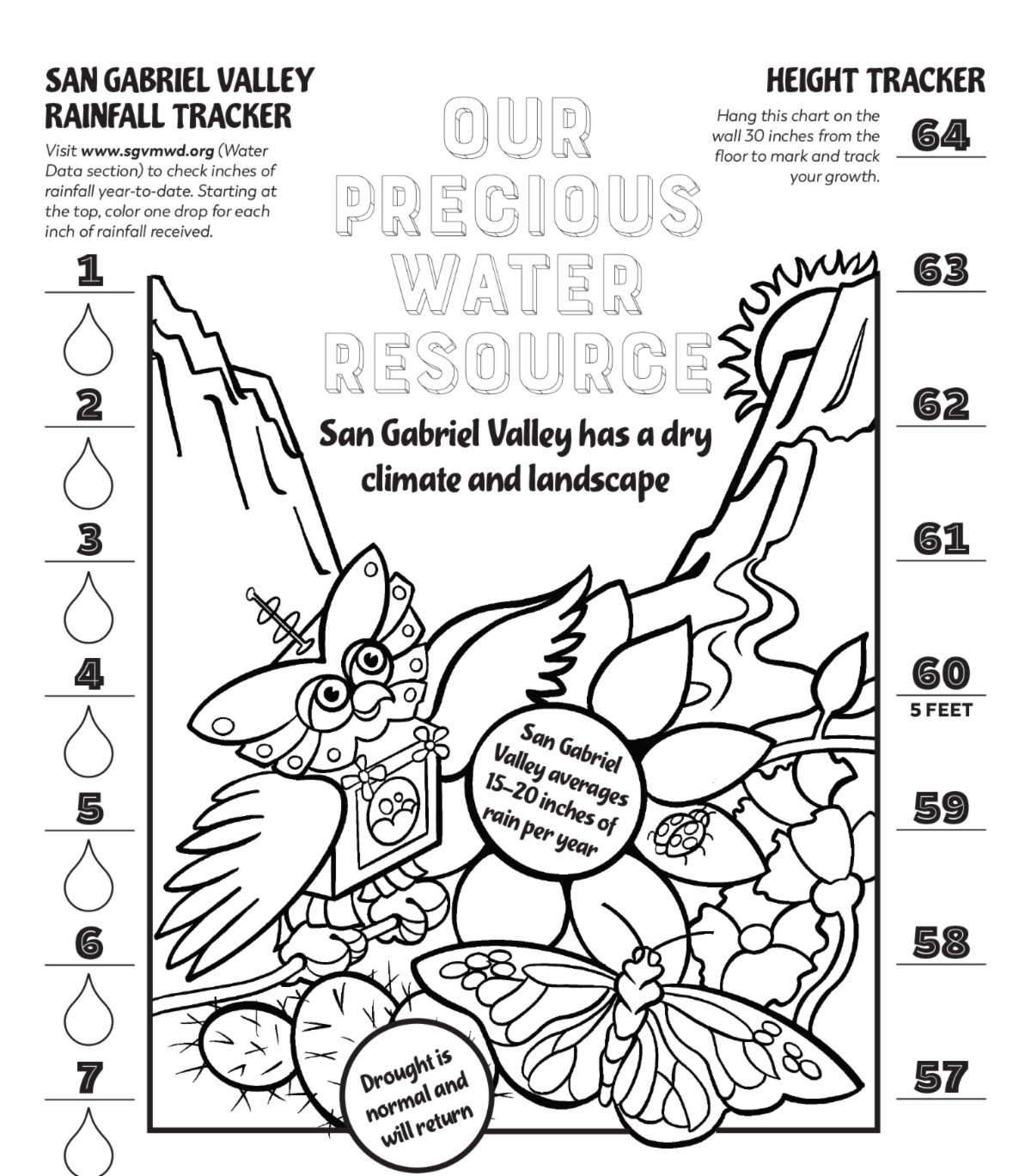
Water Conservation Growth Chart | |
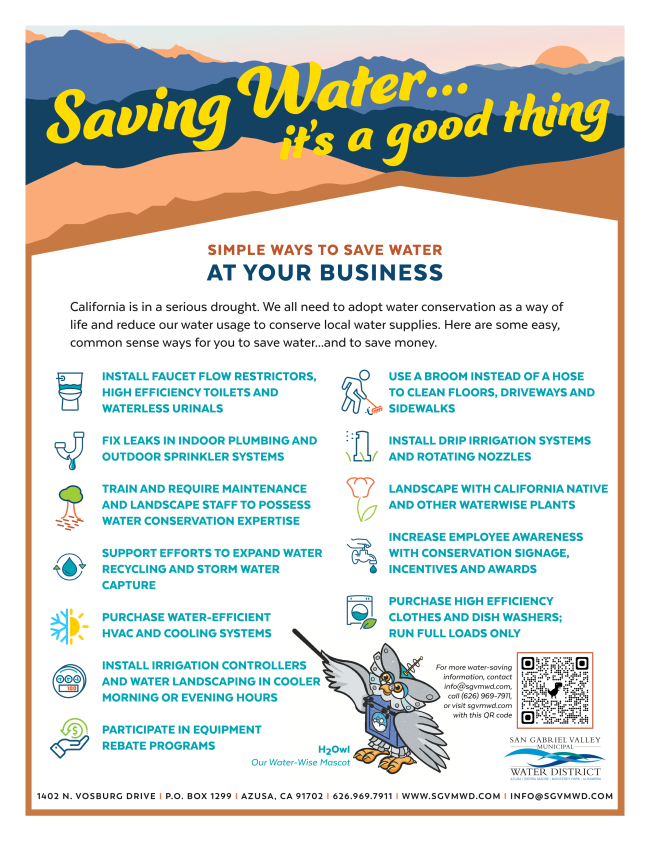
Water-Saving Tips Around the Business | |
Water-Saving Tips Around the House | |
Water-Saving Tips In Your Yard | |
Short on Time? Take a Look at these Brief, Informative and Fun Videos about Drought, Local Water Supply and Conservation | |
The State Water Contractors and the Department of Water Resources’ Save Our Water campaign released animated whiteboard videos in both English and Spanish to ensure all Californians understand the urgent need to conserve water during this historic drought. And the District, itself, has created two educational videos about our local groundwater supplies and water conservation. Click on the images below to watch the videos. A “Video Gallery” may be found on the District’s website. | |
Part 1: Where Our Water Comes From | |  |
Part 2: Water Conservation as a Way of Life | |
|
Speakers’ Bureau and H2Owl Appearances
With extra caution for pandemic and health-related safety, the District’s outreach program is in full swing with the District supporting and attending a variety of in-person community events. District representatives are available to make informational and educational presentations at community and business meetings, city council and school board meetings and business/chamber meetings. We are also interested in attending and exhibiting at weekend/evening events in our member cities, and presenting to youth and school groups. Our water conservation guru, H2Owl , is available upon request to educate and delight young people of all ages!
Our presentations cover topics such as the role of the San Gabriel Valley Municipal Water District; explaining drought; the importance of local groundwater; local and state water supply conditions; the State Water Project and imported water; water conservation and future water supply solutions. We are always open to providing virtual or online presentations, as well. To request a meeting or presentation with your group, please contact Evelyn Reyes, External Affairs Manager (626-969-7911 or ereyes@sgvmwd.com).
| |
Outreach Highlights from August | |
|
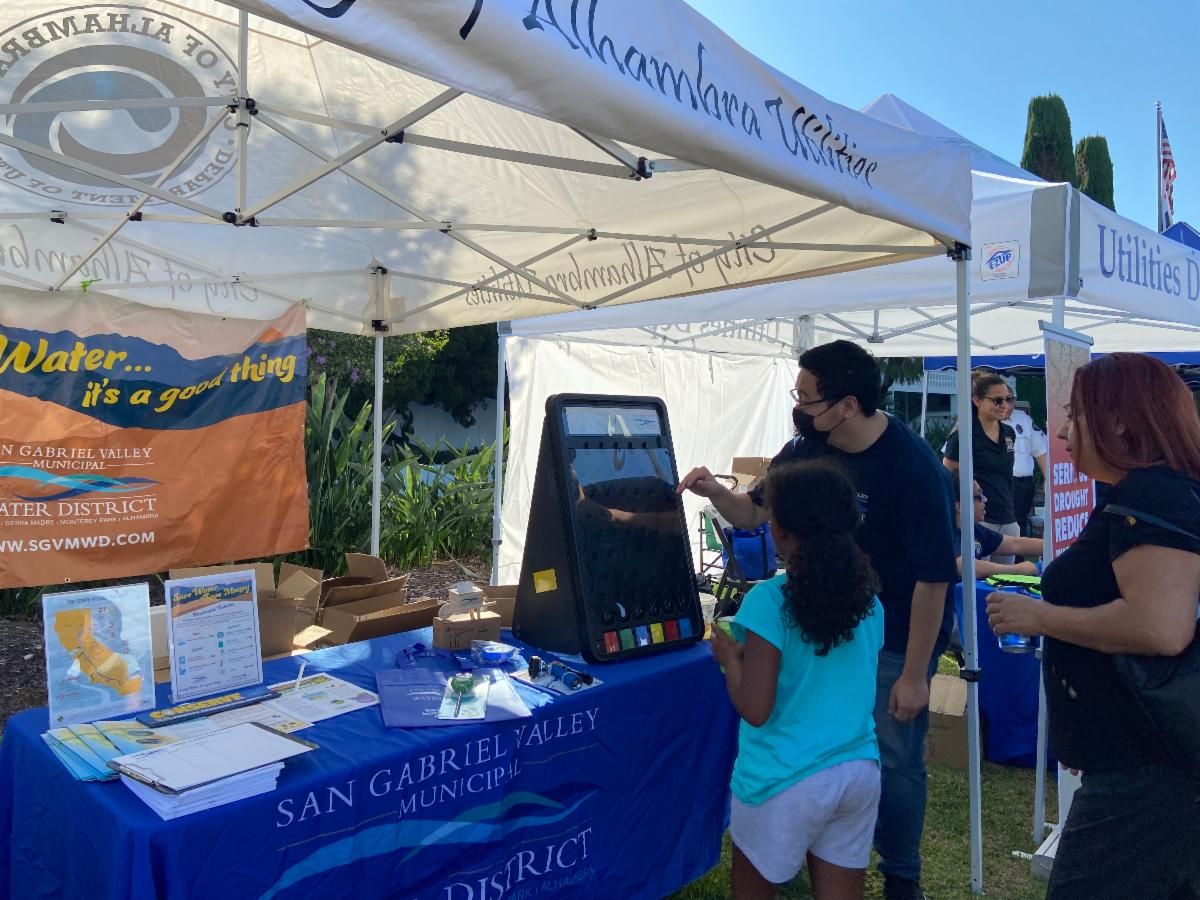
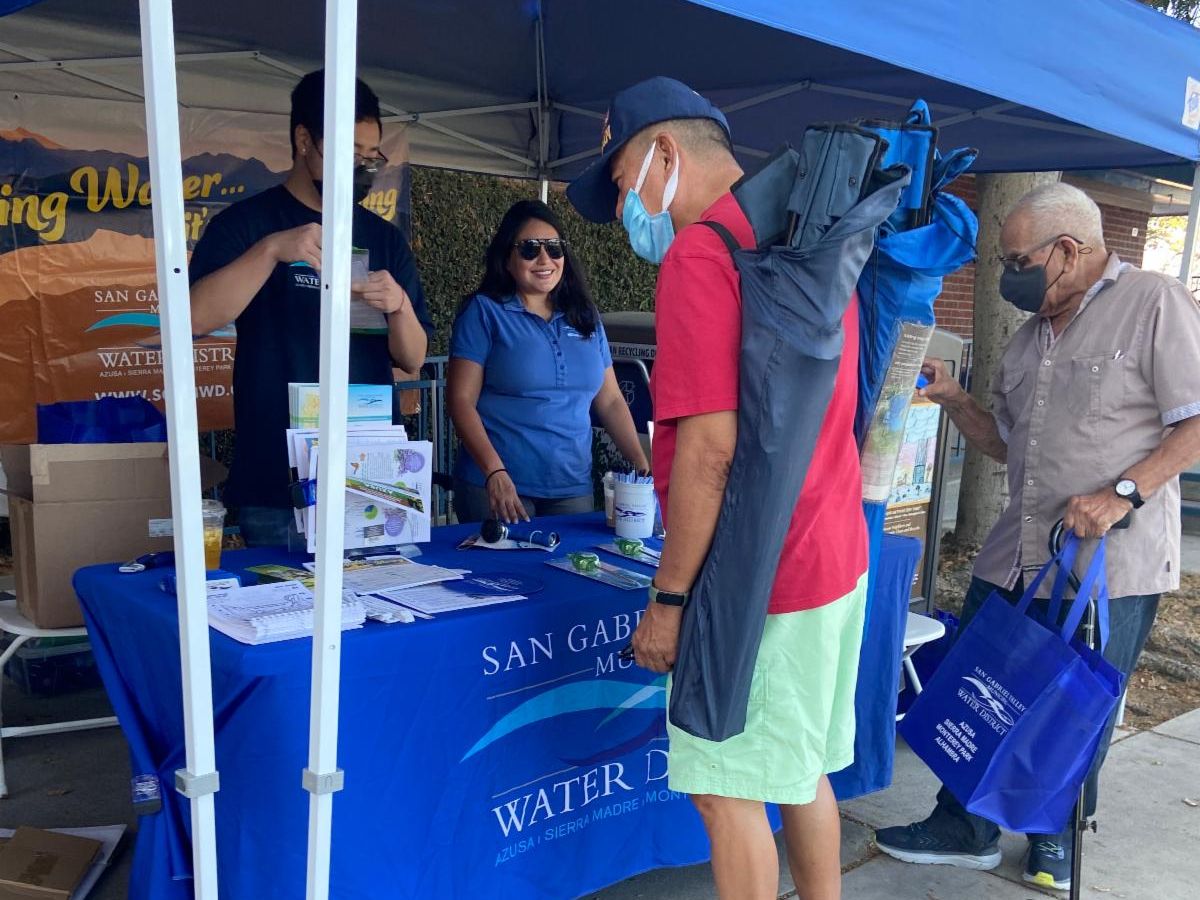
The District's External Affairs team works in partnership with member cities and makes frequent appearances at community events and venues to provide helpful water information. The District provides a booth, water information and appearances by H2Owl, the District's "Water Conservation Guru." Pictured below is our involvement in support of Alhambra's National Night Out and the City of Azusa's Concerts in the Park.
| | | | |