"Save Water...Use it Wisely!" New District Public Information Theme Reflects Changed Water Supply Conditions | |
As water supply conditions fluctuate, the District updates and refreshes its public information theme and messaging. Severe drought, decreased water supplies and heavy precipitation each call for refined messaging to inform stakeholders. After several years of severe drought, recent heavy precipitation and water supply improvements statewide and in the San Gabriel Valley, the District has developed a new theme reflecting awareness that supply conditions have improved while still encouraging wise use of our precious natural resource. | |
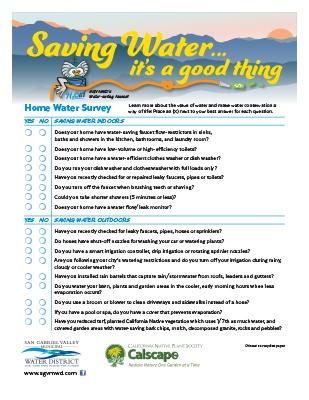
The design replaces the former theme, “Saving Water…it’s a good thing!” and incorporates new green and blue coloring along with water features. The new theme will be utilized on most District media and publications. | |
|
OPERATIONS &
INFRASTRUCTURE
| |
|
|
Operations Update
Following the April 20, 2023, announcement that State Water Project (SWP) allocations to state water contractors, such as SGVMWD, were being increased to 100% of plan for the first time since 2006, the benefits are beginning to flow to the Main San Gabriel Basin and our member cities. The increase means the District will be allocated 28,800 acre-feet of imported water in 2023 to deliver and use for replenishment of groundwater in the Main San Gabriel Basin.
| |
|
We are working closely with state and county water agencies to utilize available capacity in reservoirs, pipelines and spreading grounds to deliver the imported water. With water delivery capacity “overflowing” due to the abundance of stormwater runoff and snow melt throughout the state, scheduling deliveries is complicated and requires smart water management. Some of the 2023 water deliveries will likely need to carry over into the next calendar year.
In May, the District delivered 1,351 acre-feet of water to cyclic storage and 741 AF to CIC on behalf of Three Valleys Municipal Water District. On May 15th, the District began generating power at its San Dimas hydroelectric facility for the City of Azusa. Power generation at San Dimas should continue most of calendar year.
Imported water supplements local groundwater supplies in the Main San Gabriel Basin and Raymond Basin, the primary sources of water for the District’s member cities of Alhambra, Azusa, Monterey Park, and Sierra Madre. The planned allocation may be adjusted in the future based on hydrological conditions.
| |
SGVMWD's Member City Water Rate Update
The San Gabriel Valley Municipal Water District remains focused on fiscal responsibility and developing a sustainable water supply for our member cities. We are pleased that the wholesale water rates we charge to our member cities for replacement water remain, by far, the lowest in the Main San Gabriel Basin. In addition, the District's property tax rate, which is used to fund the fixed costs of the State Water Project, has been unchanged since 2017, at .030 cents per thousand dollars assessed value. Prior to 2017, that rate had been unchanged for 30 years.
In the past few years, the District invested in several supply sustainability and water quality initiatives benefiting our member cities short and long-term: more than $8 million in water infrastructure and supply projects in our member cities and $2.8 million in the Department of Water Resources (State Water Project) Delta Conveyance Project. We also formalized support of the Pure Water Southern California recycled water project and enhanced maintenance of our facilities. During the drought we implemented a broad-based water conservation and education program; increased funding for our rebate, direct install irrigation and community grant programs; and continued our thought leadership by sponsoring Asian media and Earth Day events, local Town Halls, and the San Gabriel Valley Water Forum.
We have experienced increasing “fixed” costs for participation in the State Water Project, from an average of $5.4 million per year from 2010-2014, to $6.8 million in 2015, to $7.5 million in 2022. In addition, we have also experienced large cost increases to maintain our own infrastructure as our pipeline approaches 50 years in operation. We've been able to mitigate these effects to a degree by obtaining additional sources of revenue such as grant funding and reducing discretionary expenses.
At its April 10, 2023, meeting, the Board of Directors voted unanimously to set the water rate at $220 per acre-foot for 2023, and to advise our member cities that we anticipate the rate increasing to $240 per acre-foot in 2024, based upon the latest forecast provided by the Department of Water Resources. In 2015, for the first time since 1989, the District adjusted its water rate from $130 per acre-foot (AF) to $145 per AF to compensate for the sharply rising State Water Project costs. We completed a three year rate adjustment that moved our rate to $200/AF by 2018-2019 and that rate was unchanged through 2022. These rates remain extremely fair and competitive: other importing water agencies in the San Gabriel Valley now have rates more than $1,000/AF for groundwater replenishment.
The rate is a pass through of the State Water Project variable cost which is the amount the Department of Water Resources charges each State Water Contractor (e.g. SGVMWD). The District has historically tried to match this cost with its replacement water rate. The District has never profited from water sales to its member cities.
| |
|
Water Supply Improvements Continue, Aided by Ongoing Snowmelt and Smart Water Management
| |
|
The continuation of the snowmelt and ensuing water runoff in May further improved drought and water supply conditions statewide and in the San Gabriel Valley, along with smart water management such as close collaboration between water agencies leading to timed releases of water in reservoirs into nearby streams and spreading grounds.
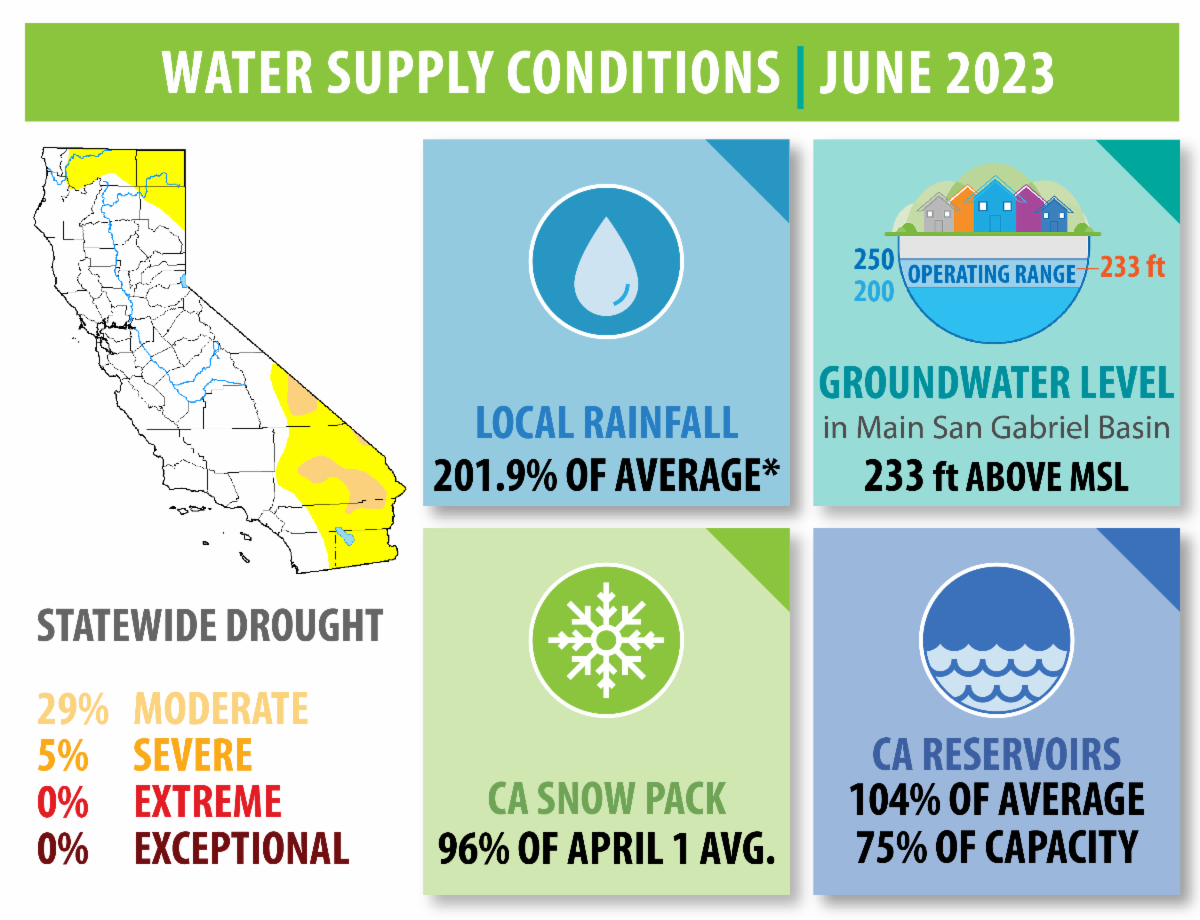
The graphics above show the marked improvement from January through June 2023 in state and local reservoir, snowpack and groundwater conditions, including significant lessening of drought conditions statewide. Local groundwater, which improves more slowly due to the time it takes stormwater runoff to percolate down to groundwater levels, has risen more than 50 feet year-to-date!
While the most recent drought is effectively over, we must remember we live in a region where most years are dry, infrastructure is aging, drought will return and climate change makes the work of water planning and delivery challenging. The reality remains that if we’re not in a drought, we are probably either getting into one or recovering from one.
We need to sustain our focus on investments in long-term water infrastructure and developing a long-term water conservation ethic that enables us to save water now, when it’s wet, for when it’s dry. While the State and some municipalities have lifted certain water use restrictions, it’s important to note that in the past 1-2 years Californians fell short of meeting the voluntary 15% conservation goal and were only saving water at a 6% rate, far short of the 25% conservation level achieved in the next most recent drought period.
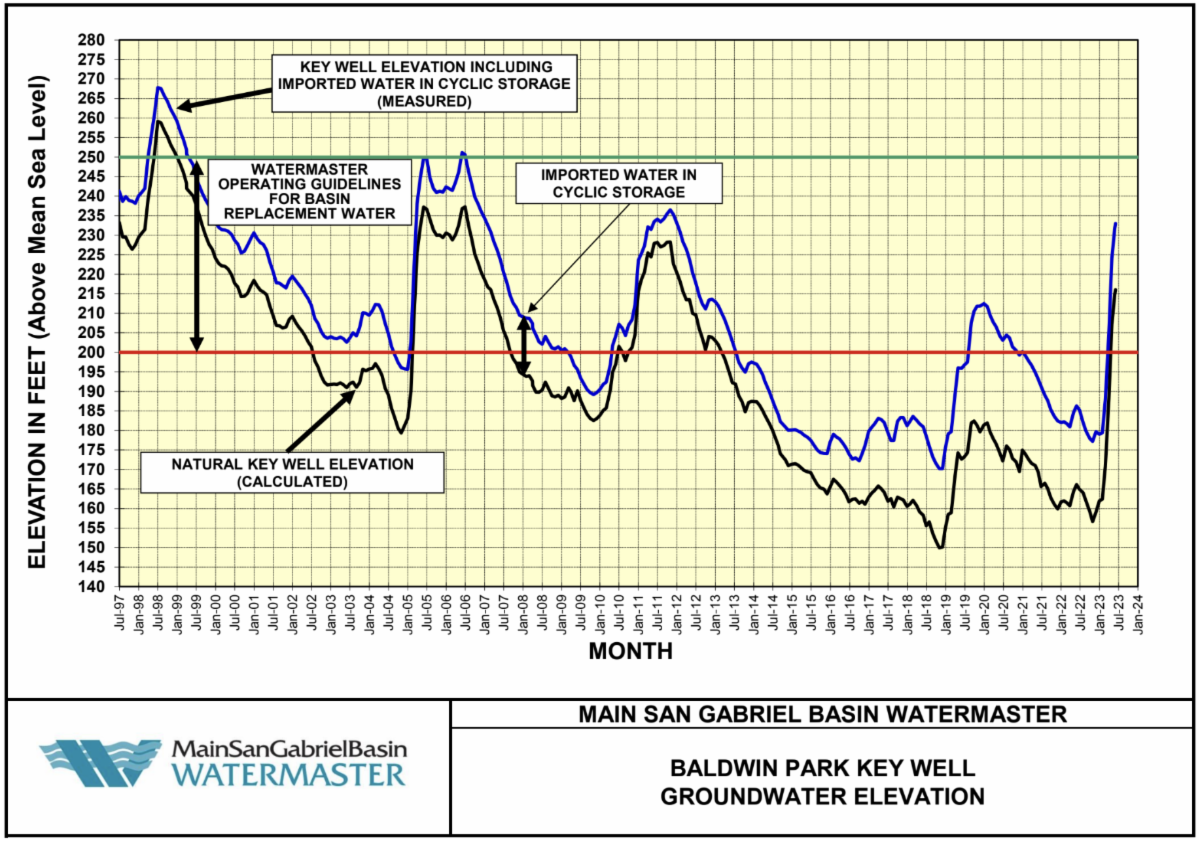
Groundwater – in the Main San Gabriel Basin, the “Baldwin Park Key Well” is the indicator of local groundwater levels (see graph – blue line includes cyclic storage; black line does not). As of June 2, 2023, the level increased significantly to 233 feet above mean sea level, compared to 221.4 in May, 204.9 in April, 189.7 feet in March, 179.4 feet in February and 179.2 feet in January. (see most recent Baldwin Park Key Well below).
Prior to the storms earlier this year, the Basin had experienced a steady decline in groundwater levels from a high of 212.5 feet above mean sea level in December 2019 and was trending downward toward the historic low of 169.4 recorded on November 21, 2018. One vertical foot is equivalent to about 8,000 acre-feet of groundwater in the Main Basin. Watermaster’s operating guidelines for replacement water or “safe yield” is between 200 and 250 feet above mean sea level.
About 80 percent of the Valley’s water supply is furnished by local groundwater, and the Valley imports about 20 percent of the water we use from northern California and the Colorado River. A 60 percent allocation is needed to meet the demand of our member cities for replacement water. Thus, in years where the allocation dips below that amount, we see the important role that water storage and water conservation play.
Note: Groundwater use accounts for 41% of California’s total water supply (80% in the San Gabriel Valley) on an average, annual basis, and as much as 58% in a critically dry year. About 85% of public water systems rely on groundwater as their primary supply. Of water diverted and pumped in California, about 80% is used by agriculture and 20% is used by cities and towns.
| |
|
Imported Water – In April, the California Department of Water Resources increased State Water Project allocations to State Water Contractors such as SGVMWD for 2023 to 100% for the first time since 2006. Imported water is used to supplement local groundwater supplies in the Main San Gabriel Basin.
Note: Two-thirds of California’s water originates in the Sierra Nevada Mountains and flows through the Delta, a large inland river delta and estuary in northern California.
| |
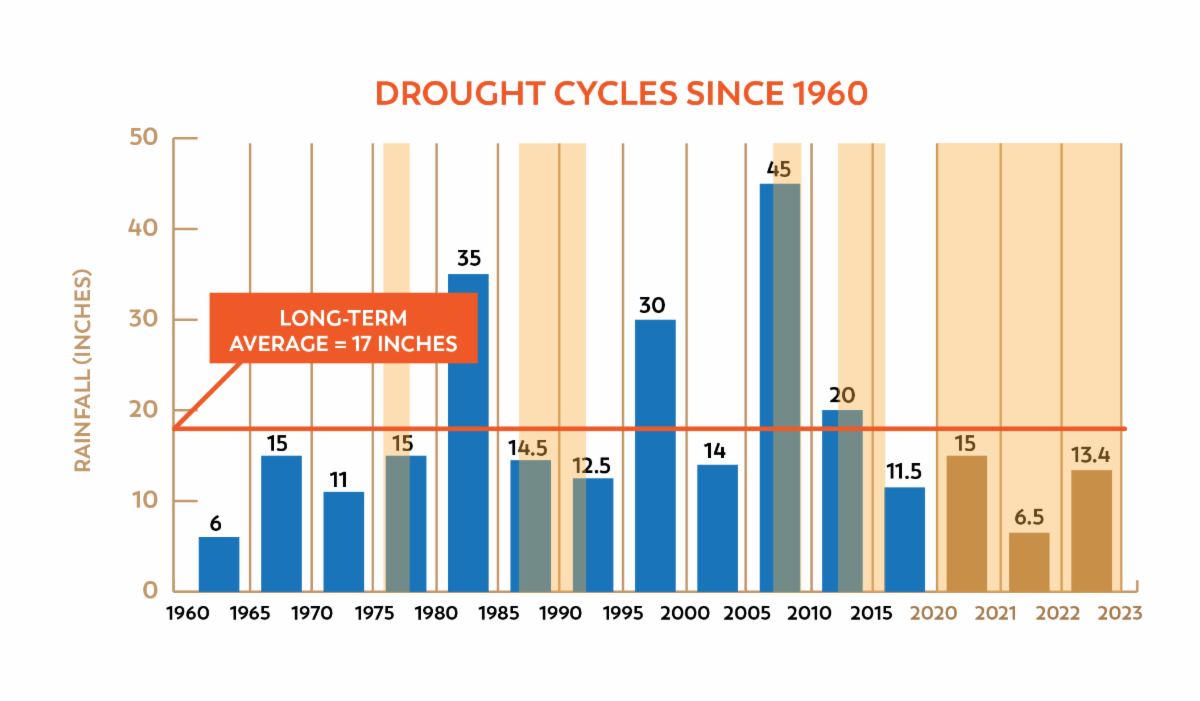
Local Rainfall – the LA County Department of Public Works (DPW) reports annual rainfall levels from October 1 to September 30 of each year. As of June 1, 2023, the DPW headquarters location in Alhambra had recorded 36.01 inches of rain, about 202% of average (average annual rainfall at this location is 17.83 inches). The graph below shows both annual rainfall totals dating back to 1960, as well as the major drought cycles since then. | |
|
Statewide Snow Pack – as of early June, the snow water equivalent was 23.6 inches, which is 96% of the April 1 average and 310% of normal for this date (snowpack is measured from April 1 to March 31, a 12-month period). April 1 is usually the “high point” for snow accumulation each year. The current snowpack is one of the biggest the state has experienced since the 1950s.
Note: On average, the Sierra Nevada Mountains snowpack, which is a key source of water banked in reservoirs, supplies about 30% of California’s water needs as it melts in the spring and early summer, feeding reservoirs and the water table, resulting in groundwater. The snowpack is often referred to as California’s “frozen reservoir.”
Statewide Reservoir Levels – statewide, as of April 30, 2023, (the latest statewide data available to us), reservoir levels had risen to 104% of average and 75% of capacity. As of May 31, storage levels at Shasta Lake, the state’s largest reservoir, were 98% of capacity and 117% of the historical average for this date, and storage levels at Lake Oroville, the state’s second largest reservoir, were 98% of capacity and 123% of the historical average.
Locally, both the San Gabriel Reservoir and Cogswell Reservoir have been emptied to enable sediment removal. Lake Silverwood, which rests above San Bernardino and is adjacent to the start of the District’s Devil Canyon-Azusa Pipeline, is filled to 90% of capacity and 101% of average. During the recent drought, low precipitation levels, high temperatures, hot and dry soil, and high levels of evaporation decreased stormwater runoff from surface levels to replenish both reservoirs and local groundwater supplies.
Note: Every winter, most areas need about 12 inches of rainfall before the ground is saturated enough to get large amounts of runoff into streams and reservoirs. California’s reservoirs generally hold enough water to go one dry year without impacts but begin to empty if a wet year does not follow.
| |
|
The District’s popular and long-running Opportunities for Water Leadership Community Grant Program (O.W.L. Grants) provided grants ranging from $500-$1,500 to schools and non-profits for Earth Day related educational activities in April. These grants were IN ADDITION to the ongoing unlimited grant program. If you were unable to participate in the Earth Day grant program, please consider our ongoing grant program.
Streamlined applications and additional information about the program are posted on the District’s website (https://sgvmwd.com/water-conservation/#owl-grants).
The District’s O.W.L. Grants Program was featured in September 2022 by ABC-Channel 7 to help encourage water conservation as part of its “Water-Wise Wednesday” community feature. The entire news segment may be viewed with the link below.
| |
|
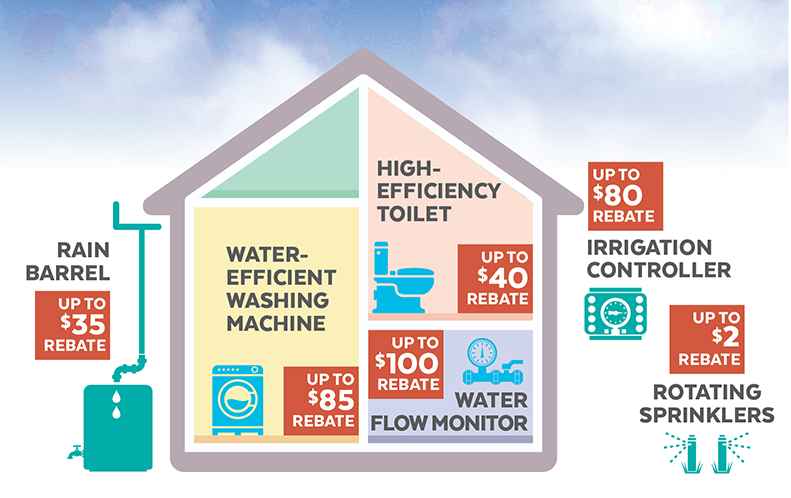
2023 Rebate Program – Save Water and Save Money!
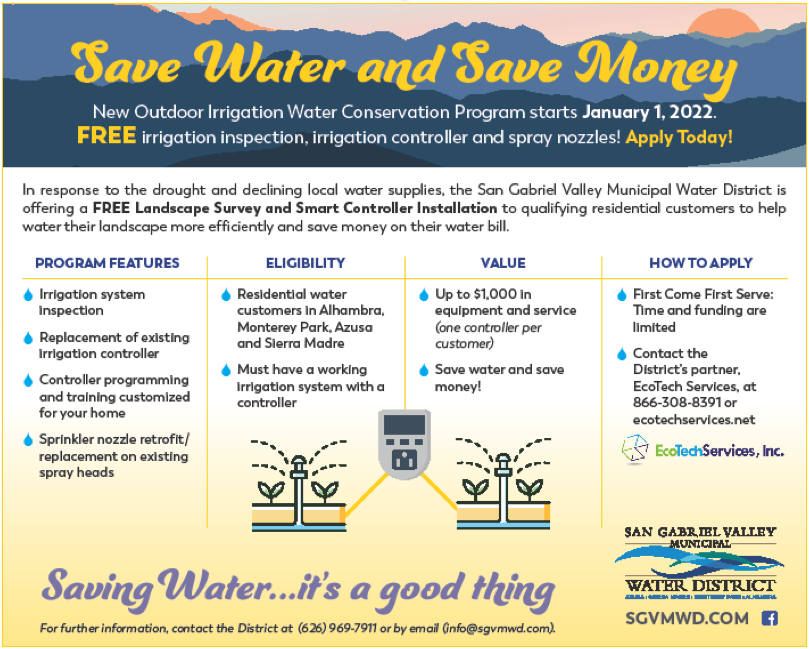
The District has enhanced its water conservation programs to help you save water and money. Our new irrigation system retrofit program features 1) a FREE irrigation system inspection; 2) replacement of an existing irrigation controller with a FREE, new programmed unit; and 3) FREE installation of new sprinkler nozzles on existing pop-up spray heads. Since January 2022, EcoTech has performed 257 site assessments. 236 weather-based “smart” controllers have been installed in 215 properties and 5,766 sprinkler nozzles have been upgraded to water-efficient rotating nozzles. The approximate cost/value per landscape to date is $1,136. Funding is limited, so please review the informational flyers below and on our website and act as soon as possible.
Residents in Alhambra, Monterey Park and Sierra Madre may apply for rebates on the District’s website (www.sgvmwd.com). Beginning July 1, the District will process rebates internally, without the assistance of an external administrator, simplifying the rebate process. More information about this change will be available in the upcoming weeks.
Residents in all our member cities may apply for the irrigation retrofit program by contacting our partner, EcoTech Services (866-308-8391 or ecotechservices.net).
|  |  | |
|
Summer is a Few Weeks Away...Have you Implemented Water-Wise Gardening Tips?
With summer beginning on June 21, please make sure your garden is water-efficient. It’s a great time to check for and fix leaks, to install or upgrade your irrigation controller with the help of a rebate (Smart Irrigation Program), and to make sure you’ve transitioned to smart, water-wise California Native Plants that use 1/7th the water of other plants. While we would recommend waiting until the hot dry summer months have concluded to do new plantings, it’s a good time to plan! Here’s how.
The District has utilized information provided by the California Native Plant Society and their very informative Calscape website (www.calscape.org) to create water-wise gardening tips customized to meet the unique climates of our four member cities – Alhambra, Azusa, Monterey Park and Sierra Madre.
Fall, winter and spring are the best times of the year to plant new water-wise vegetation, to give plants and their roots time to become established before hot, dry weather resumes in summer. The gardening tips recommend California Native plants suitable for each city, as well as local nurseries and landscape supply stores at which the plants may be purchased. These tips will save water and save money!
| |
Umbrella Season is Over...We Hope to See You at Community Events! | |
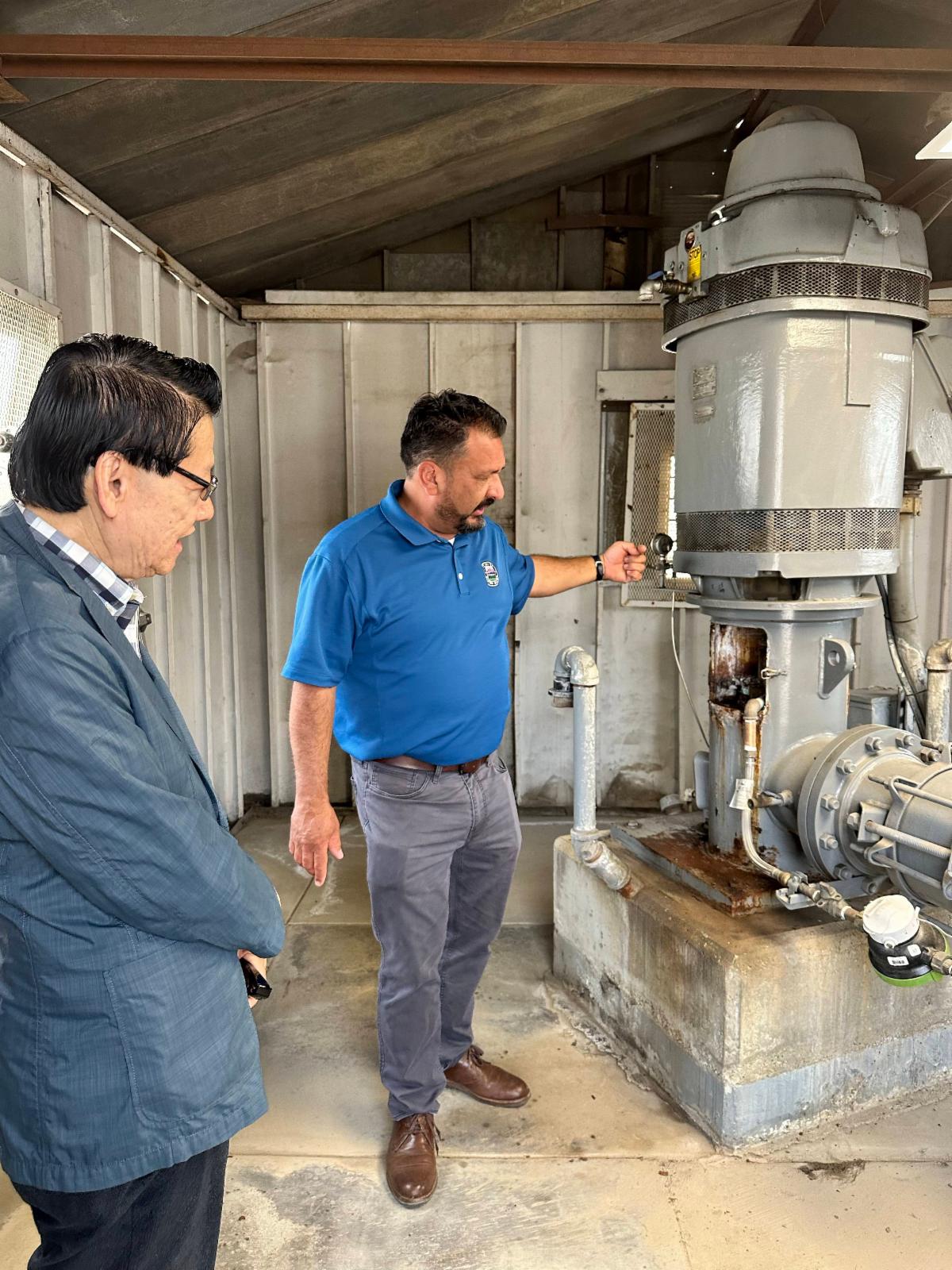
The District participated in the City of Sierra Madre’s Public Works Open House on Saturday, May 20th, and provided helpful water saving information and tools. The event was a chance for residents to learn about the city's public works department and the services it provides. Residents had the opportunity to meet with District representatives and city staff, ask questions, and learn about street maintenance, recycling, water treatment and the city's relationship with the water district. Pictured below, SGVMWD Division III Director Mike Eng is getting a tour of one of Sierra Madre's active wells by City Manager Jose Reynoso. | |
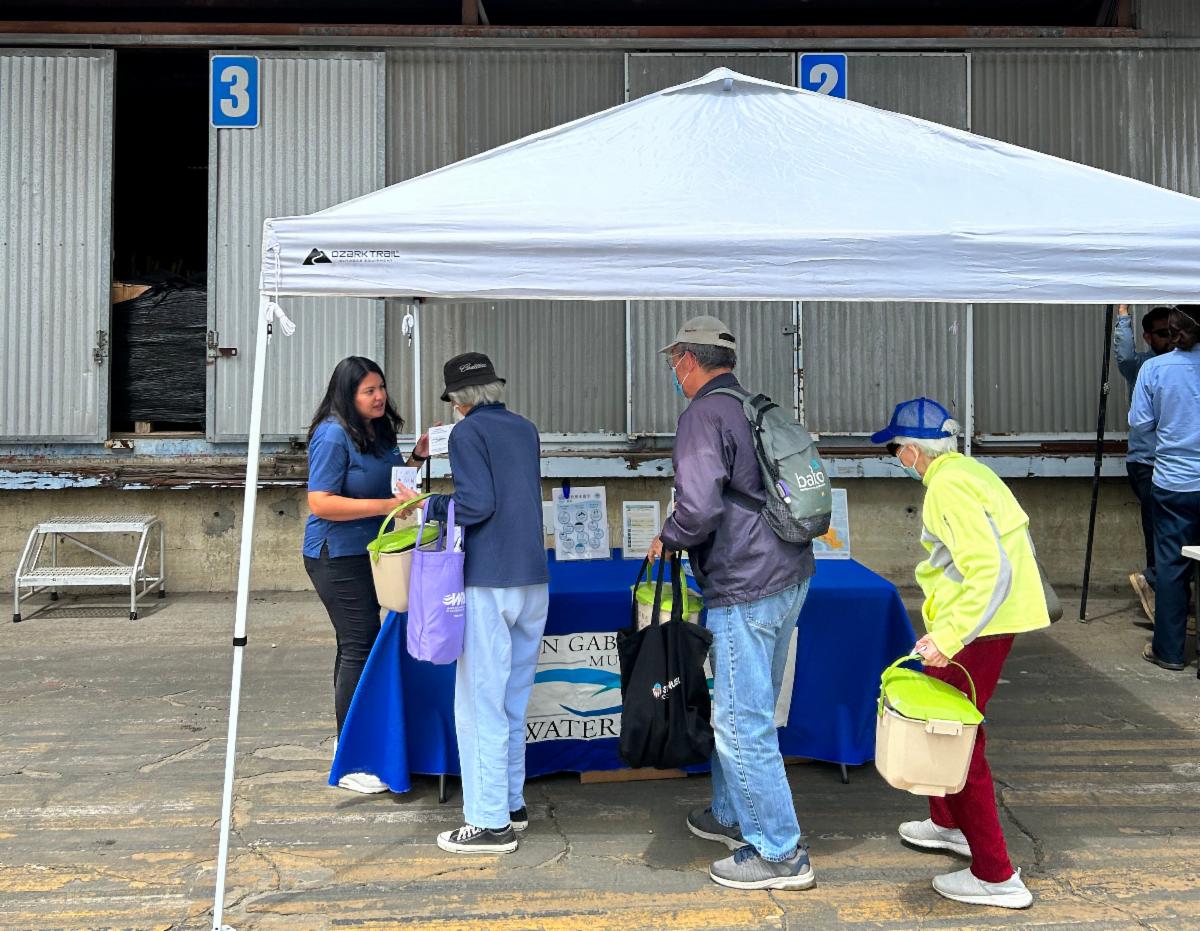
The District attended the City of Monterey Park’s Public Works Open House on May 25th to celebrate National Public Works Week, again providing helpful water saving information and tools. The event featured exhibits and demonstrations on a variety of public works topics, “meet and greet” with city staff, question and answer sessions, and giveaways (pictured below). | |
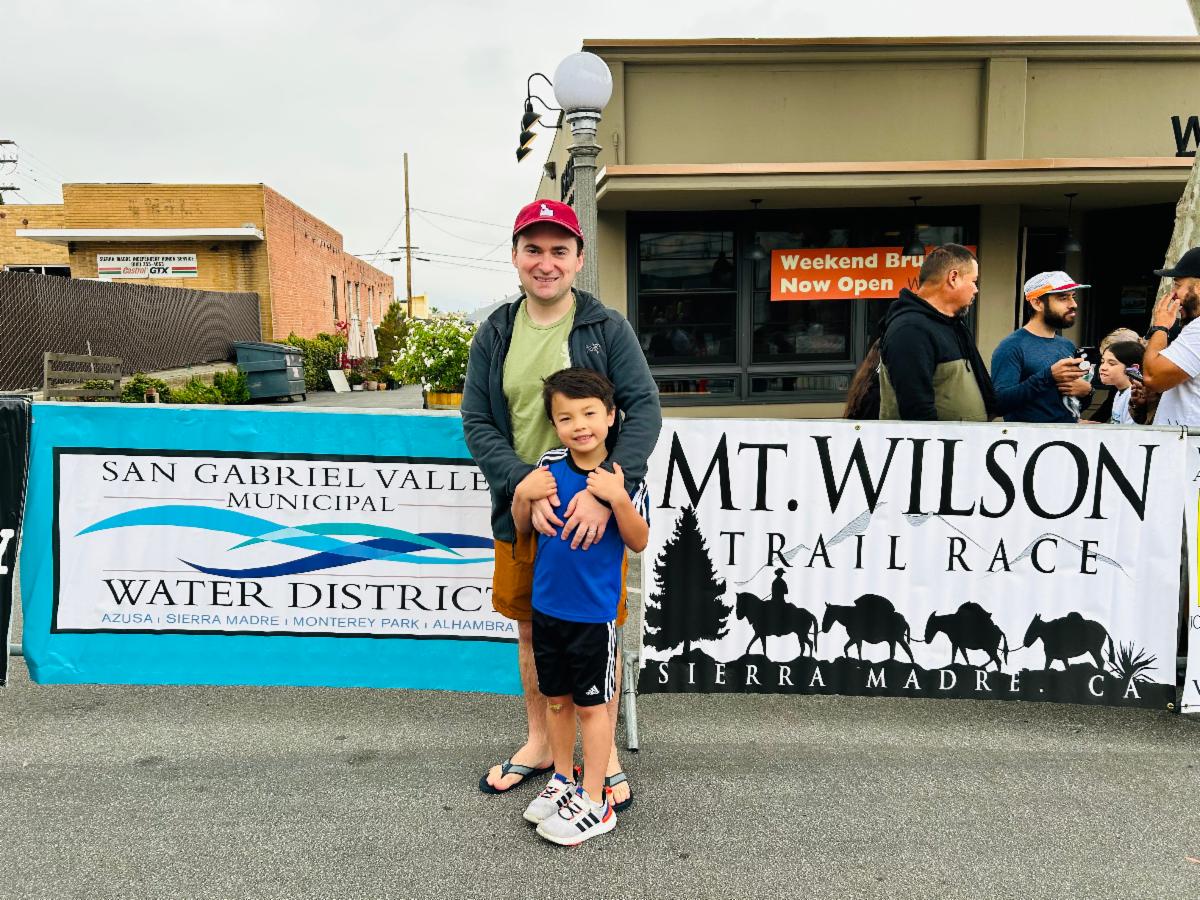
One of the most anticipated events heralding the arrival of spring each year in the San Gabriel Valley is the Mt. Wilson Trail Race. The Race is the 2nd oldest trail race in the country and happens right in the heart of the City of Sierra Madre. On May 27th, the water district helped sponsor the water stations for the runners and Director Miles Prince and his son, Holden, were there to help cheer on the 350+ runners that participated this year. | |
|
School Outreach Peaked in May
Each year, the state declares May as “Water Awareness Month,” coinciding with the end rain and snow season in much of California and the beginning of warmer and drier weather. Conservation becomes even more important during the warmer, drier spring and summer months as we must preserve our precious water resource. Especially this year, as Mother Nature has gifted us with abundant rain and snow to alleviate the drought and replenish our depleted water supplies, it’s a good idea to “save water when it’s wet, for when it’s dry.”
May featured a return to a great District tradition of assisting schools with water education and water conservation. While our school outreach was curtailed for several years due to the pandemic, we resumed providing educational materials, videos and in-school presentations at elementary schools in our service area.
Teachers: here are links to the most common materials we provide. If you are interested in an in-class or larger assembly presentation, please contact Evelyn Reyes at 626-969-7911 or info@sgvmwd.com.
| | | | |