Annual Report for Fiscal Year 2020-2021 | |
|
We are pleased to share our new Annual Report covering operations during the 2020-2021 fiscal year. The timing of our Report coincides with the return of severe drought conditions, the driest water year (October 1, 2020 through September 30, 2021) in a century and the second driest on record. This Annual Report focuses on strategic investments the District has made in infrastructure and conservation at the state level, the local level and the individual level. Our investments are planned to pursue and achieve drought and water supply resilience for our member cities.
As we are all rebounding from the challenges posed by the pandemic, we thank our member cities, water agency partners in the Main San Gabriel Basin, employees and residents for their resilience during these challenging times.
| |
|
OPERATIONS &
INFRASTRUCTURE
| |
|
|
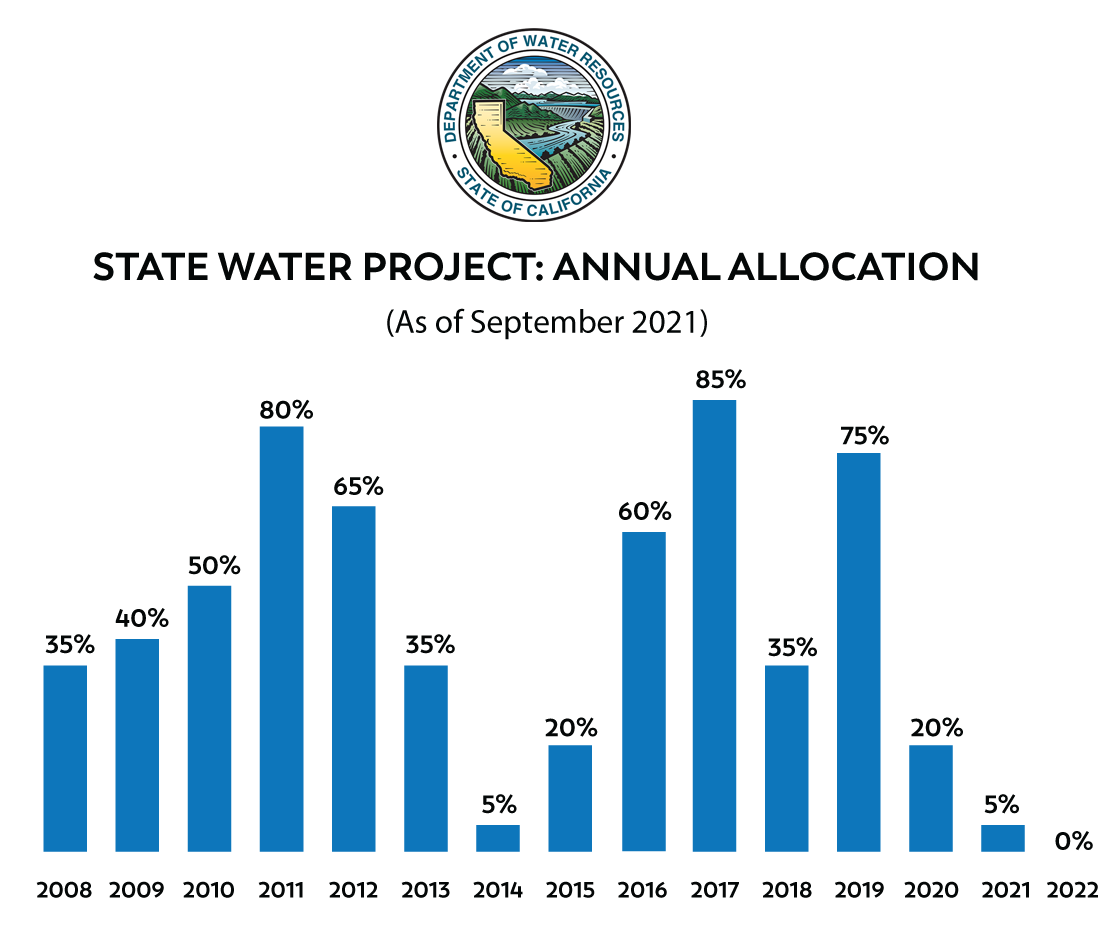
State Water Project Imported Water Update - 0% Allocation for 2022 Projected | |
|
As dry, severe drought conditions spread throughout California, Department of Water Resources Director Karla Nemeth said the agency is preparing for what would be its first ever 0% allocation in 2022 because of extraordinarily dry conditions.
The graph shows how imported water allocations from the state vary from year to year and demonstrates the challenges faced by water managers. Cities and water districts received just 5% of their full imported water allotments this year from the State Water Project. And the Colorado River, also a major source of water for Southern California, is headed for a federally declared shortage next year.
The District’s planned or full allocation is 28,800 acre-feet. About 80 percent of the Valley’s water supply is furnished by local groundwater, and the Valley imports about 20 percent of the water we use from northern California and the Colorado River. A 60 percent allocation is needed to meet the demand of our member cities for replacement water. Thus, in years where the allocation dips below that amount, we see the important role that water storage plays.
| |
|
SGVMWD Operations and Local Water Delivery Update
In May 2021, the District completed delivery of all 1,440 acre-feet (5%) of its allotted 28,800 acre-feet of imported water to the San Gabriel Canyon Spreading Grounds (SGCSG) which is used to replenish declining groundwater supplies in the Main San Gabriel Basin.
In October, the District maximized its pipeline capacity to deliver the following:
- 87 AF delivered to SGCSG Basin #1 (SGVMWD- Dry Year Transfer Program)
- 1,061 AF delivered to Covina Irrigating Company on behalf of TVMWD
- 938 AF delivered to Azusa Light and Water Canyon Filtration Plant on behalf of USGVMWD
- 1,150 AF delivered to SGCSG Basin #1 on behalf of USGVMWD.
Apart from water deliveries, the District has continued ongoing maintenance and repairs to equipment, computer systems and pipeline/water delivery infrastructure, and begun long-range infrastructure planning which includes development of a conditions assessment which will lead to an asset management and financing plan. In addition, in October, the District brought a new Pipeline Operator/Inspector, Kevin Wise, on board. Kevin Wise is a U.S. Navy veteran and has 16 years of experience in the water industry.
| |
Summary
California Records Driest Year in a Century: Drought Emergency Extended Statewide
| |
|
Following two dry winters, California reported its driest water year (October 1, 2020 through September 30, 2021) in a century and the second driest on record. As the new water year proceeds into its second month, La Niña conditions, that typically bring dry winters to California and the Southwest, have emerged in the Pacific Ocean.
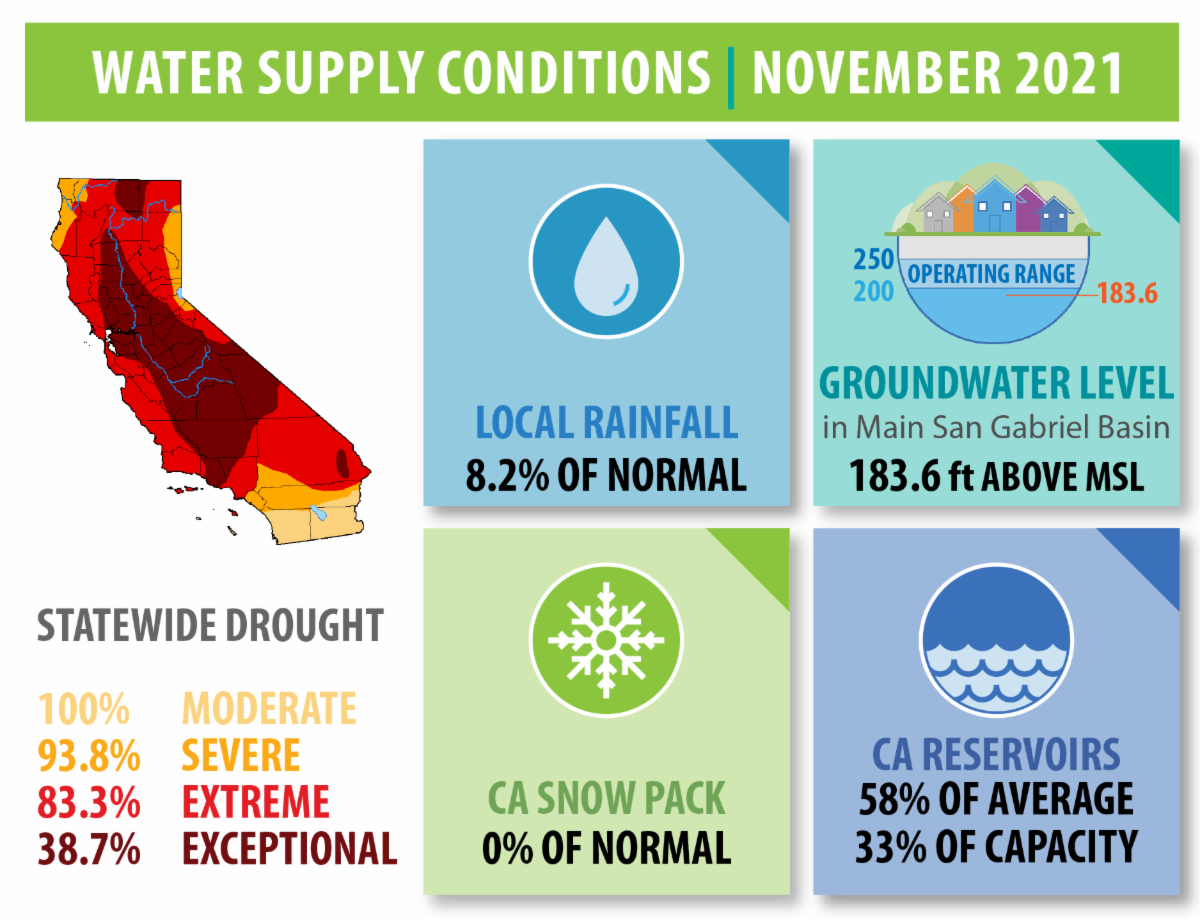
As shown in the graphic, drought conditions have worsened, and local groundwater and rainfall, and statewide snow pack and reservoirs, each remain well below desired levels. Presently, all but two of California’s major reservoirs are below their average storage level.
Many experts compare current conditions to the serious drought of 1976-1977, however, climate change and increasingly warmer temperatures (two degrees hotter, on average, now than 50 years ago) have evaporated precipitation and melted snow pack much faster than in prior years, resulting in less melting snow feeding rivers and reservoirs, and soil moisture drying out before soaking down into the ground. Computer models show that in the future, dry years will be drier, and wet years will be wetter.
In October, Governor Newsom extended the Drought Emergency to ALL of California. In July, the Governor called for voluntary water use reductions of 15%. Our member cities are communicating directly with residents and businesses about local water use rules and restrictions. Further, there are cautions at the state level about a return to mandatory water use restrictions if dryness continues this winter.
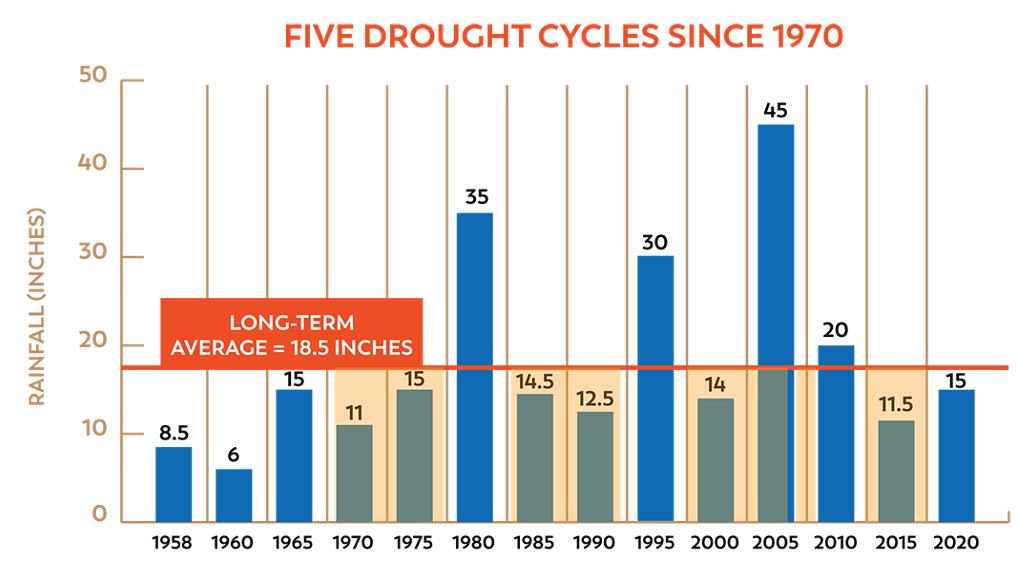
As the graph below illustrates, drought is common and “normal” in the San Gabriel Valley. Conservation works and should be a “way of life.”
| |
|
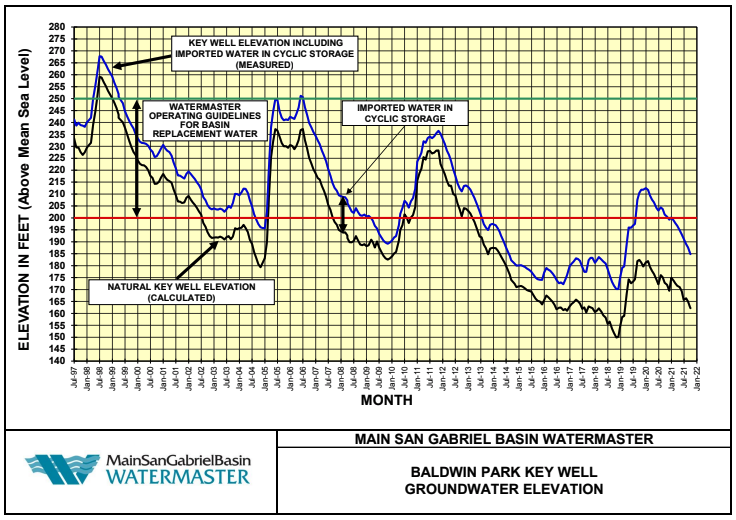
Local Groundwater – in the Main San Gabriel Basin, the “Baldwin Park Key Well” is the indicator of local groundwater levels (see graph – blue line includes cyclic storage; black line does not). As of October 29, 2021, the level is 183.6 feet above mean sea level. The Basin has experienced a fairly steady decline from 212.5 feet above mean sea level in December 2019. The present level is still an improvement from the historic low of 169.4 as recently as November 21, 2018. Watermaster’s operating guidelines for replacement water or “safe yield” is between 200 and 250 feet above mean sea level. Main San Gabriel Basin groundwater supplies, which account for nearly 80% of the water we use, remain below desired levels and remain in need of ongoing smart management, replenishment and conservation.
Local Rainfall – the Los Angeles Almanac reports annual rainfall levels from July 1 of each year to June 30 of each year. At the Santa Fe Dam weather station, due to recent storms, 1.42 inches of rain have fallen year to date; 1.04 inches are normal. The total represents only 8.2% of the full year norm. Rainfall totals for the year ended June 30, 2021 were 6.49 inches compared to a season normal of 17.38 inches (37% of normal).
Statewide Snow Pack – as of November 1, 2021, statewide, the average “snow water equivalent” is negligible. Snow levels are 0% of normal for this date and 0% of the April 1 average. On average, the Sierra Nevada Mountains snow pack, which is a key source of water banked in reservoirs, supplies about 30% of California’s water needs as it melts in the spring and early summer, feeding reservoirs and the water table, resulting in groundwater.
Statewide Reservoir Levels – statewide, as of September 30, 2021, (the latest data available to us), reservoir levels were at 58% of average and 35% of capacity, decreased slightly from a month earlier. Every winter, most areas need about 12 inches of rainfall before the ground is saturated enough to get large amounts of runoff into streams and reservoirs. Because last year’s precipitation levels were low and the ground was so dry, the ground absorbed high levels of recent precipitation. California’s reservoirs generally hold enough water to go one dry year without impacts but begin to empty if a wet year does not follow.
| |
Saving Water... it's a Good Thing! | |
|
The District Teams Up with Member Cities to Promote Water Conservation
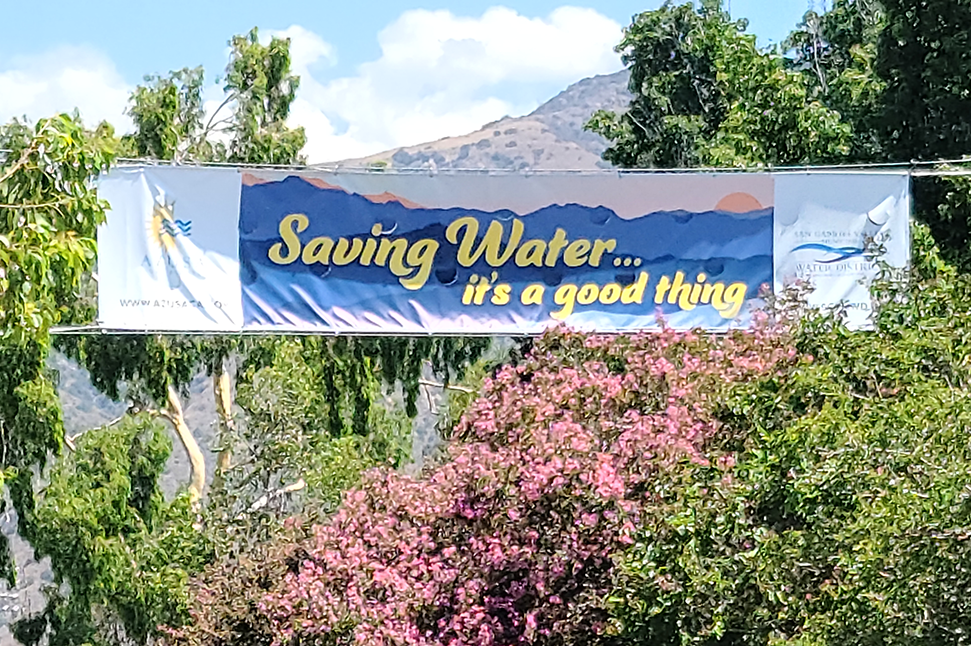
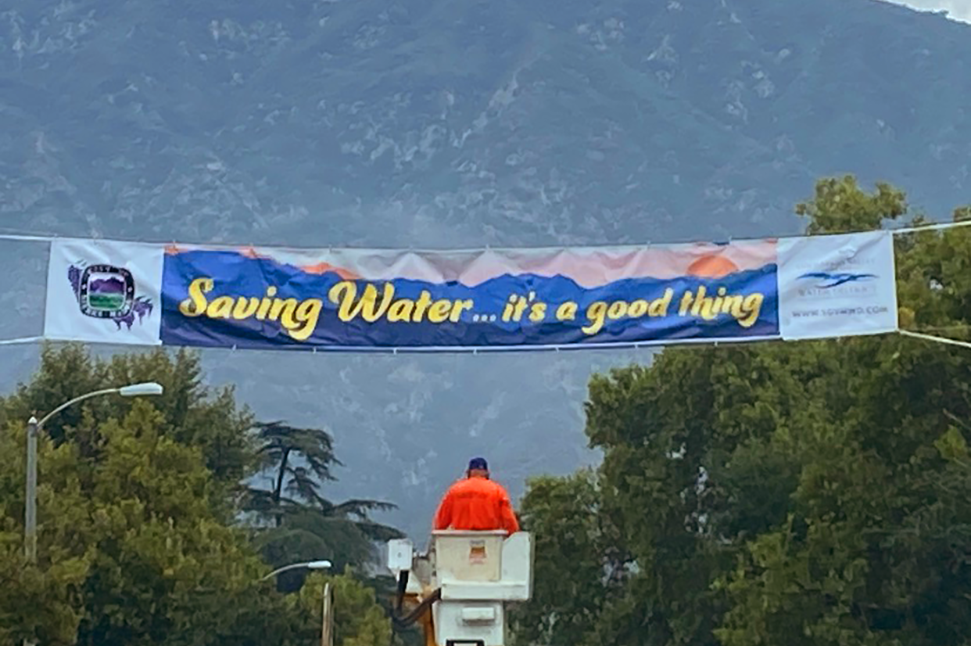
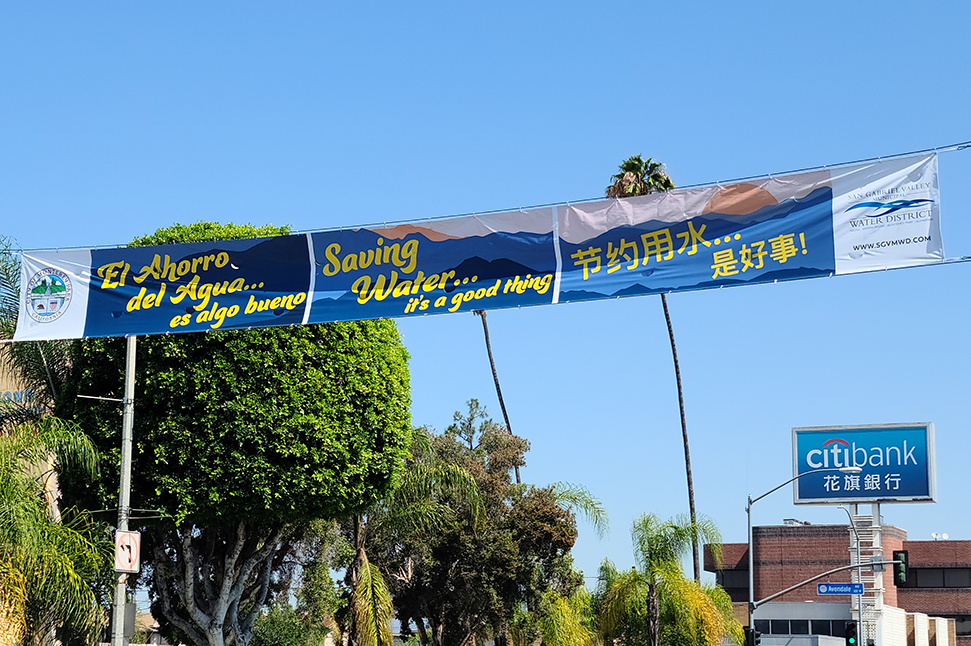
The District’s water conservation and education campaign theme for 2022 is a simple and fun call to action: “Saving Water…it’s a good thing!” The message can be taken two ways: that water, itself, is a good thing; and that the act of saving water is a good thing. Regardless of your interpretation, we hope the positive theme/message for 2021 is inspiring and helpful.
As pictured, our member cities are getting the word out in the form of banners, bus shelters and lobby signs, with much more drought outreach planned. We will provide updates in future issues of the newsletter.
| |
Fall Water-Saving is Crucial to Preserve Local Groundwater Supplies!
As weather remains warm and dry into the Fall, water use remains high throughout the San Gabriel Valley, so it is an important time to save water and save money.
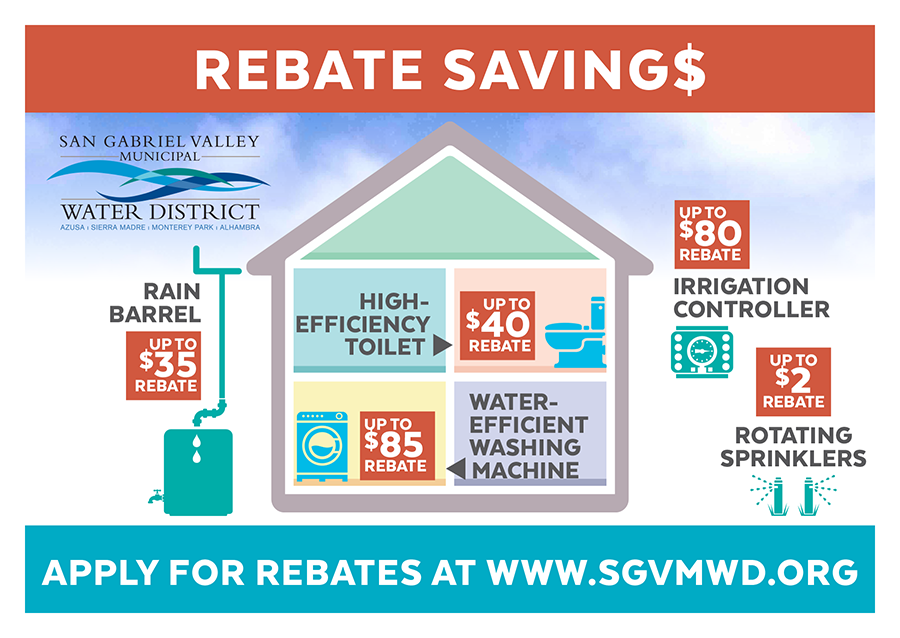
Shown below are water saving tips formulated for the Fall months that will also save you money. Items such as water-efficient appliances, irrigation controllers, rotating sprinkler nozzles and rain barrels are eligible for the District’s rebate program .
| |
INDOORS
- Repair leaks
- Take shorter showers and install flow restrictors in sinks and showers
- Install water-efficient clothes and dish washers with the help of the District’s rebate program and only run full loads
- Consider a gray water “recycling” system for your home or business.
| |  |
OUTDOORS
- Repair leaks
- Install rain barrels to capture storm water for use in gardens, pools and spas
- Install covers on pools and spas to reduce evaporation
- Adjust or turn off automatic sprinkler controls based on weather conditions
- Remove turf, plant California Native vegetation and install drip irrigation equipment.
| |
New and Fun Educational Materials for Schools, Teachers and Students | |
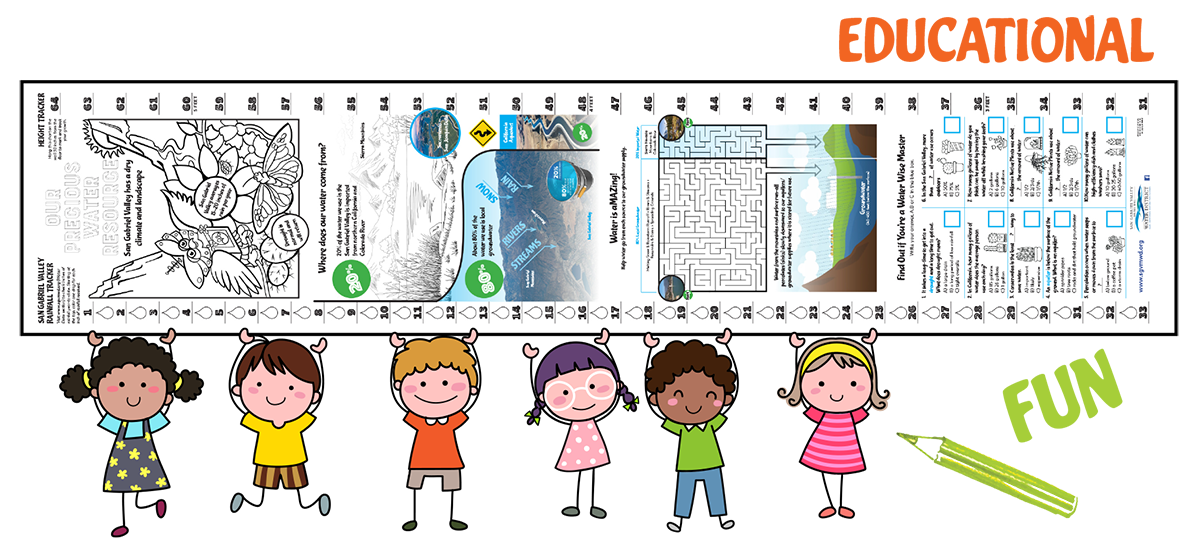
The District created several new educational videos (insert link), and a new, fun “Water Awareness Growth Chart.” The chart will help students learn more about groundwater, imported water, water terminology, and water conservation. The fun part is the Growth Chart is about 3-feet long and folds out so that students can keep it long-term. Please download the Growth Chart from our website or contact us (626-969-7911 or info@sgvmwd.com) and we will send to you. | |
|
In-Person Appearances at Community Events Resume
(Carefully and Safely) after Pandemic Hiatus!
| |
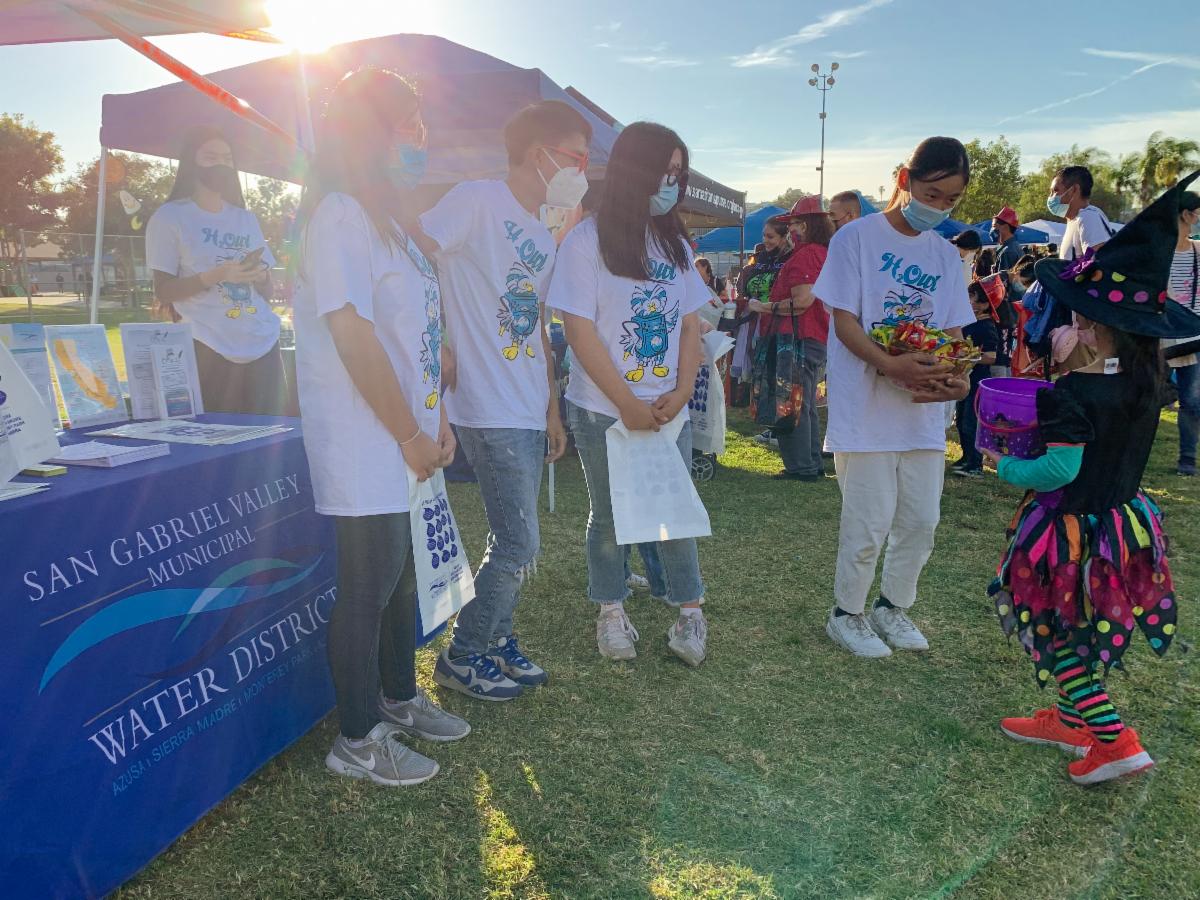
Monterey Park's 3rd Annual Monster Mash with Alhambra High School's ERAS club | |
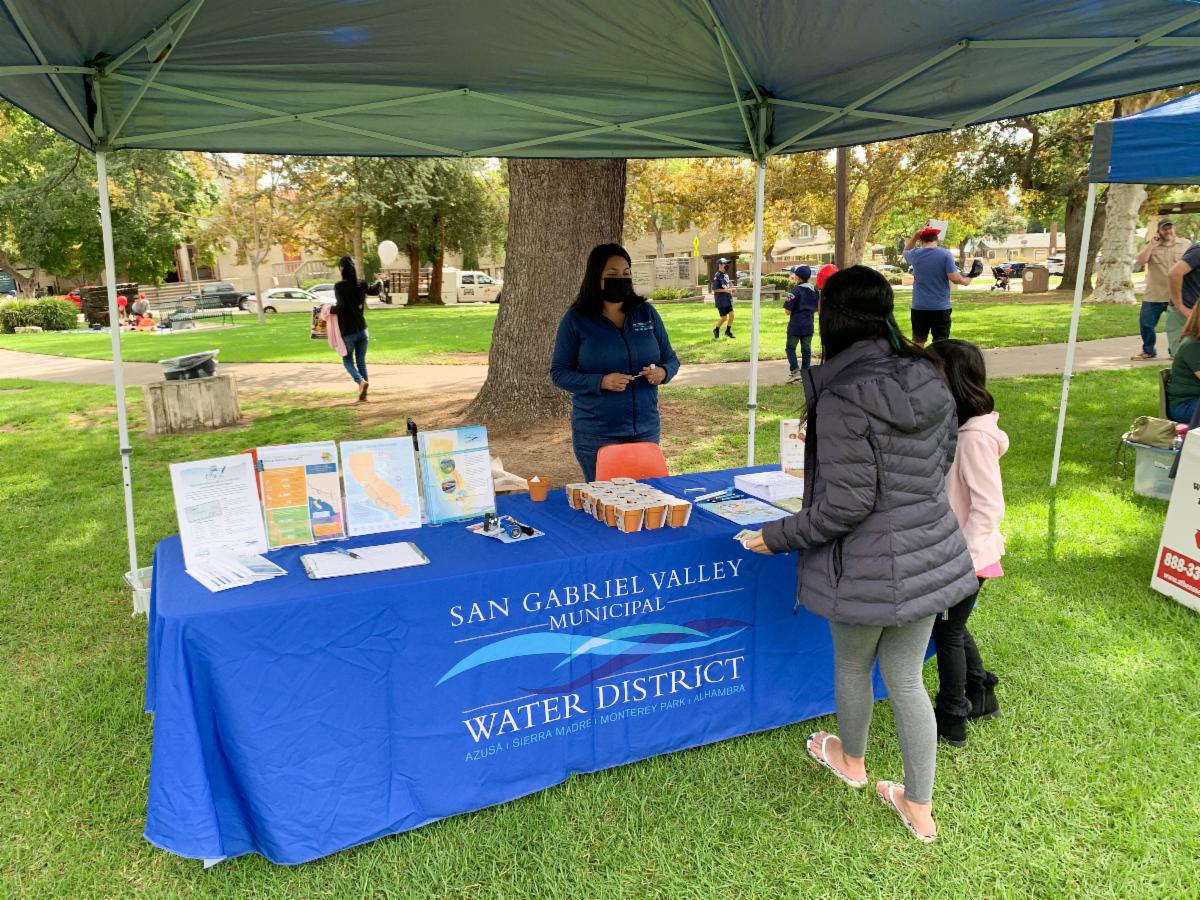
Sierra Madre Fire Prevention Fair | |
|
With the easing of pandemic-related restrictions, the District is again supporting and participating, with the utmost care and safety, in some community events in-person as the year progresses. We will also be seeking to provide in-person presentations and workshops about water supply and water conservation. We are always open to providing virtual or on-line presentations, as well.
In the fall, two “live” events have taken place, a fire prevention and awareness event in Sierra Madre, and a Halloween-themed "Monster Mash" event in Monterey Park. We look forward to seeing you in person, to introducing you to H2Owl and talking more about water issues! Please let us know about speaking opportunities and other events we might support with water education materials and our kid-friendly mascot. Please contact Evelyn Reyes at either 626-969-7911 or ereyes@sgvmwd.com.
| |
O.W.L. Grant Program for Schools and Non-Profit Organizations | |
|
The Opportunities for Water Leadership Grants (O.W.L.) are available! The Grant Program is a great way to aid educational events such as Earth Day festivals (outdoors or virtual/on-line), re-landscaping projects, waterway cleanups, tree plantings, school projects, conservation curriculum, and other civic, volunteer activities.
The grants range from $200-$2,000 for local, creative water conservation projects. The District welcomes creative ideas from schools and non-profit organizations. We are happy to provide technical assistance to help you complete the grant application.
A recap of our grant recipients to date is shown below and included on the District’s website: Please click here to read about the Grant Program and to access the online application. For further information, please contact the District at 626-969-7911.
| |
|
Rebate Program Easier than Ever with New On-line Application on the District’s New Website | |
|
The San Gabriel Valley Municipal Water District has offered a rebate program for many years for a variety of water-saving appliances and equipment. Many residents have cashed in and reaped the benefits of lower water bills and money in their pockets.
Our new website offers participants an on-line application process that is easier and faster! Please visit our new website (insert new link for www.sgvmwd.org/Conservation/Rebates). Residents who pay their water bill to the cities of Alhambra, Monterey Park and Sierra Madre are eligible to participate. If you take action today, you should be enjoying that rebate, extra cash and water savings within 8-10 weeks. If you have any questions, please call us (626-969-7911) or email us (info@sgvmwd.com). Thank you and stay safe!
| |
| | | |