Helping Make Every Day "Earth Day" in Our Member Cities! | |
|
Partnership in Earth Day Events
Earth Day was Saturday, April 22 and the District increased its support of Earth Day and environmental awareness activities with its member cities. The District partnered with member cities at the following events:
| |
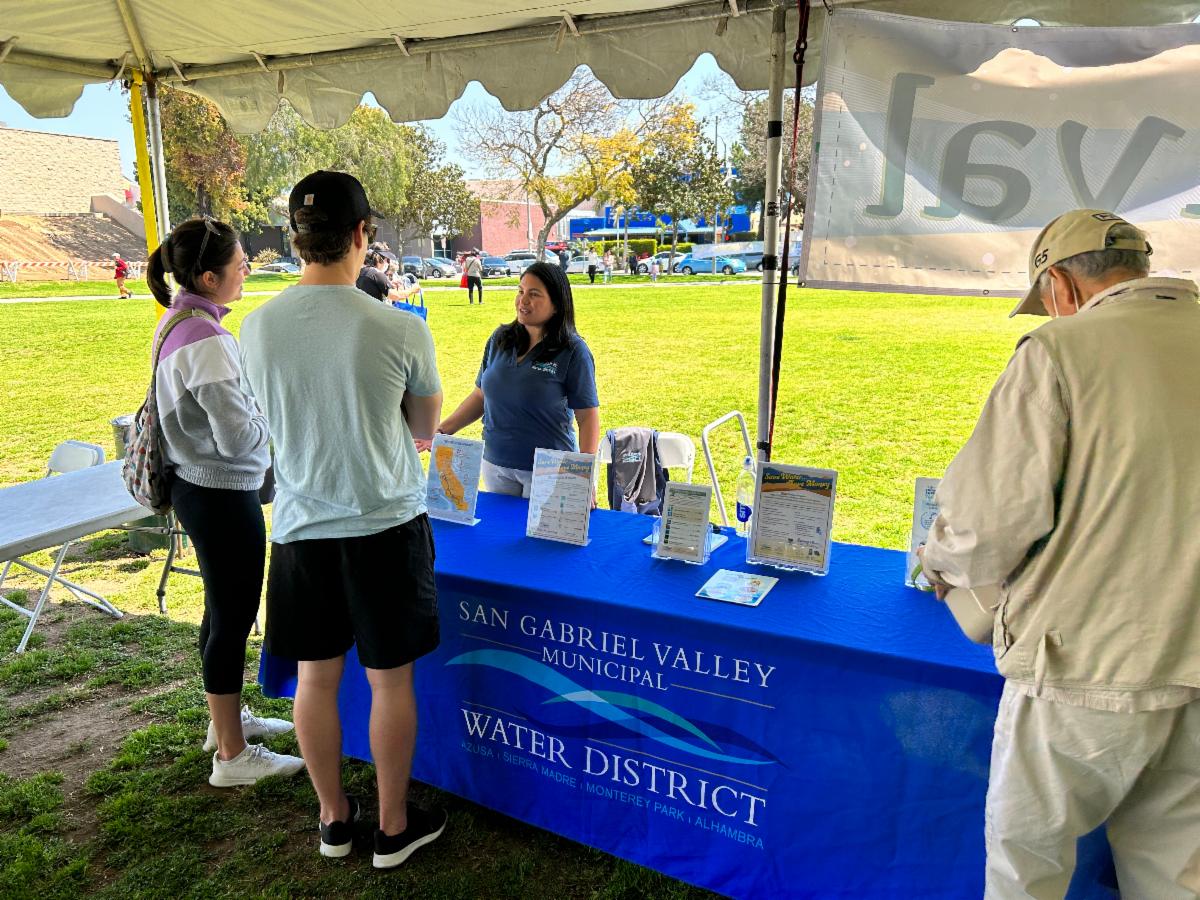
City of Monterey Park's Earth Day festival in conjunction with their annual Cherry Blossom Festival on Saturday, April 15 at Barnes Park. | |
|
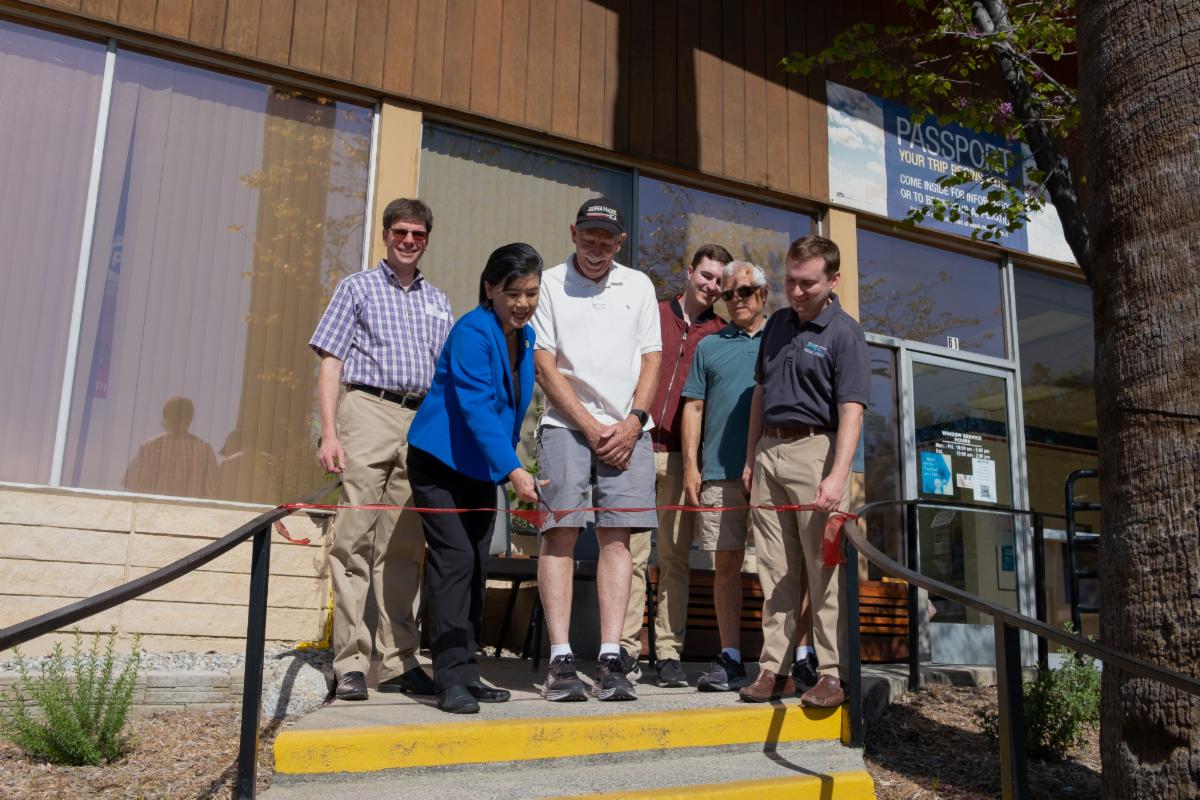
In the City of Sierra Madre, Director Miles Prince joined the community in unveiling their new native garden at their local United States Post Office on Saturday, April 22. The District was a proud sponsor and supporter of the project that was all built by volunteers. Their annual Earth Day Festival capped off the day at Memorial Park. | |
|
|
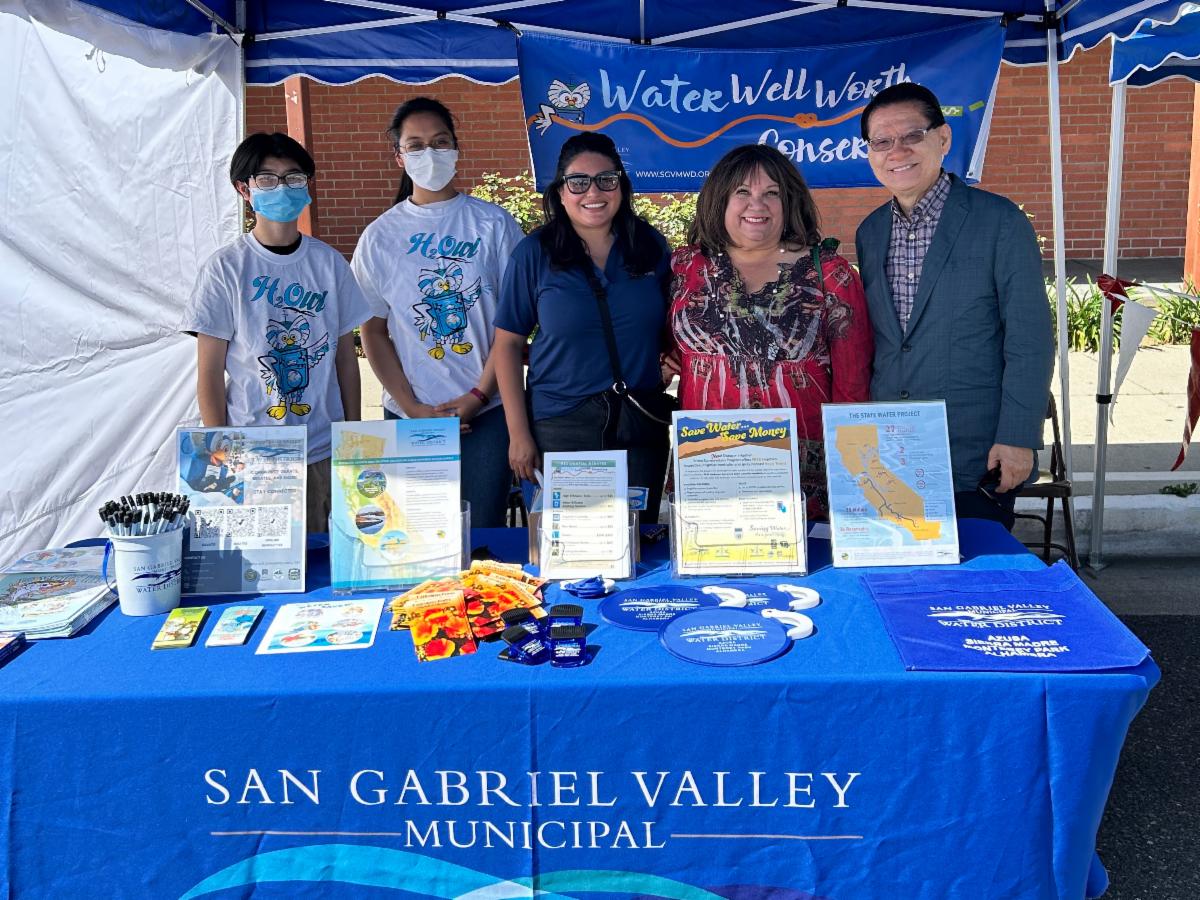
City of Alhambra hosted their annual Eco-Fair in conjunction with the Farmer's Market. Alhambra High School's ERAS (Environmental Resources Awareness Society) partnered with us to pass out giveaways and educate the community on ways to conserve water at home.
City of Alhambra Mayor Adele Andrade-Stadler and SGVMWD Director Mike Eng stopped by for the festivities.
| |
|
|
Earth Day "O.W.L" Grants
In a major new program offering, the District offered “Earth Day Grants” as part of its O.W.L. Grant Program. Grants ranging from $500-$1,500 were made available to schools in the District’s service area. The District’s goal was to identify new partners and to deepen the relationship with existing partners for more comprehensive O.W.L. Grant opportunities. Seven grants were funded totaling $10,500. A recap of the recipients and their Earth Day activities follows:
Sierra Madre Elementary School (Pasadena Unified School District)
-
Farm to Table: The program teaches students how to grow and prepare seasonal vegetables and fruit. Students are being taught about evaporation, proper water usage and water conservation.
-
Curriculum - A second grant to the school supported over 200 students in kindergarten and first grade receiving common core curriculum about the stewardship of our Earth and water conservation.
Northrup Elementary School (Alhambra Unified School District)
-
3D Printing Project - Students are being taught to develop their awareness of water-wasting practices and solutions. The students investigated, collaborated and designed a water-saving device utilizing 3D printing.
Monterey Highlands Elementary School (Alhambra Unified School District)
-
School Beautification - The grant supported beautification of the campus and helped construct a student-led water saving garden. The program involved approximately 250 students.
Brightwood Elementary School (Alhambra Unified School District)
-
Monarch Butterflies - The grant supported an Earth Day event with Monarchs with Kristy and the Pasadena Audubon Society to showcase the plight of the Monarch butterflies. The grant also enabled the District to stage an exhibit explaining the “water cycle.”
Mark Keppel High School (Alhambra Unified School District)
-
Biology Department - The biology department identified a location in front of the school at which students and teachers will be planting California Native Plants during spring and summer.
Alhambra High School (Alhambra Unified School District)
-
ERAS Club: The District has supported the ERAS Club (Environmental Resources Awareness Society) for several years. With its Earth Day grant, the Club invited a rainwater harvesting expert to teach students and their families how to properly collect rainwater in their homes and re-use it.
| |
|
OPERATIONS &
INFRASTRUCTURE
| |
|
|
Department of Water Resources Increases State Water Project Supplies to State Water Contractors to 100% for 2023
As seasonal precipitation begins to taper, what will be an incredible snow melt has begun, further improving water supplies. As a result, the District is very pleased with the state’s announcement on April 20, 2023 to increase State Water Project (SWP) allocations to state water contractors, such as SGVMWD, to 100% of plan, which last occurred in 2006, after continued rain, snow and runoff following recent storms. The increase means the District will receive 28,800 acre-feet of imported water to use for replenishment of groundwater in the Main San Gabriel Basin.
| |
Imported water supplements local groundwater supplies in the Main San Gabriel Basin and Raymond Basin, the primary sources of water for the District’s member cities of Alhambra, Azusa, Monterey Park, and Sierra Madre. The planned allocation may be adjusted in the future based on hydrological conditions. | |
SGVMWD's Member City Water Rate Update
The San Gabriel Valley Municipal Water District remains focused on fiscal responsibility and developing a sustainable water supply for our member cities. We are pleased that the wholesale water rates we charge to our member cities for replacement water remain, by far, the lowest in the Main San Gabriel Basin. In addition, the District's property tax rate, which is used to fund the fixed costs of the State Water Project, has been unchanged since 2017, at .030 cents per thousand dollars assessed value. Prior to 2017, that rate had been unchanged for 30 years.
In the past few years, the District invested in several supply sustainability and water quality initiatives benefiting our member cities short and long-term: more than $8 million in water infrastructure and supply projects in our member cities and $2.8 million in the Department of Water Resources (State Water Project) Delta Conveyance Project. We also formalized support of the Pure Water Southern California recycled water project and enhanced maintenance of our facilities. During the drought we implemented a broad-based water conservation and education program; increased funding for our rebate, direct install irrigation and community grant programs; and continued our thought leadership by sponsoring Asian media and Earth Day events, local Town Halls, and the San Gabriel Valley Water Forum.
We have experienced increasing “fixed” costs for participation in the State Water Project, from an average of $5.4 million per year from 2010-2014, to $6.8 million in 2015, to $7.5 million in 2022. In addition, we have also experienced large cost increases to maintain our own infrastructure as our pipeline approaches 50 years in operation. We've been able to mitigate these effects to a degree by obtaining additional sources of revenue such as grant funding and reducing discretionary expenses.
At its April 10, 2023, meeting, the Board of Directors voted unanimously to set the water rate at $220 per acre-foot for 2023, and to advise our member cities that we anticipate the rate increasing to $240 per acre-foot in 2024, based upon the latest forecast provided by the Department of Water Resources. In 2015, for the first time since 1989, the District adjusted its water rate from $130 per acre-foot (AF) to $145 per AF to compensate for the sharply rising State Water Project costs. We completed a three year rate adjustment that moved our rate to $200/AF by 2018-2019 and that rate was unchanged through 2022. These rates remain extremely fair and competitive: other importing water agencies in the San Gabriel Valley now have rates more than $1,000/AF for groundwater replenishment.
The rate is a pass through of the State Water Project variable cost which is the amount the Department of Water Resources charges each State Water Contractor (e.g. SGVMWD). The District has historically tried to match this cost with its replacement water rate. The District has never profited from water sales to its member cities.
| |
Operations Update
In April, the District delivered 194 acre-feet of imported water to local spreading grounds to supplement cyclic storage supplies in the Main San Gabriel Basin. In addition, the District delivered 476 acre-feet of water to Covina Irrigating Company on behalf of Three Valleys Municipal Water District. The District began water deliveries on April 26. With the Department of Water Resources increasing the allocations to State Water Contractors such as SGVMWD to 100%, the District will be working hard to receive and deliver as much imported water as possible to the Main San Gabriel Basin.
| |
|
Spring's Arrival Coincides with Significant Water Supply Improvements
| |
|
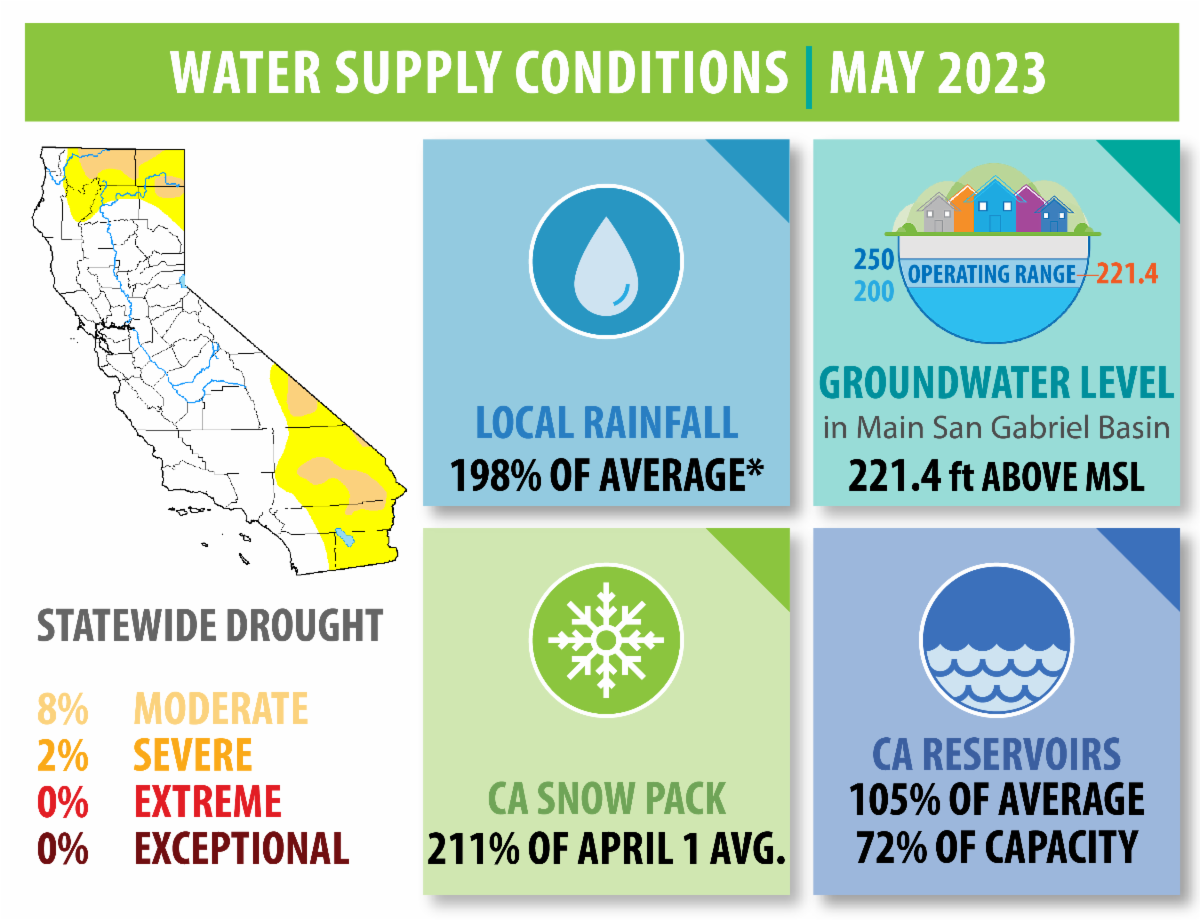
The start of the snow melt and ensuing water runoff in April further improved drought and water supply conditions statewide and in the San Gabriel Valley. The graphics above show the marked improvement from January through May 2023 in state and local reservoir, snowpack and groundwater conditions. They also show significant change in the severity of drought statewide. As many reservoirs are approaching capacity, snowpack is more than double normal levels, and local groundwater, which improves more slowly due to the time it takes stormwater runoff to percolate down to groundwater levels, has risen more than 30 feet year-to-date.
While the most recent drought is effectively over, we must remember we live in a region where most years are dry, where drought will return and where climate change makes the work of water planning and delivery challenging. The reality remains that if we’re not in a drought, we are probably either getting into one or recovering from one.
We need to sustain our focus on developing a long-term water conservation ethic that enables us to save water now, when it’s wet, for when it’s dry. While the State has lifted many water use restrictions, it’s important to note that in the past 1-2 years Californians fell short of meeting the voluntary 15% conservation goal and were only saving water at a 6% rate, far short of the 25% conservation level achieved in the next most recent drought period.
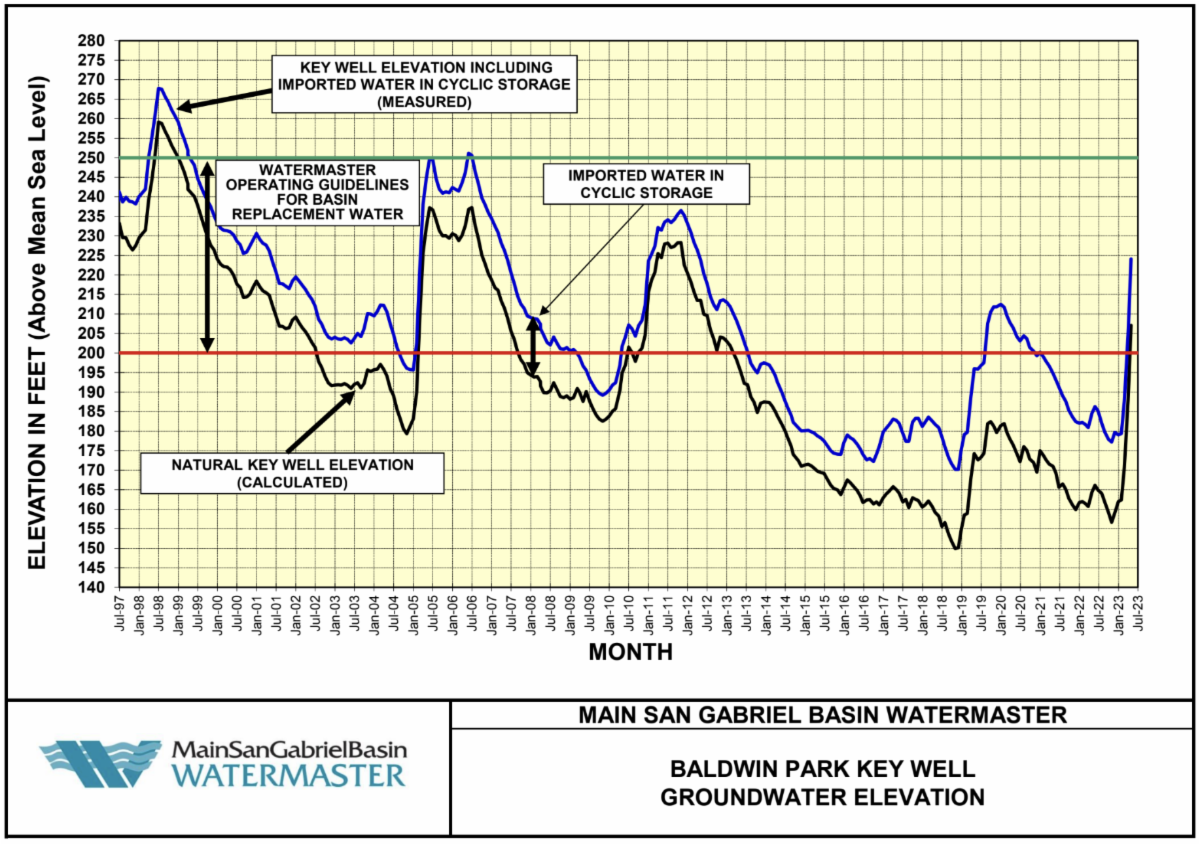
Groundwater – in the Main San Gabriel Basin, the “Baldwin Park Key Well” is the indicator of local groundwater levels (see graph – blue line includes cyclic storage; black line does not). As of April 27, 2023, the level increased significantly to 224.1 feet above mean sea level, compared to 204.9 in early April, 189.7 feet in March, 179.4 feet in February and 179.2 feet in January. Prior to the storms earlier this year, the Basin had experienced a steady decline in groundwater levels from a high of 212.5 feet above mean sea level in December 2019 and was trending downward toward the historic low of 169.4 recorded on November 21, 2018. One vertical foot is equivalent to about 8,000 acre-feet of groundwater in the Main Basin. Watermaster’s operating guidelines for replacement water or “safe yield” is between 200 and 250 feet above mean sea level.
About 80 percent of the Valley’s water supply is furnished by local groundwater, and the Valley imports about 20 percent of the water we use from northern California and the Colorado River. A 60 percent allocation is needed to meet the demand of our member cities for replacement water. Thus, in years where the allocation dips below that amount, we see the important role that water storage and water conservation play.
Note: Groundwater use accounts for 41% of California’s total water supply (80% in the San Gabriel Valley) on an average, annual basis, and as much as 58% in a critically dry year. About 85% of public water systems rely on groundwater as their primary supply. Of water diverted and pumped in California, about 80% is used by agriculture and 20% is used by cities and towns.
| |
|
Imported Water – In April, the California Department of Water Resources increased State Water Project allocations to State Water Contractors such as SGVMWD for 2023 to 100% for the first time since 2006. Imported water is used to supplement local groundwater supplies in the Main San Gabriel Basin.
Note: Two-thirds of California’s water originates in the Sierra Nevada Mountains and flows through the Delta, a large inland river delta and estuary in northern California.
| |
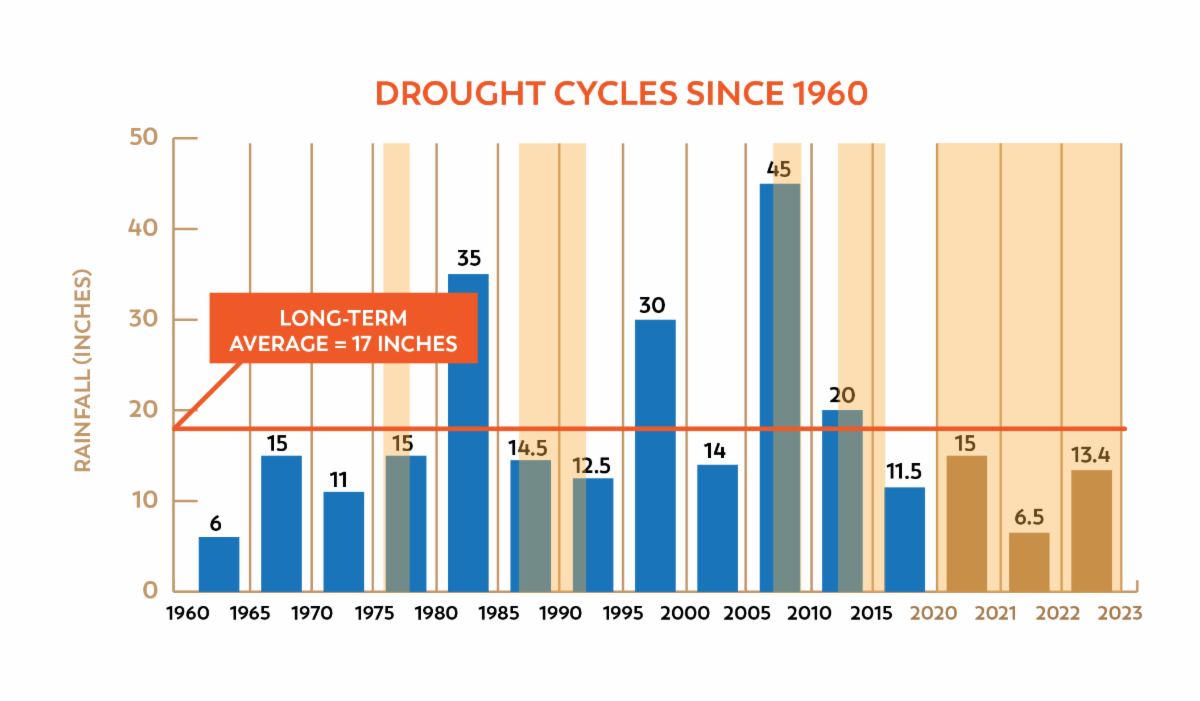
Local Rainfall – the LA County Department of Public Works (DPW) reports annual rainfall levels from October 1 to September 30 of each year. As of April 27, 2023, the DPW headquarters location in Alhambra had recorded 35.37 inches of rain, about 198% of average (average annual rainfall at this location is 17.83 inches). The graph below shows both annual rainfall totals dating back to 1960, as well as the major drought cycles since then. | |
|
Statewide Snow Pack – as of April 27, the snow water equivalent was 53.8 inches, which is 211% of April 1 average and 258% of normal for this date (snowpack is measured from April 1 to March 31, a 12-month period). April 1 is usually the “high point” for snow accumulation each year. The current snowpack is one of the biggest the state has experienced since the 1950s.
Note: On average, the Sierra Nevada Mountains snowpack, which is a key source of water banked in reservoirs, supplies about 30% of California’s water needs as it melts in the spring and early summer, feeding reservoirs and the water table, resulting in groundwater. The snowpack is often referred to as California’s “frozen reservoir.”
Statewide Reservoir Levels – statewide, as of March 31, 2023, (the latest statewide data available to us), reservoir levels had risen to 105% of average and 72% of capacity, with further gains imminent in April and May as the snowmelt and runoff occurs. As of late April, storage levels at Shasta Lake, the state’s largest reservoir, were 96% of capacity and 115% of the historical average for this date, and storage levels at Lake Oroville, the state’s second largest reservoir, were 90% of capacity and 118% of the historical average.
Locally, both San Gabriel Reservoir and Cogswell Reservoir are presently more than 125% of average. During the recent drought, low precipitation levels, high temperatures, hot and dry soil, and high levels of evaporation decreased stormwater runoff from surface levels to replenish both reservoirs and local groundwater supplies.
Note: Every winter, most areas need about 12 inches of rainfall before the ground is saturated enough to get large amounts of runoff into streams and reservoirs. California’s reservoirs generally hold enough water to go one dry year without impacts but begin to empty if a wet year does not follow.
| |
|
New!! "Seed" Grants for Schools to Help Fund Local
Earth Day Educational Activities
| |
|
The District’s popular and long-running Opportunities for Water Leadership Community Grant Program (O.W.L. Grants) provided grants ranging from $500-$1,500 to schools and non-profits for Earth Day related educational activities in April. These grants were IN ADDITION to the ongoing unlimited grant program. If you were unable to participate in the Earth Day grant program, please consider our ongoing grant program.
Streamlined applications and additional information about the program are posted on the District’s website (https://sgvmwd.com/water-conservation/#owl-grants). Our intent was to use the “seed” grants to spur new “Earth Day” environmental and water education activities and to build new, long-term partnerships at schools and non-profit organizations on Earth Day and beyond.
The District’s O.W.L. Grants Program was featured in September 2022 by ABC-Channel 7 to help encourage water conservation as part of its “Water-Wise Wednesday” community feature. The entire news segment may be viewed with the link below.
| |
|
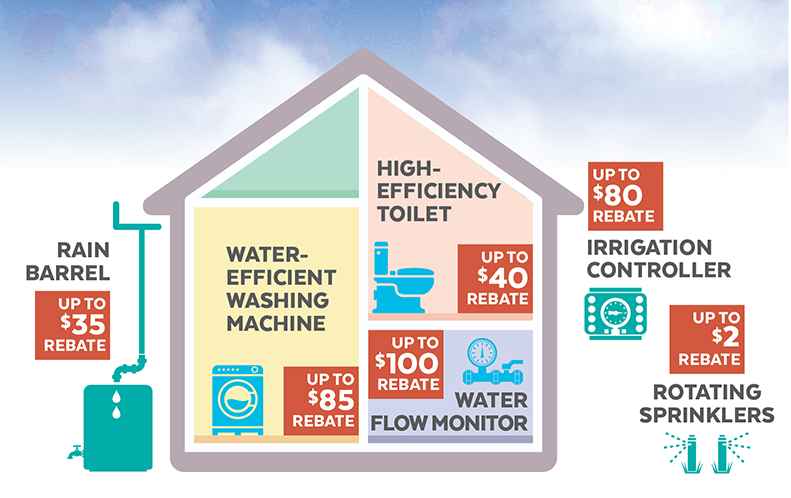
2023 Rebate Program – Save Water and Save Money!
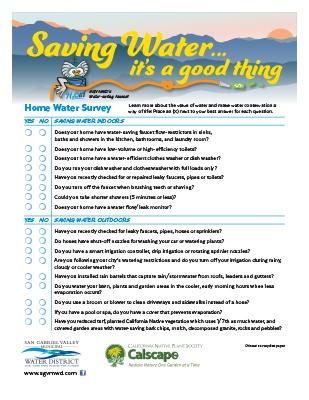
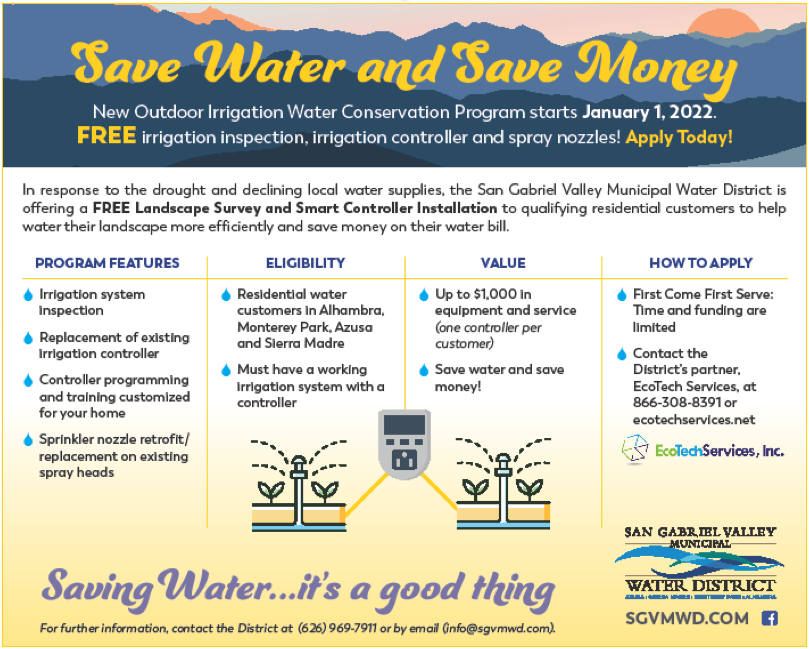
The District has enhanced its water conservation programs to help you save water and money. Our new irrigation system retrofit program features 1) a FREE irrigation system inspection; 2) replacement of an existing irrigation controller with a FREE, new programmed unit; and 3) FREE installation of new sprinkler nozzles on existing pop-up spray heads. Since January 2022, EcoTech has performed 257 site assessments. 236 weather-based “smart” controllers have been installed in 215 properties and 5,766 sprinkler nozzles have been upgraded to water-efficient rotating nozzles. The approximate cost/value per landscape to date is $1,136. Funding is limited, so please review the informational flyers below and on our website and act as soon as possible.
Residents in Alhambra, Monterey Park and Sierra Madre may apply for rebates on the District’s website (www.sgvmwd.com). Residents in all our member cities may apply for the irrigation retrofit program by contacting our partner, EcoTech Services (866-308-8391 or ecotechservices.net).
|  |  | |
|
Spring Has Sprung! It's a Great Time to Implement Water-Wise Gardening Tips
With spring having arrived, make sure your garden is water-efficient. Working with information provided by the California Native Plant Society, and their very informative Calscape website (www.calscape.org), the District created water-wise gardening tips customized to meet the unique climates of our four member cities – Alhambra, Azusa, Monterey Park and Sierra Madre.
Fall, winter and spring are the best times of the year to plant new water-wise vegetation, to give plants and their roots time to become established before hot, dry weather resumes in summer. The gardening tips recommend California Native plants suitable for each city, as well as local nurseries and landscape supply stores at which the plants may be purchased. As more and more residents change out their old, water-intensive lawns and gardens for hardscapes and drought-tolerant vegetation, these tips will save water and save money!
| |
|
May is Water Awareness Month!
Each year, the state declares May as “Water Awareness Month,” coinciding with the end rain and snow season in much of California and the beginning of warmer and drier weather. Conservation becomes even more important during the spring and summer months as we must preserve our precious water resource. Especially this year, as Mother Nature has gifted us with abundant rain and snow to alleviate the drought and replenish our depleted water supplies, it’s a good idea to “save water when it’s wet, for when it’s dry.”
May also marks a return to a great District tradition of assisting schools with water education and water conservation. While our school outreach was curtailed for several years due to the pandemic, we are again providing educational materials, videos and in-school presentations at elementary schools in our service area.
Teachers: here are links to the most common materials we provide. If you are interested in an in-class or larger assembly presentation, please contact Evelyn Reyes at 626-969-7911 or info@sgvmwd.com.
| |
SGVMWD Meets with Legislators in Sacramento | |
|
The District conducts an ongoing government relations program with elected officials and staff at federal, state, county and municipal levels. With the pandemic behind us, we resumed in-person visits to our legislators in Sacramento in March. The purpose of the meetings is to learn more about water-related state legislation impacting our member cities, to share highlights of District operations with legislators and to enhance personal relationships between District board members and staff with legislators and their key staff.
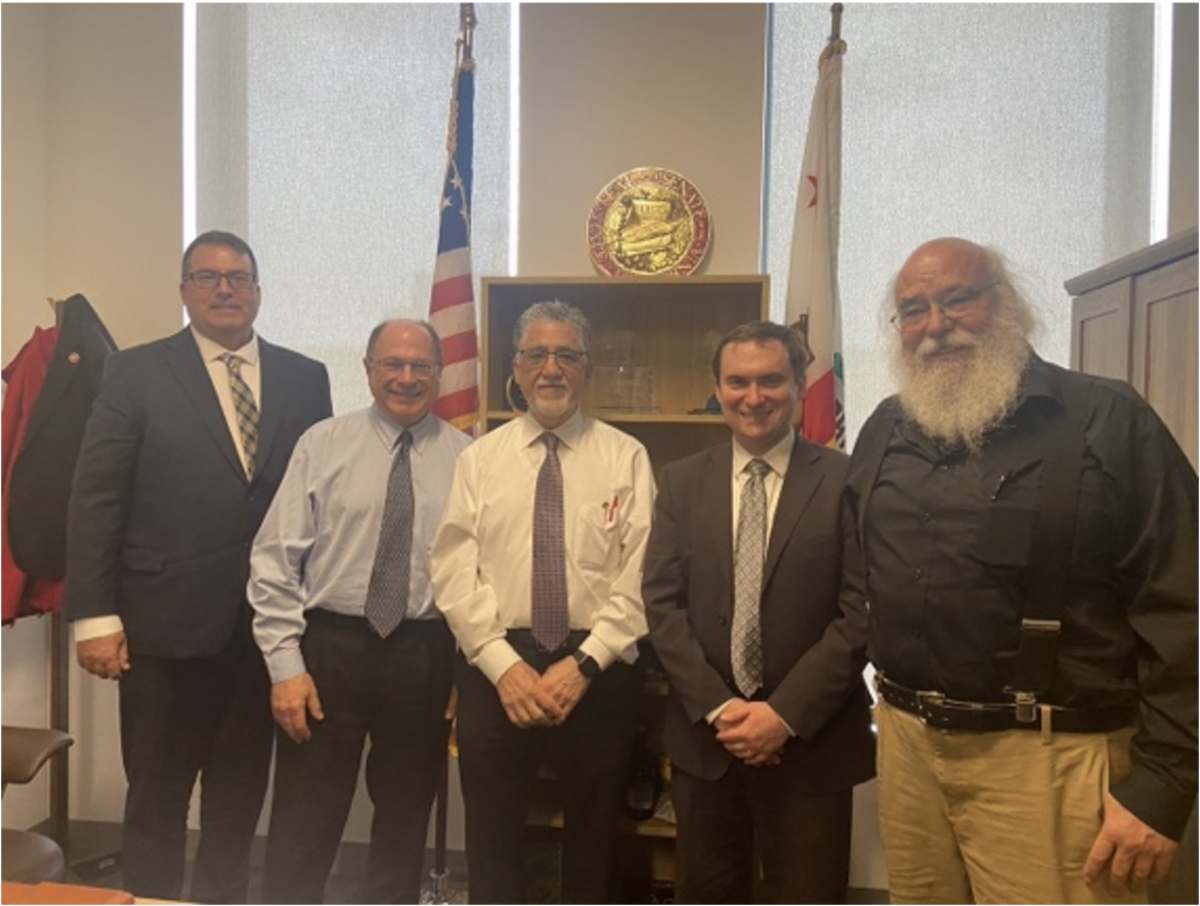
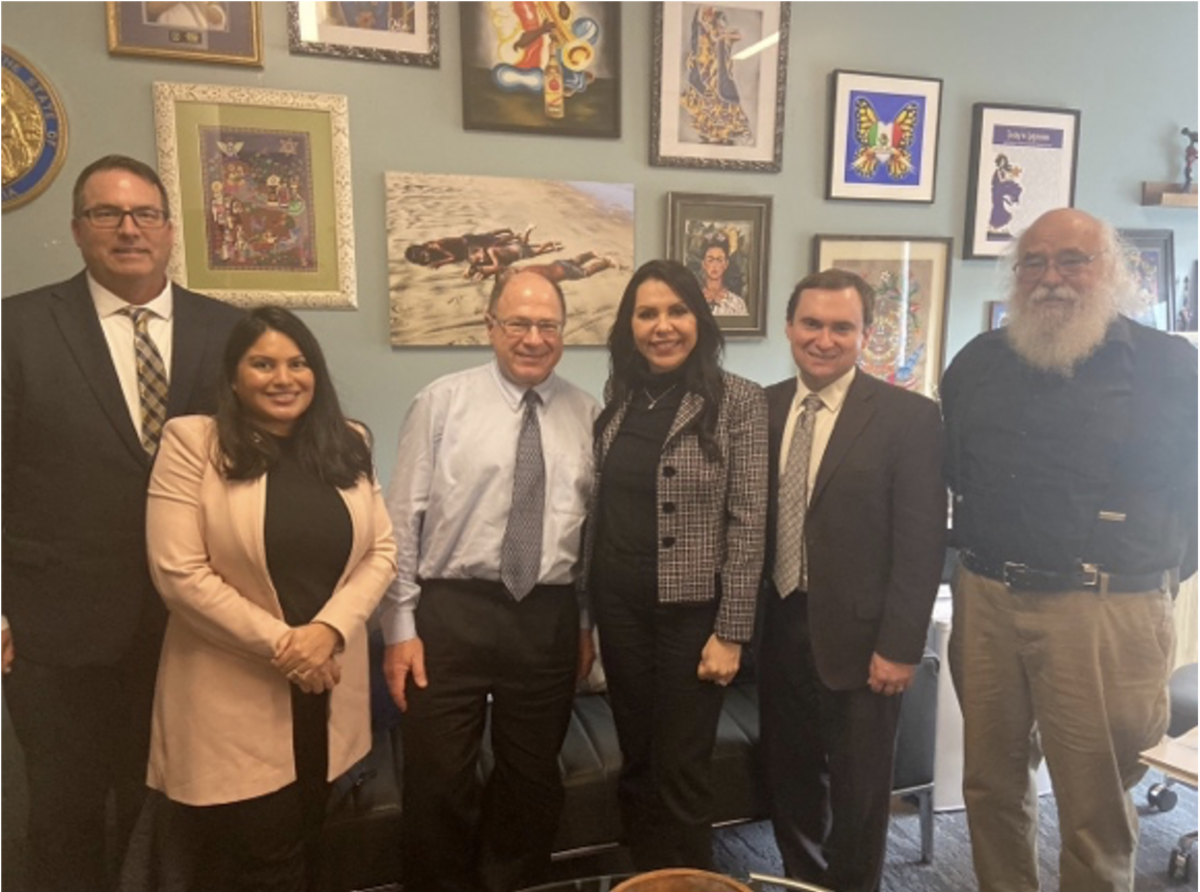
This year, Directors Steve Placido, Miles Prince and Bruce Knoles attended the meetings in Sacramento, along with District staff Steve Kiggins, Assistant General Manager, and Evelyn Reyes, External Affairs Manager. The following meetings were conducted:
- Senator Anthony Portantino, Senate District 25
- Pictured left/above, left to right: SGVMWD Asst. General Manager, Steve Kiggins; Director Steve Placido; Senator Anthony Portantino (S.D. 25); Director Miles Prince; Director Bruce Knoles
- Assemblywoman Blanca Rubio, Assembly District 48
- Pictured right/above, left to right: SGVMWD Asst. General Manager, Steve Kiggins and External Affairs Manager Evelyn Reyes; Director Steve Placido; Assemblymember Blanca Rubio (A.D. 48); Director Miles Prince; Director Bruce Knoles
- Senator Maria Elena Durazo, Senate District 26 (met with staff)
- Senator Susan Rubio, Senate District 22 (met with staff)
- Assemblymember Chris Holden, Assembly District 41 (met with staff)
- Assemblymember Mike Fong, Assembly District 49 (met with staff).
| | | | |