|
FOR IMMEDIATE RELEASE
January 2, 2026
CGG Files State Election Board Complaint
Demanding Georgia Enforce Election Law
CGG Calls on State Election Board to Act
After Five Years of Noncompliance
Atlanta, GA — Coalition for Good Governance (CGG) filed a formal complaint Wednesday with the Georgia State Election Board, Georgia’s election enforcement agency, calling on the Board to finally enforce state and federal election laws that have been violated for more than five years by use of Georgia’s touchscreen voting system.
The complaint documents chronic, unresolved failures of Georgia’s ballot-marking device (BMD) system—failures that undermine ballot secrecy, prevent voters from knowing who they are actually voting for, defeat meaningful audits, and violate both Georgia law and the federal Help America Vote Act.
“Georgia voters are entitled to elections that comply with the law—not elections where officials explain why the laws protecting voters are inconvenient. It is time to stop prioritizing Dominion profits over voters’ rights,” said Marilyn Marks, CGG’s Executive Director.
A Five-Year Failure to Enforce the Law
Since Georgia’s touchscreen voting system was deployed in 2020, courts, experts, the legislature, and election officials themselves have repeatedly acknowledged serious problems with the design and operation of the touchscreen QR code vote system. In 2019 Secretary Raffensperger improperly certified that the system met state and federal law despite the many known built-in violations and severe security flaws. Yet the State Election Board, the state’s election enforcement authority, has repeatedly declined to act, often suggesting that the legislature should intervene instead—despite the fact that lawmakers already mandated a clear remedy—a remedy the State Election Board pretends does not exist.
“The Georgia General Assembly anticipated this exact situation,” said Marks. “When the primary voting system cannot be used in compliance with the law, the answer is not paralysis. The answer is to temporarily use the backup paper ballot system that the General Assembly expressly authorized.”
That backup system—hand-marked paper ballots counted by optical scanners—is already federally-certified, and in use across the country for years, and already used by Georgia counties in unforeseen emergencies. The complaint does not seek to abandon Georgia’s voting equipment, but to require its components be used in its standard configuration that complies with the law.
Unintended Use
“The Dominion system was not designed to be used in the unworkable non-compliant configuration cooked up by Secretary Raffensperger and Gabe Sterling, where wildly expensive touchscreen voting units, intended use by limited numbers of voters with accessibility needs, were deployed as the mandatory method of marking ballots by all voters, with 35,000 touchscreens substituting for simple Sharpie pens. The touchscreens were never designed for every voters’ use, and therefore universal voter privacy or cybersecurity considerations were not design priorities. Georgia voters have been paying the price for five years while officials cling to their budget-busting Rube Goldbergian idea of a modern voting system. The answer lies in using the simple system as it was designed—hand marked ballots counted by scanners,” Marks said.
Core Violations Remain Unresolved
The complaint details several fundamental violations that remain uncorrected after five years:
-
Ballot secrecy violations. Large touchscreen displays routinely expose voters’ choices to others in polling places, violating Georgia’s constitutional requirement of absolute ballot secrecy.
-
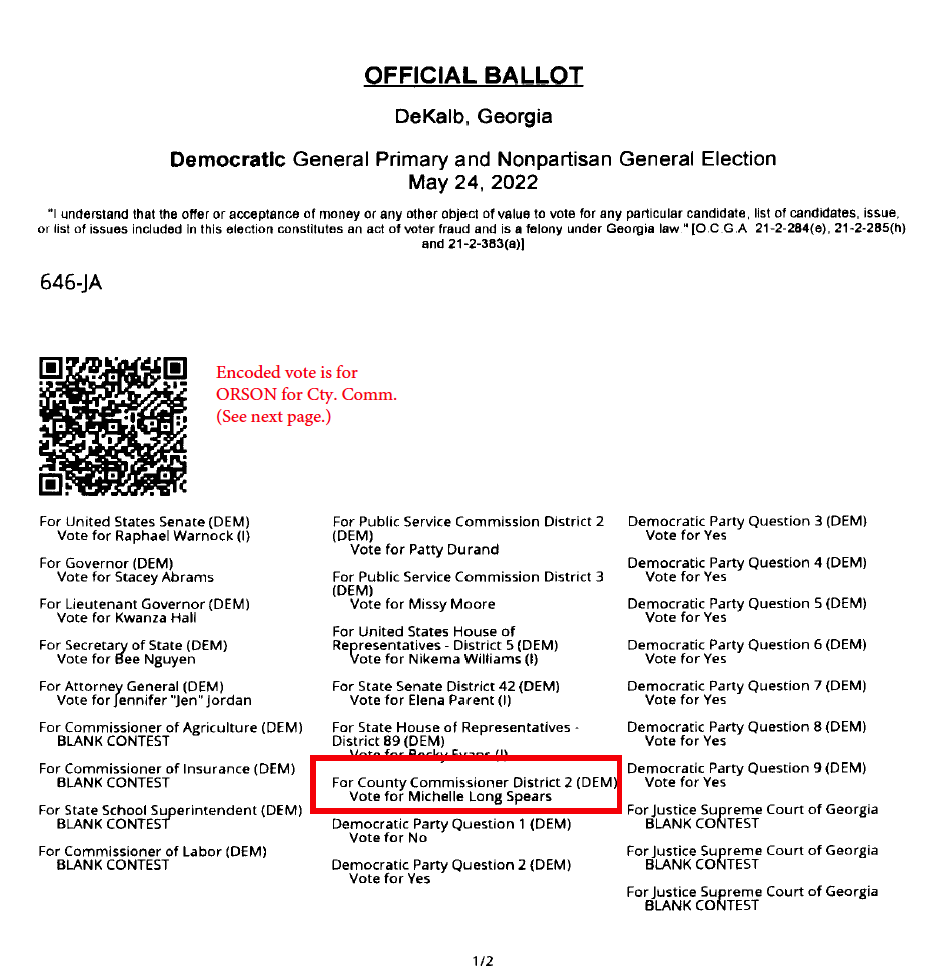
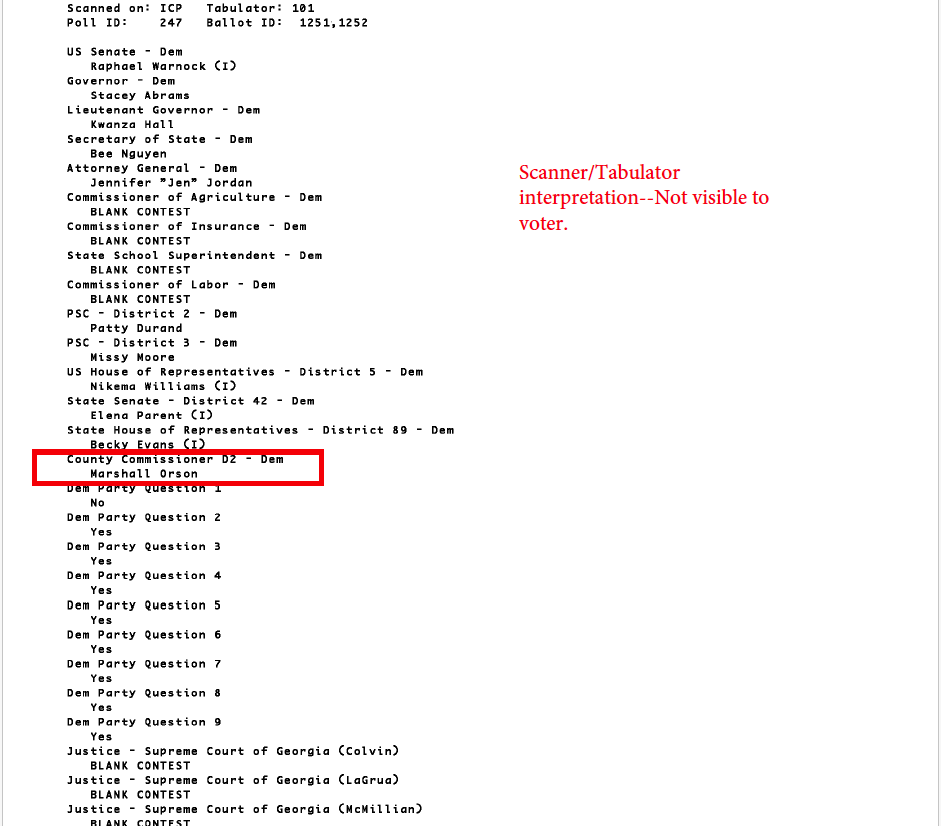
Voters cannot verify who they are voting for. The legally operative vote is encoded in an unreadable QR code, leaving voters unable to confirm or correct the vote that is recorded to be counted. (The text “interpretation” can be wrong. See example from the DeKalb May 2022 primary election.)
|