|
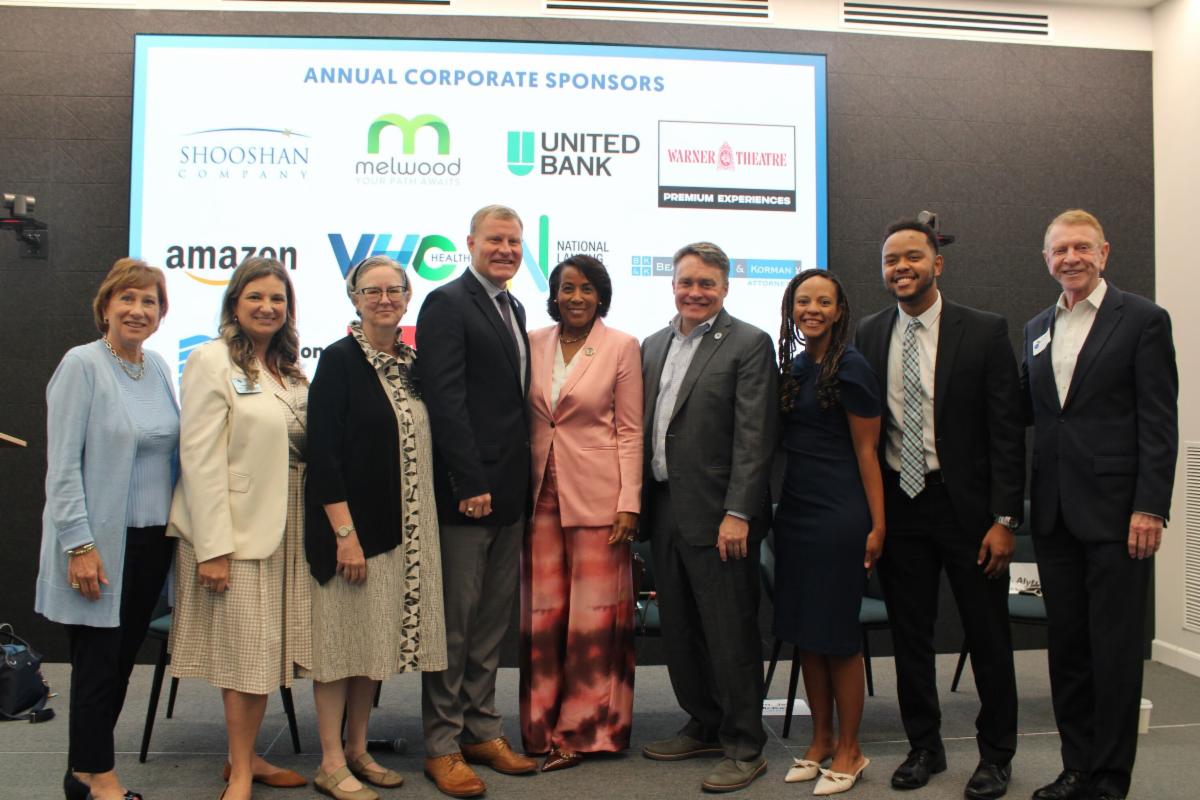
ARLINGTON, VA. - More than 200 business, government, and community leaders, including 17 elected officials, gathered on August 26 at George Mason University's Fuse at Mason Square for the 11th Annual Northern Virginia Regional Elected Leaders Summit, a signature regional event focused on the issues shaping Northern Virginia’s future.
Sponsored by Dominion Energy, this year's summit was held by the Arlington Chamber of Commerce, with premier partner NVC, co-hosts Alexandria Chamber of Commerce, Loudoun Chamber of Commerce, and the Northern Virginia Regional Commission, and contributing partner Regional Elected Leaders Initiative. The event featured a panel discussion with Arlington County Board Chair Matt de Ferranti, Alexandria City Mayor Alyia Gaskins, Fairfax County Board of Supervisors Chair Jeff McKay, and Loudoun County Board of Supervisors Chair Phyllis Randall, moderated by Drew Wilder of NBC4.
The conversation focused on several of Northern Virginia’s most consequential issues, including economic growth, data centers, housing policy and transportation funding.
Beginning with economic growth, the panelists shared initiatives in their jurisdictions aimed at incentivizing and retaining businesses. Alexandria City Mayor Alyia Gaskins highlighted Alexandria’s ALX Forward plan, and its focus on small business growth. Gaskins noted that one goal of ALX Forward is to ensure the City government is “not the hold-up when [a business] is trying to do permitting, or when you have other questions after you are open.” Gaskins added that the City recognized “that our tax rates were not always the lowest” in the region, prompting a review into the tax structure to help improve their economic competitiveness.
The panel also discussed the role of data centers in local economies and the regulatory questions surrounding their continued growth. Loudoun County Board of Supervisors Chair Phyllis Randall shared background on the history of her jurisdiction being a hub for the industry, before noting her support for additional local powers to examine data centers from a broader lens. “If I could ask anything of the General Assembly, it’d be to give us the power to say 'yes' or 'no' to a data center based on power availability," said Randall. She continued by emphasizing the positive economic impact felt from data centers. "For every $1 we spend on infrastructure costs in data centers, they give us $26 back,” said Randall, who attributed Loudoun’s low taxes and strong school and park systems to the revenue generated from data centers.
Arlington County Board Chair Matt de Ferranti suggested that finding a balance between economic promise and regulations on data centers will be more critical going forward. "The next 10 years on data centers look very different for Northern Virginia than the last 20 years."
Housing policy was another main focus of the discussion. A key part of the discussion was on a new law allowing for administrative approval of construction of housing on land owned by faith organizations, known as “Faith in Housing.” The panelists offered differing outlooks on Faith in Housing.
Mayor Gaskins expressed support, explaining that Alexandria has been seeking the ability "to accelerate what we have said, as a council, is our number one priority" of developing more affordable housing units, and saw the legislation as a potentially useful tool.
Chair Randall offered a different perspective, expressing concerns that the legislation is a form of an unfunded mandate from Richmond. Arguing that the law “would tell us where to build houses, but not give us any money for infrastructure, for schools, for roads, for water, for parks," Randall suggested with Chair McKay that retaining local authority in approval of housing projects, with financial support from the Commonwealth, is in the best interests of localities and communities across Virginia.
On Metro funding, panelists agreed on the need for a durable, long-term capital funding stream ahead of new required contributions beginning in Fiscal Year 2029. Chair de Ferranti emphasized the need for a “long-term capital funding stream so that Metro can sustain the improvement that we've seen," and stressed the importance of a regional approach. Chair McKay flagged concerns with the current funding structure, noting that the joint use of the sales tax "automatically pitted education against transportation; that is a bad way to do business." He added that he supports seeking a “more workable” alternative to the current funding model in the next General Assembly session.
The participating chambers and partner organizations will continue to monitor these issues at the local, regional, and state levels and advocate for solutions that support Northern Virginia’s economic competitiveness.
"Today's discussion showed that while we have a lot of work to do as a region to address challenges like energy supply, affordability, and transportation, we have local elected leaders who are committed to working together and with the business community," said NVC President & CEO Julie Coons. "I look forward to working with them to achieve the goals of NOVA Roadmap and create an economy that competes by design, not by default."
"Northern Virginia’s jurisdictions are deeply interconnected, and the decisions made in one community often have implications across the region," said Arlington Chamber President & CEO Kate Bates. "This summit gives the business community the opportunity to hear directly from our elected leaders about their priorities and the regional challenges ahead. The Arlington Chamber is proud to convene this conversation alongside our partners and help advance solutions that strengthen Northern Virginia’s economic future."
The annual summit reflects the organizations’ shared commitment to convening regional leaders and ensuring that the business community has a voice in consequential policy discussion.
|