|
Director's Letter
Where is your sense of urgency?
At a meeting of the National Cancer Institute in March, 2007, I listened to dozens of vitamin D researchers present information about their cancer studies. Some with mice, some with people, some positive, some with a null effect. As the meeting was in its closing, a panel of researchers was on the stage. Dr. John Milner, the leader of the conference, asked the panel, "Where do we go from here?" I was soooo excited! I had just had breast cancer treatment, had learned something about vitamin D, and I saw its potential for helping prevent cancer.
The answer from the panel: "We need more research."
I was aghast. My heart beating wildly, I stood up and asked the question that created GrassrootsHealth-- "Where is your sense of urgency?" and, sat down. Very shortly, the conference was over. Then, the life changing event for me: there was a line of scientists waiting to talk to me. Why? They wanted to know "How can you help me get the word out?"
My answer: "I don't know." In order to know what to do to help spread a message, there needs to be some sort of definition of what's required. My husband and fellow researcher, Leo Baggerly, and I then traveled the US and Canada for 6 months in our motor home to meet with the key researchers and ask "What's the message?" The
Scientists' Call to D*action was born. The key message then was about the serum level (NOT the dosage)--get it to 40-60 ng/ml (100-150 nmol/L). Their message hasn't changed in 10 years. The serum level is the biologically relevant measure. The range hasn't changed in part because no studies have had significant numbers of people in higher levels.
This month is known rather widely as 'Breast Cancer Awareness Month'. It makes me cringe. Aren't we aware enough?
Currently, 'awareness' is only focusing on early detection--after the cancer is already there.
What can we do about prevention???
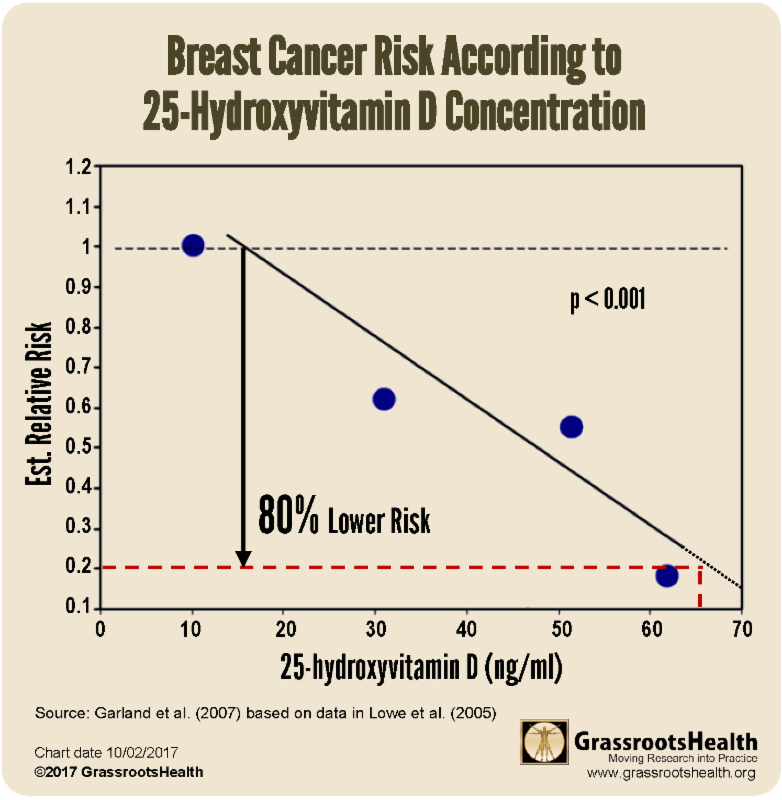
After my cancer in 2005, radiation, chemo, and mastectomy, I was determined to find something less harmful to women than that treatment regimen. It took two years of constant searching and I finally found this chart in a paper by Dr. Cedric Garland et al. at the University of California, San Diego.
I was so stunned I started to cry. Yes, I did. I quickly called a researcher I knew at UCSD and asked, "Is this guy a flake?" She quickly answered, "No, Carole, he's not a flake. He's actually discouraged--he's been doing this research for
30 years and feels like no one is listening."
TEN years ago there was data that vitamin D could prevent cancer. How can we create and capture the sense of urgency and put it into action across the world?
People are dying.
Fast forward to the present, 2017. Ten more years have passed. The
randomized controlled trials (
RCT's) are in. One such RCT by Lappe et al. in 2007 clearly showed that there is a significant reduction in the incidence (prevention) of all cancers with a serum level of at least 40 ng/ml (100 nmol/L) compared to about 28 ng/ml. Further, Dr. Lappe published results from yet another RCT in 2016 which also showed a 40% reduction in incidence between 30-60 ng/ml (p = 0.03.).
GrassrootsHealth combined the data from the 2007 Lappe cohort with our own cohort to add to the number of participants and, to add people who had higher serum levels. Using the same reference points (essential for comparison), a change from 30 to 60 ng/ml resulted in a 64% reduction with a p-value of 0.004.
We can't wait! We need prevention, NOW!
When we use the IOM's recommended level of 20 ng/ml, and go to 40 ng/ml, we see a 71% lower rate of all non-skin cancer. See the
first blog below.
It's time. We don't need more RCT's for this purpose (possibly for biological interpretations), we need strong, determined people to take action. The data shows a clear reduction, no matter which endpoints you choose.
The process of prevention with vitamin D is extremely simple: test the vitamin D serum level, supplement to get to at least 40 ng/ml. It's demonstrably safe (also by published studies), inexpensive and available.
What is the impact of starting today?
According to the American Cancer Society, approximately 1.7 million people will be newly diagnosed with cancer in 2017.
If we use our 71% reduction number, this would mean that 1.2 million people could have been saved the traumatic experience of diagnosis, treatment, and maybe death.
1.2 million! people saved from breast, colon,
and other cancers!
Now, we recognize that this doesn't happen overnight, as you read
in the blog below - it is important to maintain vitamin D levels above 40 ng/ml for multiple years to attain the best results and, maybe even above 60 ng/ml (150 nmol/L) for cancer - but we have to start today.
In addition to yourself, please
help us sponsor
1,000 new women in our
Breast Cancer Prevention Project
---we want to take the message to community groups of under-served women. Their rate of vitamin D deficiency is approximately 90%. In various trials, it has been demonstrated that the health disparity issue is almost resolved by getting this set of women's serum levels to at least 40 ng/ml. Help us find additional sponsors--community people, wealthy people, businesses.
Thanks so much for listening, and, for taking action.
Onwards!
Carole
 |
Carole Baggerly
Director, GrassrootsHealth
Moving Research into Practice NOW!
|
|