This week:
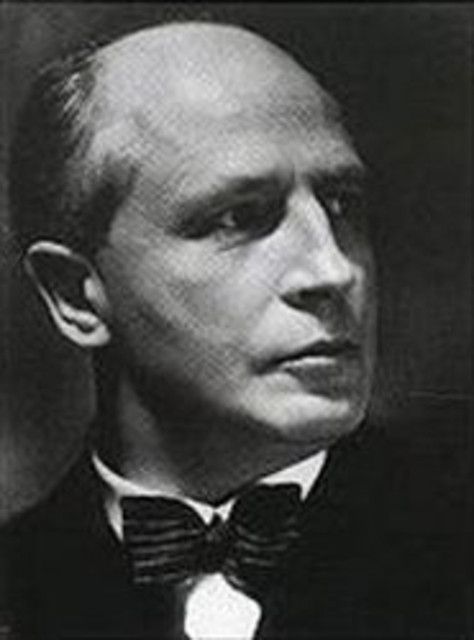
Schuricht's Paris Beethoven Symphony Cycle
New series starts today: Symphonies 1 & 6
|
|
Oh, to be damned by faint praise! Carl Schuricht's Paris Beethoven cycle of the late 1950s didn't get the initial critical reception he might have hoped for...
"At their best these performances are brisk and efficient, at their worst brusque and perfunctory. Schuricht’s no-nonsense approach to the music is welcome in some ways, for it avoids the lingering Wagnerian solemnity that some conductors inflict on the slow introductions to each of these symphonies; nor are the slow movements themselves ever allowed to bog down. This is to the good, of course, yet Schuricht’s efficiency does seem to go in hand with a certain insensitivity to detail...
...I must say that this record represents good value for money, as long as you are not out for the very best. The recording may be a little on the shallow side, but it is perfectly clear. Moreover, by eschewing scrolls H.M.V. have been able to get both symphonies on to a single disc, including the repeat of the first movement’s exposition in each of them. For anyone who regrets, as I do, the practice of omitting these repeats, this is quite a point in the record’s favour."
- The Gramophone, March 1960 (LP issue of Symphonies 1 & 4)
I've missed out - deliberately - the bit where the reviewer chips in with everything he feels is wrong in the approach of Schuricht and his French orchestra to Beethoven - it's a response that's taken its toll on this fascinating interpretation of the complete Beethoven symphonies, one which dared to be a little different to the prevailing approach of the time.
I've quoted in the sleevenotes from a 2013 MusicWeb International review which notes the ease with which earlier reviewers dismissed the series as a "strange aberration", but concludes: "The time has now come to take it seriously. Heaven forbid that any critic should recommend a “best version” of such multifarious works, or even a “best version” of each single symphony. We can try to distinguish between the ones that count and those that don’t. This cycle counts. It explores avenues of Beethoven interpretation, areas of Beethovenian truth, not touched upon elsewhere." [my italics]
Earlier in that same review the following observations also seem worth highlighting:
"Schuricht’s Beethoven cycle was recorded in Paris in mono only – except for no.9 – at a time when EMI was beginning to record in stereo as a matter of course in London, Berlin and Vienna. It was issued, in the UK at any rate, on HMV’s bargain Concert Classics label – XLP numbers. As can be seen above, it got a pretty dusty reception in high quarters and, as John Holmes points out, for many British listeners French orchestras just didn’t sound like Beethoven orchestras. The “bleating” or “braying” horns were the prime culprits, but the vibrato favoured by French woodwind and brass players in general tended to be seen as a case of continental bad manners. I recall that the 9th was available on Classics for Pleasure in my younger days, but critical opinion remained hostile. It disappeared when CFP put out the complete Berlin PO/Cluytens cycle. This, too, had made little impact when it was new – a famous “Pastoral” apart – but achieved cult status in the 1970s.
More recently, punters have been suggesting Schuricht deserves another look. Benjamin-Gunnar Cohrs, quoted above, actually claims virtue for the typically French sound. As the writer of the booklet essay he may be suspected of playing the devil’s advocate. He nevertheless presents a well-argued piece of writing and I personally believe he means what he says. [The quote is this: "Adding to that was the unique timbre of the instruments: the French-style woodwind and brass, still handcrafted at that time, produced an individual and, above all, multi-coloured sound…. Especially in Beethoven with the French instruments, Schuricht was able to achieve a degree of colour, transparency and balanced sound that … was hardly available to him elsewhere."] Elsewhere it has been remarked that this cycle is the only one to preserve the sound of the leading French orchestra in a complete Beethoven cycle back in the days when French orchestras had a tangy sound that was all their own."
As has been noted the recordings were, curiously, all made in mono, with the exception of the Ninth - which was released in mono in late 1959 despite a stereo recording having been made, something which appeared to have been missed by EMI in the late 1980s CD reissue, and which has apparently only relatively recently been addressed (in a EMI/Warner Classics set that's now apparently out of print).
Not only were the recordings made in mono at a time when everyone was going stereo, but they also seem strangely light of bass. Might this have been a strategy to fit more music onto cheaper vinyl records, rather than an unusual feature of French double basses? The issue of expense comes up over and over in the British reviews - the Fifth and Ninth Symphonies were coupled on a two-LP set by HMV in the UK, and at what was then a bargain price. But that meant about 100 minutes of music needed to fit on a format which would rather be kept to less than 80 minutes over four sides - i.e. no more than 20 minutes per side for optimal sound - unless of course they were to reduce the bass levels a little, which would allow for narrower, closer grooves to be cut and more music to be squeezed onto each side. This is, of course, pure speculation on my part.
These new Pristine XR remasters, of course, need not be concerned about the potential width of vinyl grooves, nor their spacing. I can restore any missing bass, and can give the orchestra some Ambient Stereo space to spread its collective elbows a little. And I feel that's all to the benefit of both the listener and the performers.
Will you like the results? I do hope so, at least as far as sound quality is concerned! With regard to the performances? Well that's a matter of personal taste, of course, and I'll return to our expert MusicWeb critic from 2013, Christopher Howell, who stated:
"My immediate impression was that I had never heard Beethoven conducted in quite this way. That is not the same as saying I had never heard Beethoven played this way. By certain string quartets, for example. I was reminded of Serkin playing the piano sonatas, even more, perhaps, of late Backhaus. The first symphony immediately created an impression of gut conviction and great vitality. As with late Backhaus, technical perfection is not an essential, phrasing can be a bit rough and breathless, but you get a sense of contact with the music that you more often get from hands-on performers than from conductors whose vision has to be realised by others: namely the orchestra. This generally translates into brisk, spinning tempi that are not driven, or goaded onward, by a conductor with a whip, but have a vitality that seems to arise from the music. In the second movement of this same symphony there is a warm songfulness rather than an attempt to wrest a prayer for humanity from every phrase. It is here, too, that the French woodwind are at their most piquant.
I must record a curious sensation over this. While it is true that the Historically Informed brigade would run a mile from such vibrato, modern performances on period-style instruments have rediscovered a factor which was still available in Paris in the 1950s. Each instrument has its own personality, makes its own contribution to the argument, instead of being blended so that the wind band might as well be a harmonium. With the wind forwardly balanced into the bargain, these performances contain elements that were scarcely heard again until the HIP movement got going two decades later."
And now perhaps it's time to hear it for yourself. I've chosen the final movement of the Pastoral Symphony as our sample online and on our YouTube channel. I do hope you enjoy it!
The complete symphony series will be released over five single-CD volumes between now and December, giving you plenty of time to digest each instalment before the next arrives. Bon appétit!
Andrew Rose
|
|
In case you missed them: 6 most recent releases |
|
All still available as limited-edition Digipack CD sets
(+ all download formats & slip-enveloped, unboxed CDs)
|
|
TCHAIKOVSKY Symphony No. 2
'Little Russian'
STRAVINSKY Le Chant du rossignol
SCHUMANN Symphony No. 4
Studio recordings, 1941-46
Total duration: 74:10
Cincinnati Symphony Orchestra
conducted by Eugene Goossens
|
|
|
GOOSSENS Cincinnati Symphony, Vol. 2: Tchaikovsky, Stravinsky, Schumann (1941-46)
|
|
|
|
WAGNER A Faust Overture
WAGNER Lohengrin - Prelude to Act 1
WAGNER Lohengrin - Prelude to Act 3
WAGNER Tannhäuser - Overture
WAGNER Tristan und Isolde - Prelude and Liebestod
WAGNER Parsifal - Prelude
WAGNER-TOSCANINI Götterdämmerung - Dawn & Siegfried's Rhine Journey
WAGNER Die Walküre - Ride of the Valkyries
WAGNER-TOSCANINI Parsifal - An Orchestral Synthesis
Live broadcast recordings, 1938 & 1940
Total duration: 2hr 27:22
NBC Symphony Orchestra
conducted by Arturo Toscanini
|
|
|
TOSCANINI The 1938 Wagner Special & 1940 Parsifal Synthesis (1938/40)
|
|
|
|
BEETHOVEN Piano Sonata No. 31
CHOPIN Piano Sonata No. 2
SCHUBERT Impromptu No. 3
DEBUSSY Six Preludes
Live digital recordings, 1989-1992
Total duration: 78:59
Fou Ts'ong, piano
|
|
|
FOU TS'ONG Beethoven, Chopin, Schubert, Debussy (1989-92)
|
|
|
|
BLOCH String Quartet No. 1
BLOCH String Quartet No. 2
BLOCH String Quartet No. 3
BLOCH String Quartet No. 4
Studio recordings, 1954
Total duration: 2hr 26:44
Griller String Quartet
|
|
|
GRILLER QUARTET Bloch String Quartets (1954)
|
|
|
|
TCHAIKOVSKY
Nutcracker Suite
Symphony No. 5
Symphony No. 6 'Pathétique'
RIMSKY-KORSAKOV
Church Scene from Christmas Eve
Russian Easter Overture
Studio and live recordings, 1936-1945
Total duration: 2hr 1:35
The Philadelphia Orchestra
conducted by Eugene Ormandy
|
|
|
ORMANDY and The Philadelphia Orchestra - The Early Years ∙ Volume 4 (1936-45)
|
|
|
|
TIPPETT King Priam
Live world première performance, 1962
Total duration: 2hr 22:56
Priam - Forbes Robinson
Hecuba - Marie Collier
Hector - Victor Godfrey
Andromache - Josephine Veasey
Paris - John Dobson
Covent Garden Opera Chorus & Orchestra
conducted by John Pritchard
|
|
|
TIPPETT King Priam - World Première (Pritchard, 1962)
|
|
|
|
Pristine Streaming - the app |
|
Android
You can now install Pristine Streaming on your Android phone or tablet, or other Android device direct from the Google Play Store.
If you're already a subscriber simply log in and start listening. If you're new to our streaming service enjoy ten free tracks first to try it out.
You can listen on your device's speakers, on headphones, stream via Bluetooth or Chromecast, in FLAC or MP3 quality, with all our recordings available wherever you are.
You'll find the app by searching for Pristine Classical at the Google store or by clicking here.
iOS
Following failed efforts to get approval for our app from Apple this project is currently on hold. We hope to resurrect it later this year.
Andrew
|
|
Marking Bernard Herrmann's 112th birthday
Save 10% on all our Herrmann this week!
|
|
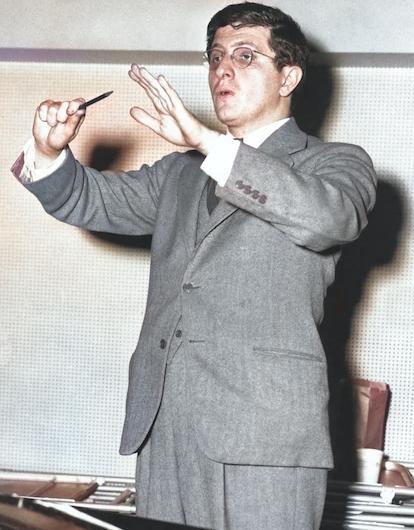
This week, we mark the 112th birthday of Bernard Herrmann.
"Bernard Herrmann (born Maximillian Herman; June 29, 1911 – December 24, 1975) was an American composer and conductor best known for his work in composing for films. As a conductor, he championed the music of lesser-known composers. He is widely regarded as one of the greatest film composers. Alex Ross writes that "Over four decades, he revolutionized movie scoring by abandoning the illustrative musical techniques that dominated Hollywood in the 1930's and imposing his own peculiar harmonic and rhythmic vocabulary."
An Academy Award-winner for The Devil and Daniel Webster (1941), Herrmann is known for his collaborations with Alfred Hitchcock, notably The Man Who Knew Too Much (1956) (where he makes a cameo as the conductor at Royal Albert Hall), Vertigo (1958), North by Northwest (1959), Psycho (1960), The Birds (1963) (as "sound consultant") and Marnie (1964). He worked in radio drama, composing for Orson Welles's The Mercury Theater on the Air, and his first film score was for Welles's film debut, Citizen Kane (1941). His other credits include Jane Eyre (1943), Anna and the King of Siam (1946), The Ghost and Mrs. Muir (1947), The Day the Earth Stood Still (1951), Cape Fear (1962), Fahrenheit 451 (1966) and Twisted Nerve (1968). Herrmann scored films that were inspired by Hitchcock, like François Truffaut's The Bride Wore Black (1968) and Brian De Palma's Sisters (1972) and Obsession (1976). He composed the scores for several fantasy films by Ray Harryhausen, and composed for television, including Have Gun – Will Travel and Rod Serling's The Twilight Zone. His last score, recorded shortly before his death, was for Martin Scorsese's Taxi Driver (1976)." - Wikipedia
We have just 2 releases featuring music written or performed by Herrmann, and for this week there's 10% off each of these recordings. See also a review of one of these discs further down in this newsletter.
The discount is now active and automatic - you'll see a reduction at the checkout on all qualifying CDs and downloads.
Offer runs until next Friday.
Pristine's Herrmann releases:
|
|
|
HERRMANN A Concert of American Music (1949/56)
|
|
|
|
|
HERRMANN A Concert of English Music (1945)
|
|
|
|
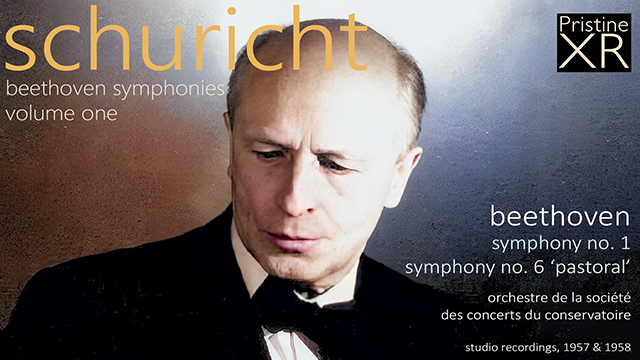
BEETHOVEN Symphony No. 1
BEETHOVEN Symphony No. 6 ' Pastoral'
Studio recordings, 1957 & 1958
Total duration: 63:10
Orchestre de la Société des Concerts du Conservatoire
conducted by Carl Schuricht
|
|
|
SCHURICHT Beethoven Symphonies, Volume One (Paris, 1957/58)
|
|
|
|
Available as a limited-edition Digipack CD release
(+ all download formats & slip-sleeved, unboxed CD)
|
|
Carl Schuricht’s late-fifties Paris Conservatoire Beethoven symphony cycle is perhaps one of the more unusual recordings both of its era and, more generally, of Beethoven cycles. To begin with there is the question of the recordings themselves.
Made in the Salle Wagram in Paris between 1957 and 1959 at a time when just about everyone was embracing the idea of stereo in classical music recordings, the Schuricht series was made and released in defiant mono. Or was it? For many years this appeared to be the case – certainly the vinyl releases at the time were all mono, and often very competitively priced – in the UK at least.
When EMI reissued the complete cycle in the late 1980s, once again the nine symphonies were released in mono. It was not until the 21st century that a stereo recording from this set emerged, in the shape of the Ninth ‘Choral’ Symphony – why this had been overlooked for so many years is hard to understand. Nevertheless the rest of the series remains mono or – in the case of these Pristine XR remasters – with a very pleasing Ambient Stereo ambience.
What was also unusual was the French orchestra, which to some contemporary ears outside of the country sounded all wrong: for some it was the playing style, for others the sound of some rather unique instruments in the brass and woodwind were off-putting. But in the fullness of time opinions have been revised and some have come around to the view that this is a very special Beethoven cycle indeed:
“My immediate impression was that I had never heard Beethoven conducted in quite this way. That is not the same as saying I had never heard Beethoven played this way. By certain string quartets, for example. I was reminded of Serkin playing the piano sonatas, even more, perhaps, of late Backhaus. The first symphony immediately created an impression of gut conviction and great vitality. As with late Backhaus, technical perfection is not an essential, phrasing can be a bit rough and breathless, but you get a sense of contact with the music that you more often get from hands-on performers than from conductors whose vision has to be realised by others: namely the orchestra. This generally translates into brisk, spinning tempi that are not driven, or goaded onward, by a conductor with a whip, but have a vitality that seems to arise from the music. In the second movement of this same symphony there is a warm songfulness rather than an attempt to wrest a prayer for humanity from every phrase. It is here, too, that the French woodwind are at their most piquant.
I must record a curious sensation over this. While it is true that the Historically Informed brigade would run a mile from such vibrato, modern performances on period-style instruments have rediscovered a factor which was still available in Paris in the 1950s. Each instrument has its own personality, makes its own contribution to the argument, instead of being blended so that the wind band might as well be a harmonium. With the wind forwardly balanced into the bargain, these performances contain elements that were scarcely heard again until the HIP movement got going two decades later.
This sense of vital contact with the music crescendos through the first three symphonies. The “Eroica” slow movement is an interesting case. Schuricht starts out at a fairly flowing, but expressive tempo. Most conductors start slower, but have to move forward later. Schuricht holds his tempo, but not in the sense of dogmatically ploughing on regardless. He simply doesn’t seem to find it necessary to make any adjustment, for his tempo fits every part of the movement beautifully. The proof of this is heard as the initial march theme returns after the climax and sails in without the conductor having to put on the brakes. The final disintegration has rarely been so moving – it emerges so inevitably from what came before. In spite of a not very slow initial tempo this is one of the longer versions on record: at 15:40 it is exceeded by Toscanini’s 16:06 in 1939 but is expansive compared with Klemperer’s 14:43 in 1956 – and no, I haven’t got these the wrong way round…
…The time has now come to take it seriously. Heaven forbid that any critic should recommend a “best version” of such multifarious works, or even a “best version” of each single symphony. We can try to distinguish between the ones that count and those that don’t. This cycle counts. It explores avenues of Beethoven interpretation, areas of Beethovenian truth, not touched upon elsewhere.”
- Christopher Howell, MusicWeb International, 2013
Andrew Rose
|
|
HAYDN Symphony No. 100 'Military'
MOZART Symphony No. 35 'Haffner'
MOZART Symphony No. 38 'Prague'
Studio & live recordings, 1956 & 1960
Total duration: 65:25
Orchestre Radio National de France
Orchestre de la Suisse Romande
Vienna Symphony Orchestra
conducted by Jascha Horenstein
|
|
|
HORENSTEIN Haydn & Mozart Symphonies, Vol. 2 (1956/60)
|
|
|
|
Available as a limited-edition Digipack CD release
(+ all download formats & slip-sleeved, unboxed CD)
|
|
The Haydn and Mozart recordings on this disc are representative of Horenstein’s artistry, and deserve a heartfelt recommendation |
|
A new release by Pristine Audio (PA) offers three outstanding renditions of Haydn and Mozart symphonies, conducted by Jascha Horenstein. All of the source material is provided by the conductor’s cousin, Misha Horenstein, who also authors the liner notes for the PA issue. The performance of Haydn’s “Military” Symphony is from a November 22, 1956 broadcast by the Orchestre Radio National de France. Music & Arts (M& A) previously included this performance on two separate Horenstein retrospectives. Alex Ross reviewed M & A’s first release of the Haydn, part of Jascha Horenstein: The Complete Paris Concert of November 22, 1956 (Fanfare 17:4, Mar/Apr 1994). Subsequently, M & A released a nine-disc set, Jascha Horenstein: Broadcast Performances From Paris, that also featured the Haydn 100th. Both Henry Fogel (28:3, Jan/Feb 2005) and William Zagorski (28:5, May/June 2005) reviewed the latter set. The Mozart “Haffner” was part of a November 30, 1960 concert by Horenstein and the Orchestra de la Suisse Romande. The “Prague” is a 1956 commercial recording, made by Horenstein and the Vienna Symphony Orchestra for Vox. I have not come across this “Haffner” before. The “Prague” was reissued by Vox on CD, but as best I can tell has not been reviewed previously in Fanfare.
All of the performances embody the many strengths that made Jascha Horenstein a conductor of distinction. Horenstein, via keen observance of the scores’ dictates, embraces the many contrasts found within the works. He also achieves a marvelous sense of flow and momentum, both within each movement, and across the work as a whole. And his affection for this music is evident in performances brimming with energy and fervor. This is “big band” Haydn and Mozart to be sure, but played with conviction, proportion, and the absence of any mannerisms (typical of the era, Horenstein is selective about observance of score repeats). The Haydn “Military” satisfies on all levels. Horenstein paces the Symphony’s opening as a true Adagio, lyrical, poised, and noble in bearing (a shame, then, that the audience’s frequent coughing attacks intrude). The ensuing Allegro, teeming with energy and sparkle, serves as an ideal foil. The opening of the second movement abounds with grace and elegance, again the perfect setup for the arrival of the “military” instruments, which make all the fuss one could hope for. In the ensuing Minuet, Horenstein observes the Moderato tempo marking, in the context of a robust performance that spotlights the music’s country dance origins. The Finale proceeds at something less than Presto, but still moves at a lively clip. As in the first movement, Horenstein times to perfection Haydn’s moments of silence, the composer’s delicious evocations of musicians searching for what to play next. Once again, the military instruments make a big ruckus to bring the performance to a rousing close, capped by audience applause. The recorded sound suffers a bit from congestion in the big tuttis, but is still more than adequate to enjoy this excellent rendition.
In the July/Aug 2021 Fanfare (44:6), I reviewed a PA release of a January 25, 1968 concert by Horenstein and the Gothenburg Symphony Orchestra. The program included the Mozart “Haffner” Symphony, a work Horenstein never recorded commercially. As I wrote about the Gothenburg rendition, “The ‘Haffner’ receives a full-bodied performance, brimming with energy and high spirits…. [It] benefits from flexible and sensitive phrasing, and a fine delineation of the various musical lines. If the Gothenburg strings don’t embody the final word in tonal opulence or precision of execution, their performance is fine enough to make this a document of importance for Horenstein collectors.” At the time of my review, the Gothenburg “Haffner” seemed to be the only available Horenstein recording of the work. But now comes the November 30, 1960 Suisse Romande Mozart 35th. While movement timings vary between the two performances, they proceed along similar, admirable lines. The Suisse Romande performance is executed with greater precision, but unlike the Gothenburg, the recorded sound is compromised in the higher frequencies. If limited to but one, I’d probably opt for the Suisse Romande performance. But both are worthy and valuable documents of Horenstein’s way with this score.
The 1956 Vox studio recording of the Mozart “Prague” Symphony, beautifully remastered by Andrew Rose, offers by far the best sound on this release. As such, it represents the best opportunity to appreciate Horenstein’s masterful balancing of instrumental voices, and his observance of dynamic gradations. And the Vienna Symphony Orchestra, a fine ensemble, plays beautifully for Horenstein. The conductor mines all the drama of the work’s Adagio introduction. Emphatic attacks, thundering timpani, and menacing woodwind sonorities all forge a connection between the “Prague” Symphony and another Mozart composition from that period, Don Giovanni. If the pacing of the ensuing Allegro is slightly on the measured side, there is more than ample vigor and drive. The Andante never dawdles, but still allows Mozart’s lyricism to shine its brightest. The finale teems with energy and momentum, even if the pacing falls short of a true Presto.
Misha Horenstein’s excellent liner notes offer valuable perspective on the significance of the featured recordings in Jascha Horenstein’s discography. I also admire the willingness of the writer to include some negative critical appraisals of Horenstein’s art, even if I don’t agree with them! Jascha Horenstein was a marvelous conductor who achieved exemplary, heartfelt interpretations, especially in Austrian and German repertoire. The Haydn and Mozart recordings on this disc are representative of Horenstein’s artistry, and deserve a heartfelt recommendation.
Ken Meltzer
|
|
IVES Symphony No. 2
ROBERT RUSSELL BENNETT Violin Concerto
HERRMANN Welles Raises Kane
Recorded in 1956 and 1949
Total duration: 76:44
Louis Kaufman, violin
London Symphony Orchestra
Columbia Broadcasting Symphony Orchestra
conducted by Bernard Herrmann
|
|
|
HERRMANN A Concert of American Music (1949/56)
|
|
|
|
He was an excellent conductor and a true Ivesian; this disc should not be missed by anyone who values the Second Symphony
— which should mean all of us
|
|
In 1909, Ives had a full ink copy of his Second Symphony made; in 1911, he loaned it to conductor Walter Damrosch (1862–1950). Ives twice asked Damrosch for it back, in 1915 and 1935, with no success. Footnote 54 on p. 471 of Jan Swafford’s Charles Ives: A Life with Music: “Ives’s own pre-final drafts of the Second and Third Symphonies survive, which are the versions currently used. Bernard Herrmann told Vivian Perlis he had found the final score of the Second in Damrosch’s papers, but if so he lost it again.”
Herrmann (1911–75) had been a major Ives supporter since 1932, conducting his own arrangement of the fugue from Ives’s Fourth Symphony in 1933 and several times thereafter. It seems improbable, incredible, that he could have “lost” so important, so triumphant a find. By the time of Herrmann’s death, Ives was the center of attention of a raft of American musicologists, and such a score could not have gone unnoticed. In the end, one is forced to question Herrmann’s claim of finding the score—as does Swafford, judging from the sarcastic tone of his footnote. Did Herrmann still have that score in 1956, and did he use it for this BBC radio recording? Oddly enough, I have not seen that question addressed in the Ives literature; perhaps no one believed Herrmann’s story. Although we cannot know what differences existed in the 1909 score, this performance suggests not: It sounds too familiar; yet the wildly dissonant, 11-tone final chord—added by Ives many decades later—is suspiciously consonant here.
Herrmann certainly understood Ives; this performance, although orchestrally a bit vague and occasionally sloppy, fully captures the composer’s nostalgia for the Danbury of his youth. Some of the phrasing is a bit square—the excellent London Symphony was dealing with an unfamiliar score—but a surprising amount of it is right on. What it lacks is the vitality and sparkle of Bernstein’s 1951 radio premiere and of his excellent 1958 stereo recording (Columbia, now Sony) with the New York Philharmonic, which by then had played the symphony 13 times and so knew it well. Herrmann does attack the finale with gusto, but orchestral struggles and a blowsy monaural recording deny us much detail. Still, this CD is a big improvement on the original LP, as Andrew Rose has done his usual superb transfer and production.
For four decades, Robert Russell Bennett (1894–1981) was the leading orchestrator of Broadway musicals—300 of them, from Rose Marie and Show Boat to My Fair Lady and Camelot. His own compositions, in most of the classical forms, are far less known. His 1941 Violin Concerto is bright, happy, extroverted music reminiscent of Broadway, superbly orchestrated. It was written for Louis Kaufman, who, although never a big-name virtuoso, played beautifully and always found the essence of the music at hand. He and this concerto fit each other to a T. The orchestral backing is equally fine and the 1956 mono BBC radio recording is bright and clear, far better than the Ives of four weeks earlier.
Herrmann is best remembered for his scores to Alfred Hitchcock films (Vertigo, Psycho), but he wrote many others, too. The suite Welles Raises Cain is drawn from his music for two Orson Welles films, Citizen Kane and The Magnificent Ambersons. Herrmann’s music always worked well on the screen, and many enjoy it for its own sake. I am part of a small minority that never cottoned to either Welles movie, nor do I find that Herrmann’s music stands up well on its own. He was a heavyweight whose music fit serious dramas and mysteries better than these two merely narrative tales. This suite is too fragmentary to gel into a whole, each piece needing the context of its place in a story. The playing is charming, the 1949 mono recording excellent for its time.
Although Herrmann’s arrogant, demanding personality grated on musicians who played for him, he was an excellent conductor and a true Ivesian; this disc should not be missed by anyone who values the Second Symphony—which should mean all of us.
James H. North
|
|
Andrew Rose | Pristine Classical | www.pristineclassical.com |
|
|
|
|
|
|