|
PSOM Update: Summer 2025
Core Facilities Newsletter
| | The Perelman School of Medicine is proud to support our integral research core facilities and research teams. | | |
In this issue:
- Announcements
- Core Director Meeting Leadership Committee Introduction
- Cores Day Update
- Core Facilities Spotlight
- Electron Microscopy Resource Lab & Beckman Center for Cryo-EM
- OCRC Tumor BioTrust
- PennVet Extracellular Vesicle Core Facility
- Tumor Tissue and Biospecimen Bank
| | |
Announcements: Introducing the Core Director Meeting Leadship Committee
| | |
We are delighted to introduce the Core Director Meeting Steering Committee, a group of experienced leaders from across Penn’s biomedical research core infrastructure. This committee will provide insight and help guide the Core Director community through meetings and instructional workshops throughout the year.
-
Chris Petucci, PhD, Director of the CVI Metabolomics Core and previously served as Core Director Meeting Chair. Dr. Petucci's core provides state-of-the-art mass spectrometry-based analyses to support studies of metabolism in health and disease, offering both targeted and untargeted metabolomics services.
-
Martin Keough, PhD, Director of the Stem Cell Xenograft Core, oversees preclinical in vivo modeling services and supports translational research across cancer and stem cell biology.
-
Tony Secreto, MRA, Associate Director of the Stem Cell Xenograft Core, contributes operational leadership and regulatory expertise to ensure the core’s continued excellence in service delivery.
-
Andrea Stout, PhD, Director of the CDB Microscopy Core, leads the application of advanced imaging technologies and provides extensive technical training and support to researchers.
-
Wenli Yang, PhD, Director of the Induced Pluripotent Stem Cell Core, has over 15 years of experience in human stem cell modeling and genomic editing and plays a key role in expanding access to cutting-edge cellular technologies.
-
Tim O’Brien, PhD, Director of the Neurobehavior Testing Core, manages comprehensive behavioral phenotyping services, supporting research on neurological and psychiatric disease models.
| | |
Announcements: Cores Day Update
| | |
Thank you to all who RSVP'd for Cores Day 2025! A friendly reminder that the event will run in a single shift from 10am-1pm on Thursday, September 11th in the Smilow lobby.
Stay tuned for more details including the event webpage and table partner assignments.
The annual Cores Day event is a joint venture with CHOP, PSOM, Penn Vet, and Wistar, in an effort to showcase the many outstanding biomedical research resources and services available throughout our campus. This event is an opportunity for students, faculty, and staff to interface with a multitude of research core facilities via informational tables staffed by core facility personnel.
| | |
The Electron Microscopy Resource Lab (EMRL) and Beckman Center for Cryo-EM at the University of Pennsylvania work hand in hand to provide state-of-the-art electron microscopy services to support high-impact research in structural biology, neuroscience, immunology, and materials science. The facilities offers access to advanced imaging technologies, including Transmission Electron Microscopy (TEM), Scanning Electron Microscopy (SEM), and Cryo-Electron Microscopy (Cryo-EM and Cryo-ET).
Our services support high-resolution imaging of cellular and molecular structures, expert sample preparation (including cryo-fixation, high-pressure freezing, and ultramicrotomy), and comprehensive image analysis. We also offer new user training to ensure safe and effective use of instrumentation. Please contact our team to schedule.
| | |
Our Available Services Include:
🔬 Cryo-Electron Microscopy (Cryo-EM & Cryo-ET)
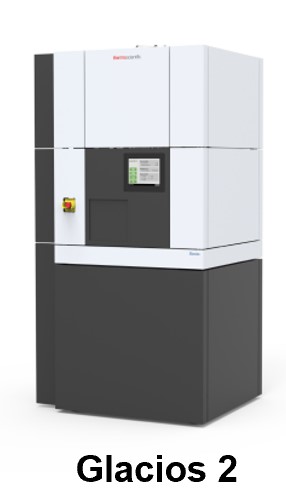
Single particle analysis and tomography on Krios G3i & Glacios 2
New! Glacios 2 Cryo-TEM is now available for use.
Hands-on training provided at all steps!
For access and training, contact: cryo-em@lists.upenn.edu
| | |
🔬 Transmission Electron Microscopy (TEM)
Cellular ultrastructure and thin-section imaging
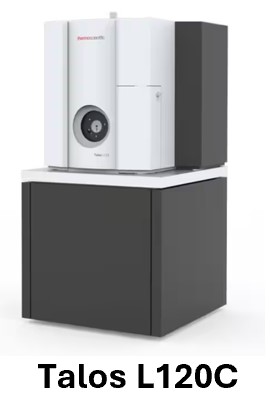
New! Talos L120C TEM for high-resolution data acquisition
For access and training, contact: ULTRA_SERV@lists.upenn.edu
🔬 Other Services
Negative staining
Ultramicrotomy
High-pressure freezing and freeze substitution
Image analysis and technical consultation
| |
Here are some of the latest publications supported by EMRL services:
Molecular basis of influenza ribonucleoprotein complex assembly and processive RNA synthesis, Science, May 2025
Peng R, Xu X, Nepal B, Gong Y, Li F, Ferretti MB, Zhou M, Lynch KW, Burslem GM, Kortagere S, Marmorstein R., Chang YW
PMID: 40373132 DOI: 10.1126/science.adq75
Snapshots of acyl carrier protein shuttling in human fatty acid synthase, Nature, May 2025
Schultz K, Costa-Pinheiro P, Gardner L, Pinheiro LV, Ramirez-Solis J, Gardner SM, Wellen KE, Marmorstein R.
PMID: 39979457 DOI: 10.1038/s41586-025-08587-x
Structural insights into TRPV2 modulation by probenecid, Nature Structural & Molecular Biology, Feb 2025
Rocereta JA, Sturhahn T, Pumroy RA, Fricke TC, Herzog C, Leffler A, Moiseenkova-Bell V.
PMID: 39972168 DOI: 10.1038/s41594-025-01494-9
Structural-functional characterization of the MIRO1-TRAK1 complex
Ravitch EE, Baltrusaitis EE, Perez TA, Barrie KR, Fenton AR, Holzbaur EL,
Dominguez R.
PMID: 40615373 DOI: 10.1038/s41467-025-61174-6
Contact Us
Electron Microscopy Resource Lab
B39 | Anatomy Chemistry Building
3620 Hamilton Walk, Philadelphia, PA 19104
Beckman Center for Cryo-Electron Microscopy
G011 | Singh Center
3205 Walnut St. Philadelphia, PA 19104
| | |
The Ovarian Cancer Research Center Tumor BioTrust Collection collects fresh cancer tissue specimens, as well as plasma, serum, peripheral blood mononuclear cells (PBMC), blood and other biological samples from various cancer cases with a focus on gynecologic cancers. We also house formalin fixed paraffin embedded (FFPE) samples including tissue microarray (TMA) construction and immunohistochemistry. Samples collected through the Penn Legacy Tissue Program (PLTP) (e.g., rapid autopsy) are also available and a quote can be provided upon request.
We would love to work with investigators to prospectively collect specific samples to support their research within the Penn research community as well as outside academic institutions. We will be working with biotech/bio-pharma companies if it is within the confines of a collaboration.
| | |
We are offering the following sample types:
- Fresh Tumor Tissue
- Fresh Ascites Fluid
- Frozen Tumor Tissue
- Enzyme Digested Tumor Cells
- Serum & Plasma
- Peripheral Blood Mononuclear Cells (PBMC)
- OCT
- Formalin Fixed Paraffin Embedded (FFPE)
- Tissue Microarray (TMA)
- Samples from rapid autopsies through our Penn Legacy Tissue Program (PLTP)
More info about the core and pricing can be found at: https://www.med.upenn.edu/OCRCBioTrust/
| |
Representative Publications:
Early Detection of Ovarian Cancer Using Cell-Free DNA Fragmentomes and Protein Biomarkers
Jamie E Medina, Akshaya V Annapragada, Pien Lof , Sarah Short, Adrianna L Bartolomucci, Dimitrios Mathios, Shashikant Koul, Noushin Niknafs, Michaël Noë, Zachariah H Foda, Daniel C Bruhm, Carolyn Hruban, Nicholas A Vulpescu, Euihye Jung, Renu Dua, Jenna V Canzoniero, Stephen Cristiano, Vilmos Adleff, Heather Symecko, Daan van den Broek, Lori J Sokoll, Stephen B Baylin, Michael F Press, Dennis J Slamon, Gottfried E Konecny, Christina Therkildsen, Beatriz Carvalho, Gerrit A Meijer, Claus Lindbjerg Andersen, Susan M Domchek, Ronny Drapkin, Robert B Scharpf, Jillian Phallen, Christine A R Lok, Victor E Velculescu
PMID: 39345137 PMCID: PMC11726017 DOI: 10.1158/2159-8290.CD-24-0393
Early Detection of Ovarian Cancer Using Cell-Free DNA Fragmentomes and Protein Biomarkers - PMC
CHK1 inhibitor SRA737 is active in PARP inhibitor resistant and CCNE1 amplified ovarian cancer
Haineng Xu, Sarah B Gitto, Gwo-Yaw Ho, Sergey Medvedev, Kristy Shield-Artin, Hyoung Kim, Sally Beard, Yasuto Kinose, Xiaolei Wang, Holly E Barker, Gayanie Ratnayake, Wei-Ting Hwang; Australian Ovarian Cancer Study; Ryan J Hansen, Bryan Strouse, Snezana Milutinovic, Christian Hassig, Matthew J Wakefield, Cassandra J Vandenberg, Clare L Scott, Fiona Simpkins
CD137+ tumor infiltrating lymphocytes predicts ovarian cancer survival.
Elizabeth A Tubridy, Monika A Eiva, Fang Liu, Dalia K Omran, Stefan Gysler, Erica G Brown, Allison G Roy, Yuyan Zeng, Jinhee Oh, Quy Cao, Sarah B Gitto, Daniel J Powell Jr PMID: 38290413 DOI: 10.1016/j.ygyno.2024.01.029
CHK1 inhibitor SRA737 is active in PARP inhibitor resistant and CCNE1 amplified ovarian cancer.
Haineng Xu, Sarah B Gitto, Gwo-Yaw Ho, Sergey Medvedev, Kristy Shield-Artin, Hyoung Kim, Sally Beard, Yasuto Kinose, Xiaolei Wang, Holly E Barker, Gayanie Ratnayake, Wei-Ting Hwang, Australian Ovarian Cancer Study; Ryan J Hansen, Bryan Strouse, Snezana Milutinovic, Christian Hassig, Matthew J Wakefield, Cassandra J Vandenberg, Clare L Scott, Fiona Simpkins. PMID: 39021796 PMCID: PMC11253285 DOI: 10.1016/j.isci.2024.109978
Performance of computational algorithms to deconvolve heterogeneous bulk ovarian tumor tissue depends on experimental factors.
Hippen, A.A., Omran, D.K., Weber, L.M. et al. Performance of computational algorithms to deconvolve heterogeneous bulk ovarian tumor tissue depends on experimental factors. Genome Biol 24, 239 (2023). https://doi.org/10.1186/s13059-023-03077-7
Functional neuronal circuits promote disease progression in cancer.
Restaino AC, Walz A, Vermeer SJ, Barr J, Kovács A, Fettig RR, Vermeer DW, Reavis H, Williamson CS, Lucido CT, Eichwald T, Omran DK, Jung E, Schwartz LE, Bell M, Muirhead DM, Hooper JE, Spanos WC, Drapkin R, Talbot S, Vermeer PD.
Science Advances 2023 May 10;9(19):eade4443. doi: 10.1126/sciadv.ade4443.
Ultrasensitive detection of circulating LINE-1 ORF1p as a specific multi-cancer biomarker.
Taylor MS, Connie W, Fridy PC, Zhang SJ, Senussi Y, Wolters JC, Cheng WC, Heaps J, Miller BD, Mori K, Cohen L, Jiang H, Molloy KR, Norden BL, Chait BT, Goggins M, Bhan I, Franses JW, Yang X, Taplin ME, Wang X, Christiani DC, Johnson BE, Meyerson M, Uppaluri R, Egloff AM, Denault EN, Spring LM, Wang TL, Shih IM, Jung E, Arora KS, Zukerberg LR, Yilmaz OH, Chi G, Matulonis UA, Song Y, Nieman L, Parikh AR, Strickland M, Corcoran RB, Mustelin T, Eng G, Yilmaz ÃH, Skates SJ, Rueda BR, Drapkin R, Klempner SJ, Deshpande V, Ting DT, Rout MP, LaCava J, Walt DR, Burns KH.
BioRxiv 2023 Mar 17:2023.01.25.525462. doi: 10.1101/2023.01.25.525462. Preprint
Folate Receptor Beta as a Direct and Indirect Target for Antibody-Based Cancer Immunotherapy
Allison G. Roy, J. Michael Robinson, Prannda Sharma, Alba Rodriguez-Garcia, Mathilde A. Poussin, Cheryl Nickerson-Nutter, and Daniel J. Powell, Jr.
https://pubmed.ncbi.nlm.nih.gov/34070369
Intra-Tumoral Nerve-Tracing in a Novel Syngeneic Model of High-Grade Serous Ovarian Carcinoma.
Barr JL, Kruse A, Restaino AC, Tulina N, Stuckelberger S, Vermeer SJ, Williamson CS, Vermeer DW, Madeo M, Stamp J, Bell M, Morgan M, Yoon J-Y, Mitchell MA, Budina A, Omran DK, Schwartz LE, Drapkin R, Vermeer PD. Cells. 2021; 10(12):3491.
https://doi.org/10.3390/cells10123491
Systematic analysis of CD39, CD103, CD137, and PD-1 as biomarkers for naturally occurring tumor antigen-specific TILs.
Eiva MA, Omran DK, Chacon JA, Powell DJ Jr.
Eur J Immunol. 2021 Sep 10. doi: 10.1002/eji.202149329. Epub ahead of print.
https://pubmed.ncbi.nlm.nih.gov/34505280/
| |
Contact Us
Ovarian Cancer Research Center Tumor BioTrust Collection
Ehay Jung, Technical Director
Smilow CTR 08-191A
3400 Civic Center Blvd
Philadelphia, PA 19104
Phone: 215-746-5137
| | |
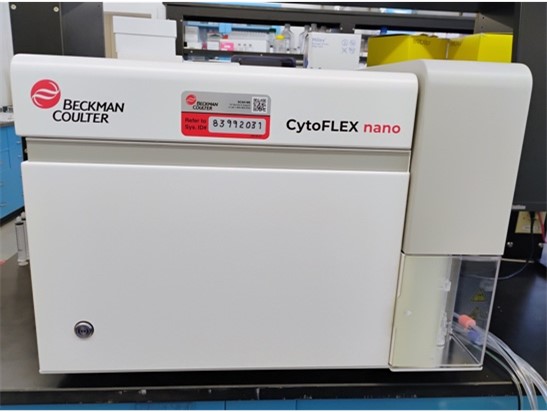
CytoFLEX nano
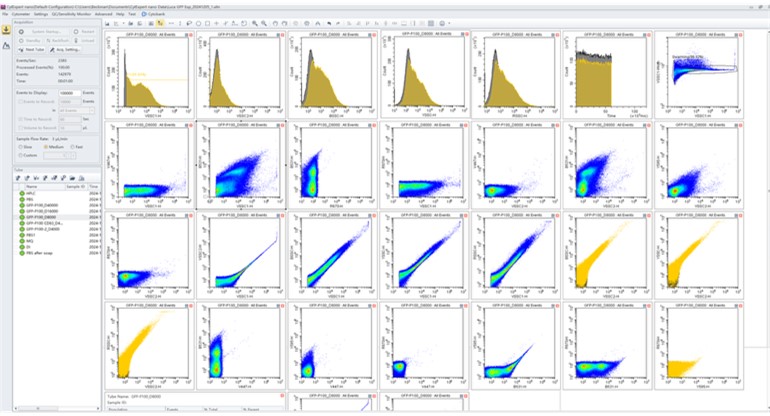
The CytoFLEX nano is a cutting-edge flow cytometer that combines the principles of flow cytometry applied to the study of nano particles. It enables the analysis of particles at the nanoscale (less than 1 mm), providing valuable information about their size, composition, and surface properties. The CytoFLEX nano Flow Cytometer is equipped with 4 lasers (Violet 405 nm, Blue 488 nm, Yellow 561 nm and Red 638 nm) and 2 Wavelength Division Multiplexers (WDMs), one for scatter optical filters (VioletSSC1, VioletSSC2, BlueSSC, YellowSSC and RedSSC) and one for fluorescence optical filters (V447, B531, Y595, R670, R710, R792)
The CytoFLEX nano Flow Cytometer offers:
1. High sensitivity to detect and characterize nanoparticles at least as small as 40 nm (based on polystyrene beads).
2. High resolution to accurately distinguish particles of similar size within 10 nm difference (based on silica beads), and ability to characterize low-abundance targets in a heterogeneous population.
3. Consistency in instrument performance and data analysis, thanks to a very detailed QC process and fluorescence Sensitivity Monitor, as well as multiple options for automated on-board cleaning to prevent carry-over between samples.
4. High flexibility to design experiments, thanks to 5 side scatter parameters and 6 fluorescence channels. It enables the detection up to 11 independent parameters at the same time on the same sample.
| | |
Expansion of Tumor Tissue and Biospecimen Bank (TTAB) Tissue Collection Services at Penn Presbyterian Medical Center (PPMC)
The Tumor Tissue and Biospecimen Bank (TTAB) [RRID:SCR_022430], aka Abramson Cancer Center Biorepository (ABR) sub core, is dedicated to advancing the mission of the Perelman School of Medicine (PSOM) by facilitating access to high-quality, well-documented human-derived samples for basic, clinical, and translational research. Established in 2005 with a shared vision of Department of Pathology and Laboratory Medicine and the Abramson Cancer Center, TTAB has significantly contributed to numerous clinical trials, cancer research, and disease-specific initiatives within PSOM, the Abramson Cancer Center (ACC), Penn Medicine Biobank (PMBB), and external partners. In addition, TTAB extends its services to preclinical researchers at PSOM and the University of Pennsylvania, offering de-identified human tissues as well as clinical and pathologic data to support their research.
We offer customized support for research projects, including initial consultation services for project planning and budgeting, IRB proposals, tailored tissue collection kits, and logistical support for sample tracking, collection, storage, and distribution to principal investigators and their collaborators, both within and outside of Penn.
Our tissue collection and storage facilities are designed to ensure the integrity and quality of each specimen, with systems in place for adequate tracking of warm and cold ischemia times, continuous freezer monitoring, robust backup systems, and comprehensive disaster recovery plans.
We are excited to announce that TTAB has expanded its tissue collection services at the Penn Presbyterian Medical Center (PPMC). This development is a key milestone in our commitment to providing you with access to a broader and more diverse range of tissue samples, critical for the success of your research.
What This Means for Your Research:
- Broader Access: This expansion grants you access to an increased variety of tissue types and pathologies, broadening the diversity and reach of your research.
- Efficient Collection Process: In close collaboration with the PPMC Pathology Department and PMBB, we have ensured that the collection process is streamlined, ethical, and fully compliant with all regulatory standards, guaranteeing you access to the highest quality specimens.
- New Collaborative Possibilities: The expansion fosters new opportunities for multidisciplinary collaborations and research initiatives with clinicians and researchers at PPMC.
We facilitate collection, storage, and distribution of a variety of biospecimens, including paired tumor and normal tissue, blood, plasma, urine, saliva, etc. as required by a research protocol:
Fresh Tissues: Collected and transported in appropriate media and conditions
Frozen Tissues: Snap-frozen and OCT-embedded frozen tissues
Formalin-Fixed Paraffin-Embedded (FFPE) tissues
Blood Components: Including whole blood, plasma, serum, buffy coat.
Hematoxylin & Eosin stained and unstained tissue sections/ scrolls: for ancillary IHC and molecular tests in collaboration with Pathology Test Development Service Center (TDSC)
Pathology review by a Board-certified pathologist
Clinical and pathologic data support
Links and Resources:
TTAB Website
Getting Started with Collections at PPMC:
To begin utilizing tissue collection services at PPMC, please contact us:
| | |
Federico Valdivieso
Technical Director & Operations Manager
Tumor Tissue and Biospecimen Bank (TTAB)
Perelman School of Medicine
University of Pennsylvania
valdivie@pennmedicine.upenn.edu
Ph: 215-615-4744
| | |
Anupma Nayak, MBBS, MD
Medical Director, Tumor Tissue and Biospecimen Bank (TTAB)
Perelman School of Medicine
University of Pennsylvania
Anupma.nayak@pennmedicine.upenn.edu
Ph: 215-662-4899
| | |
Have you used any core products, services or facilities?
We encourage you to complete a survey to provide us feedback on your experience.
Copyright © 2025 PSOM Biomedical Research Core Facilities, All rights reserved.
| | | | |