PSOM Update: Winter 2026

Core Facilities Newsletter

The Perelman School of Medicine is proud to support our integral research core facilities and research teams.

In this issue:


  • Announcements
  • Upcoming Seminar - Analytical Ultracentrifugation 2026 with Special Content on Advances in Flow Cytometry: March 10, 2026
  • Save-the-Date: Cores Day September 23, 2026
    
  • Highlights from the January Core Director Workshop - Tony Secreto, MRA


  • Core Facilities Spotlight
  • Animal Biosafety Level 3 (ABSL3) Core Facility
  • Clinical Research Collaboration Unit
  • Penn Cytomics & Cell Sorting Shared Resource Laboratory
  • Human Immunology Core Facility
  • OCRC Tumor BioTrust

Announcements: Analytical Ultracentrifugation 2026 with Special Content on Advances in Flow Cytometry: March 10, 2026

Announcements: Save-the-Date: Cores Day September 23, 2026

We are delighted to announce Cores Day 2026! Please mark your calendars for Wednesday, September 23, 2026 from 10am-1pm. 


The event will be held in the Smilow lobby. To accommodate as many interested facilities as possible, core facilities will be sharing tables by default.


The annual Cores Day event is a joint venture with CHOP, PSOM, Penn Vet, and Wistar, in an effort to showcase the many outstanding biomedical research resources and services available throughout our campus. This event is an opportunity for students, faculty, and staff to interface with a multitude of research core facilities via informational tables staffed by core facility personnel.   


Stay tuned for more details, and we hope to see you on Wednesday, September 23!   


Please contact April Weakley (aweakley@pennmedicine.upenn.edu) with questions.

Highlights from the January Core Director Workshop - Tony Secreto, MRA

The goal of the Core Director Meeting Steering Committee, a group of experienced leaders representing Penn’s biomedical research core infrastructure, is to provide insight and guidance to the Core Director community through regularly scheduled meetings and instructional workshops throughout the year.


The institution of of these quarterly meetings has fostered engaged, round-table discussion among all attendees. At the most recent meeting on January 15, 2026, a brief presentation on IPS Core services and core-specific issues transitioned into a broader discussion addressing regulatory considerations, core funding models, animal care challenges, career pathway development for technical and director-level staff, and opportunities for cross-core collaboration. As the conversation expanded from core-specific to institution-wide topics, participants exchanged ideas related to the establishment of fee-for-service rates, the use of salary support from user laboratories, and ways in which PSOM is engaging with industry partners to bring work into Penn’s core facilities.


Following this meeting, Dr. Tim O’Brien (Director, Neurobehavior Testing Core) established and distributed a shared cloud drive to facilitate file sharing across cores. This resource is intended to support the development of novel regulatory pathways, including shared IACUC protocols, EHRS documentation, and related materials. Themes for future meetings and recruitment of volunteer presenters continue to be coordinated via the Core Director group email list. 

Core Facilities Spotlight: Animal Biosafety Level 3 (ABSL3) Core Facility - RRID:SCR_022372

The core facility has now finalized preparations and protocols for the use of High Pathogenic H5N1 Influenza and can now begin collaborations and support experiments with investigators. 


Please contact Technical Director Peter Hewins, MLAS, LARC, at phewins@pennmedicine.upenn.edu for more details.

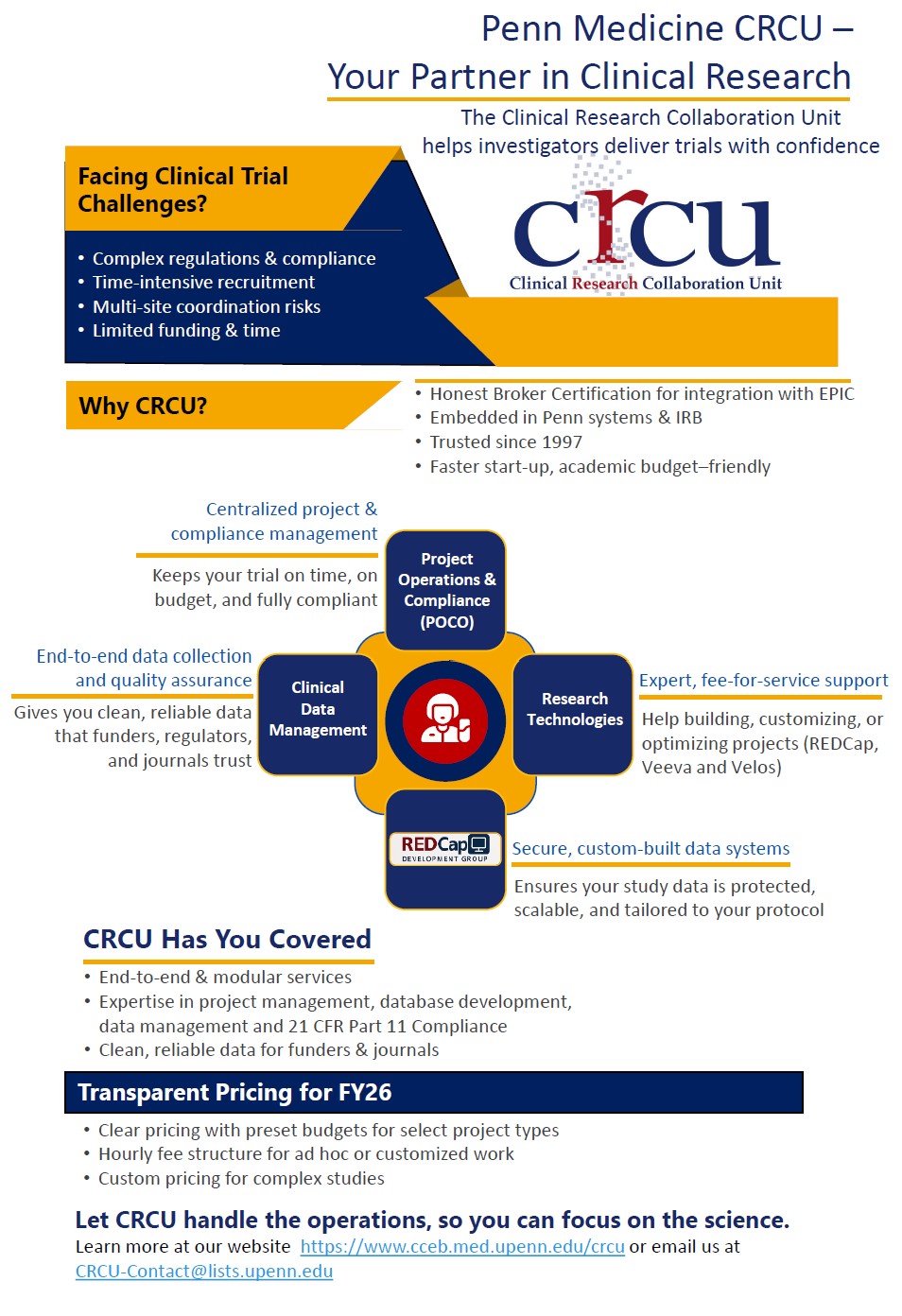
Core Facilities Spotlight: Clinical Research Collaboration Unit - RRID:SCR_022404

Core Facilities Spotlight: Penn Cytomics & Cell Sorting Shared Resource Laboratory - RRID:SCR_022376

Penn Cytomics would like to introduce Megan Fisher, the newest member of the flow cytometry core. Megan has 15 years experience in flow cytometry and immunology, with particular expertise in lymphocyte development and signaling. She received her PhD in Immunology at Penn in 2017 and has spent the last several years at NIH. There she worked in labs focused on allergic disease and on HIV biology, broadening her experience in assays of immune function. She is excited to return to Penn and advise flow core users on a range of questions, including assay and panel development using conventional, spectral, and imaging flow cytometry.

Core Facilities Spotlight: Human Immunology Core Facility - RRID:SCR_022380

Autoimmune and Infectious Disease Antibody Assays in the Human Immunology Core


Fully customizable serology, biomarker and data analysis in the HIC


Did you know that the Human Immunology Core (HIC) performs a variety of antibody and biomarker assays for autoimmune and infectious diseases? The HIC has purchase agreements with vendors allowing us to offer reagents to investigators at a discounted rate. The core offers full-service assays where we meet with you and help you design the experiment, if needed, perform the assay and then we meet with you again to review the data. Antibody detection is performed using antigen-specific immunoassays. Samples are incubated with defined antigens, and bound antibodies are detected using labeled anti-human or anti-mouse immunoglobulins. Quantification is achieved through relative signal intensity or calibrated reference standards, with validated controls and cutoffs to ensure accurate interpretation. We have specialized software and custom scripts for data analysis and visualization and can help you generate figures for your manuscript or grant application. Here are some of our assay platforms, sample assays and data. 


ELISA (enzyme-linked immunosorbent assay). The HIC can perform ELISAs with any commercial kit for anti-viral antibodies such as SARS-CoV2 spike protein, nucleocapsid, RBD etc., or other viral proteins. We can also run homebrew assays with customer or company (e.g., Sino) supplied antigens. Our ELISA reader can detect optical density and fluorescence-based probes. 


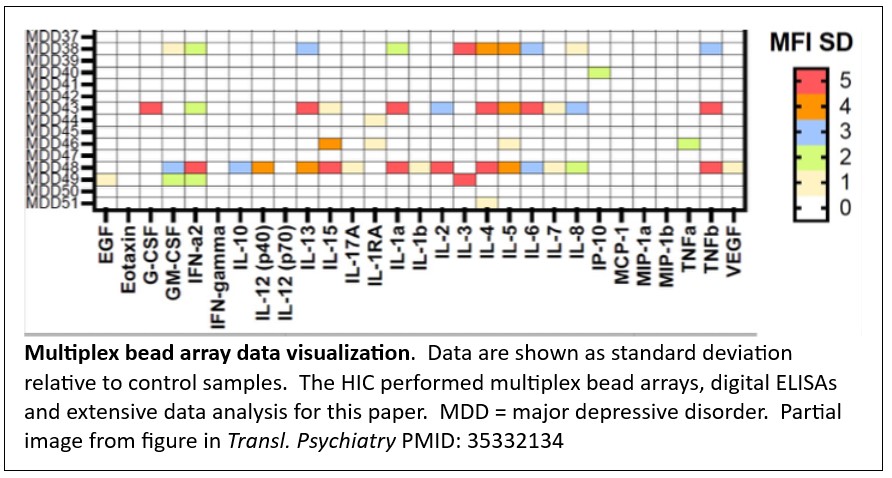
Luminex (multiplex bead array). The HIC has FlexMAP3D instruments, which can be used to analyze dozens of analytes simultaneously in small sample volumes (25-50 microliters per sample). We typically run magnetic bead-based panels (e.g., Millipore), but can work with you on customized assays. Luminex assays can be used for detection of autoantibodies, anti-viral antibodies, cytokines, chemokines and other biomarkers. We are happy to meet with you to help you design a panel of compatible analytes, get quotes for kits and run your assay. We also have specialized software for data visualization and analysis.

Digital ELISA. The HIC has a Quanterix HDX instrument which can detect very low concentrations (down to a single molecule in some cases). These assays are useful for high-sensitivity detection of markers in cerebrospinal fluid, such as cytokines, disease markers (e.g., tau, beta amyloid etc.) and markers of injury including neurofilament light (nFL), glial fibrillary acidic protein (GFAP) and others. We have worked with investigators on diluting samples and testing different sample types including serum, plasma, CSF, cell culture supernatant and tissue lysates. Digital ELISA is also a preferred platform for high-sensitivity HIV detection (p24 assay).


ECL (electrochemiluminescence). In addition to commercially available kits from Meso Scale Discovery, the HIC can adapt existing kits for different sample types and species, as well as develop and perform custom assays. For example, we currently offer custom MSD assays for several autoantibodies including anti-dsDNA, ENA, insulin, BSA, LPS, pro-insulin, zinc transporter 8, IA2, GAD65, DFS70 and SSA.

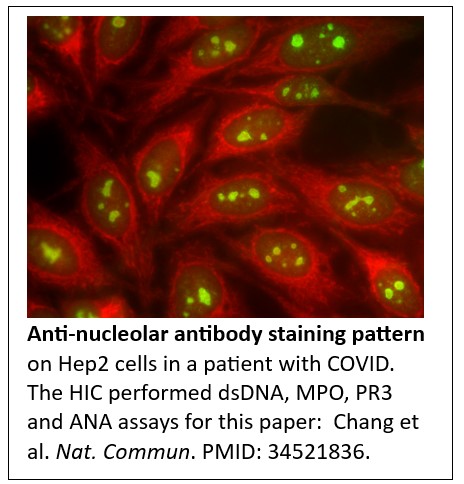
ANA (indirect immunofluorescence assay). The ANA (anti-nuclear antibody) assay is a frequently used screening assay for systemic autoimmune disease. In this assay Hep2 cells are incubated with serum and bound assays are detected with anti-IgG antibodies that are labeled with a fluorophore such as FITC. Antibody binding is detected by microscopy—we use microscopes in the confocal core facility-- and have clinical experts available for pattern interpretation. We can also transfect cell lines with custom antigens and visualize antibody binding.  


Data analysis. The core has developed custom data analysis pipelines for both Luminex and Digital ELISA (Quanterix) data platforms. We recently applied these pipelines to complete three major customer projects, transforming complex datasets into clear, actionable biological insights. Our end-to-end bioinformatics support includes:


  • Rigorous data pre-processing including automated filtering and quality control (QC)
  • Batch correction- normalization techniques to mitigate inter-run variability
  • Data visualization- including fully customizable heat maps and cluster analysis
  • Project-specific statistical modeling

Core Facilities Spotlight: OCRC Tumor BioTrust Collection - RRID:SCR_022387

The Ovarian Cancer Research Center Tumor BioTrust Collection collects fresh cancer tissue specimens, as well as plasma, serum, peripheral blood mononuclear cells (PBMC), blood and other biological samples from various cancer cases with a focus on gynecologic cancers. We also house formalin fixed paraffin embedded (FFPE) samples including tissue microarray (TMA) construction and immunohistochemistry. Samples collected through the Penn Legacy Tissue Program (PLTP) (e.g., rapid autopsy) are also available and a quote can be provided upon request.


We would love to work with investigators to prospectively collect specific samples to support their research within the Penn research community as well as outside academic institutions. We will be working with biotech/bio-pharma companies if it is within the confines of a collaboration.

We are offering the following sample types:


  • Fresh Tumor Tissue
  • Fresh Ascites Fluid
  • Frozen Tumor Tissue
  • Enzyme Digested Tumor Cells
  • Serum & Plasma
  • Peripheral Blood Mononuclear Cells (PBMC)
  • OCT
  • Formalin Fixed Paraffin Embedded (FFPE)
  • Tissue Microarray (TMA)
  • Samples from rapid autopsies through our Penn Legacy Tissue Program (PLTP)


More info about the core and pricing can be found at: https://www.med.upenn.edu/OCRCBioTrust/

Representative Publications:


LINE-1 ORF1p expression occurs in clear cell ovarian carcinoma precursors and is a candidate blood biomarker

Pamela R de Santiago, Sho Sato, Stephanie J Zhang, Meaghan C Dougher, Kyle M Devins, Agnes J Bilecz, Sagar Rayamajhi, Gabriel Mingo, Hannah S Rendulich, Yi Feng, Connie Wu, Martin S Taylor, Yelena Zhuravlev, Euihye Jung, Dalia K Omran, Tian-Li Wang, Ie-Ming Shih, Lauren E Schwartz, Sarah Kim, Mark A Morgan, Janos L Tanyi, Kathleen H Burns, Ernst Lengyel, Carlos Parra-Herran, Andrew K Godwin, David R Walt, Ronny Drapkin. PMID: 40050409 PMCID: PMC11885553 DOI: 10.1038/s41698-025-00849-1


Early Detection of Ovarian Cancer Using Cell-Free DNA Fragmentomes and Protein Biomarkers

Jamie E Medina, Akshaya V Annapragada, Pien Lof , Sarah Short, Adrianna L Bartolomucci, Dimitrios Mathios, Shashikant Koul, Noushin Niknafs, Michaël Noë, Zachariah H Foda, Daniel C Bruhm, Carolyn Hruban, Nicholas A Vulpescu, Euihye Jung, Renu Dua, Jenna V Canzoniero, Stephen Cristiano, Vilmos Adleff, Heather Symecko, Daan van den Broek, Lori J Sokoll, Stephen B Baylin, Michael F Press, Dennis J Slamon, Gottfried E Konecny, Christina Therkildsen, Beatriz Carvalho, Gerrit A Meijer, Claus Lindbjerg Andersen, Susan M Domchek, Ronny Drapkin, Robert B Scharpf, Jillian Phallen, Christine A R Lok, Victor E Velculescu 

PMID: 39345137 PMCID: PMC11726017 DOI: 10.1158/2159-8290.CD-24-0393

Early Detection of Ovarian Cancer Using Cell-Free DNA Fragmentomes and Protein Biomarkers - PMC


CHK1 inhibitor SRA737 is active in PARP inhibitor resistant and CCNE1 amplified ovarian cancer

Haineng Xu, Sarah B Gitto, Gwo-Yaw Ho, Sergey Medvedev, Kristy Shield-Artin, Hyoung Kim, Sally Beard, Yasuto Kinose, Xiaolei Wang, Holly E Barker, Gayanie Ratnayake, Wei-Ting Hwang; Australian Ovarian Cancer Study; Ryan J Hansen, Bryan Strouse, Snezana Milutinovic, Christian Hassig, Matthew J Wakefield, Cassandra J Vandenberg, Clare L Scott, Fiona Simpkins 


CD137+ tumor infiltrating lymphocytes predicts ovarian cancer survival.

Elizabeth A Tubridy, Monika A Eiva, Fang Liu, Dalia K Omran, Stefan Gysler, Erica G Brown, Allison G Roy, Yuyan Zeng, Jinhee Oh, Quy Cao, Sarah B Gitto, Daniel J Powell Jr PMID: 38290413 DOI: 10.1016/j.ygyno.2024.01.029


CHK1 inhibitor SRA737 is active in PARP inhibitor resistant and CCNE1 amplified ovarian cancer.

Haineng Xu, Sarah B Gitto, Gwo-Yaw Ho, Sergey Medvedev, Kristy Shield-Artin, Hyoung Kim, Sally Beard, Yasuto Kinose, Xiaolei Wang, Holly E Barker, Gayanie Ratnayake, Wei-Ting Hwang, Australian Ovarian Cancer Study; Ryan J Hansen, Bryan Strouse, Snezana Milutinovic, Christian Hassig, Matthew J Wakefield, Cassandra J Vandenberg, Clare L Scott, Fiona Simpkins. PMID: 39021796 PMCID: PMC11253285 DOI: 10.1016/j.isci.2024.109978


Performance of computational algorithms to deconvolve heterogeneous bulk ovarian tumor tissue depends on experimental factors.

Hippen, A.A., Omran, D.K., Weber, L.M. et al. Performance of computational algorithms to deconvolve heterogeneous bulk ovarian tumor tissue depends on experimental factors. Genome Biol 24, 239 (2023). https://doi.org/10.1186/s13059-023-03077-7


Functional neuronal circuits promote disease progression in cancer.

Restaino AC, Walz A, Vermeer SJ, Barr J, Kovács A, Fettig RR, Vermeer DW, Reavis H, Williamson CS, Lucido CT, Eichwald T, Omran DK, Jung E, Schwartz LE, Bell M, Muirhead DM, Hooper JE, Spanos WC, Drapkin R, Talbot S, Vermeer PD.

Science Advances 2023 May 10;9(19):eade4443. doi: 10.1126/sciadv.ade4443.


Ultrasensitive detection of circulating LINE-1 ORF1p as a specific multi-cancer biomarker.

Taylor MS, Connie W, Fridy PC, Zhang SJ, Senussi Y, Wolters JC, Cheng WC, Heaps J, Miller BD, Mori K, Cohen L, Jiang H, Molloy KR, Norden BL, Chait BT, Goggins M, Bhan I, Franses JW, Yang X, Taplin ME, Wang X, Christiani DC, Johnson BE, Meyerson M, Uppaluri R, Egloff AM, Denault EN, Spring LM, Wang TL, Shih IM, Jung E, Arora KS, Zukerberg LR, Yilmaz OH, Chi G, Matulonis UA, Song Y, Nieman L, Parikh AR, Strickland M, Corcoran RB, Mustelin T, Eng G, Yilmaz ÃH, Skates SJ, Rueda BR, Drapkin R, Klempner SJ, Deshpande V, Ting DT, Rout MP, LaCava J, Walt DR, Burns KH.

BioRxiv 2023 Mar 17:2023.01.25.525462. doi: 10.1101/2023.01.25.525462. Preprint


Folate Receptor Beta as a Direct and Indirect Target for Antibody-Based Cancer Immunotherapy

Allison G. RoyJ. Michael Robinson, Prannda SharmaAlba Rodriguez-GarciaMathilde A. PoussinCheryl Nickerson-Nutter, and Daniel J. Powell, Jr.

https://pubmed.ncbi.nlm.nih.gov/34070369


Intra-Tumoral Nerve-Tracing in a Novel Syngeneic Model of High-Grade Serous Ovarian Carcinoma.

Barr JL, Kruse A, Restaino AC, Tulina N, Stuckelberger S, Vermeer SJ, Williamson CS, Vermeer DW, Madeo M, Stamp J, Bell M, Morgan M, Yoon J-Y, Mitchell MA, Budina A, Omran DK, Schwartz LE, Drapkin R, Vermeer PD. Cells. 2021; 10(12):3491.

https://doi.org/10.3390/cells10123491

Contact Us

Ovarian Cancer Research Center Tumor BioTrust Collection

Ehay Jung, Technical Director

Smilow CTR 08-191A

3400 Civic Center Blvd

Philadelphia, PA 19104

Phone: 215-746-5137

E-mail: TBCrequests@pennmedicine.upenn.edu

Have you used any core products, services or facilities?

We encourage you to complete a survey to provide us feedback on your experience.


Copyright © 2026 PSOM Biomedical Research Core Facilities, All rights reserved.