|
|
October is "National Work and Family Month," "Emotional Wellness Month," "Depression Education and Awareness Month," and "National Learning and Development Month."
Each topic is, at heart, a focus within psychology, making this a fitting month to spotlight that department. Take a look inside to see how the Department of Psychology is responding to an AI-transformed workplace, a growing need for mental health care, and students seeking new paths into the field. Then, find out how its junior faculty are taking on big research questions that have public impact.
October is also "Right Brainers Rule Month."
Psychology's take: the two hemispheres have their specialties, but the best thinking happens when they cooperate. Celebrate with both.
| | | What Machines Can and Can't Do: I/O Psychology at Baruch in the Age of AI | |
When Professor Charles Scherbaum teaches his executive course in workplace analytics, his students do everything with AI. "That's how they're actually going to do it on the job," he says. "They're not necessarily going to be the analysts who need to understand the nuts and bolts underneath. They need to understand: I've got these big-picture questions from the organization. How do I get them answered? How do I manage a process?"
In his master's and doctoral courses, on the other hand, students still work through the statistical machinery by hand, because those are the tools they will use. That split captures how Baruch's Industrial/Organizational Psychology programs are meeting a moment of rapid change: not with a single mandate, but with faculty experimenting course by course.
A class on personnel selection now has to treat AI-driven hiring tools as a core subject, Scherbaum notes, "because that's key technology development in the field." Assistant Professor Anna Gödöllei's research on workplace automation, for instance, asks how workers adjust and reshape their jobs when routine tasks disappear. "The mantra for so long has been do more with less, and everybody feels overwhelmed," Scherbaum says. "If we can eliminate tasks that have low value or are repetitive, what does that free us up to do?"
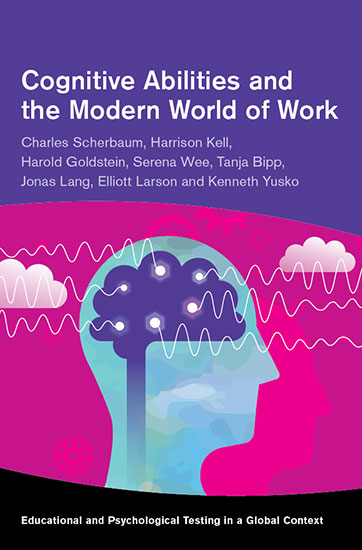
The question runs through his new book, Cognitive Abilities and the Modern World of Work (Cambridge University Press), written with Baruch colleagues Harold Goldstein and Elliott Larson and collaborators in Singapore, Australia, Germany, and the United States. The book surveys how I/O psychology measures intelligence in hiring and argues that the field has leaned too heavily on tests of acquired knowledge, an approach that produces large racial differences in scores and raises questions of fairness.
Scherbaum sees the same debate playing out in AI. "The things that are easily being outsourced and replaced are intelligence as knowledge," he says. What remains uniquely human is the ability to work with others, to reason through novel problems, and to generate solutions no one has proposed before. Those capacities, he adds, are ones the social sciences, humanities, and arts have always specialized in.
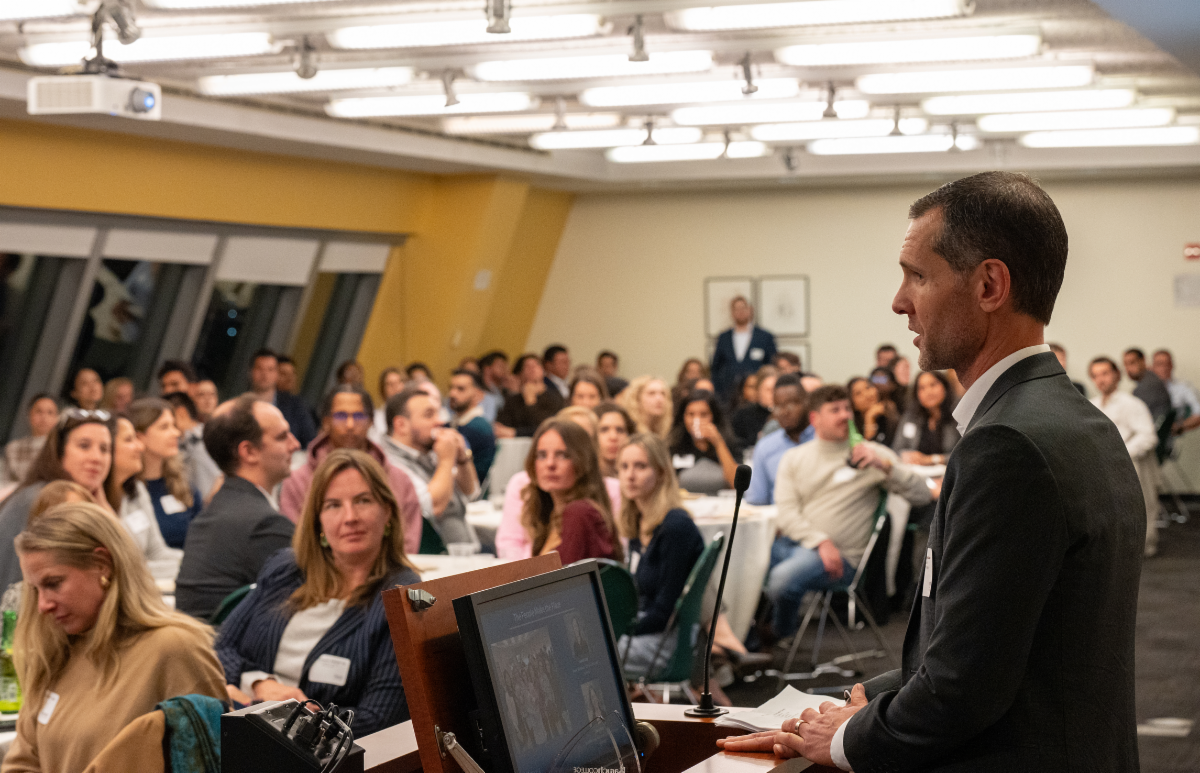
The program teaching those capacities is, in Scherbaum's account, the product of sustained investment. Now in his 23rd year at Baruch, he credits a succession of Weissman deans with treating I/O psychology as an area of excellence, and he credits Goldstein's leadership of the MS in I/O Psychology program with building something "really pretty extraordinary" on limited resources. The program's alumni network is a point of pride: the I/O Alumni Networking Night returns on October 22, and Scherbaum expects a strong Baruch turnout at next year's Society for Industrial and Organizational Psychology conference in National Harbor, Maryland. Last year, Professor Emeritus Joel Lefkowitz, who founded CUNY's I/O doctoral program, received one of the society's major awards for teaching and mentoring; this year Scherbaum himself was named a SIOP Fellow.
"There are amazing things happening at Weissman in terms of what people are doing," Scherbaum says, "and as focused as we are on doing the work, we just don't really get a chance to tell people about it."
| | | | | |
Just Published: Goldstein, Larson, and Scherbaum Detail Cognitive Abilities and the Modern World of Work
Professor Harold Goldstein, Lecturer Elliott Larson, and Professor Charles Scherbaum have published Cognitive Abilities and the Modern World of Work with Cambridge University Press. The book brings together roughly 20 years of research by the three Baruch authors and five collaborators from around the world. The book demonstrates how cognitive ability is measured and used in hiring, training, and workplace decisions.
Read more here.
| | | Room for One More Cohort: Baruch's Mental Health Counseling Program Prepares to Grow | |
Every year, Baruch's Master's in Mental Health Counseling program turns away applicants it would like to admit. The program has always been built around one small cohort that moves through the curriculum together, and director Rose Marie Chatterton has refused to dilute that model to meet demand.
But now, with new resources finally available, beginning in Fall 2027 the program will admit a second cohort.
The 60-credit, New York State–registered program leads to licensure eligibility and satisfies NYS academic requirements for diagnostic privilege. What sets it apart is the teaching. Classes are small and built around group learning, peer feedback, and clinical practice; nearly every clinical course puts students in the counselor's chair. The faculty, full-time and long-serving adjuncts alike, are practicing clinicians or active researchers who "bring into the classroom real-world knowledge and expertise," Chatterton writes.
Field training goes well beyond the state minimum. Students complete a 100-hour practicum in the spring of the first year, then the 600-hour internship New York requires, in settings that range from public schools and community mental health centers to substance-use programs, psychiatric facilities, and private practices. Several each year train through a collaboration with the New York State Office of Mental Health, treating patients with severe mental illness. Graduates, Chatterton says, are "prepared to practice in whatever clinical setting they choose."
The expansion comes as demand for counselors outpaces supply nationwide.
"Our society is currently experiencing a mental health crisis," Chatterton writes. "Our diverse students are well trained to skillfully diagnose and treat clients from a strengths-based approach." A second cohort means more of them, sooner rather than later.
Check out the program here.
| | | Opening Doors: How Psychology Is Widening the Path to Careers
| |
For the Psychology Department, student success starts with access: for working adults finishing degrees they began years ago, for graduates of other fields retraining in psychology, and for undergraduates seeking hands-on experience that makes them career ready. This fall, the department expanded all three.
This semester the department welcomed the inaugural cohorts of two new fully online, asynchronous programs. One is a BA in Psychology for degree completers. The other is a Post-Baccalaureate Training Certificate in Psychology for students who hold bachelor's degrees in other fields. Working with Baruch's Digital Learning Hub, faculty redesigned courses in the clinical and industrial/organizational tracks around best practices in online learning, then built a cohesive sequence that helps returning students regain their academic footing quickly. Co-directors Nahama Broner and Allison Siminovsky lead advising and community-building for both cohorts. Their goal is to extend access without sacrificing rigor or connection.
Next semester, the online post-baccalaureate students will be the first to take Career Pathways (PSY 3000). In this new one-credit course, students complete career inventories, sharpen their CVs, and map the graduate and professional routes open to psychology students. The department plans to eventually offer it to all majors.
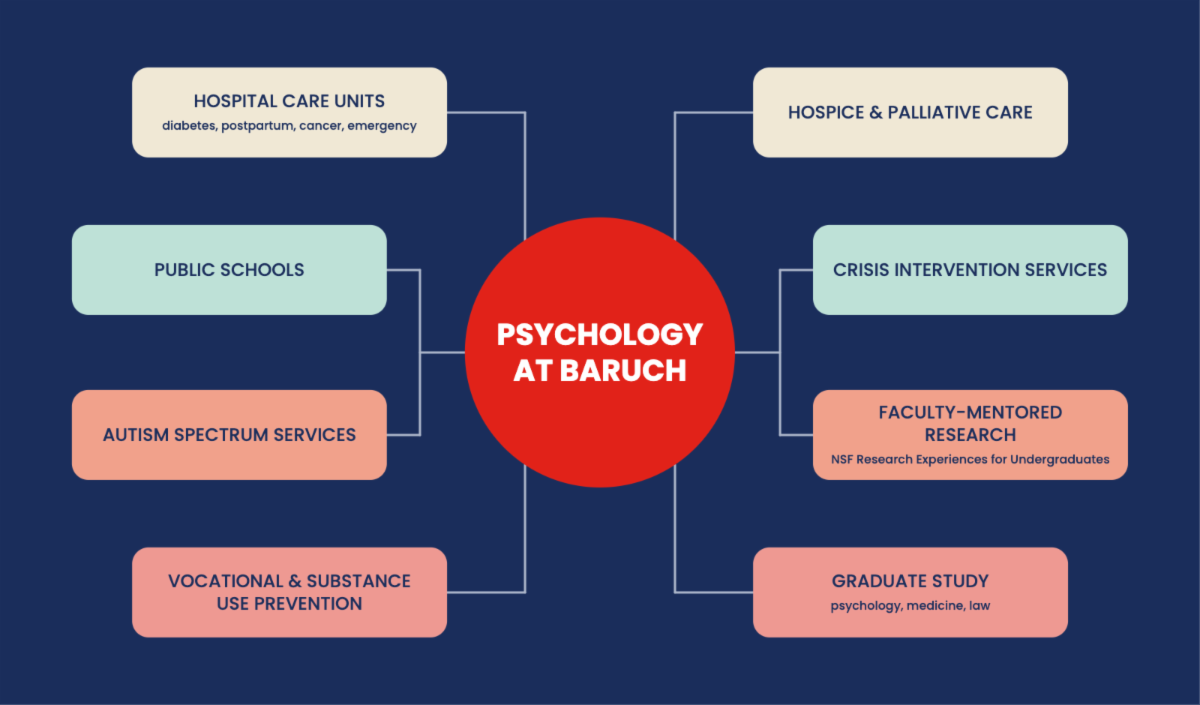
On campus, majors can put classroom learning to work through the newly revitalized Practicum in Community Psychological Services (PSY 4035). This four-credit seminar pairs weekly discussion with a 90-hour community internship. Recent placements include hospital units serving patients in diabetes, postpartum, cancer, and emergency care; public schools; agencies supporting children and adults on the autism spectrum; vocational and substance use prevention programs; hospice and palliative care; and crisis intervention services for survivors of violence. Those placements can open doors: over the last two years, 10 practicum students, about 15%, were hired by their internship sites.
For students drawn to research, the department's NSF-funded Research Experiences for Undergraduates (REU) program, recently renewed with a $377,072 award and now in its 20th consecutive year, places students in year-long, faculty-mentored research and provides stipends so they can dedicate real time to their work. Led by co-PIs Charles Scherbaum, Jaihyun Park, Tatiana Emmanouil, and Patrycja Sleboda, the program has a strong track record: roughly 64% of students who complete it enroll in graduate programs in psychology, medicine, or law.
"In 2021, I joined the REU program as an undergraduate fellow in Dr. Charles Scherbaum's lab without any research experience," says Paisley Shultz, now at the CUNY Graduate Center. "Today, I am a fourth-year doctoral student in industrial-organizational psychology, but I likely would not have even considered pursuing a PhD without the specialized training and mentorship afforded to me by the program and Charles especially."
Read more about the NSF award.
| | |
Seven Scholars, Seven Big Questions: Junior Faculty Research with Public Reach
The Psychology Department's seven pre-tenure faculty are asking questions that matter well beyond the academic world: about work, health, trust, and the choices people make every day. Some of their answers are already changing practice.
Here is a sample of their recent cutting-edge work.
| | | | | |
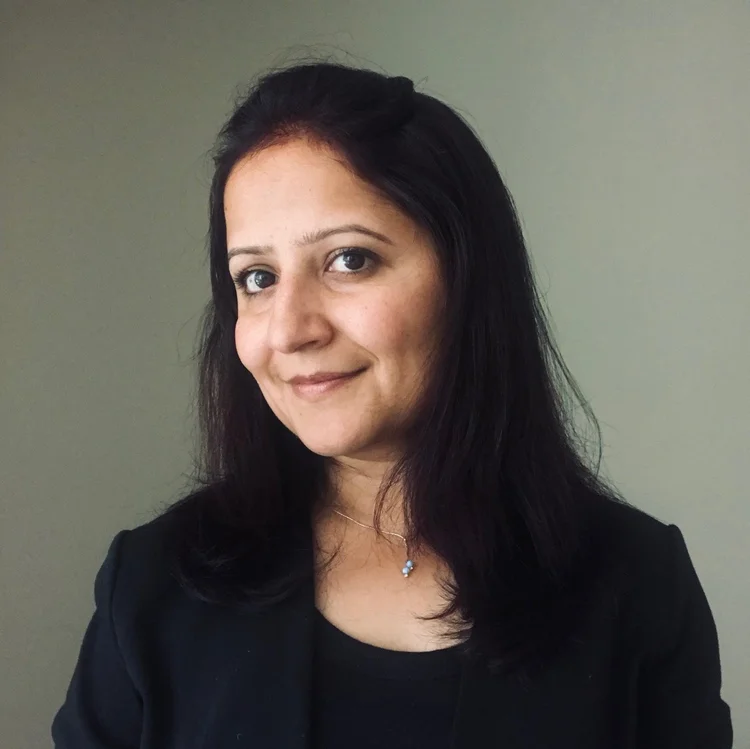
Dia Chatterjee | What keeps new recruits in policing?
Research co-authored by Dia Chatterjee, newly published in Policing: An International Journal, examined how family support and work-family conflict shape recruits' adjustment during intensive police academy training. The findings have already informed changes to academy processes. They show that training policies and institutional support help determine who stays in policing, not just who gets recruited.
https://doi.org/10.1108/PIJPSM-03-2026-0066
Chatterjee has also been invited by the Rockefeller Foundation to join a select group of scholars at its Bellagio Center on Lake Como, Italy, this fall. The convening will focus on developing "leaders of leaders" who cultivate collective intelligence through learning across organizations.
| | | | |
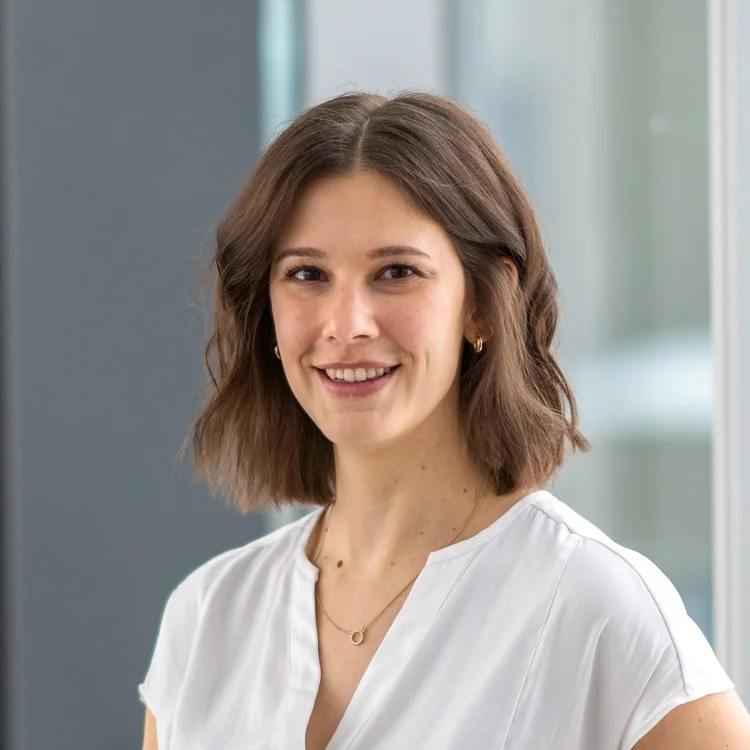
Anna Gödöllei | Can fear of automation make workers grow?
Anna Gödöllei studies when the threat of automation motivates workers rather than paralyzing them. Her newest research, co-authored with REU alum Paisley Shultz (quoted above) and now under review, finds that fear of losing a job to automation can push people to learn new skills, but this is most likely when workers can recognize gaps in their own skills and their employer supports their development.
For background:
https://doi.org/10.1016/j.chbr.2023.100342
| | | | |
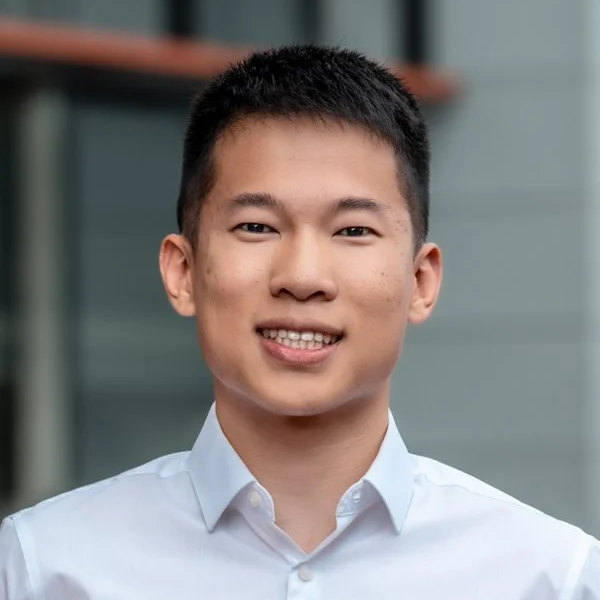
Zhixu (Rick) Yang | What happens when people are seen as machines?
In a new paper in Nature Reviews Psychology, Rick Yang maps the different forms dehumanization can take. He focuses on the "mechanistic" dehumanization of Asian Americans, who are perceived and treated as robotic and machine-like, and on what it means for their experiences at work.
https://doi.org/10.1038/s44159-026-00546-1
| | | | |
Andrea Bazzoli | Does "zero accidents" mean a workplace is safe?
Not necessarily, as Andrea Bazzoli's research shows. He is turning his findings on electrical risk into a free resource that helps organizations and industry prioritize workers' physical safety.
https://doi.org/10.1109/ESW64755.2026.11668599
| | | | |
Norian Caporale-Berkowitz | Who should talk to a peer counselor?
Peer counseling could extend mental health support far beyond what traditional therapy can reach alone, but where should its limits be? Norian Caporale-Berkowitz's Delphi study in Professional Psychology: Research and Practice built consensus on which clients are a good fit for peer counselors. It offers a roadmap for bringing peer counseling ethically into existing systems of care.
https://doi.org/10.1037/pro0000649
| | | | |
Patrycja Sleboda | Would you trust an AI doctor?
In a new study of more than 10,000 U.S. adults, Patrycja Sleboda and Michael Sobolev found that only 15% trust AI for medical diagnosis as much as they trust human professionals. But familiarity shifts the picture: people who had used ChatGPT or similar tools had 90% higher odds of trusting medical AI. Sleboda presented the findings at the FDA.
https://papers.ssrn.com/sol3/papers.cfm?abstract_id=5668630
| | | | |
Daniel Rovenpor | Why does opposing feel so certain?
In a series of experiments forthcoming in Decision, Daniel Rovenpor and colleagues found that framing a choice as opposing a bad product rather than supporting a good one raised what people were willing to pay, because it made them more confident in their choice.
For background on related work in the political domain:
https://doi.org/10.1016/j.jesp.2023.104538
| | | | | |
Weissman Alum and Psychology Faculty Member Clemente Diaz Named Interim Director of the Starr Career Development Center
Clemente I. Diaz, a Weissman alumnus who has taught financial psychology in the Department of Psychology for several years, has been appointed Interim Director of the Starr Career Development
Center. Diaz also serves as Baruch's campus lead for career-connected learning under CUNY Beyond, the University's initiative linking coursework to paid internships and careers.
His appointment puts a Weissman graduate and instructor at the head of the office responsible for the career and professional development of the College's students.
| | | FEATURE: From Internship to Leadership: Two Graphic Communication Alumni Behind the NYC by CUNY Collection | |
When Hypebeast covered the launch of NYC by CUNY, a new line of university apparel designed by CUNY students, two of the designers it named were Baruch graduates: Milton Gordon and Vera Rilossi, both alumni of the Graphic Communication program in the Department of Fine and Performing Arts.
What the article did not mention is how they got there. Both were recipients of the Rose Nagelberg Foundation Internship Award, which places Graphic Communication students in paid professional internships. Rilossi received the award in 2022 and turned her internship into a full-time position at CUNY's Office of Communications and Marketing, where she now holds a leadership role on the design team. Gordon received the award in Spring 2024 and is now a paid design assistant in the same office.
"The donors' investment in the long-term success of our students is beautifully embodied here," says Professor Zoe Sheehan Saldana, coordinator of the Graphic Communication program.
Read the full Hypebeast story here.
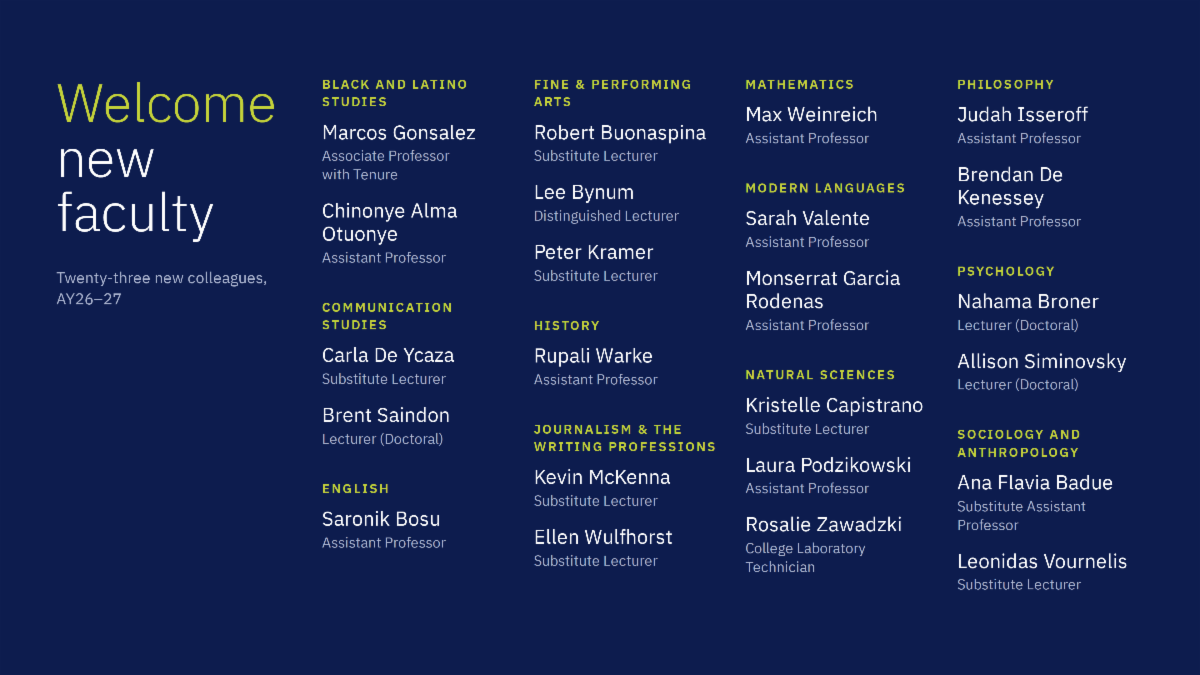
| | | Weissman Welcomes 23 New Faculty | | | OTHER FACULTY NEWS AND PUBLICATIONS | | |
Grace Schulman Publishes "Yew" in Commonweal
Distinguished Professor Emerita Grace Schulman has published a new poem, "Yew," in Commonweal. Schulman, a longtime member of the English Department and former poetry editor of The Nation, has written some thirty new poems this summer toward a forthcoming collection.
Read the poem here.
| | | |
Naima Coster's Take What You Can Named a Good Morning America Book Club Pick
Take What You Can, the new novel by Assistant Professor of Journalism and the Writing Professions Naima Coster, was the Good Morning America Book Club selection for August and appeared on summer reading lists in The New York Times, Time, PBS, and Harper's Bazaar.
An interview on NPR's All Things Considered can be heard here.
| | | |
Max Weinreich in The Atlantic
Assistant Professor of Mathematics Max Weinreich was quoted in The Atlantic article "Math Can't Go On Like This," on how artificial intelligence is reshaping mathematical research and what that means for the field's future.
Read it here.
| | | |
Andrea Gabor Moderates League of Women Voters Election Forum
Andrea Gabor, Bloomberg Professor of Business Journalism and Chair of Journalism and the Writing Professions, moderated a public forum on voting rights, election administration, and election integrity on September 30, hosted by the League of Women Voters of the Hamptons, Shelter Island and North Fork, where she chairs the Government Committee.
Watch the recording here.
| |
| |
Baofu Qiao Publishes Two Papers, One with an Undergraduate First Author
Assistant Professor of Natural Sciences Baofu Qiao has two new peer-reviewed papers. "How Phosphorylation of α/β-Tubulin Perturbs Microtubule Structure: A Computational Study," co-authored with Ahmet Osman and Susan Rotenberg, is in press at the Journal of Biological Chemistry; its first author, Annemarie Ianos, is a Baruch undergraduate, and this is her second first-author publication.
"Amphipathic β-Sheet-Forming Octapeptide Self-Assembly Using the Martini Potential Family," with Dibyajyoti Maity, appears in ACS Omega.
Read the papers here:
https://doi.org/10.1016/j.jbc.2026.113493
https://doi.org/10.1021/acsomega.6c02457
| | | |
Chester Zarnoch Featured in the Hudson River Foundation's Tidal Exchange
Professor of Natural Sciences Chester Zarnoch was highlighted in the August issue of Tidal Exchange, the Hudson River Foundation's newsletter. In a Q&A spotlight, Zarnoch discussed how to connect academic researchers with the practitioners doing habitat restoration in the estuary, and argued that habitat creation and water quality projects can double as shared learning opportunities for nature-based solutions.
Read it here.
| | | |
Josh Kruchten Awarded British Library–Clark Library Fellowship
Adjunct Assistant Professor of English Josh Kruchten has been awarded a fellowship from the American Trust for the British Library and the William Andrews Clark Memorial Library at UCLA, supporting research this year at both institutions.
Read more here.
| | | |
Sally Wen Mao Named Burke Visiting Scholar at Oklahoma State
Poet and Assistant Professor of English Sally Wen Mao has been named the 2026 Jim & Linda Burke Visiting Scholar at Oklahoma State University's Doel Reed Center for the Arts.
Read more here.
| | | |
Carolyn Abott Receives the Brownlow Book Award
Associate Professor of Political Science Carolyn Abott has received the Louis Brownlow Book Award for The Politics of Public Pensions: Parties, State Governments, and Unions (Columbia University Press, 2025). The award, given by the National Academy of Public Administration, recognizes the year's outstanding book in the field. Abott will accept it at a ceremony in Washington, DC.
| | | |
Ted Henken in PolitiFact
Ted Henken, Professor of Sociology and Anthropology, is quoted in PolitiFact's fact-checked guide to the President's midterm campaign talking points. In the section on democratic socialism, PolitiFact draws on Henken, whom it identifies as a Cuba expert, to explain why the Democratic Socialists of America platform, while radical in its call for reforms, is not a program for a communist takeover of the means of production or the abolition of capitalism.
Read more here.
| | | |
Sarah Bishop in The Atlantic
Sarah Bishop, Professor of Communication Studies, is quoted in The Atlantic's September report "ICE Deportees Are Vanishing Into Salvadoran Prisons," on deportees sent to El Salvador under the Trump administration's agreement with President Nayib Bukele.
Read more here.
| | | |
Weissman Faculty Join the Baruch AI Leadership Initiative
Elizabeth Edenberg (Philosophy) serves as Weissman's liaison to the Baruch AI Leadership Initiative, led by faculty director Mahima Hada, with Scott Erich (Sociology and Anthropology), Evan Fink (Mathematics), and David Lindsey (Political Science) among its Weissman members. The initiative's AI Learning Commons, a Brightspace course open to all students, faculty, and staff, launched in September, with discipline-specific modules following in October and a faculty course, Tools for Instruction, in Spring 2027.
| | | |
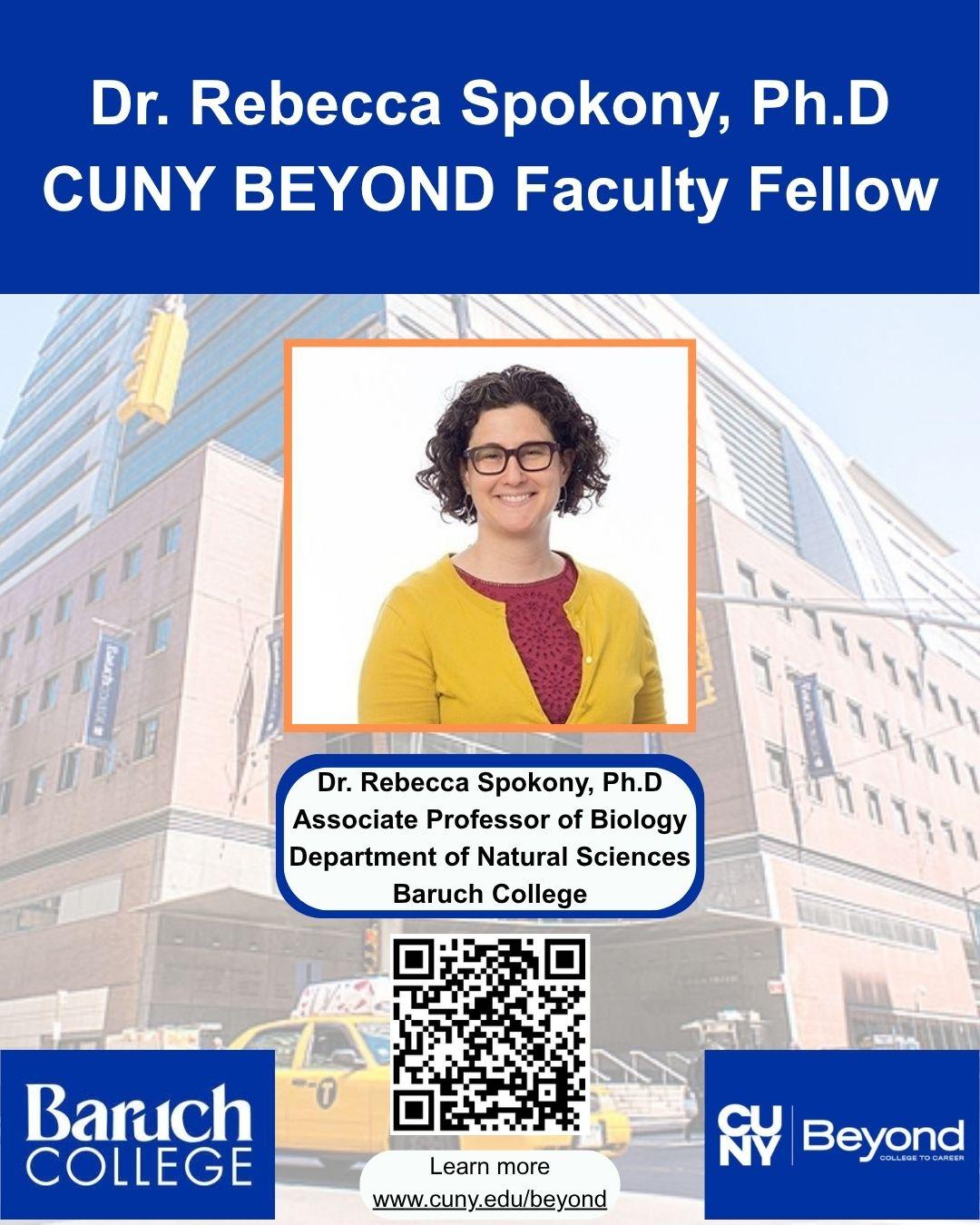
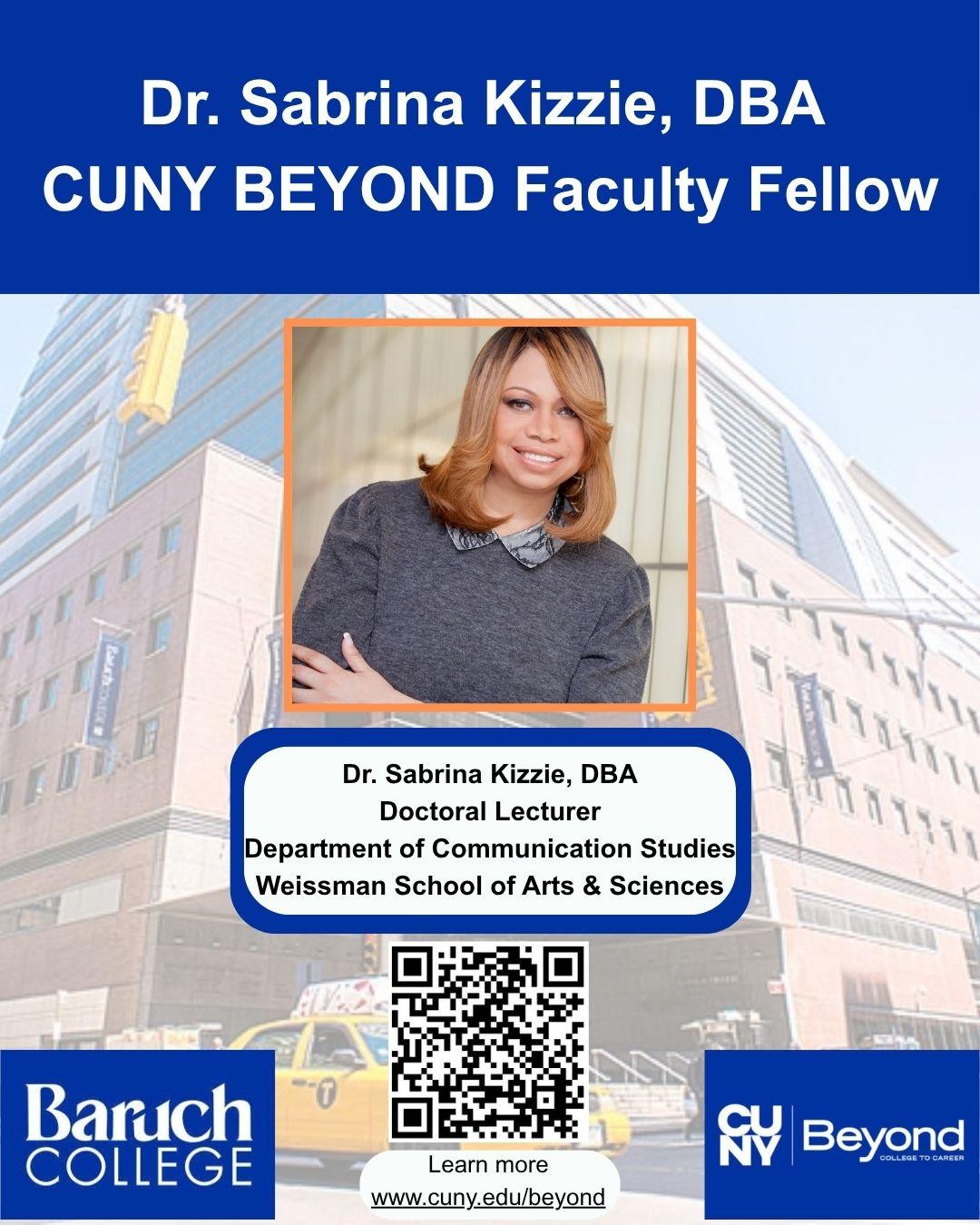
Rebecca Spokony and Sabrina Kizzie Named CUNY Beyond Faculty Fellows
Associate Professor Rebecca Spokony (Natural Sciences) and Doctoral Lecturer Sabrina Kizzie (Communication Studies) have been named Weissman's CUNY Beyond Faculty Fellows.
CUNY Beyond is a University-wide initiative focused on advancing career-connected learning and student success. Scan the QR code or click the linked images to learn more about the program and its impact across the college.
To learn more about CUNY Beyond and opportunities for engagement, please contact Rebecca Spokony and Sabrina Kizzie.
| | |
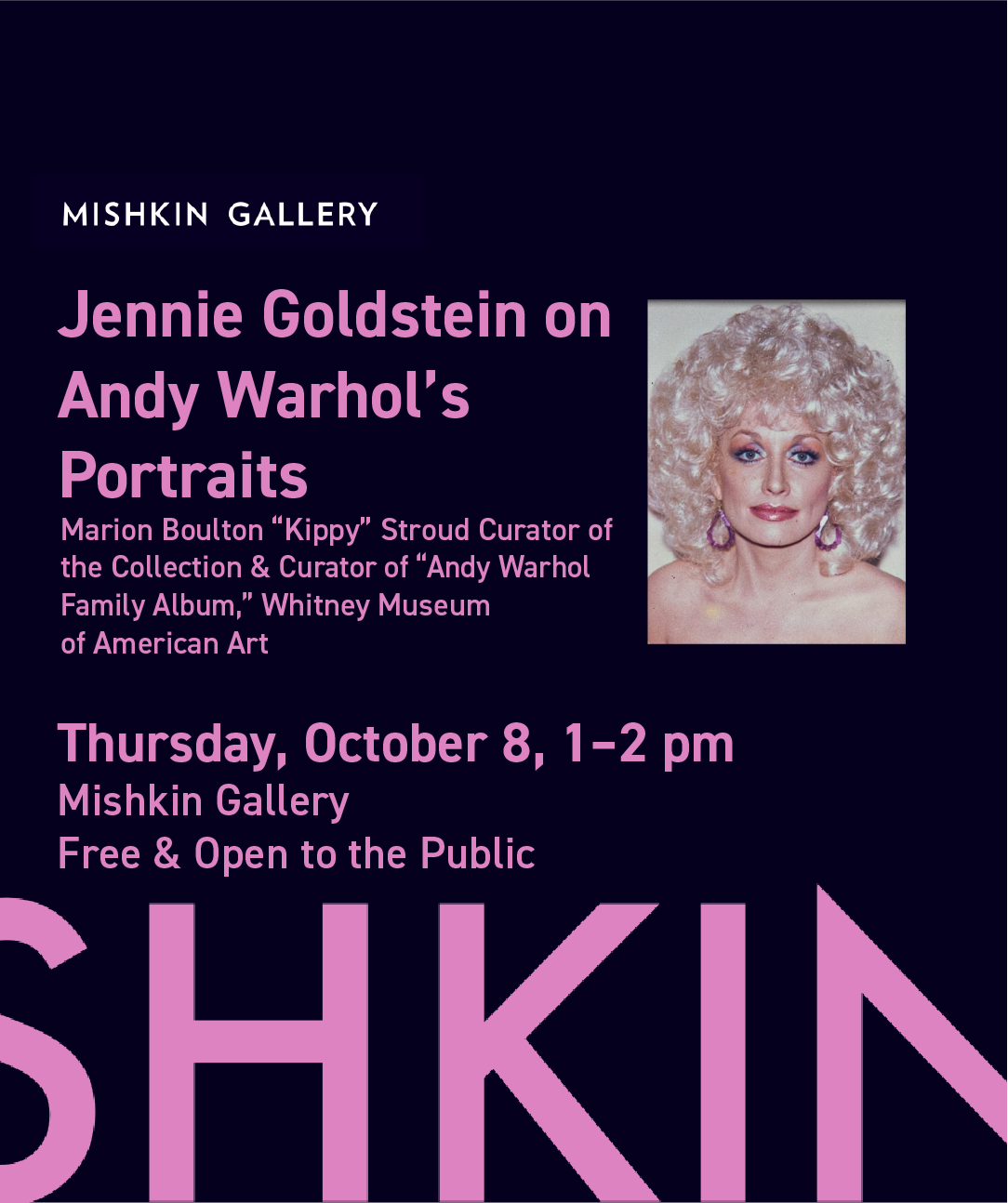
Jennie Goldstein on Andy Warhol's Portraits at the Mishkin Gallery
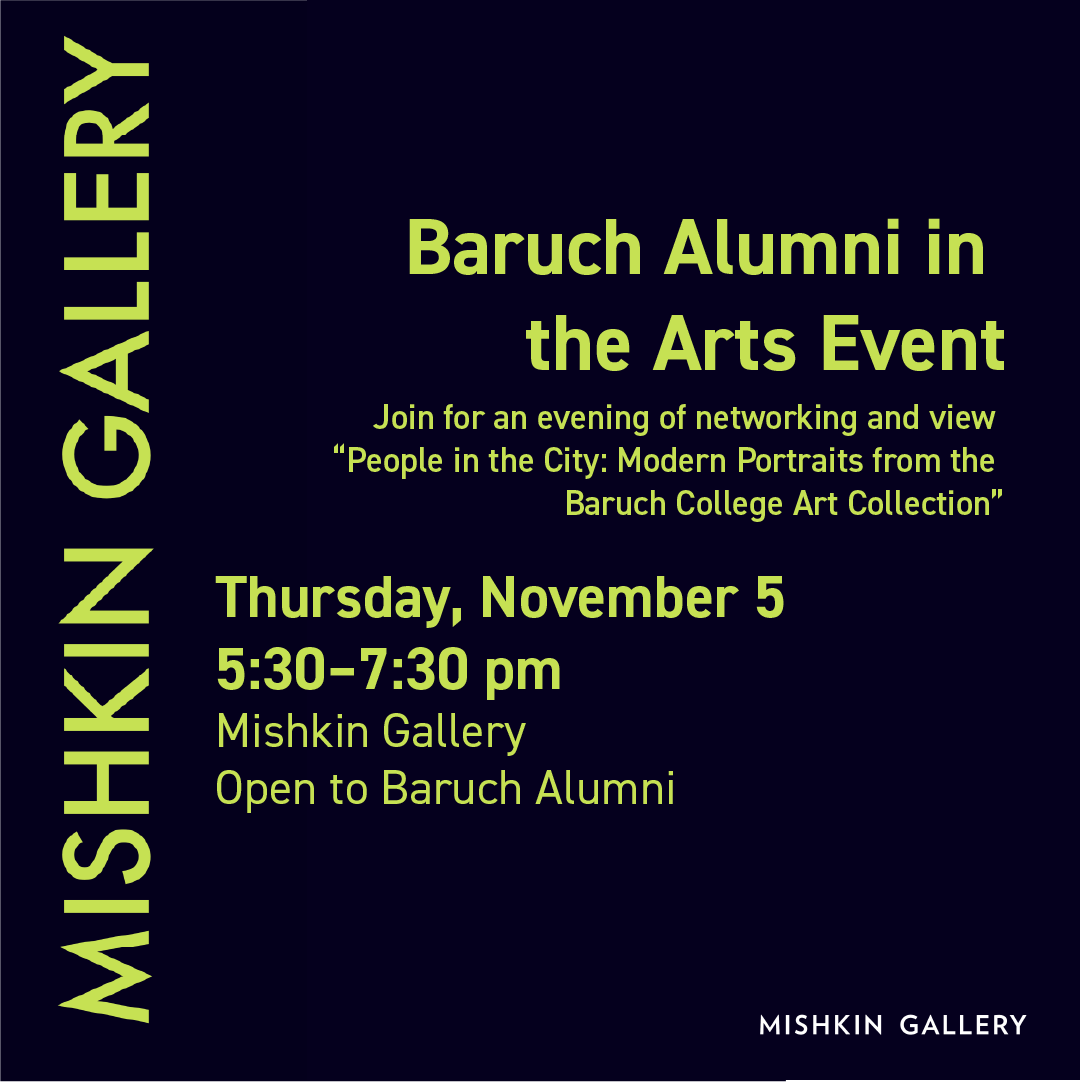
Jennie Goldstein, the Marion Boulton "Kippy" Stroud Curator of the Collection at the Whitney Museum of American Art, joins Mishkin Gallery Director Maika Pollack for a conversation on Warhol's portraits. Thursday, October 8, 1–2 pm, Mishkin Gallery. The talk accompanies the gallery's current exhibition, People in the City: Modern Portraits from the Baruch College Art Collection, on view through December 11.
Playwright Ngozi Anyanwu Visits as Fall 2026 Harman Fellow
Playwright and performer Ngozi Anyanwu, whose play The Monsters was recently produced at Manhattan Theatre Club, will spend Thursday, October 22 with students in the Department of Fine and Performing Arts as this fall's Harman Fellow. She will visit three classes, and interested Baruch students are welcome to attend: Introduction to Theatre, 10:45 am–12 pm, VC 5-165; Introduction to Acting, 2:30–3:45 pm, Bernie West Theatre; Introduction to Theatre, 4:10–5:25 pm, VC 11-145.
I/O Psychology Alumni Networking Night
Alumni, faculty, and students of Baruch's Industrial/Organizational Psychology programs are invited to a networking mixer with food and drinks, hosted by the Office of Alumni Relations. Thursday, October 22, 5:30–8 pm, Newman Library, Room 750.
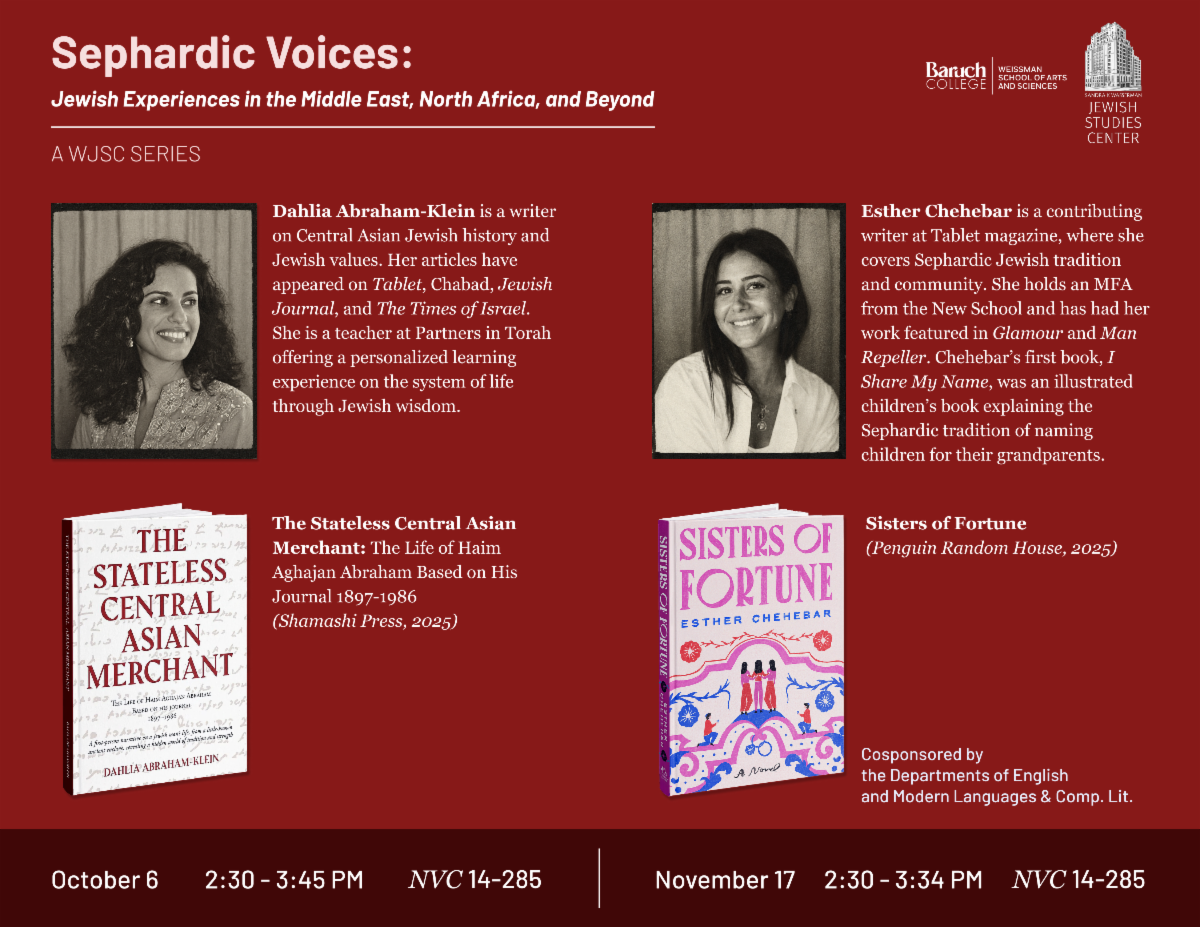
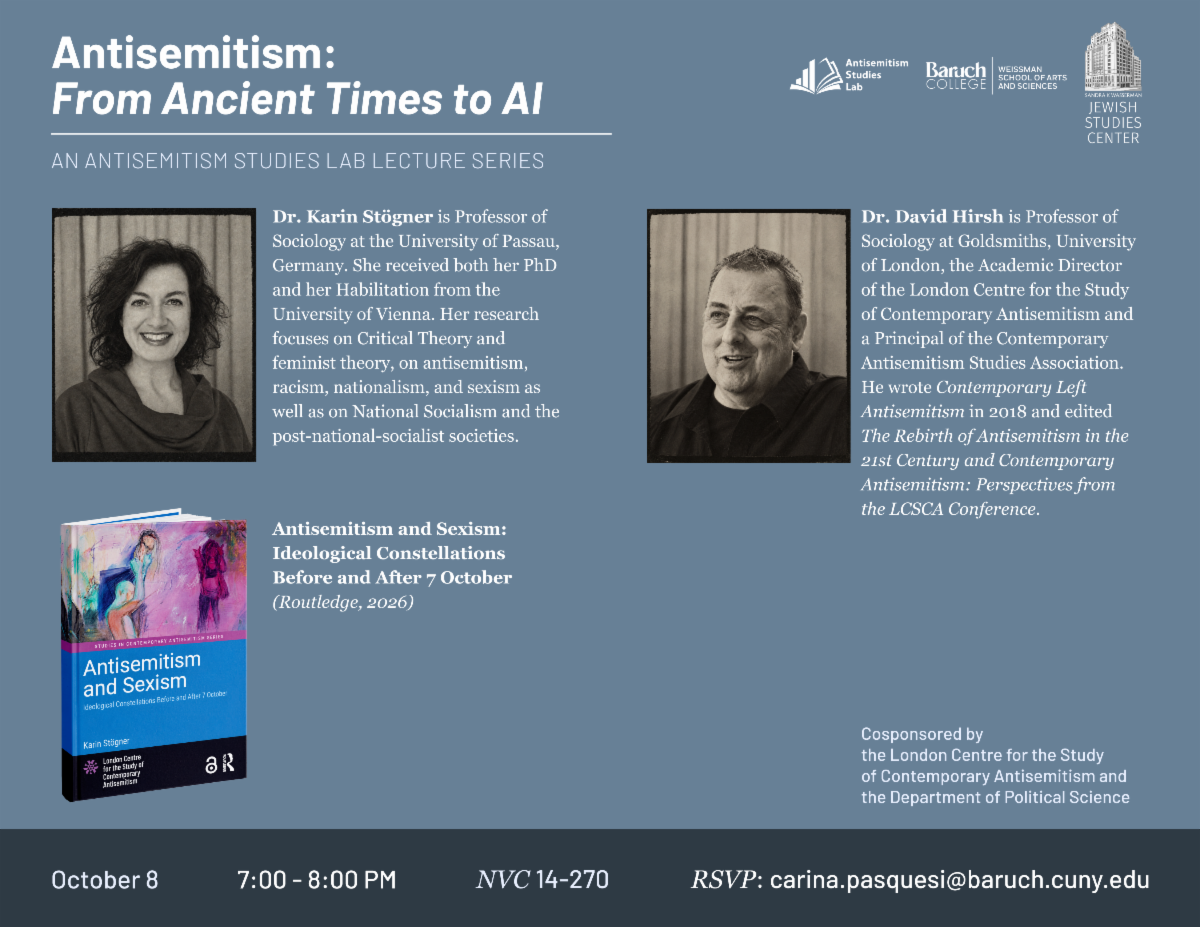
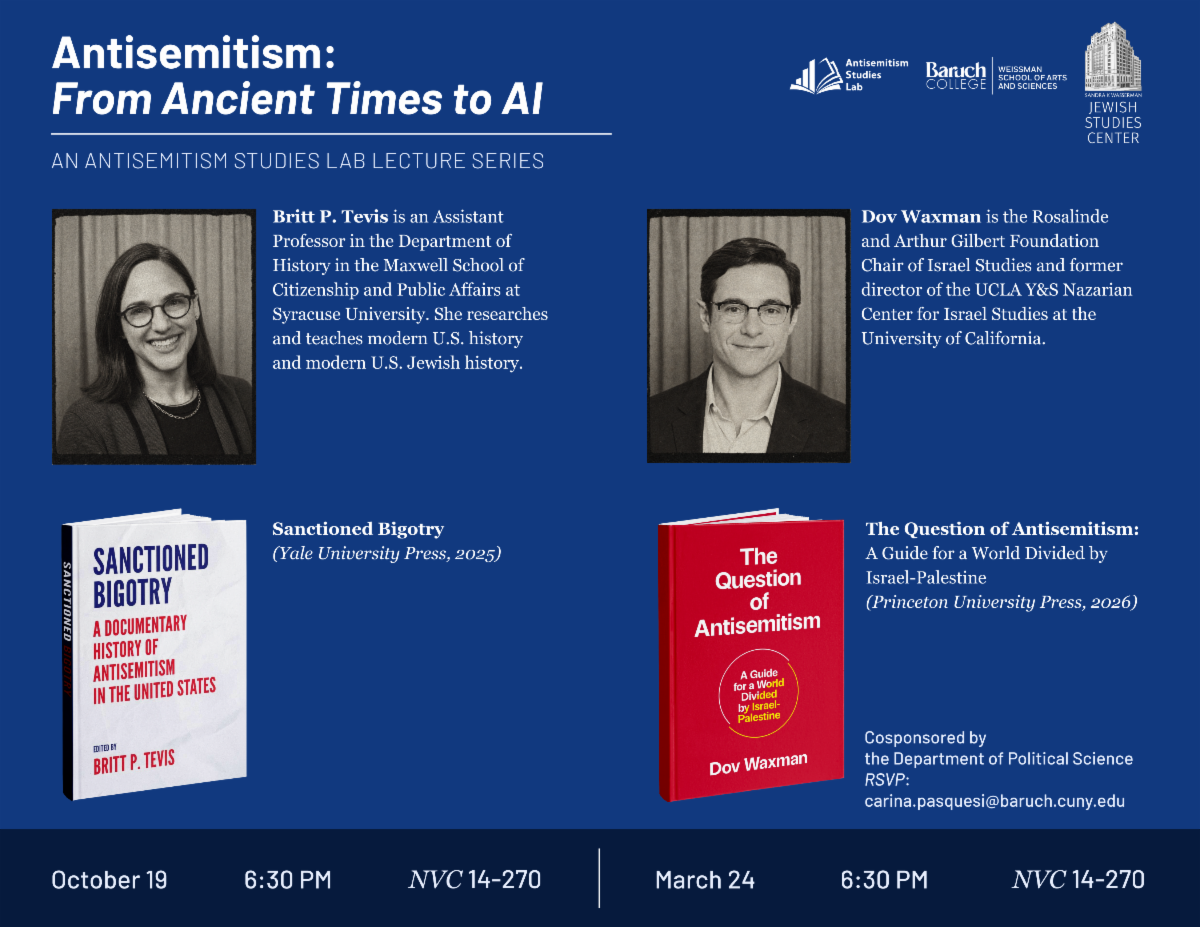
Wasserman Jewish Studies Center and Antisemitism Studies Lab Fall Programming:
| |
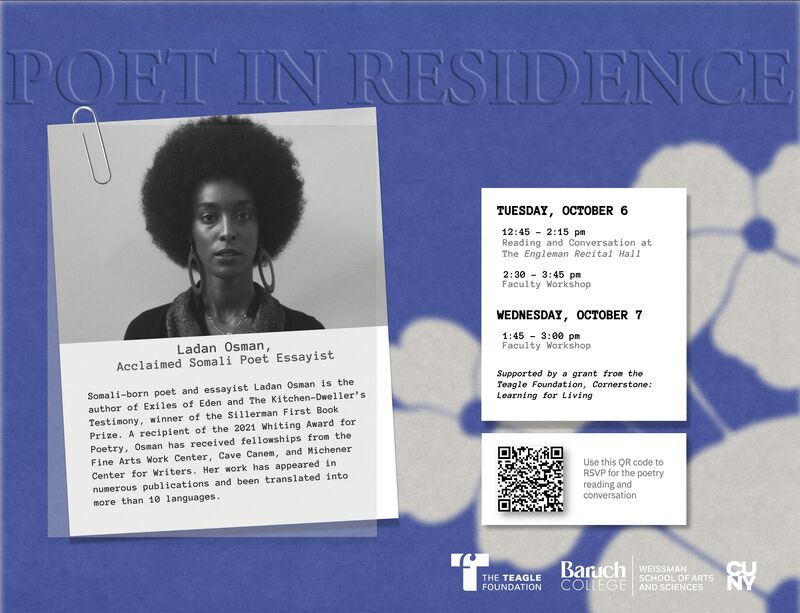
Ladan Osman, Teagle Poet in Residence
Poet Ladan Osman gives a reading and conversation on Tuesday, October 6 at 12:45 pm in the Engelman Recital Hall, with faculty workshops on October 6 and 7. Supported by the Teagle Foundation's Cornerstone: Learning for Living grant.
| |
The Acting Company Reads María Irene Fornés's Tango Palace at BPAC
Monday, October 19 at 7:30 pm, Baruch Performing Arts Center.
I Became We at Atlantic Theater Company
World premiere of the new play with music and co-lyrics by Jack D. Coen, adjunct lecturer in Fine and Performing Arts, October 16 through November 15 at the Linda Gross Theater. Baruch students can get $25 tickets to previews and performances through November 2 with the code IBWCHOIR, entered on the seat-selection screen. The code expires October 16, so tickets must be bought before opening night.
Tickets: https://atlantictheater.org/production/i-became-we/
Invoke in Concert, Silberman Series at BPAC
The string quartet Invoke performs Tuesday, October 27 at 7 pm.
Left Behind: The Fight for Dyslexia Equity Screening
Learning Ally hosts a screening of Anna Toomey's documentary. Thursday, October 29 at 6 pm, Engelman Recital Hall.
Great Works: God of Vengeance
Monday, November 2 through Thursday, November 5 at BPAC.
Israeli Chamber Project: Kristallnacht Commemoration
Monday, November 9 at 6:30 pm, Engelman Recital Hall. Presented by the Wasserman Jewish Studies Center in memory of Zsuzsanna Ozsváth. RSVP: carina.pasquesi@baruch.cuny.edu
BPAC Open House
Thursday, November 12, 5–8 pm. Tours of the theatre, recital hall, and rehearsal studio; refreshments; meet the BPAC team.
| | |
|
In our September issue and during our faculty meeting, Professor Naima Coster was identified as a member of the Creative Writing faculty; she was also misidentified in a recent issue of the CUNY newsletter.
Professor Coster is a member of the Department of Journalism and the Writing Professions.
We regret the error.
We want to get it right! Please send all future corrections and requests to baruchwsas@baruch.cuny.edu
| | | | | |