|
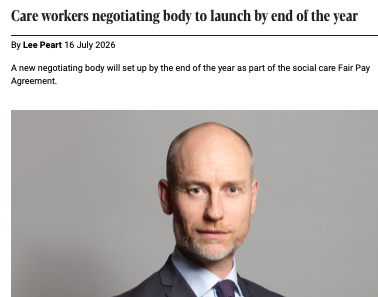
Is it indelicate to wonder if the Baroness Louise Casey (charged with sorting out social care), is deaf?
History doesn’t really repeat itself, but…
… it does send echoes down the passage of time. She can’t be listening.
Casey says social care reform needs public consent. At the risk of being set to the Tower of London, may I suggest she needs to get her ear a bit closer to the ground…
... listen for the echoes of Andy Burnham who conducted almost exactly the same exercise in 2009.
Awkwardly, his government postponed the final funding decision to another commission.
The country doesn’t lack a conversation.
It lacks the cojones to deliver a conclusion.
Casey has warned that reform will fail without public consent, calling for…
… an honest national conversation about what social care is for, who should receive it, what the state should provide, what families can reasonably be expected to do and what we should all contribute.
Perfectly reasonable, except, she’s not listening…
… we had that conversation seventeen years ago! Nowt's changed.
In July 2009, Andy Burnham, then Health Secretary, published a Green Paper called Shaping the Future of Care Together.
It proposed a National Care Service that would be fair, simple and affordable.
It promised six things people should expect:
- prevention,
- a national assessment,
- joined-up services,
- information and advice,
- personalised support and
- fair funding.
It was launched, with a tra-la-la… called the Big Care Debate.
The questions, chime with the ones Casey asks today.
-
What should people expect?
-
What should the state pay for?
-
What should individuals contribute?
-
How should health and care work together?
-
How do we protect families from catastrophic bills?
Burnham set out three funding possibilities;
- a partnership between the individual and the state;
- an insurance arrangement;
- or a comprehensive system into which people who could afford it would contribute, in return for care when they needed it.
The report on the consultation was published in March 2010 alongside a White Paper and ran to 377 pages.
Analysis by Ipsos MORI revealed;
- More than 68,000 people participated.
- With +28,000 formal responses.
- Broad support for the proposed National Care Service, and
- Burnham’s six promises, and
- Asked for greater attention paid to carers, workforce, quality, independence and clarity on entitlement.
Between 19,255 respondents
- 41% chose the comprehensive model;
- 35% chose partnership funding;
- 22% chose insurance, but…
The White Paper; Building the National Care Service, emerged, with a timetable..
‘…after 2015, the service would provide eligible care, free when needed, but…’
… the funding mechanism would be decided by…
... another commission! Burnham ducked the tough question.
Labour lost the 2010 election. The National Care Service was lost with it.
Casey says social care has never had its own ‘creation moment’.
Actually, Burnham tried to create that moment. What was missing was not a vision, a consultation or even a reasonably clear description of the service.
It was a political decision about the money.
We know a decent care service should help people
- stay independent.
- Intervene early.
- Support families.
- Pay and train care workers properly.
- Join up with the NHS.
- Provide consistent rights.
- Protect people from costs no ordinary family can sensibly insure against.
We know the choices…
- Pay through general taxation.
- Require a dedicated contribution.
- Share costs between individuals and the state.
- Use income, wealth, inheritance, insurance or some combination of them.
There may be better and worse versions, but there is no undiscovered funding mechanism waiting for another commission (or Casey) to find it.
Casey’s first report is due this year. Her final report will not arrive until 2028. Shoving any implementation beyond the next election.
Casey needs to have a word in Burnham's shell-like and ask;
'What d'ya wanna do with the 2010 report? Because, mine is gonna look very like it'.
The condition of social care is not a failure of public engagement. It’s a failure of political nerve.
Seventeen years ago, Burnham invited the country to join the Big Care Debate.
Casey wants another one.
It's a waste of time. Neither the problems nor the solutions have changed.
By now, some of the people who joined the first conversation, very probably need the service it failed to create.
We don’t need another creation story. We need Burnham to decide…
… how the ending is paid for.
|