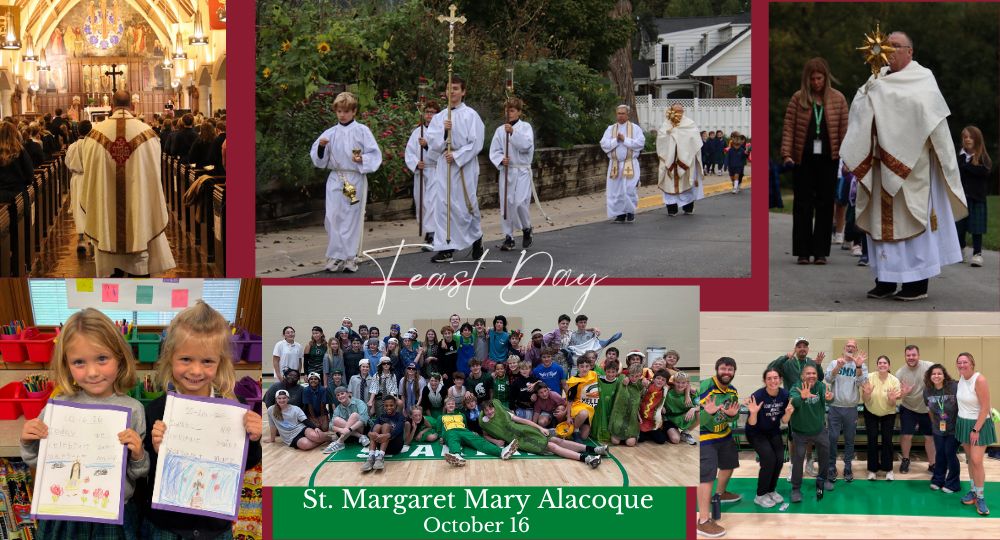
Hello, St. Margaret Mary Parish, | | We had a beautiful day last Friday as we celebrated the Feast of our patroness, St. Margaret Mary. The all-school Mass, followed by a Eucharistic procession down to the school and through the school, is such a great way to ask our Lord’s blessings upon each of our students, teachers, staff, administrators, and families of our school. Thank you to everyone who helped us celebrate this special day. Oh, and the faculty and staff beat the students in the annual SMM Feast Day volleyball game. Way to go! | |
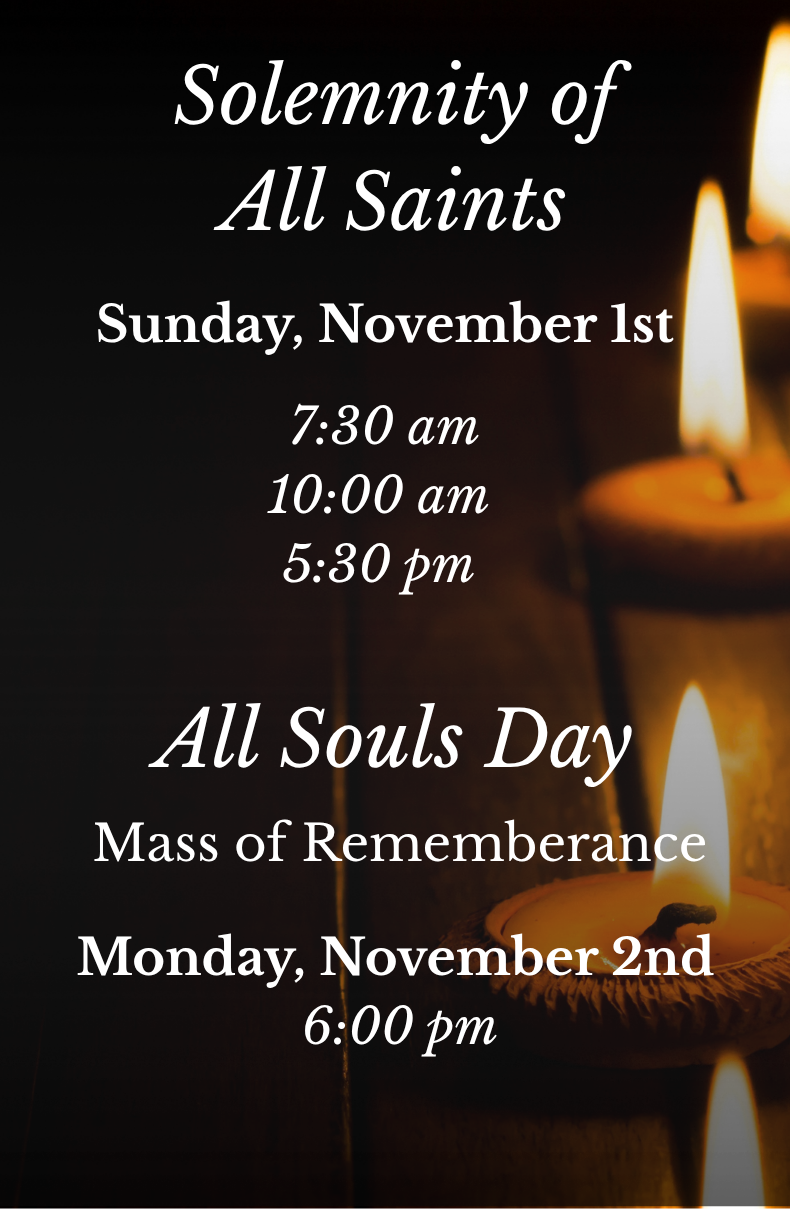
Time is flying as we prepare to enter the last week of October, but this is also a time that I love as we prepare to celebrate All Saints' Day and All Souls' Day in the life of the Church. Both are great aspects of our Catholic faith.
All Saints is a churchwide holy day of obligation and normally celebrated on Nov. 1. If the first day of November falls on a Saturday or Monday, at least in the United States, the obligation to attend Mass is abrogated. All Souls’ Day takes place on Nov. 2, unless it falls on a Sunday; then the celebration is held Nov. 3.
During these early November celebrations, those of us still living (the “church militant”) unite our hearts with, and in a special way to remember, the faithful departed, whether they be in heaven (“church triumphant”) or in purgatory (“church suffering”).
| |
All Saints’ Day, which began most likely as All Martyrs’ Day, can be traced to the earliest Christians. By the third century, the followers of Christ were annually honoring their brothers and sisters who had given their lives (martyred) while witnessing for and defending Jesus Christ. Typically, on the anniversary of a martyr’s death, those living would gather to remember and offer prayers at the tomb or place where the deceased had died. Tombs were sometimes decorated and altars built over the tomb. According to church historian Henry Chadwick, “From the third century the anniversary of a martyr’s death, called his ‘birthday,’ was commemorated at his grave by a celebration.”
The belief among the first Christians, which continues today, is that believers who died defending Christ were borne by angels to heaven and are face-to-face with the living God, in the presence of the beatific vision. In those first centuries, especially during the savage reign of the Roman Emperor Diocletian (r. 284-305), there were more and more Christians who accepted death at the hands of the Romans rather than deny Christ, rather than worship false gods or the personage of the emperor.
Additionally, others who had publicly confessed their Christian faith (confessors) and somehow survived the Romans were also honored. Thus the number of martyrs and confessors became greater than the opportunities to give each one an anniversary celebration, and the need for a common feast day was recognized.
|
| |  | By the fifth century, there is evidence of locations, such as in Antioch, where the fledgling church had set aside the first Sunday following Pentecost to collectively honor these holy and courageous people. In 609, during the reign of Pope Boniface IV (608-615), the Eastern Emperor Phocas (r. 602-610) gifted a temple in Rome to the Holy See. The temple, still standing today and still known as the Pantheon, was originally built in the first century. Destroyed by fire and rebuilt between 118 and 128, it was a public place to worship and honor all the Roman gods and goddesses — a spectacular monument to pagan Rome. Pope Boniface accepted this temple, removed all the pagan embellishments, all the statues of false gods, and, according to legend, relocated and buried the remains of hundreds of Christian martyrs beneath the Pantheon. The pope then consecrated the Pantheon as a Christian church to the Blessed Mother and all the Holy Martyrs (Sanctae Mariae and Martyrs). The consecration took place on May 13, and that was the annual date of the feast of All Martyrs for the next 125 years.
On Nov. 1, 735, Pope Gregory III (731-741) dedicated an oratory in St. Peter’s Basilica to house the relics of the apostles, martyrs, saints and confessors. Thereafter, Nov. 1 became, at least for the churches in Rome, the feast of All Saints, and the May 13 date was suppressed. Other countries and cities began to celebrate the feast on the same day as the Rome churches, and soon a vigil of All Saints was added. Eventually, Pope Gregory IV (827-844) assigned Nov. 1 as the date of the feast of All Saints throughout the Latin Church and proclaimed it a holy day of obligation.
Today, All Saints’ Day is a solemnity and holy day of obligation on which the universal church honors the martyrs, the saints, and the confessors, including all known and unknown, all who have gained the reward of heaven. Offering prayers for those who have died is ancient in origin. In the Old Testament’s Second Book of Maccabees, written around 100 B.C., Judas Maccabeus orders his army to pray and offer sacrifices on behalf of their fallen comrades.
| |
The Commemoration of the Faithful Departed, or All Souls’ Day, evolved onto the church calendar long after All Saints’ Day. Sometime between 998 and 1030, St. Odilo, the abbot at the Benedictine monastery in Cluny, France, encouraged all the monks to pray for the souls of those who had died, those awaiting the joys of heaven. He instituted this commemoration on the day after All Saints’ Day, and soon other religious orders and churches began, on that same date, to annually remember all who had died.
Remembering and praying for the faithful departed is tied directly to our belief in purgatory. On All Souls’ Day, the universal church prays for all those in purgatory, people who were much like us, whose offense may have been less than ours. By pleading for them, we are inspired to lead purer lives.
| |
On All Souls’ Day and during the entire month of November, we remember our departed brethren as we go to the cemetery where they are buried, attain indulgences for them, give alms, do some good work, ask for Masses to be said in remembrance, all on behalf of those close to us and to others we may have neglected during the year.
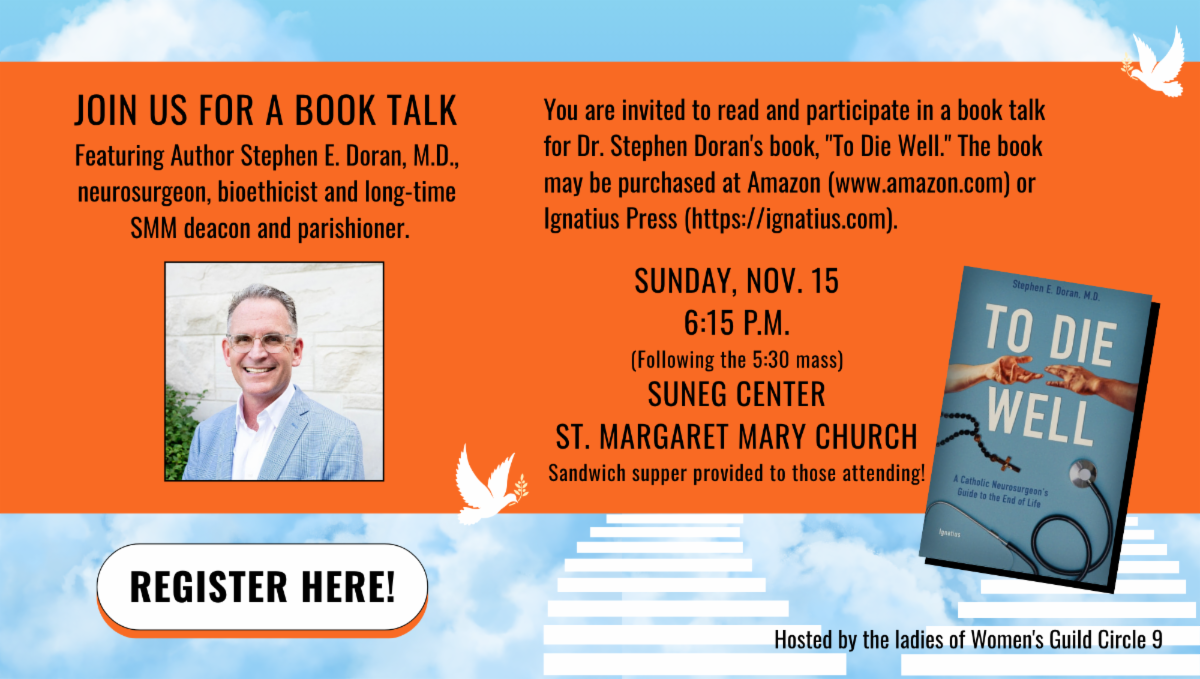
It is opportune to mention that Circle 9 is hosting and inviting SMM Parishioners to a talk on November 15 by Deacon Steve Doran on his book, To Die Well. I would encourage our parishioners to purchase this book, read it, and RSVP to attend his talk on November 15th (see graphic below to RSVP).
Have a blessed final week of October as we approach All Saints’ Day and All Souls’ Day.
| | Prayerfully yours in Christ, | | |
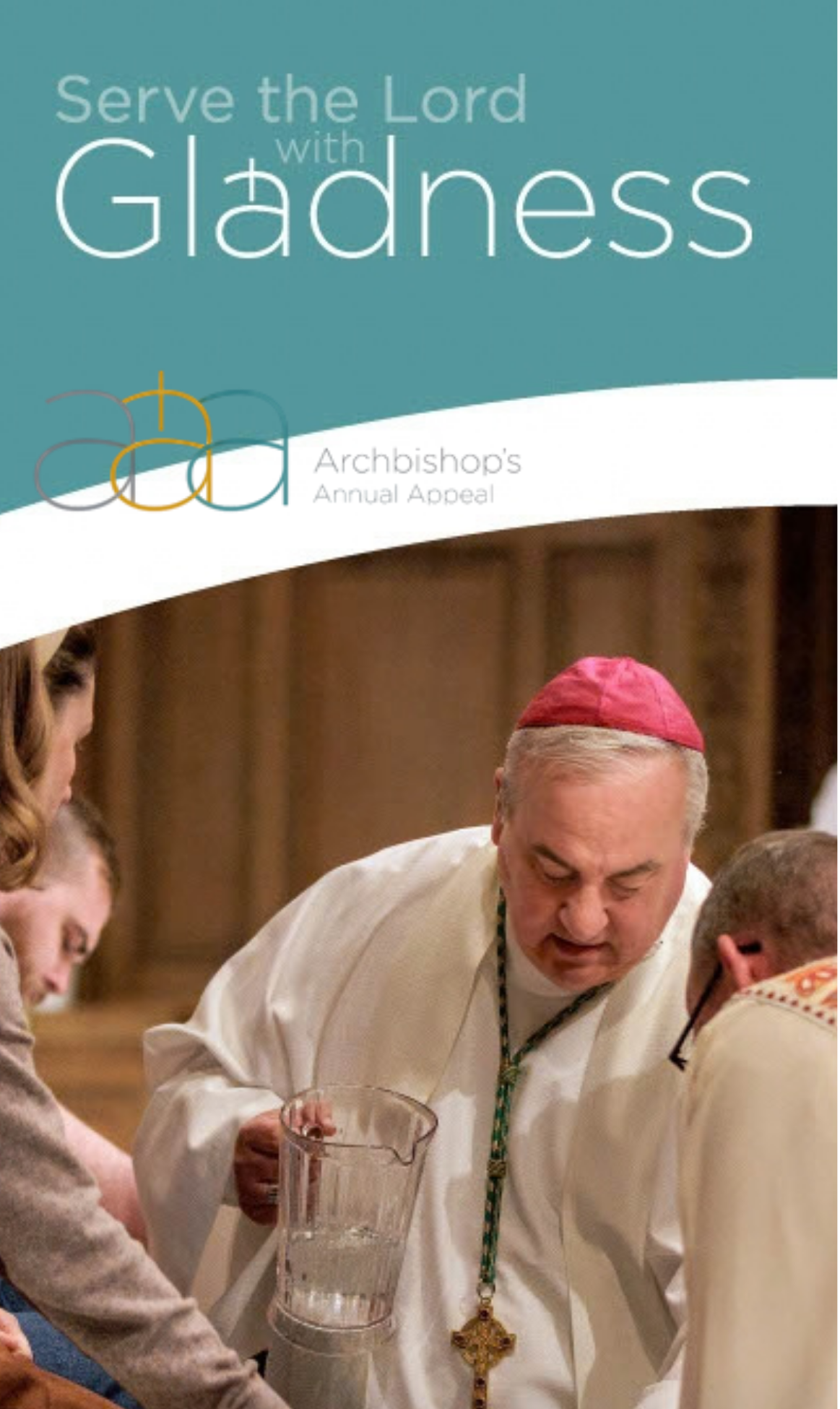
The Archbishop’s Annual Appeal is underway! The Appeal helps build One Church throughout the Archdiocese of Omaha, supporting parishes, schools, and ministries across northeast Nebraska as they grow into missional communities.
Please watch the video from Archbishop McGovern and click on the image to learn more about the Appeal. You can make your gift using the button below. Brochures, pledge cards, return envelopes, and a giving guide are also available in this weekend’s bulletin.
I encourage everyone to pray the Annual Appeal Prayer and submit any prayer intentions for Archbishop McGovern to remember in his prayers.
| |
Lord Jesus, Through this Most Holy Sacrament of Your Body and Blood, we are united with our brothers and sisters in every parish across the Archdiocese of Omaha as one people, one Church.
Make us Your Sacrament, that we might bring Your love and mercy to the world.
Increase our desire to be Your disciples, and show us how to be generous with our gifts of time, talents and resources.
| | | | |