Welcome from the Program Manager, Pierre Guigon | | |
Over 35 countries are now preparing to implement carbon pricing with support from the Partnership for Market Implementation (PMI). In this Spring 2026 issue, we highlight progress across our partner countries. Montenegro is advancing its carbon pricing framework alongside a Just Transition Plan to support economic diversification and workforce adaptation. Moldova is moving forward with the legal and policy architecture for a carbon tax, following analytical work on exposure to the European Union's Carbon Border Adjustment Mechanism (CBAM) and recent legislation. Guinea is progressing on a sector-based carbon pricing instrument to improve efficiency and reduce emissions in its mining sector.
To support these efforts, PMI provides an operational knowledge platform that advances implementation, facilitates peer learning, and aligns with emerging international approaches. Recent activities include technical masterclasses in New Delhi as India prepares to launch its Carbon Credit Trading Scheme, and ASCENT Carbon Days in Nairobi, which brought together nine countries to explore how carbon markets can mobilize finance for energy access.
This platform draws on PMI's convening role, bringing together policymakers, partners, and market actors to develop practical solutions. For example, the Carbon Market Infrastructure Working Group has developed guidance on building credible and scalable systems, now being rolled out through PMI-supported activities.
These efforts will come together in Singapore next month at Innovate4Climate and the Global Knowledge Forum. We look forward to engaging with many of you there.
We also welcome Jamie Fergusson as the World Bank Group's new Global Director for Climate, and look forward to working with him to further strengthen PMI's role in supporting countries to advance reforms and mobilize finance.
| | Join Us in Singapore to Advance Carbon Pricing and Markets | | |
Registration for Innovate4Climate 2026 (I4C) 2026 is open! Register today.
From May 20 to May 22, policymakers, investors, and market participants will convene in Singapore to engage on the latest developments in climate policy, carbon pricing, and carbon markets, and connect them to practical solutions for scaling climate finance. This year's I4C program combines high-level dialogue with technical sessions on market integrity, demand for high-integrity carbon credits, and evolving approaches to emissions trading systems and carbon pricing instruments.
Supported by the governments of Germany, Spain, and Singapore, I4C is delivered in collaboration with key partners, including the International Emissions Trading Association and the International Carbon Action Partnership. Visit the I4C website for details on the agenda, speakers, and registration.
| | |
Ahead of I4C on May 18-19, PMI and other World Bank Group programs will convene the annual Global Knowledge Forum on Carbon Pricing and Markets, bringing together policymakers and government representatives from over 50 countries, along with development partners and knowledge institutions. This closed-door forum focuses on implementation, providing a space for countries to exchange experiences, address practical challenges, and identify next steps as they advance carbon pricing and market approaches. We look forward to welcoming you in Singapore.
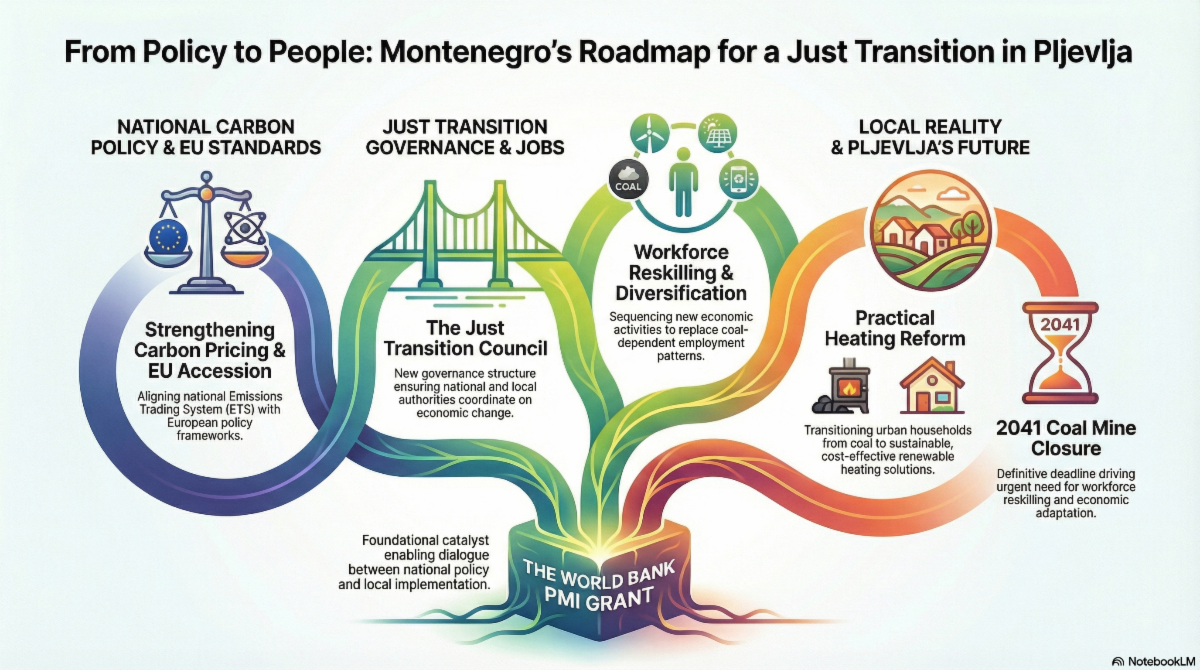
| | Updates from PMI Country Programs | | Supporting Jobs and Local Development in Montenegro | | As the first country in the Western Balkans to launch an Emissions Trading System in 2020, Montenegro is linking its carbon pricing efforts with a broader strategy to support communities as traditional industries decline. The strategy - developed with PMI support - focuses on strengthening the carbon pricing framework while helping workers and regions prepare for structural change. | | Infographic created with NotebookLM, a generative AI tool, and reviewed by World Bank staff for accuracy. | | |
In Pljevlja - home to the country's only coal plant and an adjacent mine expected to close by 2041 - a Just Transition Plan is being developed to guide economic diversification, workforce adaptation, and long-term regional development. A household heating survey and a feasibility study on sustainable heating options are already helping shape investment priorities, while engagement with local stakeholders is strengthening coordination between municipal and national authorities. The experience highlights how carbon pricing can be paired with targeted, place-based interventions to support jobs, manage transition risks, and anchor long-term development. Learn more in our web story.
| | Guinea Advances Africa's First Sector-Based Carbon Pricing | | |
Guinea is working to become the first country in Africa to launch a sector-based carbon pricing instrument, initially covering its bauxite and iron ore mining industries—sectors central to its economy. Developed with PMI technical support, the instrument adopts an intensity-based approach, setting emissions targets per ton of output and allowing operators to improve efficiency and reduce emissions while maintaining flexibility in production levels.
Institutional roles and responsibilities have been defined across relevant government entities, including the establishment of a Carbon Unit within the Ministry of Environment and Sustainable Development to oversee implementation and monitoring. Draft regulatory frameworks have been prepared, and the instrument is expected to be introduced in phases, beginning with a transition period focused on data collection, testing of systems, and capacity building.
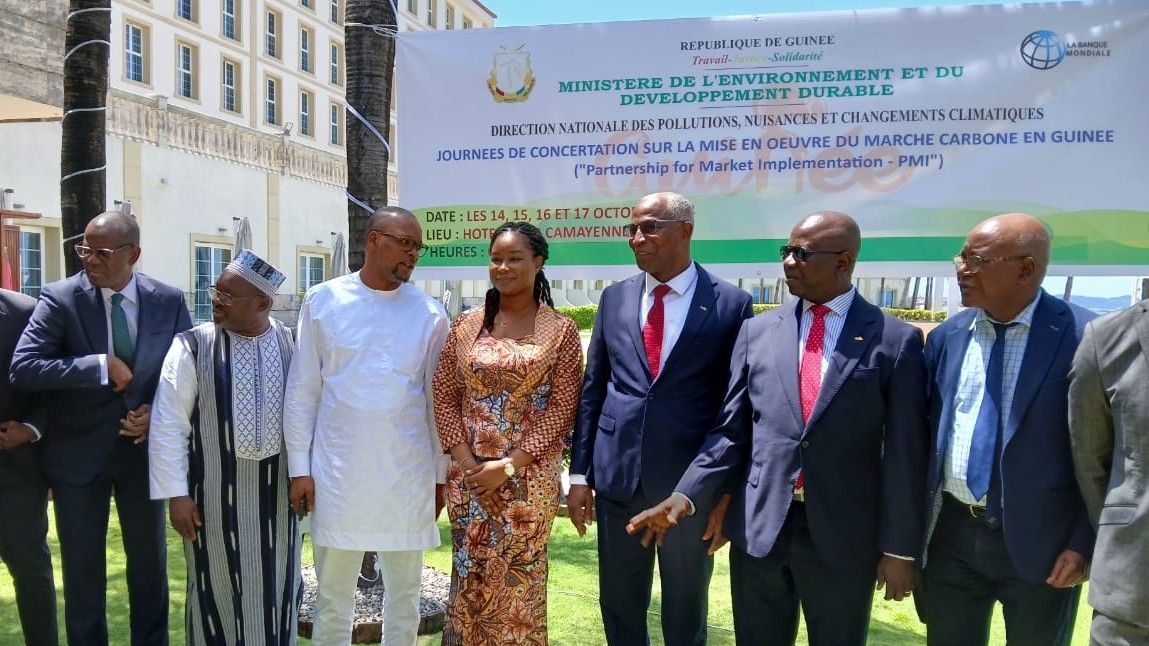
| Guinea’s Prime Minister Amadou Oury Bah with Minister of the Environment and Sustainable Development Djami Diallo and other senior government officials at a PMI-hosted event. Photo credit: PMI . | |
At a recent event in Conakry, Guinea, Prime Minister Amadou Oury Bah reaffirmed Guinea's “commitment to implementing a carbon pricing instrument in the mining sector as a means of contribution to climate change mitigation.” Read more details.
| | Moldova Enacts Legal Foundation for Carbon Pricing | | |
In January 2026, Moldova's Law on Climate Action came into force, establishing a legal basis for carbon pricing and mandating a monitoring, reporting, and verification (MRV) system aligned with European Union (EU) standards. For an economy highly dependent on energy imports and with emissions intensity well above the EU average, the law marks an important step toward more resilient and inclusive growth.
“The PMI-supported program provided Just-in-Time strategic and technical assistance… including strengthening understanding of the readiness for the MRV system, the design of a national carbon pricing framework, ensuring coherence with EU Emissions Trading System principles, and developing complementary policies to mitigate impacts on households and businesses,” said Aliona Rusnac, State Secretary in Moldova’s Ministry of the Environment.
PMI has supported Moldova in assessing carbon pricing options, including socio-economic impacts and exposure to the CBAM,, and in developing a roadmap for implementation. A new Implementation Support Grant will help advance the legal and policy architecture for a carbon tax and establish an installation-level MRV system. See how Moldova is advancing toward carbon pricing: Moldova Progresses on Path towards Carbon Pricing.
| | PMI Knowledge & Innovation | | ASCENT Carbon Days Unpacks Financing Opportunities | | |
In February 2026, the World Bank — through support from PMI, the Carbon Initiative for Development (Ci-Dev), and the Scaling Climate Action by Lowering Emissions (SCALE) program— and the Common Market for Eastern and Southern Africa (COMESA) co-hosted a workshop focused on the Accelerating Sustainable and Clean Energy Access Transformation (ASCENT) program. The event brought together delegations from Burundi, Ethiopia, Kenya, Madagascar, Malawi, Rwanda, Tanzania, Uganda, and Zambia to explore how energy access programs can generate carbon credits and mobilize additional financing.
As a flagship effort under Mission 300, ASCENT highlights the role carbon markets can play in helping close the energy access financing gap. Discussions underscored the importance of coordination across institutions, from Ministries of Energy and Finance to utilities and rural electrification agencies, to move from design to implementation.
| | Participants of ASCENT Carbon Days. Photo credit: COMESA. | | |
The workshop helped clarify roles within national ASCENT Carbon programs and identify concrete next steps. Key developments were also shared, including the expected finalization of the Energy Access Carbon Standard by the Global Carbon Council in 2026 and the launch by COMESA of a Model Policy Framework for Carbon Markets, to which all ASCENT countries will be invited to participate. Explore further takeaways from ASCENT Carbon Days.
| | PMI Delivers Masterclasses at India’s Carbon Market Event | | In March 2026, at India’s flagship carbon market event PRAKRITI 2026, PMI supported the World Bank's Environment team in convening technical masterclasses focused on carbon pricing and market implementation. As India prepares to launch the first trading cycle of its Carbon Credit Trading Scheme—covering 490 entities across its most emission-intensive industries—the masterclasses provided practical guidance on design and implementation choices, including the role of offset credits in compliance systems and interoperable market infrastructure. | | (L-R) Saurabh Diddi, Director, Bureau of Energy Efficiency, India; Marcos Castro (World Bank); Stefan Ilcus, Policy Officer (Climate), EU Delegation to India; Laura Aylett, First Secretary, Climate and Energy, Foreign and Commonwealth Development Office, UK; Ana Paula Machado Cavalcante, Undersecretary for Regulation and Methodologies at the Secretariat for Carbon Markets, Ministry of Finance, Brazil. Photo credit: Bureau of Energy Efficiency (India). | | |
The sessions brought together policymakers and practitioners from India alongside peers from Brazil, Türkiye, and the European Union, combining global experience with country-specific application. They moved beyond theory through live demonstrations of digital MRV solutions and focused on building systems that are credible, scalable, and aligned with emerging international frameworks. Read more.
| | Building Carbon Markets Infrastructure that Countries Can Trust and Scale | | |
As countries move into implementation, common challenges are emerging in how systems for MRV, registries, and transactions connect and operate. To address these, the Carbon Markets Infrastructure Working Group (CMI WG)—bringing together public and private actors including the World Bank Group—developed technical guidance notes that provide practical tools and shared approaches for building credible, interoperable, and scalable carbon market systems.
These approaches are already informing country engagement, supporting efforts to design and align MRV systems, registries, and institutional arrangements in a more integrated way. Building on this work, PMI is developing a Carbon Registry Toolkit to help countries translate guidance into operational systems and make key design decisions.
Read a new blog by Gemma Torras Vives on carbon markets infrastructure and tune in to a podcast featuring Torras Vives, hosted by the Article 6 Implementation Partnership.
| | Compact with Africa - Green Business Fund | | The Compact with Africa—Green Business Fund (CwA-GBF) is a PMI-associated trust fund dedicated to supporting small and medium enterprises (SMEs) in boosting development with positive climate impacts, along with country partners in the Compact with Africa G20 initiative. The fund achieves these objectives through policy dialogue, fostering enabling environment, capacity building, technical assistance, and in designing and piloting innovative financial instruments. The following offers a snapshot of developments under two activities: Capacity Building and Technical Assistance; and Innovative Financial Instrument Pilots. | | Supporting Coastal Resilience and the Blue Economy | | |
The Sustainable Finance Knowledge Center (SFKC) is strengthening the sustainability of its training activities by nesting them in World Bank investments. Following the Board approval of the West Africa Coastal Areas Blue Economy and Resilience Program (WACA+) in March 2026, the SFKC has been working closely with the WACA team to develop a capacity building initiative aimed at strengthening access to commercial finance for blue economy SMEs. The goal: to address the bankability constraints that limit SMEs' ability to attract private investment, and build the capacity of financial institutions to design, assess, and deploy financial products tailored to the needs of the region’s blue economy sector.
As part of this initiative, the SFKC joined a panel discussion on innovative tools and instruments to leverage blue finance at the Regional Marine and Coastal Forum (FOMACO) in April 2026 in Mauritania. Organized by the Regional Partnership for Coastal and Marine Conservation in collaboration with WACA+, the forum brought together stakeholders from across the region.
| | Advancing the Design and Implementation of CwA-GBF Pilot Investments | | A recent mission for the Commercialization and De-risking for Agricultural Transformation project underscored an important milestone for advancing the Results-Based Climate Finance (RBCF) pilot financed by the CwA-GBF and embedded within the project. The pilot aims to demonstrate proof of concept that linking results-based payments to financial intermediary lending can enhance the viability and uptake of climate-smart agriculture (CSA) investments and increase the pipeline of CSA financing for financial institutions. Under the pilot, payments will be disbursed against verified climate outcomes. | | | |
Brewing Carbon Credits Like a Barista
Preparing the perfect espresso typically requires premium beans, the right brewing equipment, and a barista with a discerning touch. Crafting a high-integrity carbon credit can mirror the skillful work of a barista. Find out how.
Photo credit: Adobe Stock
| | | The Partnership for Market Implementation (PMI) is program managed by the World Bank that supports over 35 countries in designing and putting in place the policies needed to introduce carbon pricing and participate in carbon markets — helping raise revenue, attract private investment, and drive economic development. Established in 2021, the program is supported by 12 development partners: Australia, Canada, the European Commission, Finland, Germany, Italy, Japan, Norway, Spain, Sweden, Switzerland, and the United Kingdom. | | | | |