|
League tables are back… first introduced by the John Major government in 1992.
By the late ‘90s it was clear, they misrepresented performance…
… a hospital with a high death-rate might simply be treating more complex cases. They were crude, unfair and undermined trust in the system.
From 2001, the incoming Blair government, including Alan Milburn, (yes, him again), who today is once again running the NHS (!), reshaped the tables into a star ratings...
... based on performance across a basket of targets such as waiting times, financial management, patient experience and what not…
… part of his modernising and choice palaver.
They were unpopular, didn’t paint a reliable picture and like most of Milburn’s initiatives, were quietly dumped.
The incoming Healthcare Commission created the Annual Health Check, a more rounded, contextualised assessment.
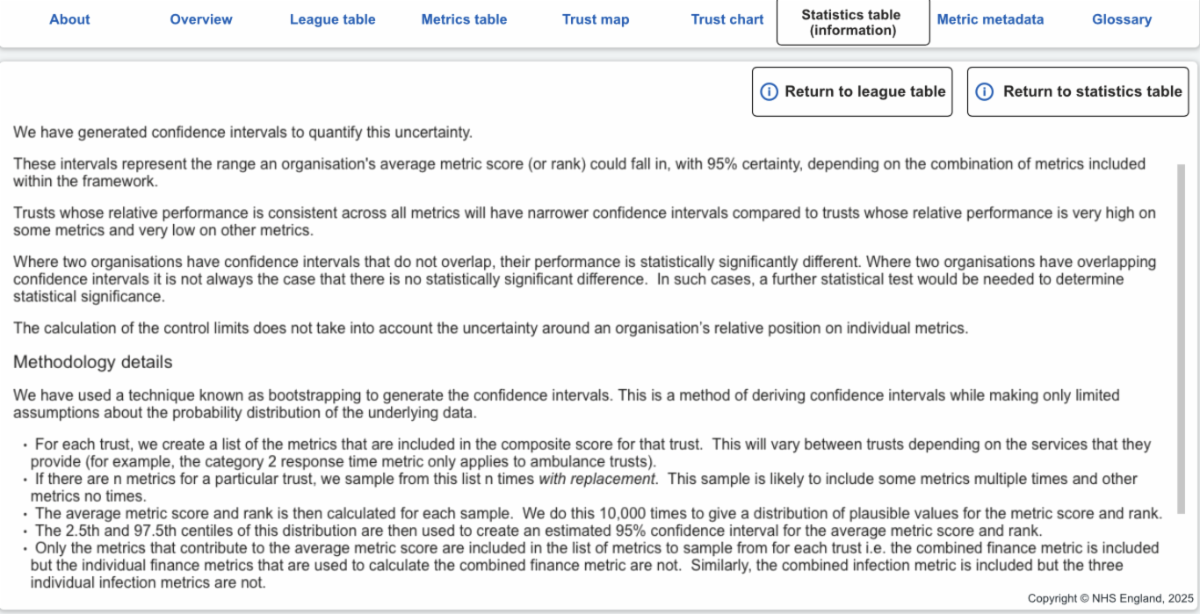
Internal performance metrics continued and this is what’s today’s tables are based on.
The CQC has since collapsed and DH+ struggled to find a stick to beat hospitals with…
… Milburn is back and so are his impenetrable league tables…
… gimmestrenght
It’s the same old story... headlines for Whitehall, grief for staff and totally meaningless for the public.
There are seven very good reasons why management by archaeology, is not a good idea and a bonus reason;
1. Oversimplification of Complex Services
Bundling multiple measures… A&E, cancer, finances, infection, staff views, waiting times… into a single ranking hides nuance.
A hospital could excel in cancer care but struggle with finances and appear ‘bad’ overall. It misleads the public and creates a false sense of clarity.
2. No Real Choice for Patients
Most people cannot freely choose their hospital, especially for emergency care.
Publishing rankings implies a consumer market that simply doesn’t exist.
The NHS Trust, serving the Isle of Wight population, where transfers of care and specialties are particularly difficult, ranks 73… there is no choice. The ranking is irrelevant.
3. Demoralises Staff and Worsens Recruitment
‘Bottom-ranked’ hospitals are publicly shamed, even if performance issues are structural. The Norfolk hospital at the bottom of the new rankings is bedevilled with RAAC and is collapsing.
They should be top, for their heroic resilience.
Note to Streeting: get this fixed.
We know from previous experience, ‘shaming’ damages morale, staff unfairly blamed for things they have no control over. Recruitment and performance suffers.
4. Encourages Gaming and Target-Chasing
Hospitals focus on improving measured metrics rather than actual patient care. Cases can be 'prioritised' and waiting lists 'managed' to look better on paper.
These tables penalise Trusts for not being able to balance their books. Fix that but not A&E times and the public is no better off.
5. Doesn’t Adjust for Context or Case Mix
Raw rankings penalise hospitals treating sicker or more complex populations. Hospitals serving deprived areas or multiple sites appear worse, even if their care quality is excellent.
Kings, the famous London teaching hospital, with an international reputation, serves one of the most deprived populations, ranks 79… despite doing a fabulous job. Their data shows they are bedevilled by discharge issues.
Note to streeting: fix social care.
6. Apples and light bulbs
Ranking a famous eye hospital, against an international children’s hospital versus an leading orthopaedic hospital, compared with a global heart hospital tells me nothing I need to know about my local hospital.
7...... this system is horribly skewed
No trust with a financial deficit can be in a segment higher than three. A financial deficit over-ride is applied. Meaning, no matter how good they are at the other thirty indicators, they'll be marked as 'failing'.
The best example is the fabulous Chelsea and Westminster, high-performing and above average in all ratings but only 28th... because it has a deficit... bonkers.
This is NHSE thuggery, plain and simple and will have a devastating effect on staff, recruitment and international reputation.
We want to know if hospitals are doing well and what is there to learn. If they are struggling… how can we help them.
The NHS has few mechanisms to share best practice other than the GIRFT programme.
Note to Streeting: Beef up GIRFT.
To be fair, these new data are immaculately presented drilling into 30 metrics and is fascinating in detail but as for where you should go for a hip operation... I'm no wiser.
Local suits me and my family and probably yours.
After all this admirable work by the bobble-hats, you are left with... so what?
The new league tables and their calculations look like action, but they’re skewed, very complex and frankly, just theatre.
They do nothing to improve patient care or support staff... and...
... don't help with the one job Silly-Boy has...
... FIX THE £!@@$^ WAITING LISTS!
We all want our hospital to be as good as the best.
That comes from skills and smart leadership that creates the time and space for good people to do great things.
Humiliating hospitals in a ranking won’t shorten waiting lists or make a roof safe...
... you do that by investing in infrastructure and people.
|