Strategic Planning Corporation
Weekly Economic Update
|
|
In This Issue
Why We So Often Fail to Keep Our New Year's Resolutions, and Why We Should Cut Ourselves Some Slack
|
|
|
This past week we had two webinars presented by the Legacy Law Firm, The Potter Law Firm and Strategic Planning Corporation entitled, "Successful Investing Means Realistic Returns". Many of you joined us for that, but if you missed it, you can watch either of the webinars by clicking one of these following links. The webinar is the same material just presented by Philip Corson & Mike Flanders for The Legacy Law Firm version and by John Potter & Mike Flanders for The Potter Law Firm version.
Did you know....
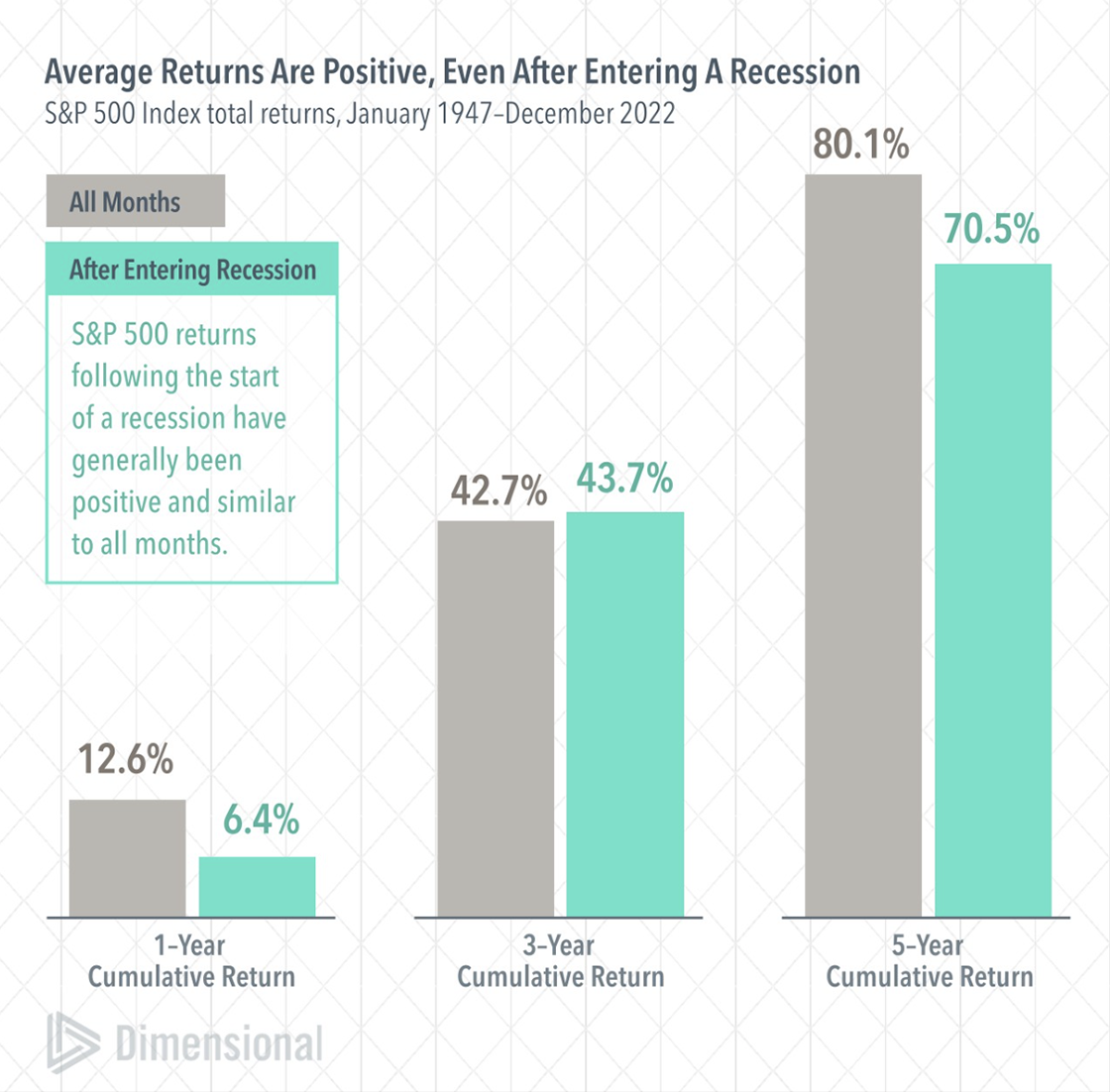
Average Returns are POSITIVE, even after entering a Recession!
Yes, you read that correctly – average returns are POSITIVE, even after entering a recession. Just check out the graphic and info below from Dimensional if it seems unbelievable!
From economists to rideshare drivers, it seems that many are fretting over the looming possibility of a recession. Markets may be in agreement, as we have already experienced a drop in stocks that some attribute to expectations of a recession. But investors should avoid the temptation to abandon equities and go to cash as equities have a history of positive performance in the years following a recession’s onset.
According to the National Bureau of Economic Research (NBER), there have been 12 recessions since 1947. The S&P 500 returns following the start of those recessions have generally been positive and similar to all months, especially for the longer 3- and 5-year time periods. How can that be?
If markets are anticipating a recession, it’s already been embedded in prices. Markets are forward-looking: stock prices incorporate not only an evaluation of days past but also expectations for the future. Plus, recessions are declared with several months delay, so markets have often readjusted to deliver positive returns shortly after the start of a recession. When it comes to recessions, it’s not clear your portfolio needs to make concessions.
|
|
The moral of the story? Hang with the markets as they have a history of providing returns that have helped a myriad of individuals realize their financial goals. While history is no guarantee of the future and future returns cannot be guaranteed, looking at historical returns and activity in the economy is interesting and instructive.
Looking at the historical record for Harry Dent is also instructive. I have included quotes and articles from and about Harry S Dent, Jr. in this space a number of times over the past years. Well, he has given me another reason to cite him again! Last year in this space on September 5th, I said the following and included some quotes from Mr. Dent:
|
|
These days, in an interview with ThinkAdvisor as reported by Jane Wollman Rusoff, Harry is telling us that we are in for the "Crash of a Lifetime" He says it "Is Here; Sell Stocks Now"! Not in a week, or a month, but NOW! "Get out of risk assets. This is your last chance to sell. Get out of the way of the crash! Sell right now!" he urges. "You don't wait. The market will go down harder and faster" than it did earlier this year, he says. And he says that by the end of 2022 the market will be at "new lows. By then it will be too late for most."
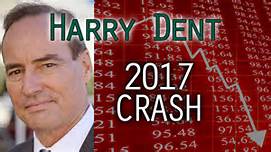
I included above a picture from an article back in 2016 where Harry was predicting a huge market crash that year. What did the S&P 500 do in 2017? +18.74% Nice Crash, Huh?!
Harry told us back in September 2022 that, "You can burn me at the stake if I'm wrong." Well.......
My advice would be to just let all the stuff you hear from the misguided gurus, prognosticators, financial media, et. al. flow past you with nary a care. Most of it is wrong and it is impossible to pick out what may turn out to be somewhat correct in the future. You are wasting time and emotions paying attention to them.
I tell you all this about Harry and others because Harry Dent is out with another prediction. Yes, he talked with the same journalist that he spoke with last summer, Jane Wollman Rusoff, who reports that "For at least six years now, controversial strategist Harry Dent Jr. has been forecasting 'the crash of a lifetime.' Now he's getting specific. His 'line in the sand' is 'one more new low' to break Nasdaq's low of 10,088 hit last October." "The next thing you know, we'll be down 50 - 60%" Harry says, "That will cause a major recession if it's not already here. You won't be able to put Humpty Dumpty together again."
Harry is saying that this year of 2023 will be "'the worst' for the U.S. economy since '1973 or 1974 or 81-82, or even back to 1931'. And 'we won't come out of this till 2025,' he insists." By the way, Harry is also predicting that "[B]itcoin will be 'the global standard for a digital monetary system.'" He has a million of 'em!
Harry is also making a short-term prediction: He responds to a question about the rally in the stock market that we've been having since October 2022 (a month after he told us the market was going to experience the "crash of a lifetime") by saying, "We're in a bounce since October. But it's not likely to last more than days or a couple of weeks. It could last a month or two, but I don't think it's going to be terribly strong." What happened to "It Is Here; Sell Stocks Now"! Not in a week, or a month, but NOW! "Get out of risk assets. This is your last chance to sell. Get out of the way of the crash! Sell right now!"???
So, put you feet up and relax because Harry may be right in a day or a couple of weeks, or a month or two and you can be enjoying things other than trying to time the market with him. We are rebalancing on highs and lows for you, so you can spend your energy on something more worthwhile for your life. I hope your experience over the past weeks, months and years shows you that trying to make adjustments to your portfolio to protect or take advantage of what are presumed to be extraordinary happenings upcoming, are futile and fraught with danger of being in the wrong place at the wrong time.
Enjoy the rest of this week's read. And be sure to check out the Weekly Tip!
|
|
Weekly Economic Update
for the Week of
January 23, 2023
Quote of the Week:
"When you get into a tight place and everything goes against you … never give up then, for that is just the place and time that the tide will turn."
~ Harriet Beecher Stowe (1811 - 1896), American abolitionist and author
|
|
The Week in Brief
Stocks showed mixed results last week as recession fears resurfaced in response to weak economic data and a tepid start to a new corporate earnings season.
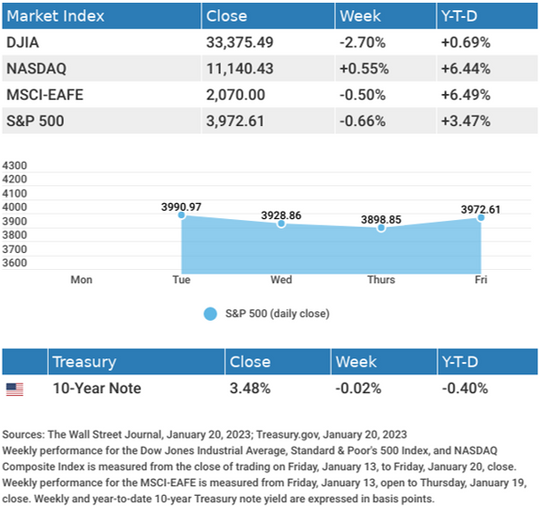
The Dow Jones Industrial Average skidded 2.70%, while the Standard & Poor’s 500 declined 0.66%. But the Nasdaq Composite index gained 0.55% for the week. The MSCI EAFE index, which tracks developed overseas stock markets, lost 0.50%.1,2,3
|
|
Mixed Economic Data
Stocks weakened to start the week amid discouraging corporate earnings and troubling economic data. Disappointing retail sales and manufacturing reports sparked concerns that the Fed may have gone too far in hiking rates, while a drop in initial jobless claims diminished chances of a near-term pause in rate hikes. Welcome news from two big technology names on Friday powered a strong rally that mixed significant indices.
The start of the earnings season was a drag on investor sentiment. While 69% of the S&P 500 constituent companies that reported earnings by Thursday (48 companies) exceeded expectations, the percentage of “beats” is below the three-year average. More concerning, however, was that average earnings declined by more than 2%.4
Consumers Retrench
Retail sales fell 1.1% in December, capping an overall weak holiday shopping season. November retail sales were revised downward to -1.0%, from the earlier estimate of -0.6%. Compared to November-December 2021, sales increased by 5.3%, below the 6 to 8% increase expected by The National Retail Federation.5,6
Many economists viewed these lackluster numbers as evidence of a weakening consumer. A more cautious consumer raises more concerns about a recession at some point this year since the primary driver of U.S. economic growth is consumer spending.
This Week: Key Economic Data
Tuesday: Purchasing Managers’ Index Composite.
Thurday: Gross Domestic Product (GDP). Durable Goods Orders. New Home Sales. Jobless Claims.
Friday: Consumer Sentiment.
Source: Econoday, January 20, 2023
The Econoday economic calendar lists upcoming U.S. economic data releases (including key economic indicators), Federal Reserve policy meetings, and speaking engagements of Federal Reserve officials. The content is developed from sources believed to be providing accurate information. The forecasts or forward-looking statements are based on assumptions and may not materialize. The forecasts also are subject to revision.
This Week: Companies Reporting Earnings
Tuesday: Microsoft Corporation (MSFT), General Electric Company (GE), Verizon Communications, Inc. (VZ), Johnson & Johnson (JNJ), Lockheed Martin Corporation (LMT), Texas Instruments, Inc. (TXN), Union Pacific Corporation (UNP), D.R. Horton, Inc. (DHI), Raytheon Technologies Corporation (RTX).
Wednesday: AT&T, Inc. (T), The Boeing Company (BA), Tesla, Inc. (TSLA), International Business Machines Corporation (IBM), Lam Research Corporation (LRCX), Abbott Laboratories (ABT), CSX Corporation (CSX), NextEra Energy, Inc. (NEE), KimberlyClark Corporation (KMB), Norfolk Southern Corporation (NSC), General Dynamics (GD).
Thursday: Intel Corporation (INTL), Visa, Inc. (V), Mastercard, Inc. (MA), Blackstone, Inc. (BX), Northrop Grumman Corporation (NOC), Southwest Airlines Co. (LUV), Rockwell Automation, Inc. (ROK).
Friday: Chevron Corporation(CVX), HCA Healthcare, Inc. (HCA), American Express Company (AXP), ColgatePalmolive Company (CL).
Source: Zacks, January 20, 2023
Companies mentioned are for informational purposes only. It should not be considered a solicitation for the purchase or sale of the securities. Investing involves risks, and investment decisions should be based on your own goals, time horizon, and tolerance for risk. The return and principal value of investments will fluctuate as market conditions change. When sold, investments may be worth more or less than their original cost. Companies may reschedule when they report earnings without notice.
|
|
FEATURE ARTICLE
Why We So Often Fail to Keep Our New Year's Resolutions, and Why We Should Cut Ourselves Some Slack
Efficient Advisors-Evidence Based Advisors/Investor Minute
|
|
Amanda Mull's father was a smoker for 20 years. When he became convinced that cigarettes were harmful, he simply quit smoking them. Later, when he decided he should take up running, he got up at 4:30 AM to get in five miles before work. And has continued this practice every day for more than 30 years.1
Mull, writing in The Atlantic, says that her dad's ability to adopt life-changing habits (or quit bad ones) was seen by her as the norm. For years she struggled to exercise regularly, and compared to her father, she's been an abject failure.
But many of us hold to a similarly unrealistic standard.
"Stories like my dad's," she writes, "often serve as pop-psychological proof that you, too, could become a runner, if you really wanted to." (emphasis added)
That's the thought we punish ourselves with after we fail. "I just don't want this bad enough." We think the key to lasting change is just somehow digging up more willpower.
But the truth is that the virtue we label "willpower" comes in two varieties: the kind that requires ongoing self-discipline, and the kind that's innate. The first requires a lot of extra effort, while the second more or less comes naturally.
Up until about 20 years ago, popular psychology lumped these two together, and added the idea that your success or failure at gaining a new habit was a matter of personal character. If you succeeded at your diet or put more of your paycheck into savings, then you were a better person.
But since then it's been shown that for some people, beneficial activities that the rest of us struggle to maintain, are easy or even enjoyable. There are people who actually like going to pool at 5 a.m. or updating their budget on a daily basis. Conversely, a person who prefers the taste of kale to French fries, will have less trouble cutting out fast food.
But what about making a change in an area that goes against your natural bent? Can you establish a good habit where you've failed before?
There's reason for hope here. Behaviorists have found that you can increase your chances for lasting success if you make the new habit as easy as possible. In other words, you can enable yourself in a positive way.
Mull gives her own example of wanting to eat a more healthy diet, which means eating out less often, which means doing more cooking at home. The problem was that she didn't like cleaning up the kitchen, and so would fall behind on doing the dishes, which made it difficult to prepare the next meal—something she wasn't naturally inclined to do anyway.
She solved her willpower problem by buying a bluetooth speaker for her kitchen. Now doing the dishes gives her the opportunity to listen to her favorite podcasts. Something she otherwise wouldn't have time for. And the task she once avoided is now a regular source of enjoyment.
As you consider the lifestyle and financial habits you'd like to establish this year, think about ways to reduce the friction and make them something you might even look forward to.
To meet your objectives as you save for financial goals and retirement, ask your trusted advisor about ways to automate the process, making it as easy as possible to see positive change.
|
|
Weekly Tip
A thought to consider!
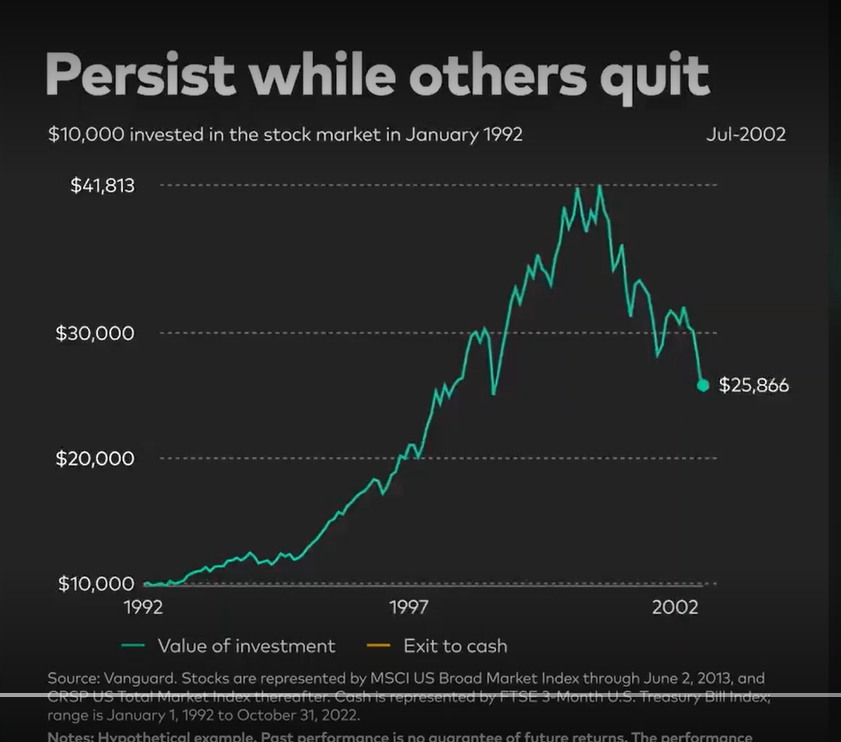
Persist While Others Quit! Click this LINK! |
|
Riddle of the Week:
Take one letter out of a 7-letter word and it becomes longer. What is this word?
Last Week's Riddle:
You need to take a gallon of oil out of a barrel of oil. How can you do it using only a 3-gallon container and a 5-gallon container?
Last Week's Answer:
Fill the 3-gallon container with oil and pour it into the 5-gallon container. Then fill the 3-gallon container again and use it to fill the 5-gallon container the rest of the way. One gallon will be left in the 3-gallon container.
|
|
Each year Strategic Planning Corporation updates it filing with the appropriate securities administrators by way of a form call the "ADV". Our ADV is available to you at any time simply by making a request or clicking here to Download it. A hard copy is also available for the asking. Please let us know if we can provide you with this important disclosure document about how we conduct our business.
Thank you for reading this newsletter. We want to be the financial partner you need . . . the financial partner you can trust. Call on us at (336) 668.4338 for anything we can do to help you.
Please feel free to forward this article to family, friends, or colleagues. You may use the "Forward email" link at the bottom of this page. If you would like us to add them to the list, please reply to us with their address and we will contact them and ask for their permission to be added. Thank you.
Sincerely,
R. Michael Flanders, CLU, CFP®
Certified Financial Planner™professional
Strategic Planning Corporation
(336) 706-2605
Investment Advisory Services offered through
Strategic Planning Corporation
|
|
Much of this material was prepared by MarketingPro, Inc., and does not necessarily represent the views of the presenting party, nor their affiliates. The information presented herein should not be construed as investment advice. This information has been derived from sources believed to be accurate. Please note - investing involves risk, and past performance is no guarantee of future results. The publisher is not engaged herein in rendering legal, accounting or other professional services. If assistance is needed, the reader is advised to engage the services of a competent professional.
This information should not be construed as investment, tax or legal advice and may not be relied on for the purpose of avoiding any Federal tax penalty. This is neither a solicitation nor recommendation to purchase or sell any investment or insurance product or service, and should not be relied upon as such. All indices are unmanaged and are not illustrative of any particular investment. The Dow Jones Industrial Average is a price-weighted index of 30 actively traded blue-chip stocks. The NASDAQ Composite Index is an unmanaged, market-weighted index of all over-the-counter common stocks traded on the National Association of Securities Dealers Automated Quotation System. The Standard & Poor's 500 (S&P 500) is an unmanaged group of securities considered to be representative of the stock market in general. It is not possible to invest directly in an index. NYSE Group, Inc. (NYSE:NYX) operates two securities exchanges: the New York Stock Exchange (the "NYSE") and NYSE Arca (formerly known as the Archipelago Exchange, or ArcaEx®, and the Pacific Exchange). NYSE Group is a leading provider of securities listing, trading and market data products and services. The New York Mercantile Exchange, Inc. (NYMEX) is the world's largest physical commodity futures exchange and the preeminent trading forum for energy and precious metals, with trading conducted through two divisions - the NYMEX Division, home to the energy, platinum, and palladium markets, and the COMEX Division, on which all other metals trade. Additional risks are associated with international investing, such as currency fluctuations, political and economic instability and differences in accounting standards. This material represents an assessment of the market environment at a specific point in time and is not intended to be a forecast of future events, or a guarantee of future results. Past performance is no guarantee of future results. Investments will fluctuate and when redeemed may be worth more or less than when originally invested. All economic and performance data is historical and not indicative of future results. Market indices discussed are unmanaged. Investors cannot invest in unmanaged indices.
Investing involves risks, and investment decisions should be based on your own goals, time horizon, and tolerance for risk. The return and principal value of investments will fluctuate as market conditions change. When sold, investments may be worth more or less than their original cost.
|
|
CITATIONS:
1. The Wall Street Journal, January 20, 2023
2. The Wall Street Journal, January 20, 2023
3. The Wall Street Journal, January 20, 2023
4. The Earnings Scout, January 19, 2023
5. Census.gov, January 18, 2023
6. The Wall Street Journal, January 18, 2023
|
|
|
|
|
|
|