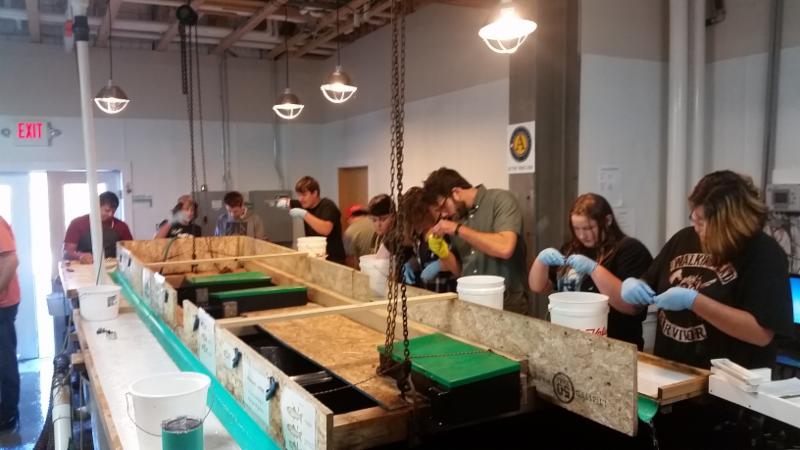
I know some people wish summer weather would never leave, but when you are operating a hatchery full of endangered salmon you look forward to cooler temperatures outside. Not to wish away time, but these cooler temperatures not only bring on the fall weather, but drop the temperature of the river into the ideal range for fin clipping. Due to the unseasonably warm weather Downeast and the continued drought, we had to push the start of fin clipping this year back a week. On the bright side though, we started in full swing today. Assuming the temperatures stay cool we can continue to clip until all of the 200,000 plus "little athletes" are marked.
For those that are new, we clip the adipose fin off each one of our fish. The goal of this activity is to distinguish salmon stocked from the Peter Gray Hatchery from wild salmon in the river during future assessment (electrofishing and smolt trapping). This allows us to know the precise impact our unique rearing and stocking strategies have on the total salmon population for the East Machias River.
Earlier this month, DSF and Maine Department of Marine Resources staff electrofished 25 sites throughout the East Machias River watershed. Electrofishing is done each year in mid-September to give a snapshot in time comparison of salmon densities from year to year...and in the case of the East Machias River...decade to decade. As you are all aware, 2017 has been a record setting drought year for Downeast Maine, and we have yet to get enough rain to start to bring water levels up in the river. Despite the drought this year and the drought during the summer and early fall of 2016, however, electrofishing results remained promising.
Preliminary numbers for 2017 East Machias River electrofishing:
- Min: 1.4 parr/unit (100 meters squared)
- Max: 28.2 parr/unit
- Drainage wide median: 13.2 parr/unit
Although the 13.2 parr/unit was not quite as high as the 14.9 parr/unit (highest drainage-wide median since 1984) observed in 2016, it is still a good density of salmon throughout the river. This is especially true given the two record setting drought years these fish have experienced in 2016 and 2017. Also, 13.2 parr/unit is still higher than the previous three year median of 11.6 parr/unit. We are also seeing densities of salmon in the East Machias that haven't been documented since the 1980's. A certain number of the parr captured during electrofishing made their way to the Craig Brook US Fish and Wildlife National Fish Hatchery to be raised to adult salmon. These adult salmon are what provide the eyed eggs for the Peter Gray Parr Project.