|
Image: Apple
Apple Reference Image vs. C2PA
At a high level, the two approaches differ in philosophy and implementation:
- “Digital passport” vs. “notary”
C2PA works like a properly stamped passport: it attaches a signed historical record to the file itself. That record can document a chain such as: Captured on a Nikon Z9 → Edited in Photoshop → Exported.
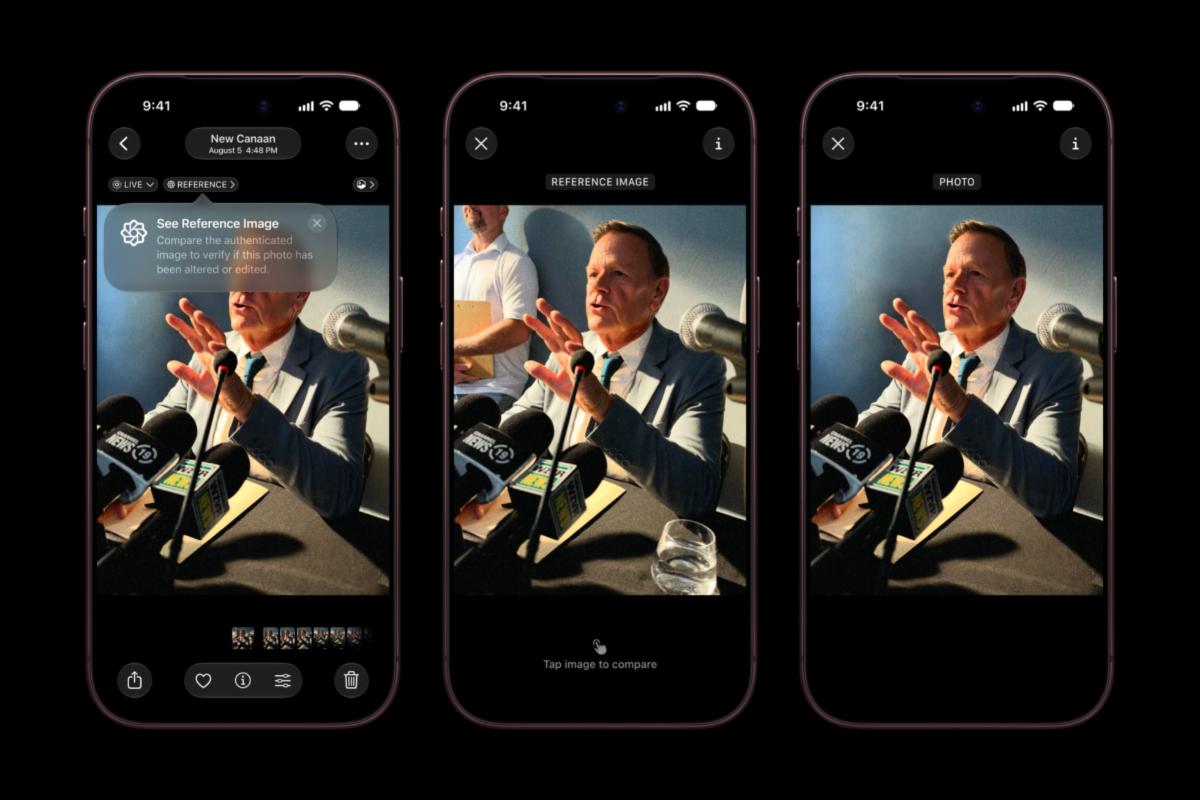
Apple Reference Image is closer to a land registry or notary. Rather than relying primarily on an edit history that travels with the file, Apple retains an untouched reference copy of what its iPhone sensor captured. The premise is that a viewer can retrieve and inspect that original digital negative to understand what may have changed.
- Open ecosystem vs. proprietary system
C2PA is designed as an open ecosystem. Any camera maker, software developer, AI company, publisher, or social network can implement it, inspect existing credentials, and append new credentials as content moves through a workflow.
Apple has chosen a walled garden approach, tying proof to its own silicon and Private Cloud Compute. That could make the system highly secure and streamlined within the Apple ecosystem. But it also creates a separate provenance path from the broader cross-platform standards effort — particularly if Apple does not add C2PA support.
Vulnerabilities and practical questions
C2PA’s chief weakness is that its credentials can be stripped. Social platforms, metadata-cleaning tools, screenshots, file conversion can break the credential chain.
- This means that if an image contains no C2PA information, that absence does not prove the image never carried credentials; it simply means provenance information is not available. Users should therefore treat missing credentials with caution, not as evidence of manipulation.
- But when C2PA credentials are present, they do provide signed provenance information about the image’s origin and the modifications recorded since capture.
Apple’s Reference approach avoids metadata stripping by cryptographically linking the image to the reference record in its secure Private Cloud.
- However, iPhone-captured Reference Images could still portray heavily edited or deepfake GenAI images if taken of existing images.
- Authentic capture verification does not establish ownership, context, intent, or truthfulness.
It’s unclear at this point to what degree professional users — or everyday consumers — will be able to compare an image with its reference image and recognize meaningful differences.
The key distinction is this: C2PA aims to make provenance portable across the media ecosystem, while Apple Reference Image aims to establish a highly trusted original capture record within Apple’s ecosystem. Both approaches can be valuable — but neither, on its own, can determine whether an image tells the full truth.
Apple. iPhone 18 Pro and Pro Max: new camera, plus updated camera app and developer API.
Apple unveiled the iPhone 18 Pro and Pro Max, featuring a redesigned 48MP Fusion Main camera. Highlights are:
-
New Main Camera System: The primary hardware upgrade in the iPhone 18 Pro is a six-bladed physical variable aperture (F1.48, F1.8, F2.8, and F4) on its main camera. Unlike the fixed aperture lenses in previous iPhones, this allows you or the phone’s software to choose whether it wants to cut down on the amount of light hitting the sensor, or make adjustments to the depth of field without resorting to software tricks.
-
Camera App Features Enhanced Manual Controls and Video: Apple introduced built-in "Pro controls" for setting parameters like manual aperture, white balance, and shutter speed, alongside software upgrades specific to video, such as 4K/60 Cinematic video and 4K time-lapse recording.
-
Unchanged Secondary Lenses: The ultra-wide (13mm equiv.) and telephoto camera hardware remains identical to the previous generation, meaning most optical enhancements are exclusive to the main lens.
-
Updated API: Camera app developers will gain complete access to the iPhone 18 Pro’s new variable aperture system via an updated API.
New York Times. Dash cam footage: the new cool thing.
Dash cams have been widely used in Russia for quite a while to record evidence against accidents and scams. Footage is typically boring when shared (and a genre in itself, search YouTube for “Russia dash cam relaxing” or “Russia driving ASMR), but now dash cam footage is becoming a compelling social-media entertainment phenomenon outside Russia as well, alongside security, body-camera, and doorbell footage.
Road videos are especially addictive because they combine genuine danger, near misses, and a built-in invitation for viewers to judge who is at fault. For instance, check out this viral “instant karma” hit-and-run clip that illustrates the format: viewers expect the fleeing driver’s punishment, but comments also scrutinize the victim’s risky decision to chase him while a child is in the car.
The result is surveillance footage that turns everyday driving into public spectacle, moral debate, and participatory storytelling.
And yes, it’s a convenient advertisement platform for the dash cam company.
OpenAI. ChatGPT Images 2.5: The next salvo in the GenAI race
Who makes the best generative AI image model? It depends on when you ask. Reviews constantly trade praise among Midjourney, Flux (Black Forest Labs), and OpenAI, but ChatGPT Images 2.5 now claims the spotlight.
Most importantly, this release get praise for its:
-
Precise editing tools — including Remove BG, Erase, Resize, Markup, and Comments — allowing direct image adjustments without rewriting prompts.
-
Prompt-guided layout templates for posters, flyers, merchandise, and product photography.
-
New Sketch tool to direct image generations using rough drawings.
-
For developers, OpenAI released two API versions: GPT-Image-2.5 Flare for fast, high-volume tasks, and GPT-Image-2.5 Sunburst for high-end creative workflows requiring fine editing control.
MediaViz AI & Kinoke. Media intelligence meets family media sharing.
Long term Visual 1st supporter MediaViz AI, a media intelligence company providing AI-powered photo analysis, organization, and curation technology, announced a partnership with Kinoke, Memory Ventures' private family media platform and last year Visual 1st presenter, to bring AI-powered organization and discovery directly into the Kinoke experience.
The initial integration uses MediaViz AI to analyze photo collections and automatically organize images into meaningful categories and albums. AI-generated metadata also makes collections more searchable, helping Kinoke customers more easily find specific photos and moments across large libraries.
Printess. Launching AI Assistant
Printess, a cloud-based web-to-print and personalization platform for creating and selling customizable products online, launches AI Assistant, a conversational designer built into the Printess Editor that turns natural language into working web-to-print products, such as business cards, banners, promotional gift items, apparel, greeting cards, invitations and more.
For instance, ask for agentic AI user can create their own twelve-month wall calendar by picking the year, the date range and the holidays, resulting in 13 spreads with image placeholders on every month.
AI Assistant works from existing templates as well as from prompts to create layouts from scratch. See it in action at Visual 1st!
Insta360. New vlogging cam.
There’s no slowdown in Insta360’s product releases. Newest kid on the the block: Luna Pro, a $599 gimbal camera co-engineered with Leica.
Built for fast, high-quality content creation, it features a Leica Summicron lens, a 1-inch sensor capable of 8K Dolby Vision video, 10-bit I-Log, and native 4K vertical video recording.
Designed for versatility on the go, the camera comes with a detachable 2-inch OLED touchscreen, 47GB of built-in storage, and up to four hours of battery life.
Fujifilm. New palm-sized camera and wide-format smartphone printer.
Fujifilm announced the Instax Pal 2 digital camera and the Instax Link Wide 2 smartphone printer.
The tiny Pal 2 camera features a retro rectangular body with a built-in optical viewfinder, a top-mounted 1.0-inch LCD screen, an upgraded 10.7MP sensor, and a new "Animation" clip mode.
Meanwhile, the Instax Link Wide 2 portable smartphone printer enable photographers to print their photos on Instax Wide instant film, no matter which digital camera they used to capture the shot. It comes with an updated app offering an automated "Photo Mixer" collage layout tool.
Both devices seamlessly connect wirelessly, allowing users to format and print images across Instax Mini, Square, or Wide film sizes.
Jan Banning. Photos of bureaucrats from all over the world.
Check them out. Happy Wednesday!
|