You're receiving this email because of your relationship with Lofy Group Wealth Management. Please confirm your continued interest in receiving email from us. 
You may unsubscribe if you no longer wish to receive our emails.
LOFY GROUP NEWSLETTER
8/23/2021
TAGLINE
One Mission -- Many SolutionsTM
In This Issue
The Markets

Picking The Right Place To Live...

Thought for the Week
The Markets
 
On Wednesday, the minutes of the United States Federal Reserve’s Open Market Committee Meeting were released. They confirmed the Fed could begin tapering – buying fewer Treasury and U.S. government agency bonds – sooner rather than later, reported Jack Denton and Jacob Sonenshine of Barron’s. While that wasn’t new information, investors startled like cats surprised by cucumbers, triggering a broad sell-off.
 
In the United States, economic data was mixed. The U.S. Census reported that retail sales declined in July, suggesting weakening consumer demand. Normally, that’s not great news because consumer demand drives U.S. economic growth. However, with inflation at the highest level in more than a decade, lower demand could help relieve upward price pressure.
 
Lower consumer demand was accompanied by improving supply. Lisa Beilfuss of Barron’s reported, “…business inventories rose in June at the fastest clip since October as wholesalers and manufacturers posted solid increases and retailers saw inventories rise for the first time in three months. From a year earlier, inventories across American businesses rose 6.6%, compared with a 4.6% pace a month earlier.”
 
Of course, we could see supply bottlenecks again if a COVID-19 surge results in new lockdowns and continued worker shortages.
 
Finally, on Friday, Chinese stocks dropped sharply after Beijing announced that a new strict data-privacy law will take effect on November 1, 2021. Investors remain concerned that China’s regulatory tightening will affect other market sectors, including fintech, gaming and education, reported Hudson Lockett of the Financial Times.
 
“American investors’ shock at an ongoing regulatory crackdown in China points to a fundamental difference between the two countries,” reported Evelyn Cheng of CNBC. “…whereas the U.S. system is designed to let corporations influence the government, China’s system is designed to bring corporations in line with government goals.”
 
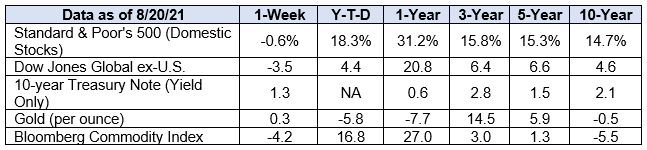
Major U.S. stock indices finished the week lower. The yield on 10-year U.S. Treasuries finished the week where it started.
S&P 500, Dow Jones Global ex-US, Gold, Bloomberg Commodity Index returns exclude reinvested dividends (gold does not pay a dividend) and the three-, five-, and 10-year returns are annualized; and the 10-year Treasury Note is simply the yield at the close of the day on each of the historical time periods.
Sources: Yahoo! Finance, MarketWatch, djindexes.com, London Bullion Market Association.
Past performance is no guarantee of future results. Indices are unmanaged and cannot be invested into directly. N/A means not applicable.
Picking The Right Place To Live...
The COVID-19 pandemic caused many people to reconsider how and where they want to live. People relocate for a variety of reasons. They may want to be closer to family and friends, live in a more affordable place with lower taxes or have better employment opportunities.
 
Another reason people relocate is climate. While many people move to regions with better climates, today they also are avoiding areas with high climate risk, reported a 2021 survey from RedFin.
 
“About half of respondents who plan to move in the next year said extreme temperatures and/or the increasing frequency or intensity of natural disasters played a role in their decision to relocate. More than a third (36%) said rising sea levels were a factor.”
 
Those who planned to move and lived in the northeastern and southern U.S. were most concerned about the frequency and intensity of natural disasters, while those in the West were most concerned about extreme temperatures. The two factors tied for most serious concern in the Midwest.
 
The importance of climate change to relocation decisions varied by age. People age 55 and older were less likely to factor climate risk into relocation decisions, while younger respondents, especially 35- to 44-year-olds, prioritized climate risk issues.
 
When all respondents, regardless of whether they intended to move, were asked whether natural disasters, extreme temperatures or rising sea levels would affect their decision to buy a home, the majority said they would hesitate to buy homes in areas with these issues (79%, 75% and 76% respectively).
 
Home buyers aren’t the only ones thinking about climate risks. A real estate developer told Swapna Venugopal Ramaswamy of USA Today, “…real estate investors such as banks and insurance companies used climate risk data to inform their investing decisions.”
 
It seems that climate risk is becoming a factor in personal and business investment decisions.

Weekly Focus - Think About It
“The evidence on climate risk is compelling investors to reassess core assumptions about modern finance.... Will cities, for example, be able to afford their infrastructure needs as climate risk reshapes the market for municipal bonds.... How can we model economic growth if emerging markets see their productivity decline due to extreme heat and other climate impacts? Investors are increasingly reckoning with these questions and recognizing that climate risk is investment risk.” 

--Larry Fink, Chairman and Chief Executive Officer of BlackRock 
Best regards,
 
Lofy Group Wealth Management
  
P.S. Please feel free to forward this commentary to family, friends, or colleagues. If you would like us to add them to the list, please reply to this e-mail with their e-mail address and we will ask for their permission to be added. 
Securities offered through LPL Financial, Member FINRA/SIPC
Accounting and Legal Services are not affiliated with LPL Financial

* This newsletter was prepared by Peak Advisor Alliance.
 
* The Standard & Poor's 500 (S&P 500) is an unmanaged group of securities considered to be representative of the stock market in general.
 
* The DJ Global ex US is an unmanaged group of non-U.S. securities designed to reflect the performance of the global equity securities that have readily available prices. 
 
* The 10-year Treasury Note represents debt owed by the United States Treasury to the public. Since the U.S. Government is seen as a risk-free borrower, investors use the 10-year Treasury Note as a benchmark for the long-term bond market.
 
* Gold represents the London afternoon gold price fix as reported by the London Bullion Market Association.
 
* The DJ Commodity Index is designed to be a highly liquid and diversified benchmark for the commodity futures market. The Index is composed of futures contracts on 19 physical commodities and was launched on July 14, 1998.
 
* The DJ Equity All REIT TR Index measures the total return performance of the equity subcategory of the Real Estate Investment Trust (REIT) industry as calculated by Dow Jones.
 
* Yahoo! Finance is the source for any reference to the performance of an index between two specific periods.
 
* Opinions expressed are subject to change without notice and are not intended as investment advice or to predict future performance.
 
* Past performance does not guarantee future results.
 
* You cannot invest directly in an index.
 
* Consult your financial professional before making any investment decision.