Here's How the San Gabriel Valley Did Great Things to Capture Stormwater During Recent Storms! | |
|
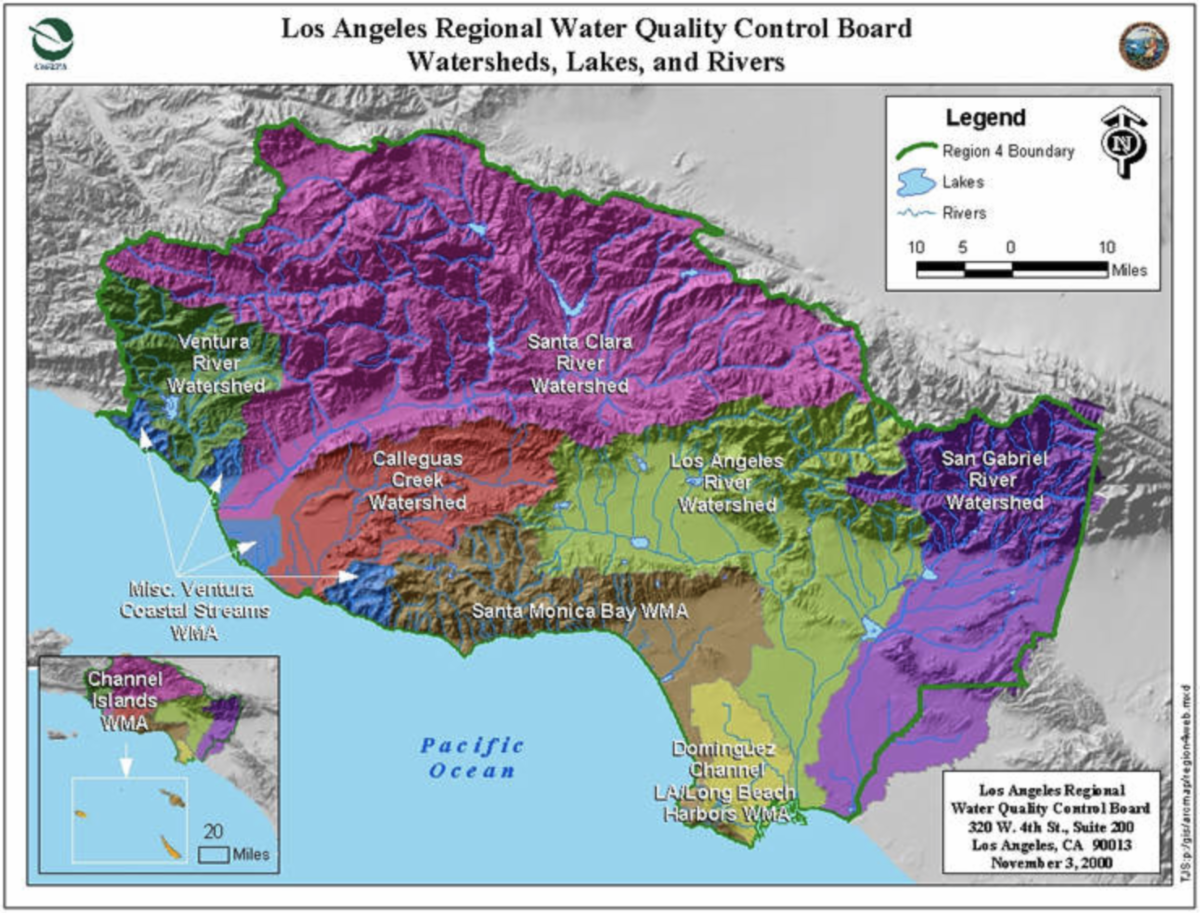
We live in the purple-colored San Gabriel River “watershed,” one of several watersheds in Los Angeles County. But we live in the Los Angeles media market. Much of the water “news” we are exposed to relates to the city of Los Angeles. However, different watersheds manage their stormwater in ways best suited to their locales. The San Gabriel Valley “water story” is unique in that 80% of the water we use is local groundwater.
Each watershed is formed by distinct topography, geology and hydrology. Decades ago, as reservoirs, dams, flood control channels, and spreading grounds were being planned, as public works and flood management personnel grappled with saving life and property, some watersheds went in the direction of building infrastructure and operating programs that “flushed” water to the ocean via storm drains as fast as possible to reduce the risk of flooding, thus, saving life and property.
Our San Gabriel River watershed was different. We, too, had to protect life and property. However, we embraced saving water for beneficial use, as well. Our region built its water infrastructure to retain and channel as much stormwater within the San Gabriel Valley as possible so it could percolate down and recharge our groundwater supplies.
Overall, the greater San Gabriel Valley captures more than 95% of stormwater, even during massive storms like we experienced earlier this year, to supplement local groundwater supplies. Data shared by the Main San Gabriel Basin Watermaster reveal that of the more than 500,000 acre-feet of stormwater captured this year in Los Angeles County, about 300,000 AF came from the San Gabriel River watershed.
Our water management agencies and infrastructure have positioned us well for the future. Plus, our District and other state water contractors will receive 100% of their imported water allocations this year to use to supplement our local groundwater supplies. This means imported water will replace more of the water we use than in recent years, helping to preserve our improved water supplies.
Our water supplies are not fully sustainable…. yet, because in the long-term we still use more water than Mother Nature provides. So, the final piece of the puzzle is conservation. Statewide, conservation levels need to increase – we did not achieve the voluntary 15% conservation level called for by the State during the recent drought. If we can increase our water saving, we can make our precious groundwater supplies last even longer!
| |
|
OPERATIONS &
INFRASTRUCTURE
| |
|
|
Operations Update
Following the April 20, 2023, announcement that State Water Project (SWP) allocations to state water contractors, such as SGVMWD, were being increased to 100% of plan for the first time since 2006, the benefits have continued to flow to the Main San Gabriel Basin and our member cities. The increase means the District will be allocated 28,800 acre-feet of imported water in 2023 to deliver and use for replenishment of groundwater in the Main San Gabriel Basin.
| |
|
We are working closely with state and county water agencies to utilize available capacity in reservoirs, pipelines and spreading grounds to deliver the imported water. With water delivery capacity “overflowing” due to the abundance of stormwater runoff and snow melt throughout the state, scheduling deliveries is complicated and requires smart water management. Some of the 2023 water deliveries will likely need to carry over into the next calendar year.
In July, the District delivered 1,905 acre-feet (AF) of water to cyclic storage and 885 AF to CIC on behalf of Three Valleys Municipal Water District. Three important facility maintenance projects are underway: the Hydro 24-inch Butterfly Valve Replacement Project is nearly completed; the San Gabriel Flow Control Structure 30-inch Ball Valve Replacement Project bid award will occur at an upcoming board meeting; and the Schedule I Pipeline Continuity Bonding, Corrosion Assessment Validation Project bid award will take place at a special board meeting on or after August 21, 2023. On May 15th, the District began generating power at its San Dimas hydroelectric facility for the City of Azusa and power generation should continue most of calendar year. In July, the District generated 242.9 MWh of power for the city.
Imported water supplements local groundwater supplies in the Main San Gabriel Basin, the primary sources of water for the District’s member cities of Alhambra, Azusa, Monterey Park, and Sierra Madre. The planned allocation may be adjusted in the future based on hydrological conditions.
| |
|
Water Supply Have Improved as We Face Hot and Dry Summer Months
| |
|
The continuation of the snowmelt and ensuing water runoff in July, coupled with increased flow of imported water into the San Gabriel Valley and aggressive stormwater capture infrastructure and programs, further improved drought and water supply conditions statewide and the Valley. Smart water management and collaboration between water agencies is needed to strategically time releases of water in reservoirs into nearby streams and spreading grounds.
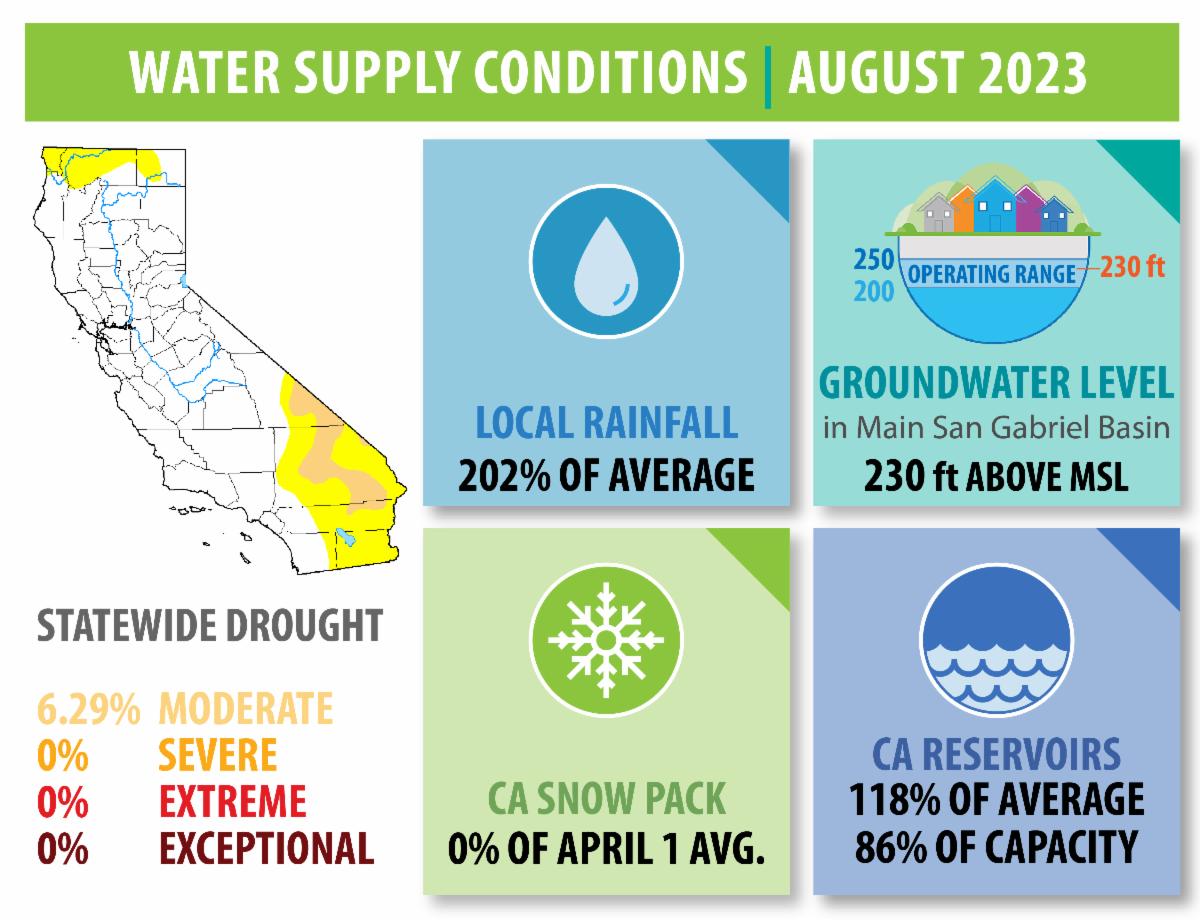
The graphics above show the marked improvement from January through August 2023 in state and local reservoir, snowpack and groundwater conditions, including significant lessening of drought conditions statewide. Local groundwater, which improves more slowly due to the time it takes stormwater runoff to percolate down to groundwater levels, has risen more than 50 feet year-to-date!
The Main San Gabriel Basin captured more than 95% of stormwater to supplement local groundwater supplies in the storm surge earlier this year, which is much different than other watersheds that convey the majority of their stormwater to the Pacific Ocean as a flood control measure. Data from Watermaster reveal that of the more than 500,000 acre-feet of stormwater captured this year, about 300,000 AF came from the San Gabriel River watershed.
While Mother Nature has granted us a reprieve from the most recent drought, we must remember we live in a region where most years are dry, infrastructure is aging, drought will return, and climate change makes the work of water planning and delivery challenging. The reality remains that we use more water than Mother Nature provides and if we’re not in a drought, we are probably either getting into one or recovering from one.
We need to sustain our focus on investments in long-term water infrastructure and developing a long-term water conservation ethic that enables us to save water now, when it’s wet, for when it’s dry. While the State and some municipalities have lifted certain water use restrictions, it’s important to note that in the past 1-2 years Californians fell short of meeting the voluntary 15% conservation goal and also fell short of the 25% conservation level achieved in the next most recent drought period.
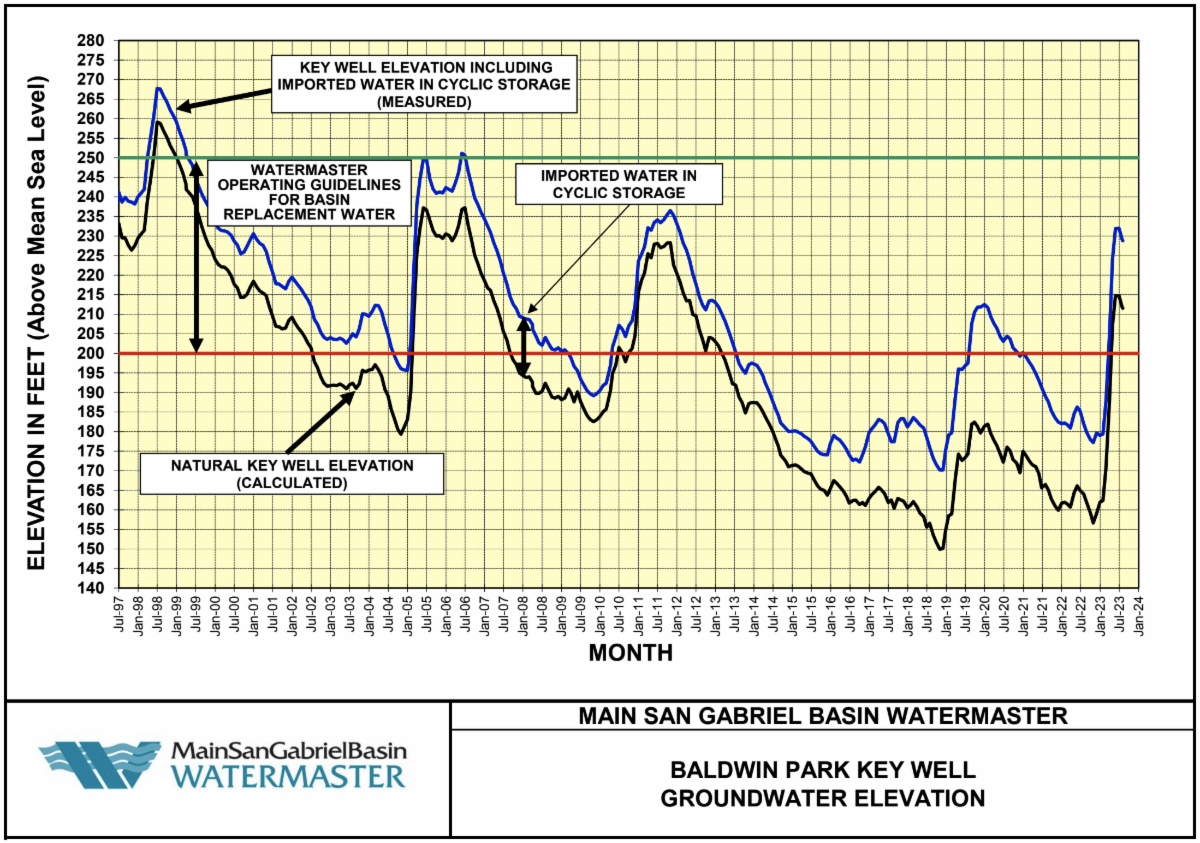
Groundwater – in the Main San Gabriel Basin, the “Baldwin Park Key Well” is the indicator of local groundwater levels (see graph – blue line includes cyclic storage; black line does not). As of July 28,2023, the level decreased slightly to 229.2 feet above mean sea level (see most recent Baldwin Park Key Well below).
Prior to the storms earlier this year, the Basin had experienced a steady decline in groundwater levels from a high of 212.5 feet above mean sea level in December 2019 and was trending downward toward the historic low of 169.4 recorded on November 21, 2018. One vertical foot is equivalent to about 8,000 acre-feet of groundwater in the Main Basin. Watermaster’s operating guidelines for replacement water or “safe yield” is between 200 and 250 feet above mean sea level.
About 80 percent of the Valley’s water supply is furnished by local groundwater, and the Valley imports about 20 percent of the water we use from northern California and the Colorado River. A 60 percent allocation is needed to meet the demand of our member cities for replacement water. Thus, in years where the allocation dips below that amount, we see the important role that water storage and water conservation play.
Note: Groundwater use accounts for 41% of California’s total water supply (80% in the San Gabriel Valley) on an average, annual basis, and as much as 58% in a critically dry year. About 85% of public water systems rely on groundwater as their primary supply. Of water diverted and pumped in California, about 80% is used by agriculture and 20% is used by cities and towns.
| |
|
Imported Water – In April, the California Department of Water Resources increased State Water Project allocations to State Water Contractors such as SGVMWD for 2023 to 100% for the first time since 2006. Imported water is used to supplement local groundwater supplies in the Main San Gabriel Basin.
Note: Two-thirds of California’s water originates in the Sierra Nevada Mountains and flows through the Delta, a large inland river delta and estuary in northern California.
| |
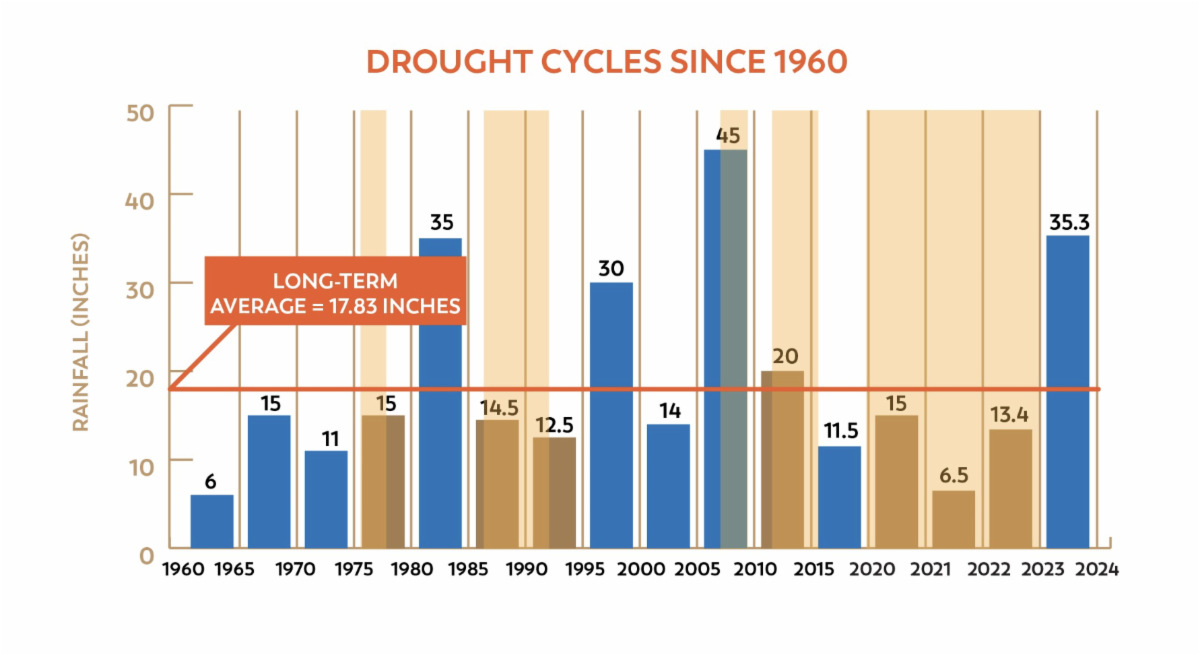
Local Rainfall – the LA County Department of Public Works (DPW) reports annual rainfall levels from October 1 to September 30 of each year. As of August 1, 2023, the DPW headquarters location in Alhambra had recorded 36.01 inches of rain, about 202% of average (average annual rainfall at this location is 17.83 inches). The graph below shows both annual rainfall totals dating back to 1960, as well as the major drought cycles since then. | |
|
Statewide Snow Pack – as of July 1, the State is reporting 0% for its snow data, effectively starting its recordings anew as we head into the summer, fall and winter months. Snowpack is measured from April 1 to March 31, a 12-month period). April 1 is usually the “high point” for snow accumulation each year. What remains of the recent winter’s snowpack is one of the biggest the state has experienced since the 1950s.
Note: On average, the Sierra Nevada Mountains snowpack, which is a key source of water banked in reservoirs, supplies about 30% of California’s water needs as it melts in the spring and early summer, feeding reservoirs and the water table, resulting in groundwater. The snowpack is often referred to as California’s “frozen reservoir.”
Statewide Reservoir Levels – statewide, as of June 30, 2023, (the latest statewide data available to us), reservoir levels had risen to 118% of average and 86% of capacity. As of July 30, storage levels at Shasta Lake, the state’s largest reservoir, were 85% of capacity and 125% of the historical average for this date, and storage levels at Lake Oroville, the state’s second largest reservoir, were 91% of capacity and 138% of the historical average.
Locally, both San Gabriel Reservoir and Cogswell Reservoir are conducting sediment removal, and Lake Silverwood, which rests above San Bernardino and is adjacent to the start of the District’s Devil Canyon-Azusa Pipeline, is filled to 92% of capacity and 104% of average. During the recent drought, low precipitation levels, high temperatures, hot and dry soil, and high levels of evaporation decreased stormwater runoff from surface levels to replenish both reservoirs and local groundwater supplies.
Note: Every winter, most areas need about 12 inches of rainfall before the ground is saturated enough to get large amounts of runoff into streams and reservoirs. California’s reservoirs generally hold enough water to go one dry year without impacts but begin to empty if a wet year does not follow.
| |
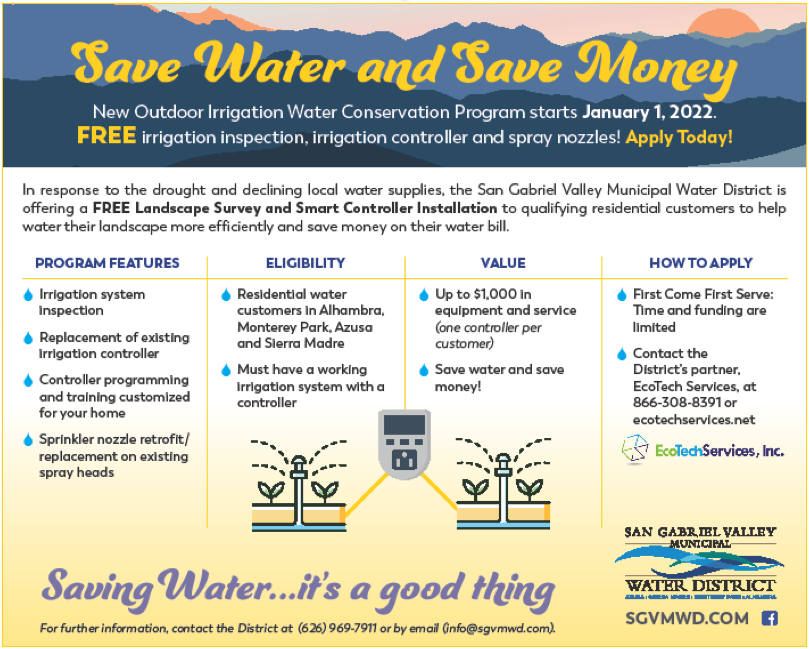
Our popular irrigation system retrofit program continues to feature 1) a FREE irrigation system inspection; 2) replacement of an existing irrigation controller with a FREE, new programmed unit; and 3) FREE installation of new sprinkler nozzles on existing pop-up spray heads. Since January 2022, EcoTech has performed 257 site assessments. 236 weather-based “smart” controllers have been installed in 215 properties and 5,766 sprinkler nozzles have been upgraded to water-efficient rotating nozzles. The approximate cost/value per landscape to date is $1,136. Funding is limited, so please review the informational flyers below and on our website and act as soon as possible. Residents in all our member cities may apply for the irrigation retrofit program by contacting our partner, EcoTech Services (866-308-8391 or ecotechservices.net). | |
|
The District’s popular and long-running Opportunities for Water Leadership Community Grant Program (O.W.L. Grants) provided grants ranging from $500-$1,500 to schools and non-profits for Earth Day related educational activities in April. These grants were IN ADDITION to the ongoing unlimited grant program. If you were unable to participate in the April 2023 Earth Day grant program, please consider our ongoing grant program at the most convenient time of the year for you and your organization.
Streamlined applications and additional information about the program are posted on the District’s website. www.sgvmwd.com
The District’s O.W.L. Grants Program was featured in September 2022 by ABC-Channel 7 to help encourage water conservation as part of its “Water-Wise Wednesday” community feature. The entire news segment may be viewed with the link below.
| |
|
Water Saving Tips For Our Hot Summer and Fall Months
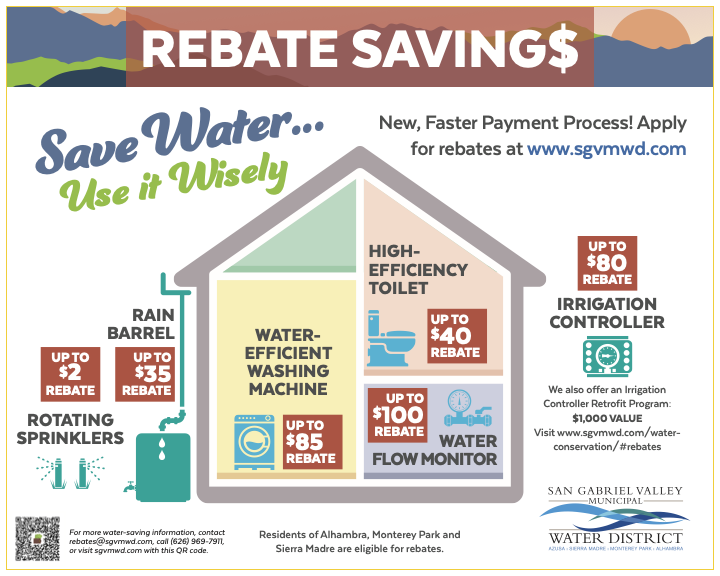
The most important thing residents can do during our hot and dry summer and fall months is save water…and use it wisely. Here are some water saving tips for you to use around your home (indoors and outdoors).
| |
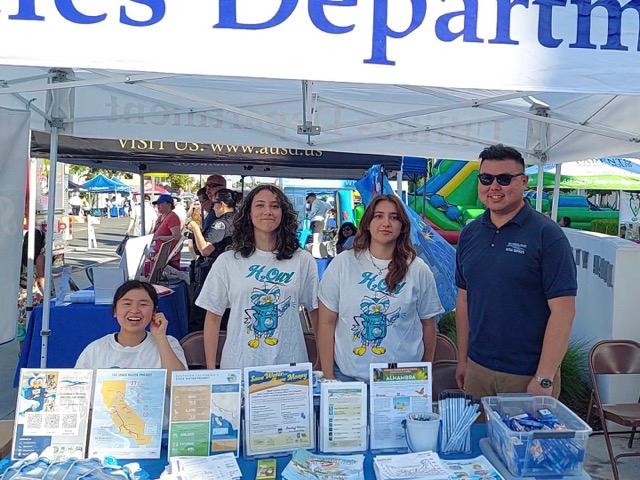
2023 Alhambra National Night Out with Alhambra High School's Environmental Resource Awareness Society
Early August at the Alhambra Police Department's annual National Night Out, the Water District and Alhambra High School's Environmental Resource Awareness Society (ERAS) engaged with hundreds of attendees by handing out free giveaway items as well as educating residents on the District's rebates and irrigation retrofit program.
Thank you to the Alhambra Police Department and the City of Alhambra's Utilities Department for sharing space with us.
| |
|
|
Introducing Albert Lu, External Affairs Specialist
We are pleased to introduce and welcome Albert Lu, who recently joined the District's professional staff full-time in June. Albert has supported the District's community outreach activities part-time for several years. He will help us immediately with increased leadership and presence in our member cities at community and water conservation-related events, and support all the District's external affairs activities.
Albert grew up in the San Gabriel Valley and attended local schools including Alhambra High School and East Los Angeles College. He has been active in his communities for many years and serves on the Transportation Commission for the City of Alhambra and is a member of the Pasadena Tournament of Roses. Albert lives in Alhambra and speaks Cantonese.
Albert says he's excited for this opportunity to work for the community he grew up in. With established roots in much of the San Gabriel Valley, he is looking forward to guiding residents through complicated water issues, promote water conservation, and to help folks understand the District's role in supplementing local ground water supplies. Albert can be reached via email at alu@sgvmwd.com.
| |
|
2023 Speakers' Bureau and H2Owl Appearances
With summer weather upon us, the District will continue to support, sponsor and attend a variety of in-person community events. District representatives are available to make informational and educational presentations (in-person and virtually) at community and business meetings, city council and school board meetings and business/chamber meetings.
Our presentations cover topics such as the role of the San Gabriel Valley Municipal Water District; explaining drought; the importance of local groundwater; local and state water supply conditions; the State Water Project and imported water; water conservation and future water supply solutions.
To request an in-person or virtual meeting or presentation with your group, please contact Evelyn Reyes, External Affairs Manager (626-969-7911 or ereyes@sgvmwd.com).
| | | | |