|
Board Meeting
Monday, October 12, 2020; 8:00am
Please note that due to the coronavirus pandemic, the October Board Meeting will not be held "in-person" at District headquarters. Rather, the meeting will be conducted via conference call.
You may dial in using your phone. +1(312) 757-3121 Access Code: 458-928-461
Check the Calendar on our website (www.sgvmwd.org) for board meeting agenda and dates and times of committee meetings. You may also request to receive such information by email. Meetings are usually held on the second Monday of each month. Please join us; all meetings are open to the public.
Save the Date: the November 2020 Board Meeting is tentatively scheduled for Monday, November 9, 2020.
|
|
Update on District Operations During Pandemic Response
In response to the ongoing public health crisis resulting from the novel coronavirus, in March, the San Gabriel Valley Water District closed its headquarters office to the public and adopted a modified work schedule and "virtual" board meetings broadcast on-line or by phone call-in.
Effective Monday, June 1, 2020, the District headquarters office re-opened for essential staff and operations. In an abundance of caution, we are not permitting visitors and in-person meetings involving non-District individuals at this time. Should you have any questions, concerns or comments, please don't hesitate to contact us by phone (626-969-7911) or email (info@sgvmwd.com).
Please be assured that all essential District operations are being maintained, however, several of the District's external affairs, outreach and education programs have been modified or postponed indefinitely. The District will continue to monitor and abide by all LA County Department of Health recommendations, as well as those of national, state and medical experts, to ensure the safety of our water supply, stakeholders and employees.
Thank you and please be safe!
|
|
Board of Directors Approves $8.2 Million of Zero-Interest Loans and Grants for Member Cities for Water-Related Infrastructure and Pandemic Relief Projects
At its August 2020 meeting, the District's Board of Directors approved offering member cities (Alhambra, Azusa, Monterey Park and Sierra Madre) up to $8 million of zero-interest financing for water-related infrastructure and pandemic relief projects, up to $2 million for each city. That followed Board action in June 2020 resulting in the allocation of $50,000 per member city for water-related projects, such as rate-payer relief, water conservation and public education, to
help cities cope with the effects of the COVID-19 pandemic.
The funds would be allocated out of reserves to spur water infrastructure investment to help ensure continued safe and reliable water supplies and also to help support local jobs during the current economic downturn. Details of each loan and grant will be finalized in coming months.
To read the complete news release on this subject, click here.
|
|
Sierra Madre Utilizes $50,000 'Pandemic-Support' Grant Funding from SGVMWD for Water-Related Projects
When the District's Board approved $50,000 per member city in June 2020 for water-related projects to help cities cope with the effects of the COVID-19 pandemic, planning began in our member cities. Sierra Madre's Utilities Department has already moved to put the grant funds to work on three projects: to improve its West Tunnel treatment facility; to establish a pandemic relief fund; and to provide funding for its low-income water rate.
West Tunnel
$35,000 in grant funding will be utilized to update the treatment facilities at the West Tunnel. Improvements include updating the treatment plan, updating the operations, monitoring and maintenance plan (OMMP) and automation of treatment processes including Supervisory Control and Data Acquisition (SCADA) monitoring of chlorine residual, water temperature, PH and turbidity.
Pandemic Relief Fund
$5,000 will be allocated to establish a pandemic relief fund. The City has received requests from several utility customers for relief due to financial hardship incurred as a direct result of the COVID-19 pandemic. City staff is currently working on payment plans to assist utility customers. In addition, water shut-off activities have been suspended for any accounts unable to pay during the pandemic. Funding will allow for partial credits to those accounts that have been identified as having experienced a financial hardship related to the COVID-19 pandemic.
Low-Income Rate
$10,000 will be utilized in support of the City's low-income utility subsidy. The City provides households that qualify as "Very-Low-Income" and "Extremely-Low-Income" (using HUD income guidelines) a discounted fixed charge rate and an exemption from paying the Utility Users Tax (UUT). The low income rate and UUT exemption are subsidized by the General Fund and vary per year. The impact to the General Fund is projected to be $10,000 in fiscal year 2020-21; funding will provide a savings to the General Fund of $10,000 and continue to provide assistance to households who qualify for the low-income water rate.
The District is pleased to continue its strong working relationship with Sierra Madre. In past years, District funds helped fund the Joint Well Project, the City's Automated Meter Infrastructure project, the replacement of the Mira Monte reservoirs, Sierra Vista Park landscape irrigation, Memorial Park Irrigation, the City Hall drought tolerant landscape and irrigation improvements, water-efficient landscaping at Sierra Madre Elementary School and numerous school and community conservation education projects.
|
|
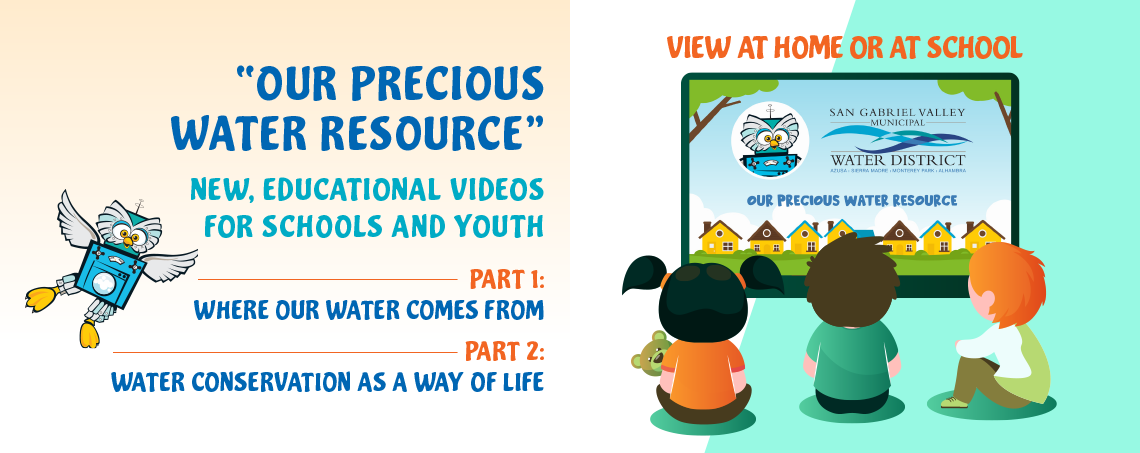
District Creates Educational Water Supply and Conservation Videos for Use in Pandemic and Post-Pandemic Worlds
For more than a decade the District has offered a school-based water education program consisting of guest speakers, educational materials and a Home Water Survey, designed to help elementary school-aged students implement water-saving practices at home. As part of our effort to instill the value of "water conservation as a way of life," the District's program has reached out to elementary schools such that nearly every student graduating from high school in our service area has participated in this long-standing, learn-by-doing program.
Facing the challenges of evolving learning habits and techniques, as well as the COVID-19 pandemic, the District created a digitized, video version of its school information program, so that it could still offer the popular program content to schools in our member cities both during and after the pandemic, in both "real" and "virtual or on-line" school and classroom environments.
Over the years, a variety of water-related concepts had been tested and refined to the point that students received a comprehensive introduction to water supply and water conservation in a short 20-minute school assembly program provided by District representatives. We have captured the essence of those many years of experience in our new video series entitled, "Our Precious Water Resource." The videos are featured on our website as shown below, and are part of our Speakers Bureau Program, whereby we reach out to and accept invitations to speak about water at schools and other youth and community organizations.
|
Water Delivery Highlights
2020 State Water Contractor "Imported Water" Allocation Remains at 20 Percent
On May 22, 2020, the Department of Water Resources (DWR) announced it was increasing the allocation of 2020 State Water Project (SWP) water for long-term contractors to 20 percent of most SWP contractors' requested Table A amounts. On January 24, 2020, DWR had increased the allocation to 15 percent of requested supplies, up from the year's initial 10 percent allocation announced in December 2019. The SWP provides water to 29 SWP contractors who supply water to more than 27 million Californians and 750,000 acres of farmland. The 20 percent allocation amounts to 843,696 acre-feet of water, statewide, and 5,760 AF for the District. DWR may revise this and any subsequent allocations if warranted by the year's developing hydrologic and water supply conditions.
District Operations and Water Deliveries
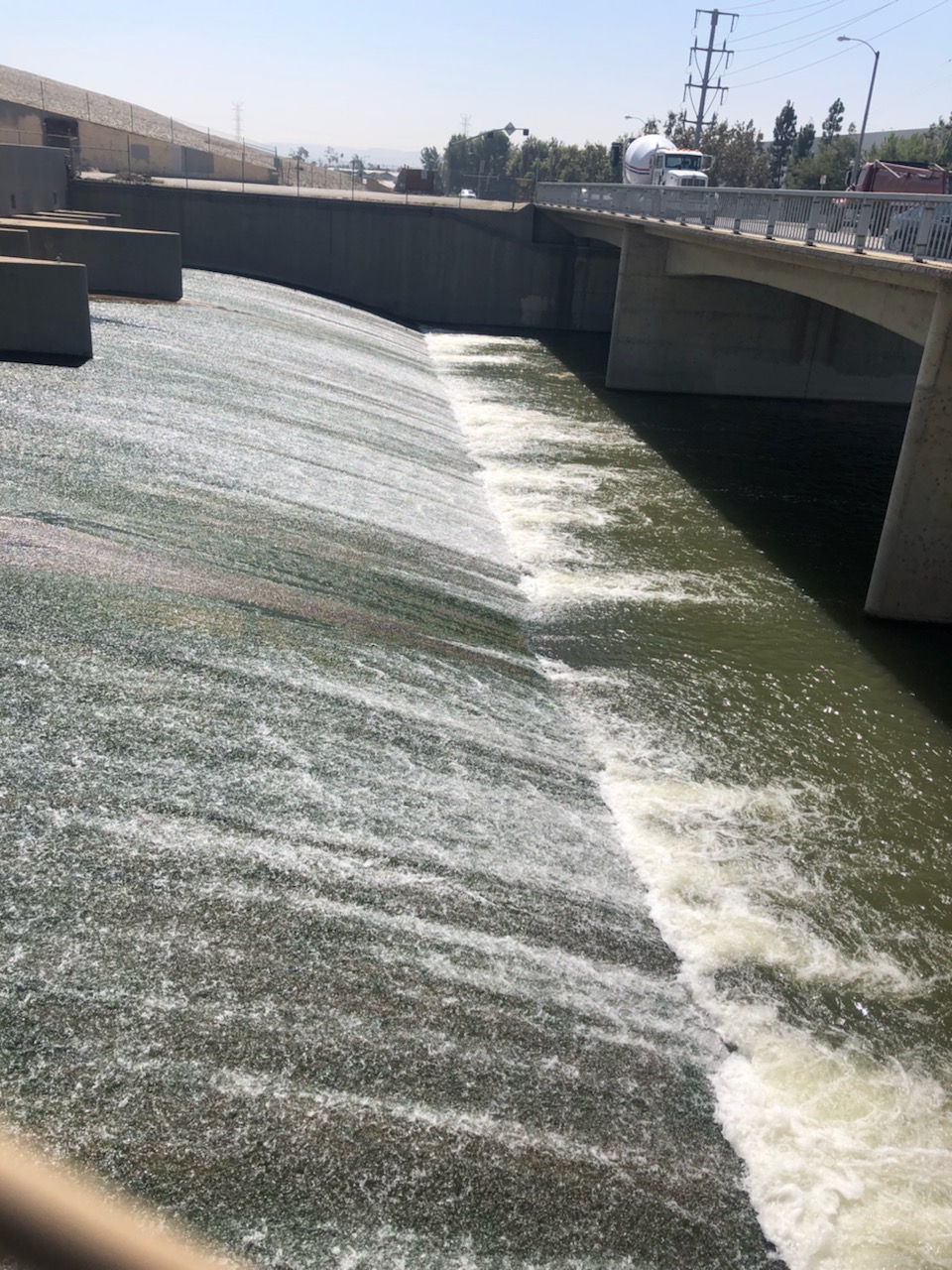
As of August 31, 2020, the District completed its delivery of "Table A" water to the Main San Gabriel Basin for calendar year 2020. In September, as part of its desire to partner with and assist area water agencies, the District delivered 1,109 acre-feet to Covina Irrigating Company's (CIC) surface water treatment facility on behalf of Three Valleys Municipal Water District. Beginning September 29, 2020, the District is implementing a scheduled outage of the Devil Canyon-Azusa Pipeline for maintenance and repair.
|
Water Supply Update: Dry Summer Months Continue to Stress Local Groundwater Supplies
Statewide, dry, drought-like conditions are expanding. The La Niña weather phenomenon has formed for the first time in two years and the National Weather Service indicates that when you average out the effect of La Niñas over the last few decades, they tend to indicate precipitation will be less than in an average winter.
California gets most of its annual precipitation from a handful of major and infrequent winter storms, which have become even more unpredictable as a result of climate change. On average, the Sierra Nevada Mountains snow pack, which is a key source of water banked in reservoirs, supplies about 30% of California's water needs as it melts in the spring and early summer. Water departments look to the result of the April 1 measurement, when snow pack is typically at its highest, to make supply decisions for the remainder of the year. Snow water content is one factor in determining imported water allocation amounts along with reservoir storage and releases necessary to meet water supply and environmental demands.
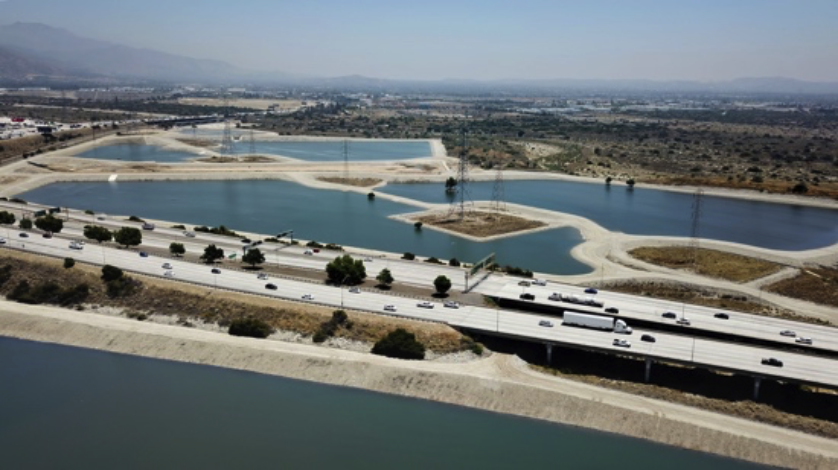
Locally, Main San Gabriel Basin groundwater supplies, which account for nearly 80% of the water we use, continue to trend downward. It's critical to note that our supplies remain in need of ongoing smart management, replenishment and conservation. We live in a dry region where drought will recur; we all need to view "conservation as a way of life."
Following is a summary of water supply conditions in the State and the San Gabriel Valley.
-
State Summary - According to the U.S. Drought Monitor, as of September 22, 2020, 84.38% of the State is considered "abnormally dry" (increased from 79.45% in August and 59.66% in late July); 67.09% of the State is experiencing moderate drought (up from 46.74% in June); and 35.27% of the State is experiencing severe drought (an increase from 20.84% in June). Further, 3.39% of the State is experiencing extreme drought (up from 2.45% in June).
-
Rainfall - the Los Angeles Almanac reports rainfall for the annual period of July 1, 2019 to June 30, 2020 from a variety of weather stations in the County. With no rainfall in July, August and September, rainfall totals are presently non-existent as we began a new reporting season on July 1st. To review recent history, rainfall totals in Pasadena for the "year" ended June 30, 2020, totaled 20.67 inches compared to a season average of 19.77 inches (105% of average). At Santa Fe Dam in Irwindale, rainfall totaled 15.33 inches compared to a season average of 16.94 inches (91% of average).
- Snow Pack - as of June 26, 2020, statewide (the latest data available to us), the average "snow water equivalent" is 0 inches. Snow levels are 0% of normal for this date and 0% of the April 1 average.
- Reservoir Levels - statewide, as of August 31, 2020, (the latest data available to us), reservoir levels were at 93% of average and 57% of capacity (compared to 92% and 64%, respectively, from the end of July).
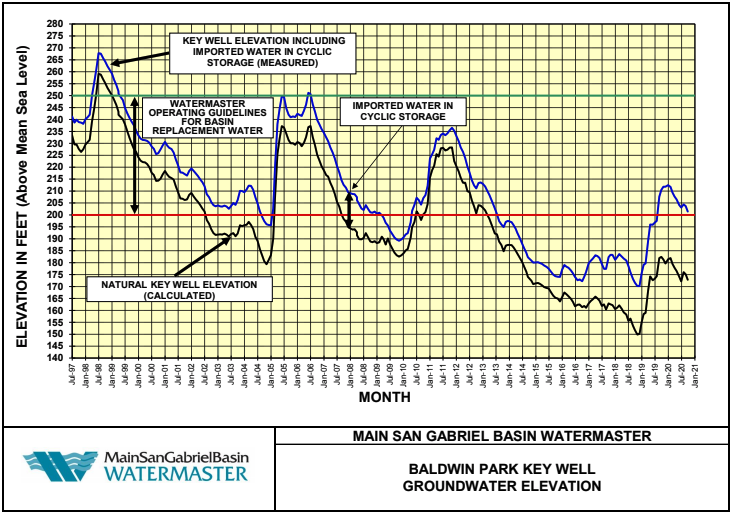
- Groundwater - in the Main San Gabriel Basin, the "Baldwin Park Key Well" is the indicator of groundwater levels (see graph below - blue line includes cyclic storage; black line does not). As of September 25, 2020, the level is 201.4 feet above mean sea level, a decrease from 203.7 in late August. Except for a slight increase in late June due to releases of local precipitation, water which had been stored since last winter, from Morris Reservoir by LA County Department of Public Works, the Basin has experienced a steady decline from 212.5 feet above mean sea level in December. The present level is still an improvement from the historic low of 169.4 as recently as November 21, 2018. In mid-2019, for the first time since 2013, groundwater levels moved within Watermaster's operating range.
|
Obtain an OWL Community Grant to Develop Water Conservation Projects in Your School or Community
|
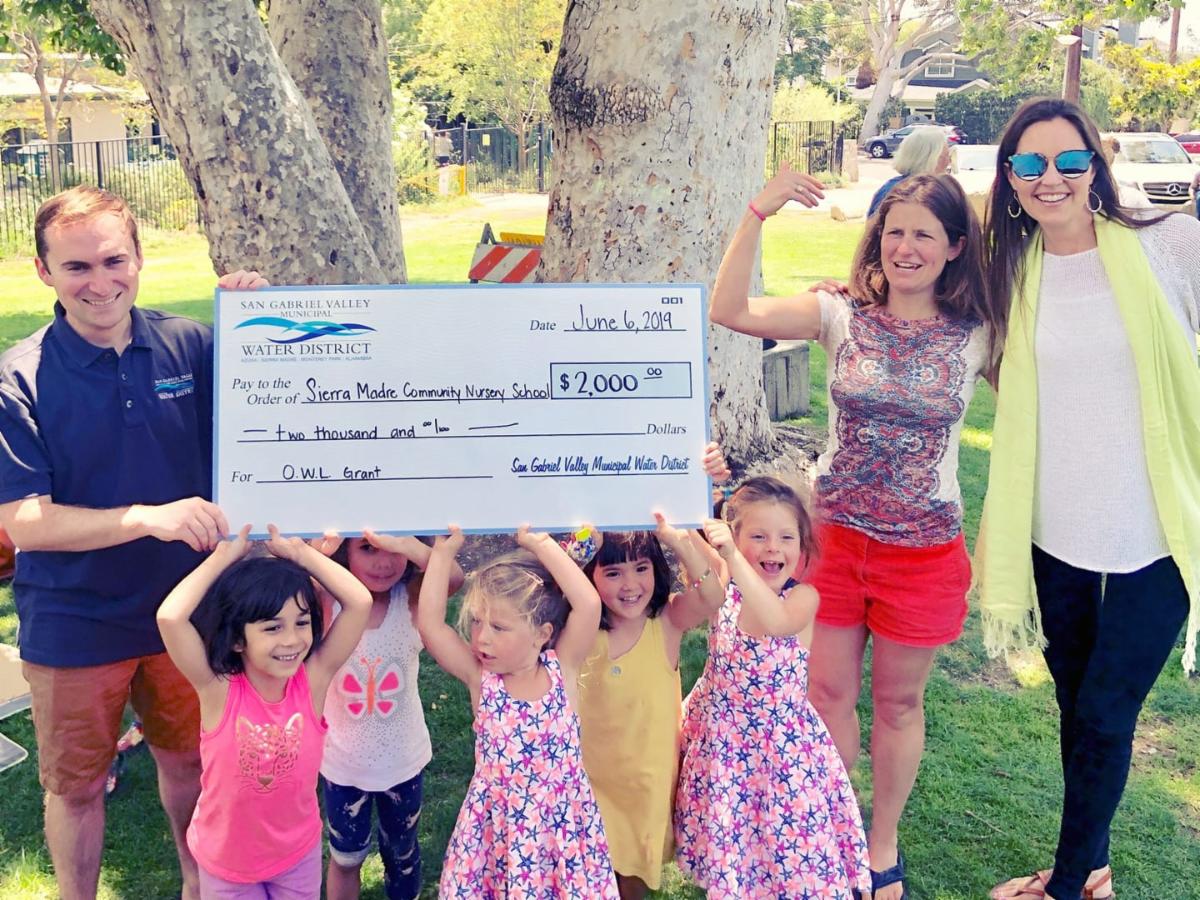
| | Division IV, Director Miles Prince with Sierra Madre Community Nursery School (June 2019) |
Despite the COVID-19 pandemic, the District continues to consider grant applications!
The O.W.L. - Opportunities for Water Leadership Grant Program is a great way to aid educational events such as Earth Day festivals, re-landscaping projects, waterway cleanups, tree plantings, school projects, conservation curriculum, and other civic, volunteer activities. The grants range from $200-$2,000 for local, creative water conservation projects. The District welcomes creative ideas from schools, teachers, PTAs, community organizations, scouting organizations, athletic teams and service clubs, and is happy to provide technical assistance to help you understand and complete the grant application. The Grant Program remains open to applicants through June 30, 2021.
Our list of grant recipients is growing so please review our grant program information and prepare your applications today! A recap of our grant recipients to date is included on the District's website: Please click here to read about the Grant Program and to access the online application. For further information, please contact the District at 626-969-7911.
|
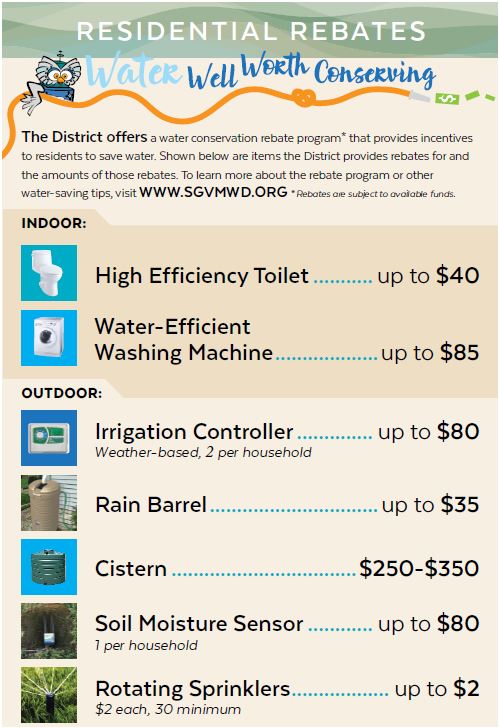
Save Water and Save Money with the District's Rebate Program
|
|
|
SAN GABRIEL VALLEY MUNICIPAL WATER DISTRICT | 1402 N. VOSBURG DRIVE | AZUSA | CA | 91702
|
|
|
|
|
|