|
September 23, 2026
Greetings!
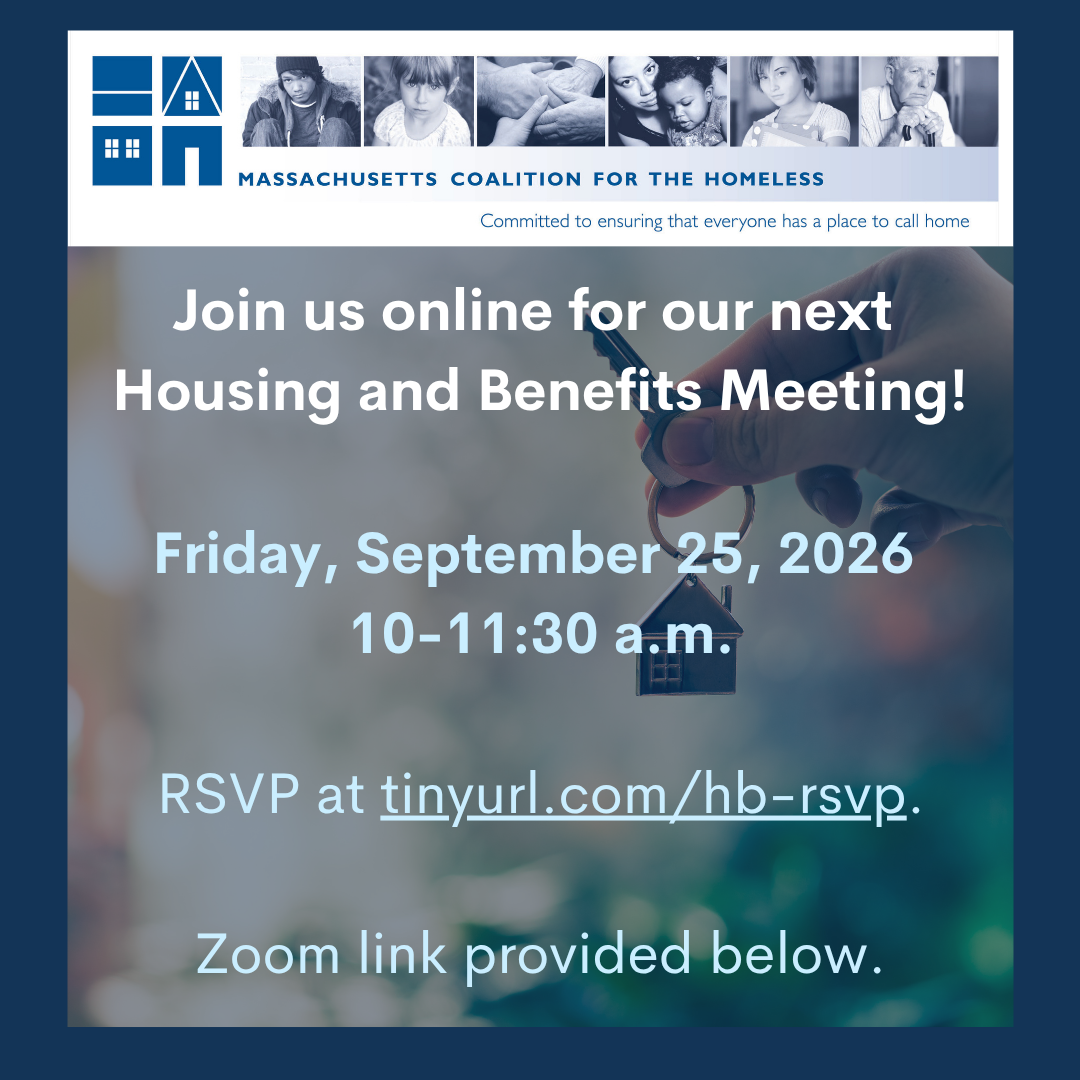
It's almost time for our September Housing and Benefits Committee meeting, coming up this Friday, September 25th, 10:00–11:30 a.m. on Zoom. Please RSVP and plan to join us!
Here is our agenda:
- Supplemental Nutrition Assistance Program (SNAP) Updates: Federal Changes and Rollout of EBT Chip/Tap Cards – Presented by Vicky Negus, Senior Economic Justice Advocate, Massachusetts Law Reform Institute (MLRI)
-
Massachusetts Law Reform Institute (MLRI) "provides statewide advocacy and leadership to advance laws and policies that support low income people and communities."
-
SNAP "is a monthly benefit to buy eligible food items at stores, online, or farmers markets."
-
The 2025 federal reconciliation legislation (OBBB Act), signed into law in July 2025, made significant changes to SNAP, including changes to benefit eligibility and work requirements. The changes began taking effect in November 2025.
-
The new rules expanded the Able-Bodied Adults Without Dependents (ABAWD) work requirements to additional adults ages 18-64 and changed exemptions for certain groups, including parents of older children, veterans, and people experiencing homelessness. See Work Rules for SNAP Clients.
-
According to the Center on Budget and Policy Priorities’ SNAP Tracker, Massachusetts had approximately 175,000 fewer SNAP participants in May 2026 than in July 2025, a 16% decline. SNAP participation among children declined by approximately 61,600, or 18%, during the same period.
- Massachusetts launched chip- and tap-enabled EBT cards statewide in July 2026, with updated cards mailed to clients throughout August. The new cards are designed to provide additional protection against theft and skimming through more secure chip technology.
- EBT Chip/Tap Frequently Asked Questions (FAQ)
- Overview of the PROTECT Act – Presented by Heather Yountz, Senior Immigration Staff Attorney, Massachusetts Law Reform Institute (MLRI)
-
The PROTECT Act, signed into law in August 2026 by Governor Maura Healey, establishes new protections and requirements related to federal immigration enforcement in Massachusetts.
- The law includes protections related to civil immigration enforcement at courthouses (effective November 3, 2026), public schools, child care facilities, health care facilities, and state property.
-
Press release: Governor Healey Signs PROTECT Act to Keep ICE out of Courthouses, Schools and Hospitals
- On September 8th, Governor Healey issued guidance for health care providers, employers, law enforcement, and state agencies.
-
Guidance: Protecting People From ICE
-
Press release: Governor Healey Issues PROTECT Act Guidance for Health Care Providers, Employers, Law Enforcement and State Agencies
- Federal Changes Affecting MassHealth (Medicaid) Members – Presented by Hannah Frigand, Senior Director, HelpLine & Public Programs, Health Care for All
-
Health Care For All "advocates for health justice in Massachusetts by working to promote health equity and ensure coverage and access for all."
-
MassHealth "provides health benefits and help paying for them to qualifying children, families, seniors, and people with disabilities living in Massachusetts."
-
The 2025 federal reconciliation legislation (OBBB Act), signed into law in July 2025, also made significant changes to the federal Medicaid program that will affect MassHealth eligibility and enrollment. Important changes include:
-
October 2026: Some immigrants will no longer be eligible for MassHealth coverage because of changes to federal Medicaid eligibility. See MassHealth Information for Noncitizens.
-
January 2027: Some MassHealth members ages 19–64 will face new work and education requirements, also known as community engagement requirements, and some members will need to renew their MassHealth coverage every six months instead of annually. See New Work and Education Requirements for MassHealth Members and More Frequent Renewals for MassHealth Members.
-
Additional information: Federal Changes Affecting MassHealth (Medicaid) Members
- Member-facing materials for MassHealth federal changes
-
On September 28th at 2:00 p.m., Health Care For All and MassHealth will host a virtual training on the federal changes "geared specifically for providers who work with unhoused or housing-unstable MassHealth members." Register here.
- Legislative Updates – Presented by Kelly Turley, Associate Director, Massachusetts Coalition for the Homeless
- Everyone Needs ID Campaign Update
-
House Bill 3750 and Senate Bill 2399, An Act to provide identification to youth and adults experiencing homelessness, would:
- Establish a fee waiver process for youth and adults experiencing homelessness seeking standard Mass IDs
- Codify a process for individuals experiencing homelessness to apply for standard Mass IDs if they cannot meet the existing criteria by allowing ID applicants who are experiencing homelessness to submit residency documentation from providers of homelessness and/or youth services and state agencies under the Executive Office of Health and Human Services (EOHHS) and the Executive Office of Housing and Livable Communities (EOHLC)
-
S.2399 was reported out favorably by the Joint Committee on Transportation and referred to the Senate Committee on Ways and Means. H.3750 was also reported out favorably by the Joint Committee on Transportation and referred to the House Committee on Ways and Means.
- The Senate has unanimously passed similar versions of this legislation in each of the past four legislative sessions, but has not yet taken up the bill this session.
-
Take action: Please take one minute to sign and share our Everyone Needs ID online action to urge key legislators to support the bill and expand access to Mass IDs for people experiencing homelessness.
-
Full link to online action: https://win.newmode.net/everyoneneedsidbill
- Bill fact sheet
- FY26 Supplemental Budget Update
-
On April 14th, Governor Maura Healey filed a supplemental budget request for Fiscal Year 2026 (FY26), which included "adjusting the six-month length-of-stay policy in the emergency shelter system to a nine-month length of stay and increasing the emergency assistance income threshold to 120 percent of federal poverty guidelines to better reflect cost-of-living pressures and align with similar programs."
-
The House passed its version of the FY26 supplemental budget, H.5496, on June 10, 2026, after considering amendments.
-
On June 11, 2026, H.5496 was sent to the Senate Committee on Ways and Means, where the bill is still awaiting action.
-
For more details, see the Coalition's FY26 supplemental budget chart: https://tinyurl.com/fy26supp.
- Additional supplemental budgets, including the FY26 closeout budget, are expected to be considered this fall.
Click here to RSVP for our September 25th meeting (or go to tinyurl.com/mch-hb-rsvp.)
Best wishes,
Julia and Kelly
Julia Garvey
Senior Policy Advocate
Pronouns: She/her/hers
julia.garvey@mahomeless.org
Kelly Turley
Associate Director
Pronouns: She/her/hers
kelly@mahomeless.org
|