|
Background
Malignant hyperthermia (MH) is a life-threatening, autosomal dominant disorder of skeletal muscle in which susceptible individuals experience a hypermetabolic response following exposure to volatile anesthetics or succinylcholine. Although rare, MH remains a critical perioperative emergency due to its rapid onset, high risk of mortality without intervention, and the need for immediate recognition and management.
Pathophysiology
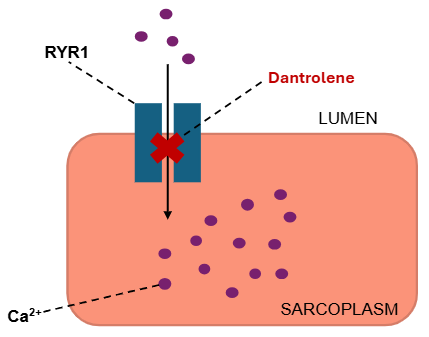
Malignant hyperthermia results from excessive, uncontrolled calcium release in skeletal muscle caused by pathogenic variants, most commonly in the ryanodine receptor (RYR1). A mutation in the RYR1 causes the receptor to open abnormally when exposed to triggering anesthetics, producing massive intracellular calcium accumulation. This drives sustained muscle contraction, accelerated ATP consumption, heat generation, and widespread metabolic derangements (Rosenburg et al., 2015).
Clinical Presentation
The presentation of malignant hyperthermia is marked by rapidly rising end-tidal carbon dioxide, generalized or masseter muscle rigidity, hyperthermia, and sympathetic activation such as tachycardia, tachypnea, and arrhythmias. As the crisis progresses, a mixed metabolic and respiratory acidosis can develop, accompanied by electrolyte disturbances and rhabdomyolysis. MH can mimic other hypermetabolic conditions such as sepsis, certain toxidromes, withdrawal, thyroid storm, neuroleptic malignant syndrome, or serotonin syndrome. The peri-anesthetic timing and dramatic increase in carbon dioxide production remain key distinguishing features of MH (Hopkins et al., 2020).
Diagnosis
There is no definitive laboratory test to diagnose malignant hyperthermia in the acute setting; diagnosis is clinical and relies on early recognition of hallmark features, particularly an abrupt rise in end-tidal carbon dioxide despite adequate ventilation. The caffeine-halothane contracture test (CHCT) is the gold standard for confirming susceptibility but may not be immediately available. Because MH can mimic other conditions it may be overlooked early in its course (Rosenburg et al., 2015).
Treatment
Immediate management begins with discontinuing all triggering agents and promptly administering dantrolene, which inhibits abnormal calcium release from the RYR1 receptor, effectively halting the hypermetabolic cascade. It is administered through intravenous boluses every 15 minutes until clinical improvement is observed, followed by scheduled dosing or continuous infusion for at least 24 hours (Hopkins et al., 2020). Supportive therapy includes cooling measures, increasing ventilation to reduce carbon dioxide levels, and correcting associated complications. In most cases, once dantrolene is initiated and supportive measures are implemented, clinical improvement begins within minutes, although full stabilization may take several hours. Early recognition and rapid access to dantrolene have reduced mortality from greater than 80% historically to less than 5% (Rosenburg et al., 2015).
|