Click to Read More


The JUST RELEASED


2024 MID-YEAR OUTLOOK is HERE!


In case you missed it, make sure to take a look at the...


2024 Mid-year Outlook:

Still Waiting for the Turn


**IMPORTANT DISCLOSURES

This material is for general information only and is not intended to provide specific advice or recommendations for any individual. The economic forecasts may not develop as predicted. Please read the full MIDYEAR OUTLOOK 2024: Still Waiting for the Turn publication for additional description and disclosure. This research material has been prepared by LPL Financial LLC.

CLICK HERE TO DOWNLOAD YOUR COPY
Fait Accompli \fe takɔ̃ˈpli\ noun: an accomplished fact; a thing already done

Cornerstone Fait Accompli

The Autumn season once had a completely different name; during the 12th and 13th centuries in England, Autumn was known as ‘haerfest’, or in today’s spelling, ‘harvest’. One of the reasons it earned this name was because the full moon nearest to the Autumn equinox is called the harvest moon.

Did you see our latest post?
Never miss a Cornerstone announcement - make sure you are following us on Facebook!
When you follow us you'll get access to up to date market information, helpful financial planning tools like calculators, and all of the Cornerstone office happenings!
Click on the buttons below and don't forget to like, comment and share our posts!
Facebook
Twitter - X
LinkedIn

Of course, last week’s headliner was Jerome Powell and the Federal Reserve (Fed) cutting rates by a half percent on Wednesday, September 18, the first time since the COVID-19 pandemic broke out in 2020. The Fed “pause” ended at 423 days and now stands as the second-longest on record, while the 26% gain for the S&P 500 during the pause (7/27/23–9/18/24) ranks first. Here we share some thoughts on the Fed’s move last week and some potential market implications of not only Fed policy but also fiscal policy post-election.

It's Not How You Drive, It’s How You Arrive

Golfers may appreciate this mantra as representing the importance of the final putt that goes in the hole as being the most important thing, more so than a well-struck first shot off the tee. We think this analogy works for the Fed here. While the 0.25% vs. 0.50% debate was all the rage, what matters most is how much Powell and company cut for the entire cycle and how lower rates affect the economy. Whether the cycle starts with a quarter or half-point cut isn’t as important given the Fed will almost certainly have to cut much more than that this cycle. (For those who appreciate NASCAR more than golf, call it a pit stop on the way to the more important finish line.)

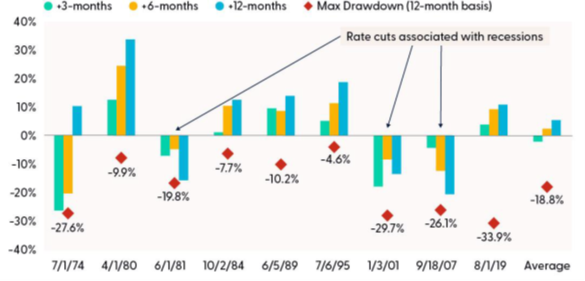
We don’t know how much the Fed will end up cutting, but if they are able to engineer a soft landing — and last week’s rally sure suggests the market thinks that’s what we’ll get — then perhaps they end up stopping before they get to 3% (the upper bound now sits at 5%, down from 5.5%). The Fed and most analysts think the neutral rate is around 3%, or potentially a bit higher. Either way, based on the 1995 experience, that sets up a favorable environment for stock investors. After the initial cut in February 1995, the S&P 500 rallied 18.7% over the next 12 months.

Stocks Have Performed Well After Initial Fed Rate Cuts, if Recession Is Avoided

S&P 500 Performance After Initial Fed Rate Cuts

Source: LPL Research, Bloomberg 09/18/24

Disclosures: Indexes are unmanaged and cannot be invested in directly. Past performance is no guarantee of future results.

As Central Bank Risk Ebbs, Election Risk May Intensify

Now that the 0.25% vs. 0.50% debate has been settled, policy discussions are shifting toward the upcoming presidential election. In our Midyear Outlook 2024: Still Waiting for the Turn, we expressed our belief that volatility would likely increase in the second half, potentially around election-related policy uncertainty (geopolitical threats or an unexpected reacceleration in inflation were also cited as risks). We still hold this viewpoint, though inflation risks appear well contained at this point.

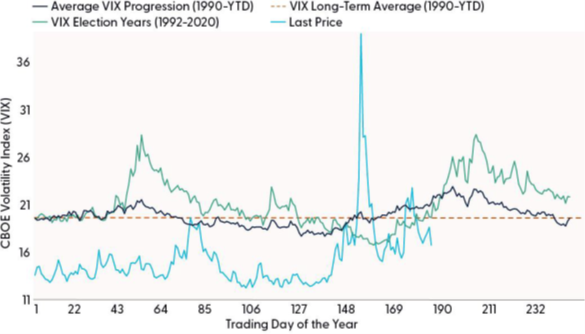
Stocks tend to be more volatile during election years, particularly within the three-month window before Election Day, as the accompanying chart illustrates. The CBOE Volatility Index (VIX) measure of implied market volatility (based on prices for index options) typically rises at this time of year, but the increase in volatility is more pronounced during election years.

Market Volatility Will Likely Increase Ahead of the Election

Source: LPL Research, Bloomberg 09/19/24

Disclosures: Indexes are unmanaged and cannot be invested in directly. Past performance is no guarantee of future results.

The swings don’t usually prevent stocks from going higher during election years, as they will likely do in 2024. In fact, during election years, the S&P 500 Index is higher 83% of the time, and higher by an average of 12.2% when positive. So, while a strong stock market during an election year is quite common, as we have experienced in 2024, a pullback is to be expected and we would not suggest a typical 60–40 investor add to equities here.

Stocks as an Election Predictor

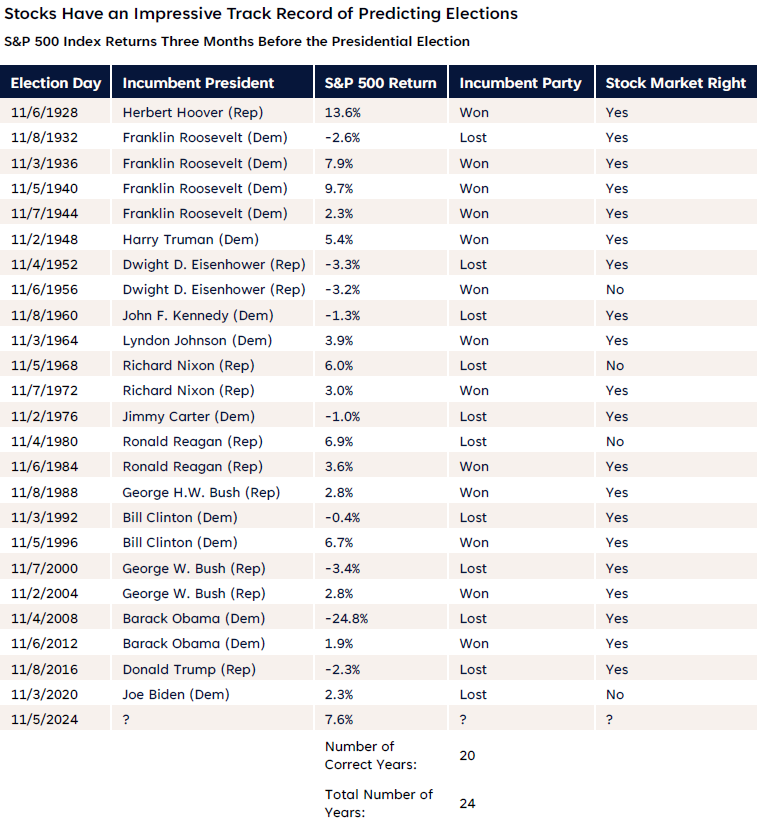
It’s hard to mention policy and the election without referencing one of the stock market’s more popular and accurate election predictors. Historically, the stock market has been a surprisingly accurate and unbiased election forecaster. Since 1928, if the S&P 500 was positive in the three months leading up to an election, the incumbent party remained in control of the White House 80% of the time (12 of 15 elections). Conversely, a declining market in the same period usually signaled a loss for the incumbent —occurring in eight of the last nine elections.

The S&P 500’s roughly 10% gain since August 5 suggests a Harris victory is more likely (as does the misery index, the sum of unemployment and inflation, which has fallen below 7%). This stock market pattern has predicted 20 out of the last 24 elections — a pretty good track record. However, the unpredictability of this election season, the incorrect prediction in 2020, and the fact that the incumbent party switched candidates, all suggest we should be cautious about relying on these historical patterns. The latest polls in swing states suggest the race is close (and no, this is not a prediction in any way).

Source: LPL Research, FactSet 09/19/24

Disclosures: All indexes are unmanaged and can’t be invested in directly. Past performance is no guarantee of future results. The modern design of the S&P 500 stock index was first launched in 1957. Performance back to 1950 incorporates the performance of the predecessor index, the S&P 90.

What Sectors Might Be Potential Winners and Losers Depending on the Election Outcome

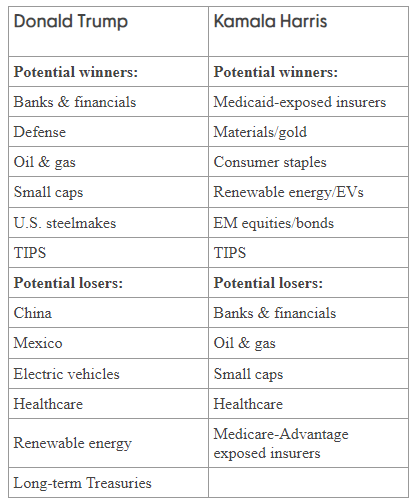
We often get the question of what industries or sectors might do better under Republican or Democratic leadership. As a result of some of the potential policy differences, there could likely be market “winners and losers,” depending on who stands as president in 2025, as illustrated in the accompanying table. Note: The potential winners for each candidate highlighted below, would perhaps be more likely or more definitive should that candidate’s party also control the House and/or Senate.

Of the potential winners below, we believe renewable energy/electric vehicles (EV) and Medicaid-exposed insurers may be the most likely beneficiaries in a Harris administration, while U.S. steelmakers and oil and gas could be the most likely beneficiaries in a Trump administration. On the downside, a Trump administration may be the most detrimental to China’s economy and its companies, while a Harris administration would perhaps weigh the most heavily on the traditional oil and gas segment. LPL Research will be providing much more on the election in the weeks ahead.

Potential Sector and Industry Election Winners and Losers

Winner of U.S. Presidential Election

Source: LPL Research, Evercore ISI 7/31/24

Disclosures: Forecast may not materialize as predicted.

Asset Allocation Insights

LPL’s Strategic and Tactical Asset Allocation Committee (STAAC) maintains its neutral stance on equities, though, with a slightly negative bias in the very short term based on the technical setup near record highs on the S&P 500, historical seasonal weakness, and political and geopolitical uncertainty. The Committee expects volatility to remain elevated in the coming months as the market waits for more clarity on the economy, elections, and a better seasonal setup. For fixed income, the STAAC recommends a modest overweight, funded from cash, with an up-in-quality approach and benchmark-level interest rate sensitivity.

Etymology /edəˈmäləjē/ noun: the origin of a word and the historical development of its meaning.

Stagflation: Slow economic growth during a time of high unemployment and high inflation. 

Have you taken advantage of
CAPS
yet?
Don't miss out!

Many of our clients ask how they benefit from taking action and initiating a Financial Plan for themselves.
When you sign up for our CAPS program, you will get access to:
A personalized financial plan, a place to keep all of
your accounts in one location and a secure place to store your
important documents.

Le commentaire \ˈkɒmɛnt\ masculine noun: a French word meaning a remark or comment

Cornerstone Commentaire

"I would rather sit on a pumpkin and have it all to myself than be crowded on a velvet cushion."

- Henry David Thoreau

Stay Safe, Stay Kind, Stay Strong, Stay Well
P.S. Please feel free to forward this commentary to
family, friends, or colleagues.
+++++++++++++++++++++++++++

The highest compliment
you can give us would be the
referral
of your friends or family!
Visit our website

Important Disclosures

For public use.

Member FINRA/SIPC.

RES-0001819-0824W Tracking # 633595 (Exp. 09/25)

This material is for general information only and is not intended to provide specific advice or recommendations for any individual. There is no assurance that the views or strategies discussed are suitable for all investors or will yield positive outcomes. Investing involves risks including possible loss of principal. Any economic forecasts set forth may not develop as predicted and are subject to change.

References to markets, asset classes, and sectors are generally regarding the corresponding market index. Indexes are unmanaged statistical composites and cannot be invested into directly. Index performance is not indicative of the performance of any investment and do not reflect fees, expenses, or sales charges. All performance referenced is historical and is no guarantee of future results.

Any company names noted herein are for educational purposes only and not an indication of trading intent or a solicitation of their products or services. LPL Financial doesn’t provide research on individual equities.

All information is believed to be from reliable sources; however, LPL Financial makes no representation as to its completeness or accuracy.

All investing involves risk, including possible loss of principal.

US Treasuries may be considered “safe haven” investments but do carry some degree of risk including interest rate, credit, and market risk. Bonds are subject to market and interest rate risk if sold prior to maturity. Bond values will decline as interest rates rise and bonds are subject to availability and change in price.

Municipal bonds are subject to availability and change in price. They are subject to market and interest rate risk if sold prior to maturity. Bond values will decline as interest rates rise. Interest income may be subject to the alternative minimum tax. Municipal bonds are federally tax-free but other state and local taxes may apply. If sold prior to maturity, capital gains tax could apply.

All index data from FactSet and Bloomberg.

The information contained in this email message is being transmitted to and is intended for the use of only the individual(s) to whom it is addressed. If the reader of this message is not the intended recipient, you are hereby advised that any dissemination, distribution, or copying of this message or content is strictly prohibited. If you have received this message in error, please immediately delete.


Securities and advisory services offered through LPL Financial (LPL), a registered investment advisor and broker-dealer (member FINRA/SIPC). Insurance products are offered through LPL or its licensed affiliates. To the extent you are receiving investment advice from a separately registered independent investment advisor that is not an LPL affiliate, please note LPL makes no representation with respect to such entity. 


Not Insured by FDIC/NCUA or Any Other Government Agency

Not Bank/Credit Union Guaranteed

Not Bank/Credit Union Deposits or Obligations

May Lose Value


Securities and Advisory Services offered through LPL Financial, a Registered Investment Advisor. Member FINRA / SIPC .


Privacy Policy | LPL.com