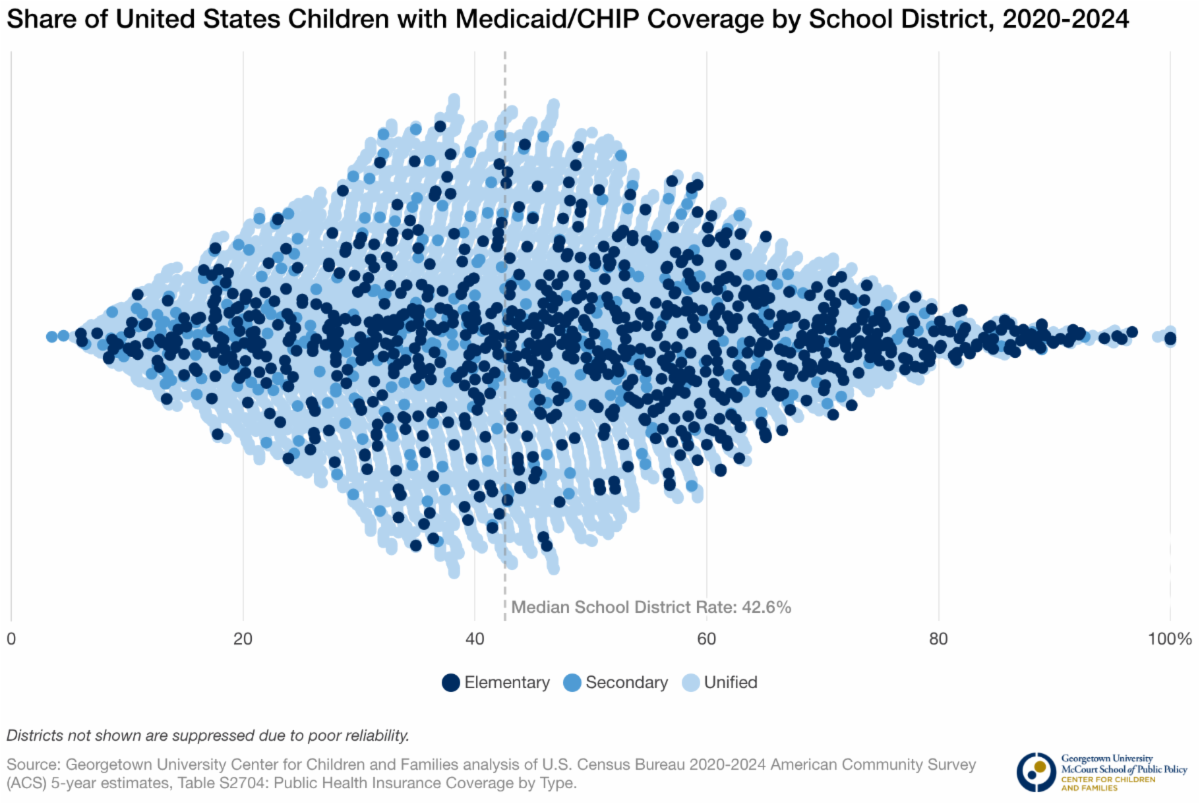
Medicaid and CHIP Cover More than 4 in 10 Students in Public Schools Nationwide 

Georgetown University Center for Children and Families (CCF) is excited to announce updated data showing the share of children with Medicaid and CHIP coverage by school district. Read a blog post explaining some national trends we are seeing.


See each state's data here.

Advisory Committee on Immunization Practices (ACIP) Temporarily Halted by Judge 

On March 16, 2026, a federal judge temporarily blocked sweeping changes to U.S. vaccine policy ordered by Health and Human Services (HHS) Secretary Robert F. Kennedy Jr., dealing a significant setback to the Trump administration’s efforts to overhaul the nation’s immunization system.


U.S. District Judge Brian E. Murphy, presiding in Boston, issued a preliminary injunction halting a January directive that would have reduced the number of vaccines recommended for all children. The blocked changes affected immunizations for illnesses such as flu, rotavirus, hepatitis A and B, meningitis, and RSV. The ruling also stopped a scheduled meeting of a newly imposed federal vaccine advisory panel that had been set to convene in Atlanta.


Murphy found that Kennedy likely violated federal law and long-standing procedures in both scaling back the childhood immunization schedule and restructuring the Advisory Committee on Immunization Practices (ACIP), a key panel that guides federal vaccine recommendations. The judge determined that the administration bypassed the committee’s traditional scientific process and acted in a manner that was “arbitrary and capricious,” undermining the integrity of federal decision-making.


The ruling also invalidates actions taken by the reconstituted ACIP, including controversial recommendations to alter hepatitis B vaccinations at birth, delay certain combined childhood vaccines, and move away from universal COVID-19 vaccination guidance in favor of individualized decision-making.


Central to the case is Kennedy’s decision last year to dismiss all 17 members of the ACIP and replace them with new appointees.


The lawsuit was brought by the American Academy of Pediatrics and other medical organizations, which argued that the changes endangered public health and ignored established scientific standards.


Public health advocates and infectious disease experts praised the ruling as a major victory for evidence-based medicine and the rule of law.


The judge’s order is temporary and will remain in place pending further legal proceedings, including a potential trial or summary judgment decision.

  • NASN Resources: As conversations around vaccine policy continue to evolve, clear, trusted communication is more important than ever. In the latest episode of Beyond Bandaids, NASN brings together a school nurse and a teen advocate to explore how to address misinformation, build trust, and support informed decision-making around adolescent immunization. Listen to the podcast for practical insights you can use in your school community.

Department of Education to Relocate

The U.S. Department of Education announced it will move out of its headquarters in Washington, D.C., and the U.S. Department of Energy will take over the space.


Education Secretary Linda McMahon said the move reflects efforts to reduce the department’s physical footprint and better align space with staffing levels. The agency has reduced its workforce significantly over the past year through layoffs and voluntary departures, though some positions were later reinstated. Critics argue they could weaken the federal government’s role in education and affect program oversight.


The relocation comes amid broader efforts by the administration to scale back the role of the Education Department. The agency was established in 1979 after Congress approved legislation separating education functions from the former Department of Health, Education, and Welfare. Because it was created by statute, eliminating the department would require congressional approval.


In the absence of such action, officials have pursued changes including transferring some responsibilities to other federal agencies. These include agreements affecting the administration of federal student aid programs, with the Treasury Department taking on certain functions such as collecting defaulted student loans. 

The Risks are Real: Gathering Stories from Providers and Healthcare Leaders 

Champions for Vaccine Education, Equity and Progress (CVEEP) is gathering stories from healthcare providers and public health leaders who have witnessed the impact of infectious respiratory diseases in their work.


This campaign invites individuals to share their personal experiences and perspectives on respiratory illness prevention and treatment (guided by simple prompts) through a short filming session on Zoom. 


The collected videos will be featured across CVEEP’s digital channels—including its website (cveep.org) and social media (Instagram, LinkedIn, Facebook, and X)—and you, along with your organization, are encouraged to share the content through your own networks. 


For more information, please contact Jennifer Sheridan Palute.

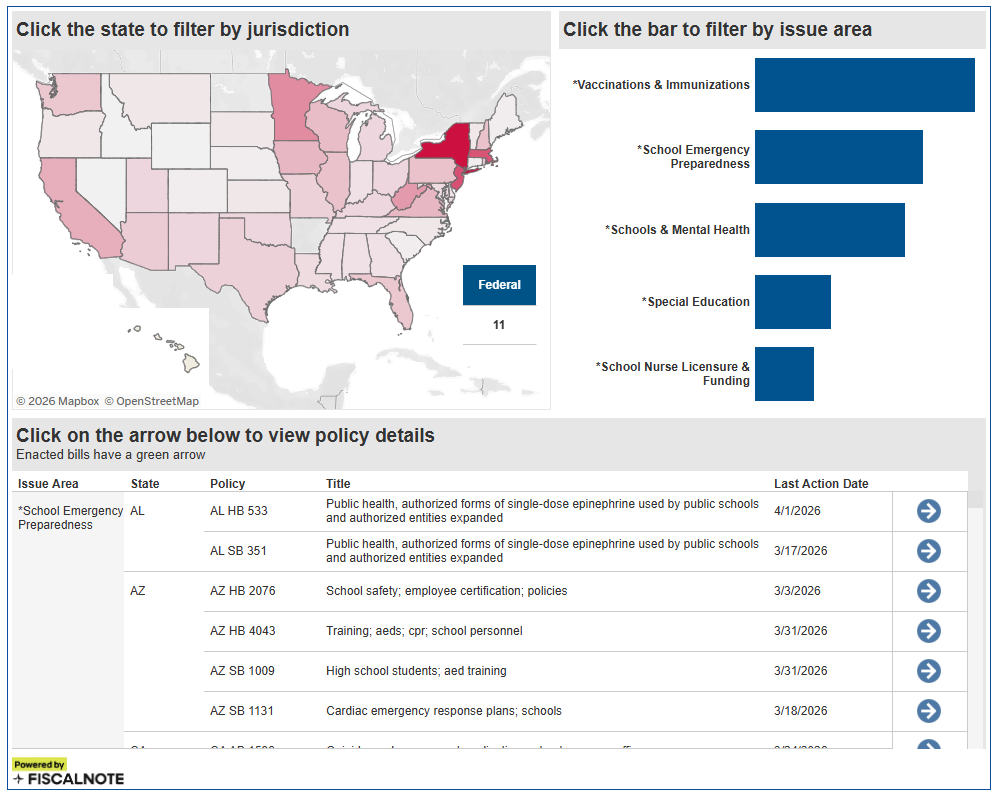
Interactive Policy Map Now Available

NASN is now offering an interactive policy map in its action center that enables school nurses to explore state-level legislation that directly impacts their profession, schools, and communities. The map allows NASN members to research pending legislation in their state or to track advocacy efforts across the nation. Use the map to research proposals that affect school nursing licensure and funding, efforts to increase or restrict vaccination rates, legislation to improve school emergency preparedness, programs to bolster student mental health, as well as bills that would alter special education programming. The map provides NASN members with a summary of the bill, previous and future hearing dates as well as other valuable information like sponsors and the bill’s text. Explore this new tool here

State Legislation News

Wyoming Takes a Step Toward a Nurse in Every School 

Wyoming lawmakers are tasked with recalibrating the state’s block grant funding model for its educational system at least every five years. On March 8, Wyoming passed such recalibrating legislation, and, for the first time, school nurses were included in a block grant contained in the funding package. While this is a step-forward in NASN’s goal to have a school nurse in every school, NASN will be working with its state affiliate to ensure funding is provided to school nurses. Learn more.

View as Webpage

Facebook  Instagram  LinkedIn  YouTube