NASN Joins Nationwide Response to Protect Graduate Nursing Education | | |
The Department of Education (ED) closed their comment period on the proposed new rule that would limit federal graduate student loans for post-baccalaureate nurses. In the proposed rule, post-baccalaureate nursing programs weren't included as 'professional degrees' despite meeting the definition and purpose—to prepare students with the education necessary for professional practice. This will have dire effects on the pipeline of nurses and school nurses.
Over 150 lawmakers spoke up for nursing, submitting comments, joining other national nursing organizations in urging the Department of Education to reconsider the proposed rule. In total, more than 126,000 comments were submitted during the public comment period, including letters from congressional champions supporting graduate nursing education. Read more.
| 2026 AAP Immunization Schedule Endorsed by Leading Health Organizations | |
The 2026 American Academy of Pediatrics Recommended Child and Adolescent Immunization Schedule was released on January 26, 2026, and was formally endorsed by 12 medical and healthcare organizations.
In a letter signed by more than 230 organizations, including NASN and representing clinicians, scientists, public health professionals, and patient groups, the signatories called on lawmakers to "conduct swift and robust oversight" of an overhaul they described as abrupt and opaque.
“Today, our organizations are coming together to champion the best interests of children in the United States by showing our support for the 2026 American Academy of Pediatrics Recommended Child and Adolescent Immunization Schedule."
Childhood immunizations have reduced the incidence of Vaccine Preventable Diseases (VPD) by more than 90% (CDC, 2019a). Vaccines provide community protection where vaccination rates are above 95%, thereby offering protection to vulnerable populations who cannot be vaccinated for medical reasons (CDC, 2019a).
As vaccine rates in the United States decline, and cases of vaccine-preventable illness increase, access for parents and caregivers to reliable information about childhood immunizations is crucial. School nurses are trusted to deliver accurate health information. School nurses are strongly positioned within their communities to educate students, families, and school staff about the critical role of vaccines in preventing disease, promoting student and staff health and school attendance. See NASN's Immunizations page for resources including NASN's Position Statements, Journal articles, and more.
| | KFF Poll Highlights Shifts in Public Trust Following Vaccine Schedule Changes | | |
KFF just released a new poll on the public’s trust and confidence in the CDC and vaccines following changes to the federal recommended childhood vaccine schedule.
Some key takeaways according to KFF:
-
About half the public have heard about the changes to the federal childhood vaccine schedule. Among those, more say they expect the changes will hurt children than help them (54% vs. 26%). There is a partisan split, with most Democrats and independents expecting a negative impact, and about half of Republicans and supporters of the “Make America Healthy Again” expecting a positive one.
-
Public trust in the CDC on vaccine information remains at its lowest point following recent changes to the recommended childhood vaccine schedule. Fewer than half of adults say they trust the agency at least a fair amount, a level similar to September but down more than 10 percentage points since the start of the second Trump administration.
-
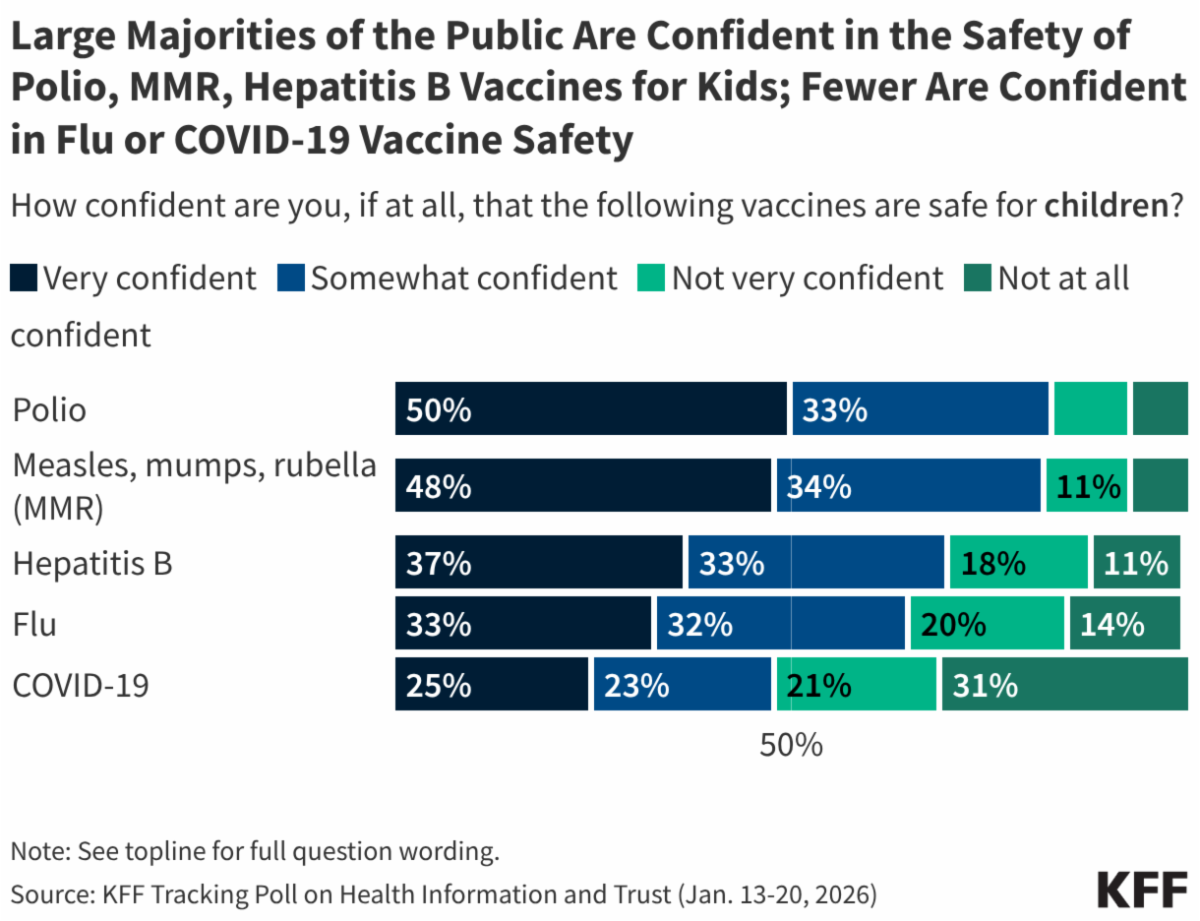
KFF polling shows public and parental confidence in the safety of the MMR and polio vaccines remains high for most people, including across partisans. But fewer are confident in the safety of the vaccines that are no longer universally recommended, with larger partisan differences.
For the 24th year in a row, Nurses are ranked the most trusted profession in the U.S., and 87% of adults view school nurses positively, rising to 91% once they learn about their roles. A new NASN School Nurse article co-written by NASN CEO Terri Hinkley and Judy Klein, President of Unity Consortium, highlights practical, evidence-based strategies for school nurses to communicate adolescent immunization recommendations clearly and confidently using existing public health messaging.
NASN, the National Foundation for Infectious Diseases, and National Association of County and City Officials will host a panel discussion March 18 on strengthening vaccine communication in diverse healthcare settings, featuring Dr. Eva Stone, School Nursing Leader and Manager of District Health for Jefferson County Public Schools, KY. Learn more and register.
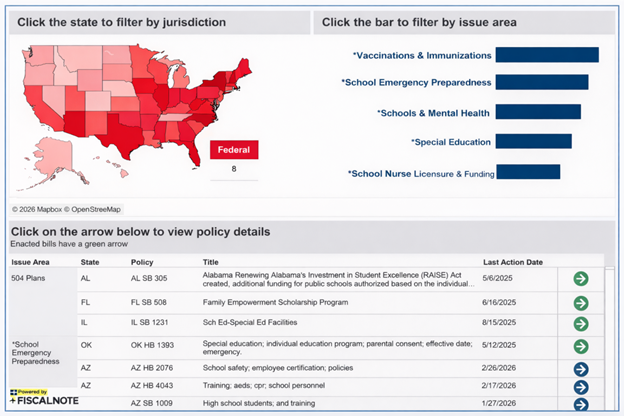
| | NASN Announces a New Resource, Policy Map, for School Nurse Advocates | NASN will launch a new interactive policy map that allows school nurses to explore state-level legislation that directly impacts their profession, schools, and communities. The map will allow NASN members to research pending legislation in their state or to track advocacy efforts across the nation. The map can be used to research proposals that affect school nursing licensure and funding, efforts to increase or restrict vaccination rates, legislation to improve school emergency preparedness, programs to bolster student mental health, and bills that would alter special education programming. The map will also provide NASN members with a summary of the bill, previous and upcoming hearing dates, and other key information, including sponsors and the bill's text. | | One Nurse:One School: Grassroots Advocacy in Anchorage, Alaska | | |
School nurses throughout the country are feeling the pinch of budget shortfalls and staffing shortages. These problems finally landed in the Anchorage School District, a mid-sized city district of 40,000 students and about 100 schools. With a recent budget shortfall of millions, the district proposed to cut 25 nursing positions. In a district with under 100 school nurses, this was a devastating cut.
The announcement was made on Friday, January 30. The first opportunity to speak on this topic at the School Board was just four days later, but it was at this meeting that a school nurse first used the term One Nurse:One School to describe the ideal staffing situation, and argued that cuts would reduce student safety, burden nonprofessional staff, and create costly liabilities.
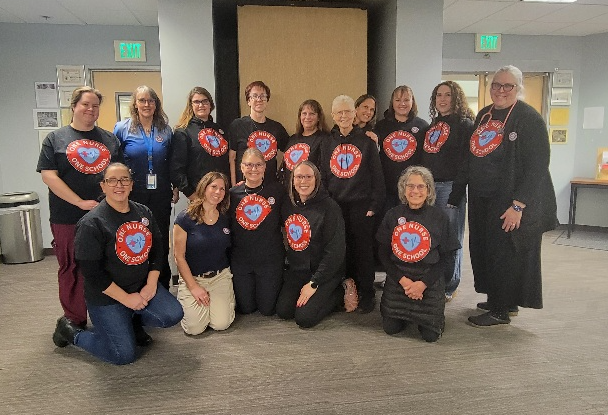
It did not take long for school nurses to mount a full-on advocacy campaign. A nurse created the One Nurse/One School logo and took it upon herself to manufacture pins for nurses and others to wear. Another nurse put up a website where we published research, comments, pictures, and important dates for testimony. Other nurses ordered T-shirts sporting the logo. Nurses wrote and submitted written testimony and called key advocates.
Just two weeks later, on February 17, nurses wearing the One Nurse:One School logo sat at the School Board meeting, and 11 of them gave heartfelt testimony on why the best model for nurse staffing is one nurse in every school. Parents and community members joined with their own supportive testimony. TV and newspaper coverage developed seamlessly after our appearances at School Board meetings.
In just under one month, on February 24, the School Board restored 16.5 school nurse positions. While this does not address the One Nurse:One School number entirely, it does show how well school nurses communicated their importance.
| | Iowa Vaccine Legislation Update | | The Iowa School Nurse Organization, in partnership with Iowa Immunize, testified against HF 2171, legislation that would eliminate Iowa’s K–12 school immunization requirements. Despite these efforts, the Iowa Committee on Education voted 14-9 to pass the bill to the House floor. ISNO will continue its advocacy efforts while the bill awaits consideration before the full House. There is no similar legislation in the Iowa Senate, so the bill would need Senate approval before passage. | | | | |