Policy Week in Review

Shutdown Continues and Could Drag on for Weeks

Key Takeaways from this Week


  • The shutdown stalemate continues without signs of a breakthrough. 


  • November 1 seems to be the next major political inflection point when ACA premium increases will become more apparent to consumers. 


  • Senate Leader Thune explicitly offered a vote on ACA subsidies after the government reopens but Democrats want guaranteed outcome, not just a guaranteed vote.  


  • The White House is showing no signs that the shutdown is bothering them.  


  • Senate vote on Russia sanctions expected in the next 30 days. 


  • The Administration has indicated they will renegotiate the USMCA trade agreement as the six-year review process approaches in July. We break down what that could look like. 


  • President Trump announced another MFN agreement with a pharmaceutical company, this time for fertility drugs.  


  • Don’t miss our new Executive Action Dashboard at the end of this email. 

Shutdown Stalemate Drags Along

It has been another week of very little progress on a deal to re-open the government. Here are some of the biggest events this week in government shutdown news.  


  • The Senate voted against temporary government funding for the tenth time yesterday. 


  • President Trump authorized the use of Department of Defense funding to pay active-duty troops. Speaker Johnson said that this will keep the military paid for now but could expire by October 31.  


  • Yesterday, Senate Majority Leader John Thune (R-SD) explicitly guaranteed a vote on enhanced premium tax credits after the government reopens, saying, “if you need a vote, we can guarantee you get a vote by a date certain.”  


It is looking increasingly like the shutdown will persist for days if not weeks. Many observers in Washington are of the opinion that there will be no significant movement from Republicans or Democrats until after November 1, 2025, when open enrollment will make the Affordable Care Act (ACA) premium increases clear to consumers. 


Some Say Wait Until November 

The beginning of November marks the start of open enrollment for the 24 million Americans who shop for insurance in the ACA marketplace. Assuming Congress has not passed a bill extending enhanced federal ACA tax credits by that time, those individuals are going to see their health insurance plan premiums potentially double on November 1.


Democrats believe that sticker shock will push public sentiment in favor of extending ACA enhanced tax credits. Some conservatives think that most Americans will not notice the changes in except for a few million at the upper income thresholds. Either way, both sides can plausibly tell themselves that their position will improve following the announcement of next year's insurance rates when open enrollment begins. 


Vote Guarantee Likely Not Enough for Democrats 

The promise of Senate Republicans is probably not enough to get the government reopened at this point. Even if the Senate votes and passes legislation to extend the enhanced tax credits, there is no guarantee that the more conservative House will follow suit. Simply put, Democrats cannot accept assurance of a vote from Leader Thune because he does not speak for Republicans in the House. This means that Democrats will likely demand ACA extensions be included in the same bill that funds the government. This makes the negotiation more complicated and suggests the shutdown will persist.  


Predicting the Policy Parameters of a Deal 

One frustrating aspect of this shutdown has been the fact that the policy outcome seems easy enough to predict. There will probably be a compromise that extends the ACA enhanced tax credits beyond 2025. At the outset of the debate most Republicans were adamant that subsidies should end as scheduled without any exception. More recently, conservatives are starting to articulate policy parameters necessary for a deal on ACA subsidies which include: 


  1. Income limits at the top end to ensure that wealthy enrollees do not receive subsidies.  
  2. Ensure that every enrollee spends some amount of money on their insurance plan by eliminating zero-dollar plans. 
  3. A short-term extension that expires after several years rather than permanence.  


The fact that these policy guardrails are openly being discussed suggests Republicans know that they will make a deal. For the time being, however, it does not appear either side feels pressure to start negotiating. If nothing shifts into the political playing field, both political parties may wait until November and see if sticker shock or lack thereof changes their hand.  

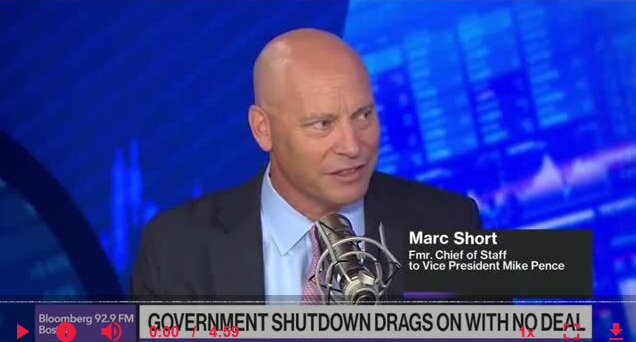
ICYMI: Marc Short on the Government Shutdown Politics and Timing


Russia Sanctions Vote Likely in Next 30 Days

Before the August recess, the Senate was prepared to take up bipartisan legislation to put harsh sanctions on Russia for its military aggression in Ukraine. With 84 bipartisan cosponsors, the legislation has strong support on Capitol Hill but was backburnered as talks between President Trump and Russian President Vladimir Putin were announced. However, in light of continued military action against Ukraine and little movement towards an end to the conflict, Leader Thune has indicated that it is now time for the Senate to consider the bill and a vote is likely within 30 days. Among other things, the bill puts a 500% tariff on imported goods from countries that buy Russian oil, gas, uranium, and other products. 


On Thursday, President Trump spoke on the phone with Russian President Vladimir Putin ahead of a planned meeting today (Friday) with Ukrainian President Volodymyr Zelenskyy. Trump has said he will meet with Putin in Hungary, but the date of that meeting has not been made public. 

The Status of USMCA and Potential Renegotiation 

A few days ago, Commerce Secretary Howard Lutnick said that the President will likely renegotiate the USMCA, saying he “wants to protect American jobs.” Other reports indicate the President might be interested in two separate trade agreements versus the larger USMCA. 


The United States-Mexico-Canada Agreement (USMCA) was signed at the end of President Trump’s first term, replacing the North American Free Trade Agreement (NAFTA). However, since beginning his second term, the President has been critical of the USMCA, raising concerns that he will withdraw or renegotiate the agreement. 


Since the beginning of his second term, the President has implemented additional tariffs on both Mexico (25%) and Canada (35%), although goods covered under the USMCA are exempt.  


Timeline 


  • September 26, 2025: The Office of the U.S. Trade Representative (USTR) announced a joint review of the USMCA on July 1, 2026.  


  • End of October 2025: Deadline for Mexico and the U.S. to agree to a trade deal to avoid increased tariffs. 


  • Early November 2025: Comments are due to USTR. 


  • November 17, 2025: Public hearing is held.  


  • Early January 2026: When ratified by Congress, Congress required that USTR submit a report to the appropriate Congressional committees assessing the USMCA and providing recommendations for action. This will give us a preview of how the review in July will play out. 


  • July 1, 2026: Joint review between the U.S., Mexico, and Canada. 


  • 20 Days Post-Meeting: USTR must brief the relevant congressional committees regarding the positions expressed by the countries during the joint review. USTR must also continue to engage the committees after the review and keep them apprised of any developments. 

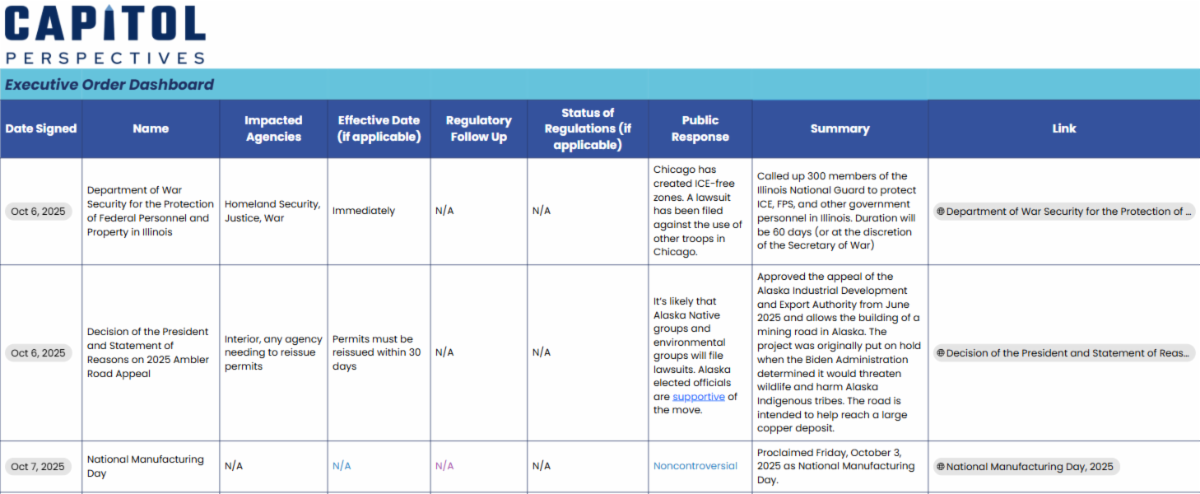
Introducing: Capitol Perspective's Executive Action Dashboard

Each week, we'll review the executive actions signed by President Trump. The Dashboard will be a living document shared every week and will build upon each action signed from September 1, 2025, onward. 


The Dashboard includes: 


  •   Impacted agencies 
  •   Effective date 
  •   If any regulatory follow-up is expected 
  •   Status of regulations (including sharing the regulations when released) 
  •   Public response (if applicable) 
  •   Summary of the action 
  •   Link to the text of the action 


This week, the President signed five executive actions. Some highlights: 


  • President Trump signed an order directing the Secretary of War to use any remaining funds appropriated by Congress for FY 2026 to pay military personnel, both active duty and reserve, during the shutdown. 
  • President Trump announced an agreement with pharmaceutical manufacturer EMD Serono, to offer fertility medications at most-favored-nation (MFN) pricing for Americans beginning in January. Additionally, the order creates a New Benefit Option for fertility benefits, giving employers a new legal pathway to offer fertility benefits directly to employees. The Departments of Labor, Health and Human Services, and Treasury issued initial guidance with additional rulemaking expected.  

As always, if you have questions about these or any other policy topics and would like to schedule a meeting or call with Marc and Andy, please email us.