Policy Week in Review - Supplemental Strategies, Major SCOTUS Decisions, and Delayed Signings

Key Takeaways


  • The Administration wants its $87 billion supplemental Iran war spending bill to pass in a bipartisan vote.


  • Democrats immediately unified in opposition.


  • There is also growing skepticism that a large Reconciliation 3.0 package can pass. 


  • The best path forward may be a skinny reconciliation only focused on the Iran war.


  • FISA and federal housing program reforms hit unexpected road blocks this week.


  • The Supreme Court has a big slate of major decisions coming soon (below). 


  • President Trump flipped votes to stop the passage of a war powers resolution.


  • There are only 28 days of House session before the midterms and the long Congressional agenda is starting to look more and more aspirational.


  • At this point, priorities like government funding, NDAA, and the supplemental spending bill for Iran might be the last “must pass” bills for the year. 

White House Submits $87.6 Billion Supplemental

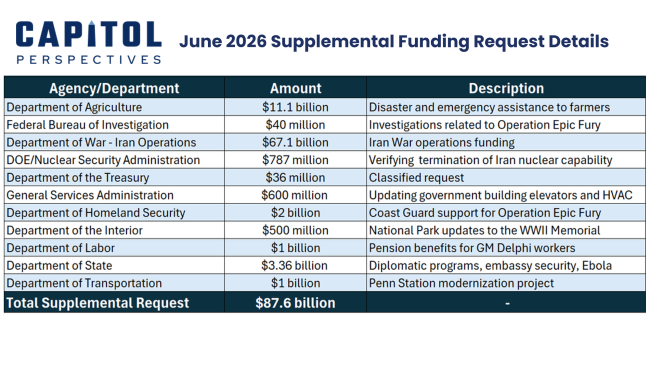
Late Wednesday, the White House submitted a formal request for $87.6 billion in supplemental defense funding to “replenish weapon stockpiles, pay troops in harm’s way, and ensure the resources necessary to meet evolving national security challenges and needs.” 


The bill includes $67 billion in funding directly for operations in Iran. There are also spending requests meant to elicit bipartisan support from Democrats including funding for farmers, $1.4 billion to fight Ebola outbreaks, and $1 billion for Penn Station in New York. There are also policy requests like the ability to sell E-15 fuel blends year round. 

The attempted policy overtures to Democrats do not appear to be working. Democratic leadership on both sides of Capitol Hill have unified against the supplemental request. The quick response is notable because the administration’s preferred path forward is a bipartisan bill that would require 60 votes in the Senate. At this point, it is difficult to see seven Democrats bucking leadership to support this version of the supplemental.


Republicans control the schedule in both chambers of Congress and will no doubt force votes in the House and Senate on the President's supplemental request. Their hope will be to apply political pressure on Democrats to support American troops and farmers. In the hyper political atmosphere heading into the November midterms, however, it seems unlikely that Democrats have any incentive to align with President Trump on Iran. If these initial votes fail in the coming weeks, there are still other options to pass the funding.

Could Reconciliation 3.0 Serve as a Backup Plan? 

At the same time as they submitted this request for funding, a spokesman for Secretary of War Pete Hegseth reiterated that the administration is still requesting an additional $350 billion in mandatory military appropriations through reconciliation. Those funds would be used to “Build the Golden Dome, reshore critical minerals supply chains, scale munitions production, and make critical Quality of Life investments for our amazing service members.”


While House Republicans are still planning to move a large-scale reconciliation budget in the coming weeks, there is growing skepticism in town that a broad reconciliation budget can pass this year. The biggest issue is that conservatives are demanding that any spending be offset with other cuts. This means spending reductions for mandatory assistance programs the moderates cannot support. The legislative math doesn't add up.


There is, however, recent evidence that a skinnier reconciliation package that is solely focused on the defense supplemental request could pass the Senate later this year. 


This week, the President was able to move Senator Bill Cassidy’s (R-LA) and Senator Rand Paul’s (R-KY) votes on an Iran war powers resolution and block the measure on Thursday after it had already passed the Senate during earlier votes. As Senator Lindsey Graham (R-SC) pointed out, this vote could be viewed as an affirmation of President Trump’s authority to prosecute the war in Iran. That vote could even serve as a very early proxy vote for the Iran supplemental in the Senate.


At this point, we do not believe a reconciliation package with $350 billion for the military and hundreds of billions in spending cuts has 50 votes to pass in the Senate. Odds of passing a spending bill increase significantly if Republicans pivot to a slimmed down version of Reconciliation 3.0 in July or September that focuses solely on the $87.6 billion Iran supplemental. That backup strategy would give the supplemental its best chance at success in our estimation.

Update on a Busy Week of Congressional Action


FISA Remains Stalled as Pulte Takes the Helm: Reauthorization of Section 702 of the Foreign Intelligence Surveillance Act (FISA) remains stalled this week as Democrats block the bill in the Senate. Last Friday, Acting Director Bill Pulte took charge of the Office of National Intelligence amid reported staff changes and layoffs. Democrats are using Pulte’s interim leadership as a justification to block a FISA extension until the new Director of National Intelligence is confirmed. The path forward remains unclear but the House is set to force another vote this week. 


Federal Housing Reform Signing Pulled from the President’s Desk: After months of back-and-forth between the House and Senate, federal housing reform legislation overwhelmingly passed both chambers and headed to the President’s desk. The final version of the 21st Century ROAD to Housing Act passed the Senate 85-5 on Monday night, and the House 358-32 on Tuesday. President Trump has delayed the signing ceremony indefinitely in an attempt to leverage passage of the SAVE American Act voting reform bill. On Thursday evening, Speaker Mike Johnson (R-LA) announced he had transmitted the legislation to the White House, which gives the President 10 days to sign or veto the legislation before it becomes law (which is widely expected to occur one way or the other). 


SAVE America Act Full Court Press: President Trump is upping the pressure on the Senate to pass voting reform and voter ID laws in the SAVE America Act. He met with senators this week and demanded changes to the filibuster to fast-track the legislation. President Trump is also delaying some signing ceremonies to help force action. The push for the bill also spilled over into the House where the procedural Rule for consideration of a veterans benefits package was delayed until next week because Freedom Caucus threatened to vote against the motion unless a path to pass the SAVE Act was presented.


House Moves Appropriations Bills: The House is trying once again to avoid a government shutdown or long-term continuing resolution by starting to move the least controversial of the twelve FY 2027 appropriations bills on the House floor. This week, the House passed the $47 billion State Department funding bill and the $58 billion energy and water development funding bills. In total, the House appropriations bills total $1.85 trillion in spending which is an increase of 12% over 2026.  


Committee Releases Bipartisan Online Rules for Minors: This week, leaders of the Energy and Commerce Committee released a bipartisan bill that would create new federal rules meant to shield minors from obscenity on social media platforms. H.R. 7757, the Kids Internet and Digital Safety Act (KIDS Act) was released this week and starts a debate with the Senate who are pushing state preemption and more liability for platforms. For more analysis, see our update from yesterday. Reports indicate the House could consider the bill as early as next week.


Senate Begins Farm Bill: On April 30, the House passed its version of the $495 billion “Farm Bill” reauthorization by a vote of 224-200. The Senate Agriculture Committee started its process by releasing the text of their version of the bill which funds both farm support programs and food stamps. Passing the bill before the September 30 expiration of the current extension is a big GOP priority but will require Democrat votes. 


Senate Passes One War Powers Resolution and Rejects Another: The Senate voted Tuesday afternoon 50-48 to pass a war powers resolution that the House had previously passed 215-208 directing the President to end the war with Iran or seek congressional approval. Four Republicans - Senators Rand Paul (KY), Lisa Murkowski (AK) Susan Collins (ME), and Bill Cassidy (LA) - voted for the resolution, while Democrat Senator John Fetterman (PA) voted against the resolution. 


By Wednesday evening, another vote was held and Sen. Paul (Present) and Cassidy (Nay) switched their votes after President Trump attended the Senate lunch. The concurrent resolution then failed. It has been taken as a signal that future resolutions will fail and a potential sign that there are 50 votes for Iran war funding. The concurrent resolution does not need the President’s signature but also does not become law, leaving the outcome symbolic. 

Administrative Action

Below is an update on a number of agency and White House actions taken this week primarily related to foreign policy and tech policy. 


Talks Continue with Iran Following Signing of MOU: Following last week’s signing of the memorandum of understanding (MOU) between the U.S. and Iran, both parties continue negotiations on a more lasting peace deal. Complicating those talks are Iran’s public disavowals of having agreed to nuclear inspections by the International Atomic Energy Agency (IAEA), and a reported Iranian attack on a cargo ship in the Strait of Hormuz. President Trump forcefully pushed back on Iran’s characterization, stating “Iran has fully and completely agreed to highest level Nuclear inspections long into the future” and that no further negotiations would occur if Iran had not made that commitment. 


President Signs Quantum Computing EOs: On Monday, President Trump signed two executive orders (EOs) on quantum computing. 


  • Securing the Nation Against Advanced Cryptographic Attacks: The EO directs relevant federal agencies to lead an “accelerated, nationwide migration to post-quantum cryptography” and ensure “clear practical guidance” for implementing post-quantum cryptography migration. The pilot project will be completed by the end of 2027.


Department of Energy Jumpstarts Nuclear Deployment with New Loans: Energy Secretary Chris Wright announced that the Department of Energy will provide $17.5 billion in low-interest loans in order to support the construction of five new projects that each consist of two nuclear reactors. According to Secretary Wright, the loans will “help accelerate the timeline of building those large-scale reactors by up to three years.” The projects will use the Westinghouse AP1000 nuclear reactor and could come online starting in 2035.


U.S. Oil Blockade and Cuba’s Market Reform: In late January, following the arrest of Venezuelan President Nicolás Maduro, President Trump signed an executive order to impose tariffs on any country selling or providing oil to Cuba. Without access to Venezuela’s heavily-subsidized oil, Cuba has since approved 176 free-market reforms in an attempt to stave off economic collapse. These reforms are aimed at decentralizing the current economic system and allow more private businesses, remove the requirement for foreign investors to form joint ventures with the state, and loosen restrictions on imports and exports. Meanwhile, Mexican President Claudia Sheinbaum is contemplating resuming oil exports to Cuba.

Supreme Court Set to Issue Major Rulings 

Yesterday, the U.S. Supreme Court (SCOTUS) handed the President big wins on his immigration policies by ruling the President is allowed to unilaterally end temporary protected status designations. With the approaching its summer recess, the Court is expected to announce a number of major decisions over the next two weeks, including cases that are high priority for the Trump Administration. SCOTUS will soon rule on:


  • Whether the President can deny birthright citizenship to the children of those in the country unlawfully or on temporary visas (Trump v. Barbara)


  • Whether states can restrict transgender athletes from playing sports based on their gender identity (Little v. Hecox and West Virginia v. B.P.J.)


  • Whether the President can fire heads of independent agencies (Trump v. Slaughter)


  • Whether the President can fire members of the Federal Reserve Board (Trump v. Cook)


  • Whether federal election-day statutes can preempt state laws allowing mail-in ballots cast by election day to be received after election day (Watson v. Republican National Committee)

Tracking Policy Priorities and Legislation 

Republicans in Washington are hoping to sprint down the stretch to stack accomplishments and make a strong case to voters before the month-long August recess and then the November 3 elections. It is going to be an uphill climb with a lot on the agenda and only a short time to do it. In the House, there are 28 more legislative days scheduled until the midterms. The Senate is set to be in session for 37 days. 


Here’s a look at the major items still on the agenda for the White House and Congress, generally listed in the order that we expect them to occur.


  • Reauthorizing FISA 702 foreign surveillance authority.


  • Consideration of the National Defense Authorization Act (NDAA) for 2027. 


  • Passing the CLARITY Act to provide a new structure for crypto currency banking. 


  • Hearings and confirmation for Jay Clayton as Director of National Intelligence.


  • Hearings and confirmation for Todd Blanche as Attorney General.


  • U.S.-Mexico-Canada Agreement (USMCA) extension decision on July 1, 2026. 


  • Consideration of $87 billion in supplemental war funding related to Iran. 


  • Congress will likely start Budget Reconciliation 3.0 to address additional military funding, targeted tax relief, and wasteful government programs. 


  • Farm Bill including nearly $500 billion for food stamps and agriculture support. 


  • Reciprocal tariffs under Section 122 of the Trade Act expire July 24, 2026, and could be replaced by Section 301 tariffs meant to stop forced labor.


  • Addressing expiring funding for CHIPS Act and semiconductor incentives. 


  • Highway and transit funding to keep federal dollars flowing beyond the September 30 expiration and cover a $275 billion shortfall over the next five years. 


  • Implementing a new federal tax framework for crypto and online currency.


  • Consideration of the Kids Internet and Digital Safety (KIDS) online safety bill. 

As always, if you have questions about these or any other policy topics and would like to schedule a meeting or call with Marc and Andy, please email us.