Policy Week in Review

The Government Funding Impasse Continues

The government shutdown is on its tenth day. With the senate now out of town until Tuesday, it is certain the funding lapse will continue until after the Columbus Day federal holiday. Here is more on the GOP and Democrat perspectives on Capitol Hill and the search for a way out.  

Key Takeaways on Shutdown Dynamics


  • There was no discernible progress toward restarting government this week. 


  • Leaders from both parties are feeling little particular pressure to make a deal. 


  • Some in Congress hope external pressure will mount in the coming days.  


  • Most federal employees will receive partial checks starting today. 


  • Servicemembers will start to miss paychecks next week without legislation. 


  • Furloughs at the Internal Revenue Service (IRS) have begun. 


  • These dynamics could shift the calculus in the coming days. 


  • The potential offramp for the government shutdown is predicated on what Democrats are willing to accept to declare a victory. 


  • Senate Minority Leader Chuck Schumer (D-NY) is earning credit with liberals the longer the shutdown persists. 


  • The way to end this shutdown is making deals to earn individual votes from rank-and-file Senate Democrats.  


  • Non-leadership Senate Democrats are starting to coalesce around the extension of enhanced Affordable Care Act (ACA) tax credits that expire in January. 


  • There are several variations of an agreement on ACA subsidies, including agreeing to negotiations, and guaranteeing a future vote. 


  • It’s unclear when the logjam breaks at this point. 

Reasons for the Persistent Stalemate

The current mood on Capitol Hill suggests that Republican Members of Congress feel little pressure to make a deal with Democrats. Simply put, Republicans’ concerns about being blamed for the shutdown are quite low. There are several reasons why Republican Members do not currently feel constrained by Democrat demands: 


  1. Many in Congress feel like Americans have not started to notice the impact. 
  2. Only 28% of government workers are furloughed during the shutdown. 
  3. Health insurance premium increases do not hit consumer pocketbooks until January. 
  4. House Republicans already passed a clean continuing resolution (CR) to fund the government and universally believe they do not need to negotiate.  
  5. As more time passes and more insults are hurled, there is less of an appetite to make a deal with Democrats. 
  6. There are still more steps that the Office of Management and Budget (OMB) can take to apply pressure to Democrats. 


Democrats said Thursday that they believe the shutdown has been good for them politically. They have also been slow to coalesce around a single policy request largely because Leader Schumer is earning credit with his left flank the longer this shutdown persists. As his popularity with liberals increases, Schumer will be disinclined to define a policy goal. In many ways, the growing praise from the liberal base encourages Schumer to keep moving the goalposts and avoid a deal.  

The End Game

For the reasons noted above, this shutdown is more likely to end with Senate Majority Leader John Thune (R-SD) making one-on-one deals than through a grand bargain between leadership. There are some signs of small progress. The first health care bill Democrats put forward was an unrealistic non-starter. However, rank-and-file Democrats increasingly are only talking about the extension of enhanced Affordable Care Act (ACA) tax credits that expire on January 1, 2026.  


Majority Leader Thune must try to make side deals with individual senators moving forward. Offerings could include a guaranteed vote on extended subsidies, a plan to move FY 2026 spending bills, or pet priorities like the authorization for use of military force (AUMF) regularly sponsored by Senator Tim Kaine (D-VA). It is also unknown whether Speaker Mike Johnson (R-LA) would make similar assurances to vote in the House.  


House Republicans appear to be comfortable with their position, evidenced by the fact that they believe that pressure will mount on Democrats when federal employees miss their first paychecks tomorrow. Senate Republicans hope that will increase the pressure and force Democrats to accept a guaranteed vote on enhanced premium tax credits. 

Searching for an Offramp

If Democrats can unify behind extending ACA subsidies as the clear, lone ask in exchange for reopening the government, Republicans will be more willing to meet them at the negotiating table. This is especially true considering that President Trump wants a deal on ACA subsidies and moderate Republicans were likely to break in that direction even absent a shutdown. The political theater and failure of Democrats to define a clear offramp so far have entrenched both sides and have made an agreement on common interests more difficult to achieve. 


One key question when thinking about the potential offramp is what Democrats are willing to accept to declare a victory. At this point, Senate Democrats could plausibly claim a win and begin ACA negotiations as soon as the CR is passed. That is obviously not enough right now. In order of specificity, Republicans can offer: 


  • Assurances to conduct further negotiations on federal spending and ACA credits.  
  • A promise in the House and Senate to hold a vote on ACA tax credit extensions and/or federal funding.  
  • A written agreement on the parameters of ACA subsidy extensions.  
  • Agreement on actual legislative text. 


There have been reports that Senators on both sides are talking about a potential agreement that would end the shutdown. Regarding those talks, Democratic Leader Schumer said yesterday that a guarantee of a vote to extend enhanced tax credits was not enough for him to support a CR. The question is whether it might be enough to garner seven votes from other Democratic Senators.  

A Primer on Enhanced ACA Premium Tax Credits

As we noted above, it seems that Democrats will start focusing on one single policy issue in the shutdown fight - the expanded premium tax credits for health insurance available through the ACA health insurance exchanges.  


Policy Background

As part of a COVID relief package passed by Congress in 2021, the tax credits created by the ACA were expanded to allow more individuals to qualify. These expanded credits were then extended again through the end of 2025 in the Inflation Reduction Act of 2022. 


According to the Congressional Budget Office (CBO), if the credits expire, premiums will increase by 4.3% and the uninsured population will increase by 2.2 million in 2026. CBO and Joint Committee on Taxation (JCT) have estimated that a permanent extension would add $350 billion to the budget deficit between Fiscal Year (FY) 2026 and 2035. 


The Politics Behind the Policy

Democrats are in favor of the full and permanent extension of the enhanced tax credits to prevent a premium hike at the end of this year. Republicans view the enhanced credits as subsidies under Obamacare that have driven up premiums and were always supposed to be temporary, emergency spending during COVID. While most Republicans eventually want to eliminate the costly expanded credit, there is likely a split between conservatives who support immediate expiration and vulnerable moderates who want to phase it out. 


Letting the credits expire is a perceived as a political liability for Republicans. Even though no Republican ever voted for the expanded credit, they will face criticism if the subsidy ends on their watch. That is because one recent study estimates that the expiration of tax credits would raise average premiums for 22 million Americans by $5,023 in 2026.  


Republicans fear that the sticker would be blamed on the majority party right before key midterm elections. Notably, Republican pollsters Tony Fabrizio and Bob Ward recommended in a July 2025 memo that Republicans should extend the tax credits to take the lead in the 2026 midterms, citing bipartisan support for the extension. 


The Latest Attempts to Compromise

In recent days, reports indicate there are behind the scenes conversations focused on extended tax credits. This would perhaps include new income caps, guardrails, or expiration dates. From a policy standpoint, the fact that high profile Republicans are working on the subsidies suggests that moderates in the GOP will win the day and tax credits will be extended. 


  • Earlier this week, it was reported that Senator Susan Collins (R-ME) is working on a bipartisan plan to extend the expanded credits, outside of Senate leadership.  
  • Conservative Representative Marjorie Taylor Green (R-GA) also unexpectedly came out in support of extending the credits, after learning her daughter’s health insurance premiums will be doubling as a result of the expiration.  
  • Other Republicans who have spoken out in favor of extending the credits: Senator Tommy Tuberville (R-AL), Senator Mike Rounds (R-SD), Senator Thom Tillis (R-NC), and Representative Brian Fitzpatrick (R-PA). 
  • Reports indicated President Trump instructed his team work on plans that would extend the COVID-era tax credits.  


We believe that we are heading to a compromise on the tax credits that will result in their extension for several years. We do not, however see a scenario where Republicans agree to making the enhanced credits permanent. Any extension is likely to either be temporary or adjusted to cover fewer Americans to reduce the cost.  

Next Steps in Gaza Peace Agreement

This week, President Trump announced that Israel and Hamas both signed off on phase one of a historic agreement to end the war in Gaza, which includes a ceasefire, the exchange of hostages held by Hamas for prisoners held by Israel, and the withdrawal of the Israeli military to an agreed-upon line in Gaza. Next on the agenda will be negotiations over implementing the rest of the President’s 20-point plan for peace, including governance over Gaza, redevelopment of the area, disarmament, and the future of Hamas.  

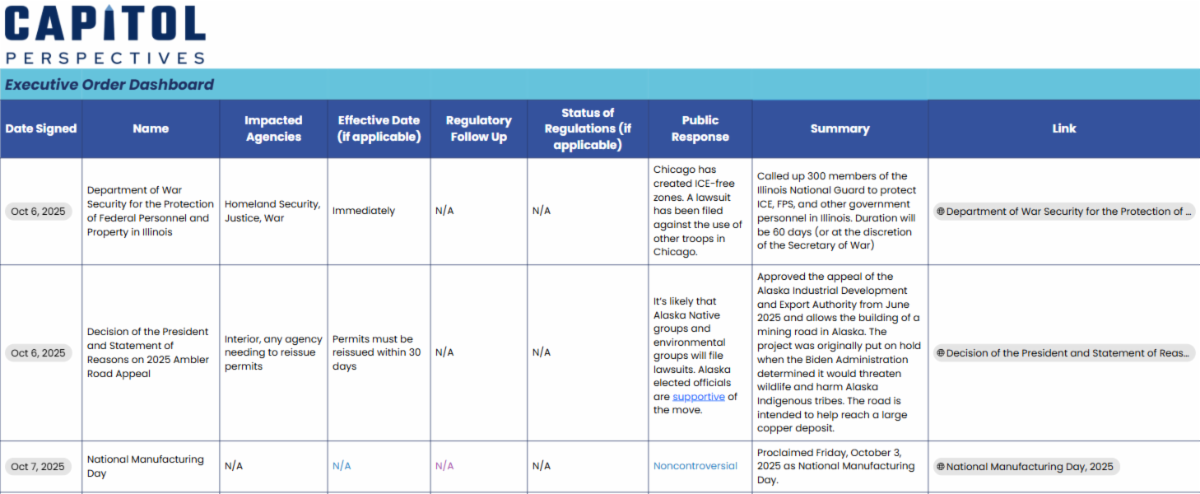
Introducing: Capitol Perspective's Executive Order Dashboard

Each week, we'll review the executive actions signed by President Trump. The Dashboard will be a living document shared every week and will build upon each action signed from October 6, 2025, onward. 


The Dashboard includes: 


  •   Impacted agencies 
  •   Effective date 
  •   If any regulatory follow-up is expected 
  •   Status of regulations (including sharing the regulations when released) 
  •   Public response (if applicable) 
  •   Summary of the action 
  •   Link to the text of the action 


Preview next week’s dashboard below. 

As always, if you have questions about these or any other policy topics and would like to schedule a meeting or call with Marc and Andy, please email us.