|
Great travelers. Weeds are great travelers; they are, indeed, the tramps of the vegetable world. They are going east, west, north, south; they walk; they fly; they swim; they steal a ride; they travel by rail, by flood, by wind; they go underground and they go above, across lots, and by the highway.
Weeds love a free ride.
In the High Plains, farmers have been known to remove field bindweed from the shanks of tillage tools to keep from transporting the viney weed from one field to the next.
During wheat harvest, custom harvesters are often asked to wash their combines before starting work on a new client, just to keep one farmer's weed problems from spreading.
In 2015 Kevin Bradley, weed scientist at the University of Missouri, examined the digestive tracts of 350 migratory ducks and geese to see if they contained weed seeds. Bradley's team counted more than 14,000 intact weed seeds in the waterfowl, including pigweeds and barnyard grass.
According to the Weed Science Society of America (WSSA) weed seeds may be found on tires, bumpers and wheel wells of vehicles, or can crisscross the country in a package of wild bird seed. Understanding weed seed disbursement is an important part of weed science, Dille says. Dandelion seeds are designed to catch wind, which is why they spread so far and so fast.
"Pennycress tends to stay local because the seeds stay where they fall," she says. The WSSA notes that tiny seeds, such as horseweed, can move up to 300 miles by air.
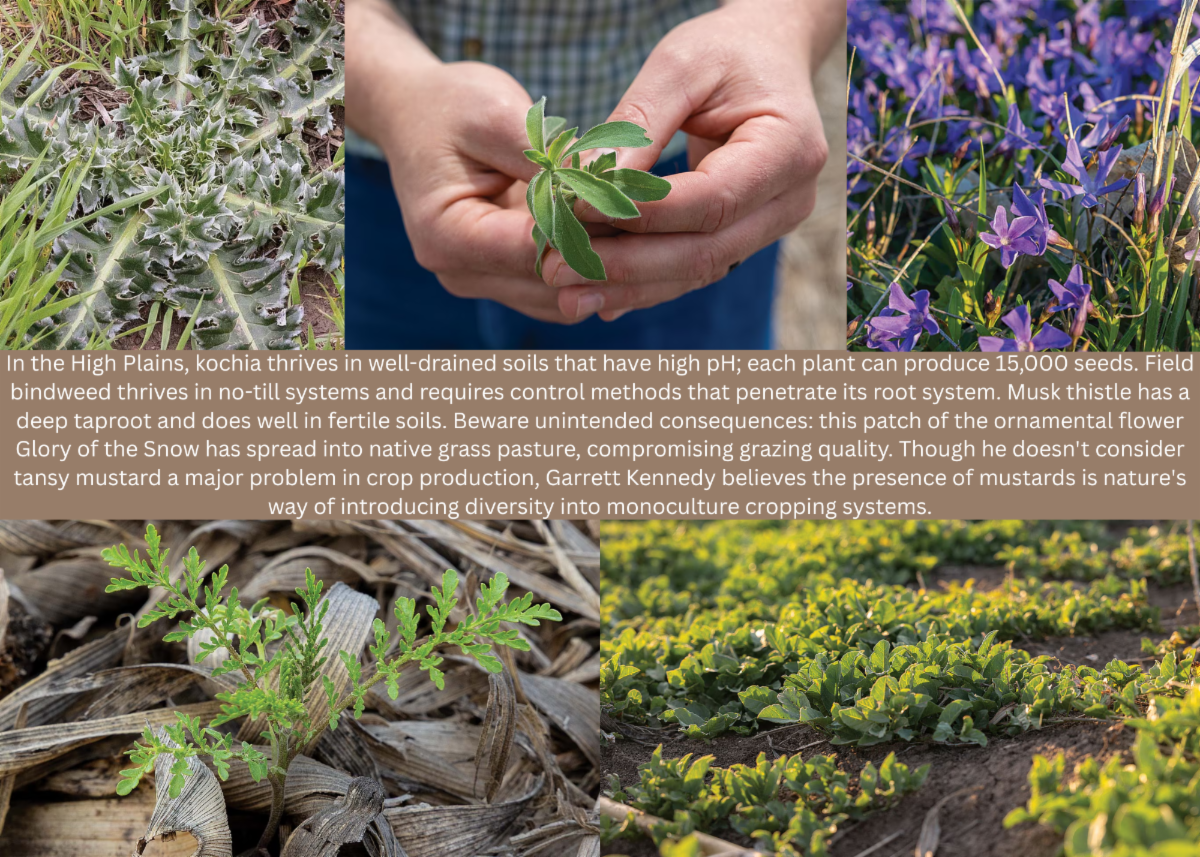
That contrasts with kochia, a tumbleweed that moves via wind across open fields each winter throughout the High Plains. The average kochia plant will roll about half a mile, dropping thousands of seeds in its wake.
Almost human. One is tempted to say that the most human plants, after all, are the weeds.
Just like farmers' cultural practices have evolved, so too have weed challenges, Kennedy says.
Three generations ago, the moldboard plow turned over thick layers of soil and generally, only large-seeded, robust weeds could emerge from those tillage passes. As shallow tillage tools were adopted, a cornucopia of large- and small-seeded weeds thrived. Now, tools like no-till, ridge-till, and cover cropping bring about new and different challenges. Thus, keeping weeds at bay may require a more holistic thought process, he adds.
"As weed control has become more challenging lately, with more herbicide resistance concerns, I think we have to think through it a little bit differently." Farmers can no longer spray a field and walk away, Kennedy says. Controlling weeds is like a game of chess, in which participants need to think a few moves ahead.
"Margins are tight and commodity prices are low, so we've got to look at other ways to think outside the box. Cultural control is one of those," he explains. Can a tweak to the nitrogen management program ensure the cash crop—not a weed—uses the nitrogen? Can we build residue on headlands to prevent edge-of-field weed populations?
To be clear, not every weed has a specific purpose. Sometimes, a weed's initial presence is just a random act of Mother Nature. But why did it thrive? Is it compaction, or soil pH? Or maybe excess fertility after the cash crop. Understanding the weed's strengths and weaknesses and looking for clues is imperative.
"That goes back to looking at the whole system approach: figuring out why that weed is here and what are things we can do to prevent it," Kennedy says.
|