|
Artificial Intelligence — and human intelligence — point the way to better crops and crop protection.
Story and Photos by Steve Werblow
In agriculture, the letters "AI" used to be easily understood shorthand for "active ingredient" or "artificial insemination," depending on whether your brain leaned more to the crop or livestock side of the business. Simple enough. Now agricultural AI also encompasses "artificial intelligence," a computer-driven set of capabilities growing so quickly and marketed with such enthusiasm in all industries that it's hard to put a finger on what it actually is.
Computer scientists grapple over the precise meaning of "artificial intelligence," which ranges from spotting patterns in massive data sets to creating novel works of art. The common denominator among the definitions is that AI accomplishes tasks that generally require human intelligence, including understanding language, adapting to new situations, and learning from data and results.
Agriculture can give AI plenty to chew on. The corn genome contains about 2.3 billion base pairs that form approximately 32,000 genes. Tapping into AI's capability to sort through the repetitive codes in all that data to find patterns is a godsend to breeders and agronomists. The same is true of scientists developing new approaches to crop protection, which requires a deep knowledge of how a molecule interacts with a target—and with the environment.
In short, the powerful combination of artificial intelligence and human creativity is driving agriculture to new heights.
Stalemate. In nearly 40 years, only two new herbicide modes of action have been introduced worldwide. That has left farmers reliant on approximately 20 modes of action, a growing number of which have encountered weed resistance. In Oxford, England, scientists at Moa Technology have harnessed AI to help analyze screening data on more than 830,000 synthetic and biological compounds to find new herbicidal modes of action.
Alexandra Ranson at Moa explains that the company uses AI in its key screening systems.
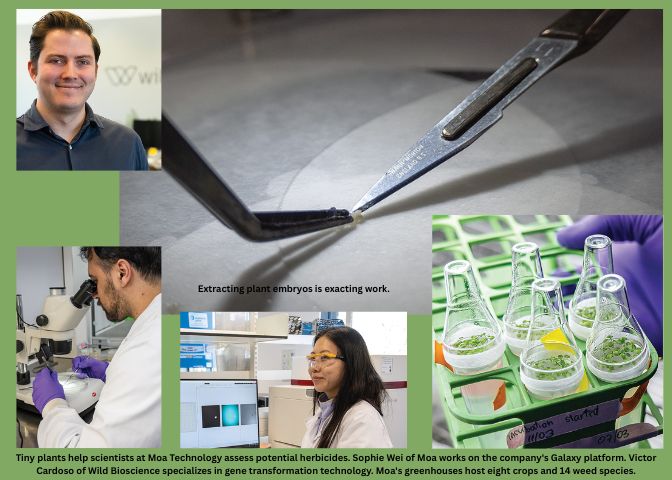
Moa's Galaxy platform spots the effects of the herbicidal compounds down to the subcellular level. Company researchers expose microscopic plants to promising candidates, photograph them, then use AI to help analyze more than 100 parameters in each image. That can indicate a molecule's herbicidal activity and shed light on how it operates.
Candidates that show potential in the lab and polytunnels are tested in greenhouses, then out in the field. Moa has completed three seasons of trials, testing potential new modes of action on tough, resistance-prone weeds including pigweed, waterhemp, and ryegrass.
Finally, massive computing power helps Moa organize its gigantic databases.
Lightning. Compared to traditional herbicide discovery and testing, Moa operates at lightning speed. Over the past four years, Moa has identified 80 potential new modes of action and a new class of "amplifier" molecules that multiply the herbicidal effects of other compounds. Moa is partnering with Nufarm and Gowan to test and commercialize products in what it hopes will be a suite of herbicide tools.
Evolution. In nearby Milton, Wild Bioscience uses AI to analyze plant genetics and guide breeders toward huge improvements in crop performance based on how plants evolved. It recently launched an initiative to master the genetics behind chloroplasts, where photosynthesis takes place.
"It's really about trying to understand what's been happening in wild plants over hundreds of millions of years of historic climate change, and try to learn from solutions that the plants have already come up with," says Wild Bio CEO and co-founder Ross Hendron. "We'll be working back from that and saying, 'how do we redesign this trait concept?'"
As the Wild Bio team's AI wranglers sift billions of data points to identify and understand natural adaptations—as well as how different crops can harness them—company scientists use the latest genetic transformation tools to edit those genes in tiny wheat, soybean, and corn embryos. Ultimately, Hendron says Wild Bio will provide trait bundles that seed companies can integrate into their elite germplasm for double-digit yield gains.
"We are taking big swings for dramatic improvements," he notes. "When you're thinking about gene editing, this is not a case of 'incremental but faster.' We are trying to do things that today really aren't possible."
|