STAY INFORMED – TALKING POINTS – ACTIONS TO CONSIDER – VOICES – STORIES | |
When Prayer Needs Protection, No Faith Is Truly Safe
| |
Prayers turned into shouts as an assailant forced his way into New York City’s Central Synagogue during Friday night Shabbat services on Aug. 14 and attacked a congregant and a guard. An hour earlier, worshippers walked past metal detectors, armed guards and a police sergeant just to enter the building.
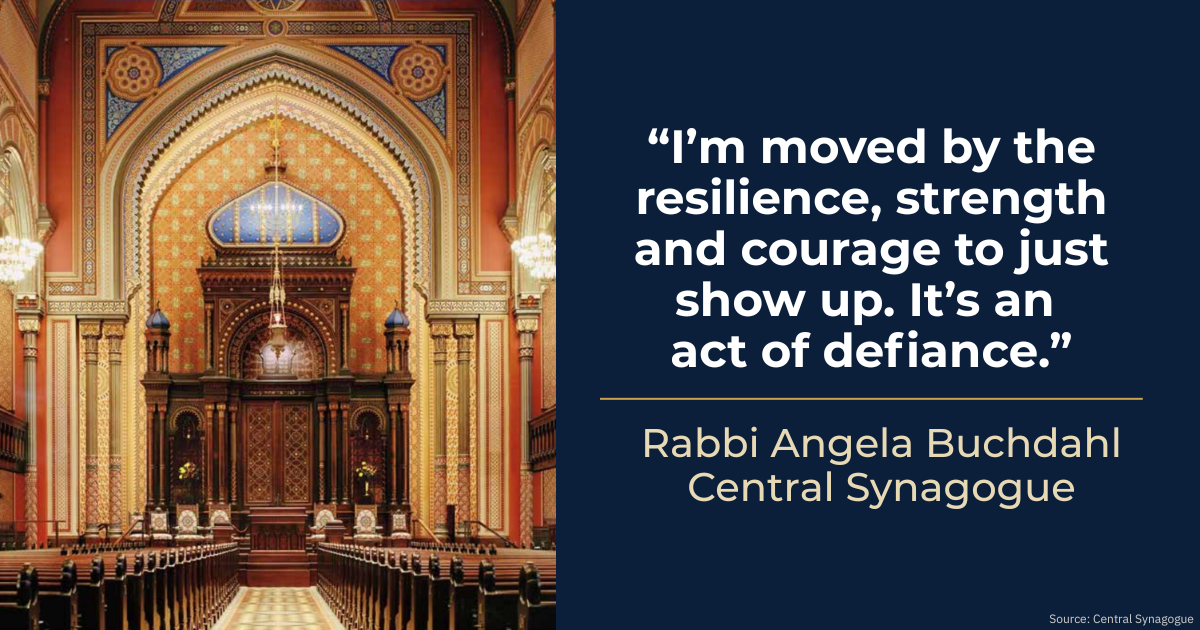
The attacker, Larry Montes, burst in, calling the congregation “fake Jews,” striking a 63-year-old woman in the face and headbutting a security guard. He raised no alarms on his way in. Despite the frightening intrusion, prayer services continued as an act of defiance. Like an eerie foreshadowing, Rabbi Angela Buchdahl had warned weeks earlier that political rhetoric was creating “the climate in which threats and violence flourish.”
NYPD Commissioner Jessica Tisch, who grew up in the congregation and was married there, stated that “a place of worship should never be a crime scene.” Rabbi Buchdahl’s warning had been directed at NYC Mayor Mamdani, whose “rhetoric that demonizes Jews and the Jewish state” she condemned, while citing multiple past threats against her congregation.
American synagogues maintain a level of security that places of worship for other faiths rarely need – and it was still not enough. Protection stops at the door, leaving Jews exposed the moment they step onto the sidewalk. Solutions that can restore a sense of safety require politicians, law enforcement and non-Jewish neighbors to treat an attack on Jews as an attack on America itself.
| |
Deadly Attacks Increase Security Costs
Security preparations at synagogues, schools and other Jewish community centers are now standard – often carried out by people who never signed up for the job. Clergy rehearse active shooter scenarios, volunteers guard doors and preschoolers practice lockdown drills.
The deadliest antisemitic attack in U.S. history pushed communities to increase their security. Pittsburgh’s Tree of Life synagogue had no armed guard at its doors when a white supremacist murdered 11 worshippers in 2018. A year later, a gunman murdered Lori Gilbert-Kaye, 60, inside a Poway, CA, Chabad synagogue before congregant Oscar Stewart charged him.
The Oct. 7, 2023, Hamas massacres in Israel unleashed an unprecedented wave of antisemitic violence in the U.S. and around the world. An Islamist terrorist drove dozens of miles past other Michigan synagogues in March to reach Temple Israel in West Bloomfield. The security director led an FBI active-shooter training for the synagogue’s staff months earlier. He was the only person injured when the terrorist rammed a vehicle loaded with explosives through the synagogue’s doors – stopping only feet from the Early Childhood Center, where more than 100 young children were inside.
The Jewish Federations of North America puts the cost of community security protection at $765 million a year warning that it means “fewer resources for education, camps and essential programs.” A Teach Coalition report found Jewish day schools spending 84% more on security currently than before Oct. 7 – “like an antisemitism tax.” Synagogues are preparing perimeter plans and hiring guards now for the High Holidays, which begins at sundown on Sep. 11.
Attackers Target Jews Where They are Most Vulnerable
FBI data shows that most anti-Jewish hate crimes are committed outside Jewish institutions – on city streets, at schools and in private homes. Nationally, Jews are targeted in 64% of religious based hate crimes – despite only being about 2% of America’s population. Beyond the perimeter, what often marks a Jew as a target is visibility: a kippah, a Star of David or Hebrew being spoken.
Moshe Grunhaus had just finished afternoon prayers at the Jewish Center on Manhattan’s Upper West Side on July 23 when an assailant shouting “Allahu Akbar” – God is greatest – stabbed a screwdriver into his chest. Grunhaus, who was wearing a kippah, pulled it out himself. Four blocks away, the attacker stabbed a 57-year-old Asian man in the back.
A Hadassah survey of Jewish women found 52% had hidden their Jewish identity out of fear. “I am afraid to wear my Jewish Star necklace and Chai ring out in public,” one respondent said. “I only wear it to the synagogue, Hadassah and other Jewish events.”
| |
Faith Groups Are Answering Threats Together
A response to the violence and intimidation is already underway – in state legislatures, in federal court and among neighbors, but more is needed.
After protests outside Manhattan’s Park East Synagogue in May, Jewish New Yorkers did not wait for a second protest. Leaders pressed their legislature to enact a 50-foot buffer zone around houses of worship, community centers and religious schools of all faiths, making it a misdemeanor to intimidate individuals entering them. Gov. Hochul stated that these kinds of demonstrations are “harassment, not free expression.” Since Mayor Mamdani declined to sign a similar bill protecting houses of worship, the NYC Council overrode him with a veto-proof majority.
The California legislature also is pursuing safe worship zones and a measure expanding state security grants to cover events held away from a congregation’s building – written after protests at Wilshire Boulevard Temple and Adas Torah in LA.
The Freedom of Access to Clinic Entrances Act makes it a federal crime to obstruct religious worship, but for three decades it was used almost exclusively in abortion clinic cases. That changed when the StandWithUs Center for Legal Justice, supported by the Justice Dept., sued the organizers of the mob that blocked Jews from entering Adas Torah. Asst. U.S. Attorney General Harmeet Dhillon said that the “pioneering application of the FACE Act to defend Jewish synagogues” is now the model for protecting churches.
Neighbors have stepped up their support as well. After the terror attack at Temple Israel in MI, the Shenandoah Country Club opened its doors. Temple Israel said that the Catholic organization founded by the Chaldean Iraqi American Association of Michigan “welcomed us, fed us and sheltered our staff, teachers, children and parents.”
On Capitol Hill, more than 100 Jewish organizations across the ideological spectrum are backing a six-point security policy plan asking national politicians to raise the Nonprofit Security Grant Program to $1 billion annually. Current funding falls far short of that and a bipartisan group of lawmakers recently raised concerns.
The day after her congregation was attacked, Rabbi Buchdahl described the city she wants: “One in which people of all faiths, classes and colors feel belonging.” Religious freedom is one of the most cherished American values.
| | |
1. Armed guards have become a prerequisite for Jews to worship safely
A coalition of Jewish organizations – joined by other faith groups – is pressing Congress to pass the Pray Safe Act, which would create a centralized resource hub to provide security guidance for houses of worship. Jewish Federations of North America CEO Eric Fingerhut told Congress that exercising the First Amendment right to worship now “depends on comprehensive, even extraordinary, security precautions.” That is not a description of a grant program – it is an admission that prayer itself now requires a security plan. In Europe, many synagogues require armed soldiers – a sight American Jews still hope never becomes their reality.
2. Being visibly Jewish in public carries real risk
A Star of David deserves to be worn as proudly as a cross or any other religious symbol – but for many Jews, the anxiety starts before leaving home. Jews also weigh whether to wear a kippah or cover it with a baseball cap or to speak Hebrew in public – considerations that would be unimaginable for most Americans walking out their door.
3. Violence aimed at Jews does not stop with Jews
The man who stabbed Moshe Grunhaus outside his Upper West Side synagogue in July also stabbed an Asian man. Two teenage gunmen who murdered three men at a San Diego mosque earlier this year carried a racist manifesto that also targeted Jews. An attacker who cannot tolerate Jews, rarely stops with just the Jews. Anyone who ignores an attack on Jews should not assume they are safe from the next one.
4. Federal security funding for all religions falls far short of needs
A coalition of faith groups wrote to Congressional leaders warning of an “unprecedented and escalating threat environment facing religious communities” and requesting up to $1 billion annually for the Nonprofit Security Grant Program. Congress appropriated $300 million for 2026, and the House Appropriations Committee has proposed $315 million for 2027 – a third of the request, two years running. A funding request that keeps getting shortchanged is not a budget dispute – it is an unheeded warning.
5. Jews respond to danger with defiance
Central Synagogue’s Rabbi Buchdahl said her sanctuary has filled to the balconies every Friday night since Oct. 7. She is moved to tears by it “because I know it takes a lot of courage sometimes to do that, to just show up.” Union for Reform Judaism President Rabbi Rick Jacobs answered the Central Synagogue attack the same way: “We will not answer fear by retreating behind locked doors.” Every filled sanctuary is not simply attendance – it is an answer of defiance in the face of continuing attacks.
| |
-
Urge federal support for increased security funding: Contact your U.S. Representative and Senators directly or sign the Jewish Federations of North America petition urging Congress to raise Nonprofit Security Grant Program funding to $1 billion annually and pass the Pray Safe Act. Current funding covers roughly a third of what religious institutions of all faiths are requesting.
-
Show up and stand as an ally: Attend community events, defend Jews online and tell your elected officials that a heavily-guarded sanctuary should not be an accepted American norm. Every one of those acts tells a congregation it is not standing alone.
| | |
In Solidarity: A Statement from The New York Board of Rabbis
An excerpt from the full statement.
There was a time when the words “Never Again” were followed by an exclamation mark. Today, in the face of rising antisemitism, hatred, and violence, they too often seem to be followed by a question mark.
We must not allow that question mark to become our new reality.
On Friday evening, as the community of Central Synagogue gathered to welcome Shabbat, the sanctity of prayer was violated by an act of hatred and violence. Security alone cannot address the hatred that makes such protection necessary.
For generations, people of faith have looked to the commandment “Love your neighbor as yourself” as a fundamental moral obligation. Today we are witnessing the dangerous normalization of its opposite: the idea that a neighbor can be despised, dehumanized, or threatened because of their religion, identity, beliefs, or opinions. We must reject that culture of hatred wherever it appears and whomever it targets.
The Jewish community cannot, and should not, be expected to confront antisemitism alone. We are heartened by the faith leaders, civic institutions, elected officials, and neighbors who have stood with us. Their solidarity affirms an essential truth: antisemitism is not solely a Jewish problem. An attack upon Jews because they are Jews is an assault upon the fundamental promise that every person should be able to live, worship, and express their identity without fear.
Words matter. The demonization of Jews, antisemitic tropes, and rhetoric that treats Jewish identity as suspect have consequences. When Jewish New Yorkers wonder whether it is safe to wear a kippah or Star of David, something fundamental has gone wrong. No parent should have to tell a child to hide who they are to remain safe. That must never become normal.
We are especially moved that Central Synagogue returned to prayer. That act carries its own message: hatred will not determine whether Jews gather, whether Jews pray, or whether Jews live openly as Jews.
At this moment, we must remember a truth that is both simple and profound: We are not apart from one another. We are a part of one another.
The safety and dignity of one community are inseparable from the safety and dignity of us all.
In solidarity,
The New York Board of Rabbis
| | |
Stories of Resilience
Stories Impacting American Jews
Stories Impacting the U.S. and Israel
Stories from Around the World
| | CLICK BELOW TO ACCESS ADDITIONAL FOCUS PROJECT RESOURCES: | |
Want to Read More of Our Talking Points? | Did you miss a recent edition of The Focus Project? No need to search your inbox. Our most recently published editions are available on our website. Click below to continue reading. | | | | |
The Focus Project develops and distributes news, background, history and weekly talking points on timely issues to inform individuals and organizations about issues affecting the American Jewish community and Israel, and help readers speak with more consistency and clarity. The editions also provide potential responses for addressing incidents of antisemitism and anti-Zionism. With input from a spectrum of major American Jewish organizations, we focus on that which unites us, rising above political and individual agendas.
Recognizing that hatred of Jews comes in many forms and directions, we strive to address all sources as they arise, and educate our growing audience on topics ranging from inter-religious relations to relevant international developments. From week to week, we may focus on issues arising from the political left, university campuses, from the political right and from institutions, government, and corporations. We don’t try to address all issues in each edition. We hope you will find this information useful in your writing and/or speaking. We are always open to your feedback: info@focus-project.org.
| | | | |