Media Contact: Ashley Baker
|
|
Note: This email contains two statements. The first is from Ashley Baker on Senator Schumer's remarks. The second press release on the abortion-related case is from Curt Levey.
|
|
FOR IMMEDIATE RELEASE:
Schumer Reaches New Low in Threatening Justices
|
|
Washington, DC --
The following is a statement by Committee for Justice director of public policy Ashley Baker on Senator Schumer’s threats directed explicitly at Justices Gorsuch and Kavanaugh in his remarks today at a pro-abortion rally:
"Senator Schumer reached a new low today when he stood on the Supreme Court steps and threatened Justices Gorsuch and Kavanaugh. His political posturing outside the Court was a flagrant attempt to influence the two newest Justices in the building.
Justices Gorsuch and Kavanaugh were nominated out of the Tenth Circuit and the D.C. Circuit, respectively. They have no lower court records on abortion-related cases, so it is absurd to say they have “released the whirlwind.” As with any new member of the court, there is some speculation about how Gorsuch and Kavanaugh will weigh in on abortion-related cases. Senator Schumer is attempting to strong-arm them with vague threats. It won’t work.
What’s more is that
June Medical Services v. Russo
is not a case about the right to abortion -- it is really about legal standing. Senator Schumer has a long history of deliberately misrepresenting legal issues in order to score points. It’s also being done at the expense of women, as the law disputed in the case requires doctors who perform abortions to have local hospital admitting privileges. People should be outraged by not only Senator Schumer’s reprehensible threats but also by the fact that his opportunistic attempt to manipulate the women he claims to represent actually makes them less safe."
###
|
|
Washington, DC -- The following is a statement by Committee for Justice president Curt Levey on today's Supreme Court argument in June Medical Services v. Russo, a challenge to the constitutionality of the Louisiana Unsafe Abortion Protection Act, which requires doctors who perform abortions to have local hospital admitting privileges:
"For many of the people and organizations closely watching this case, it is all about abortion. But there is just as much reason to watch this case for what it says about precedent and what it signals about the Court's newest justice, Brett Kavanaugh. Though not addressed here, there is an interesting standing issue as well.
At today's argument, eyes will inevitably be focused on Kavanaugh because it is not yet clear what sort of justice he will be. Conservatives hope that he will be a principled conservative jurist in the mold of Justices Thomas, Alito and Gorsuch. But they also worry that he might share some of the tendencies of Chief Justice John Roberts, a politically-minded compromiser.
Such tendencies would be most likely to emerge in a case like
June Medical Services
, involving the political sensitivity of the abortion issue and the potential of further angering the women's groups on the left that attacked Kavanaugh when he was nominated to the Supreme Court,
Eyes will also be on Roberts himself, not only because he is the Court's swing vote, but also because his past votes make his vote here hard to predict. Roberts voted to temporarily block the Louisiana abortion law last year, but also voted in dissent to uphold a similar Texas abortion law in 2016.
Court watchers will also be focused on precedent for at least a few reasons. One, opponents of the Louisiana law say the 2016 Texas case (
Whole Woman’s Health v. Hellerstedt
) is binding precedent. Two, under current Supreme Court precedent, the constitutionality of the Louisiana law hinges on whether it places an 'undue burden' on abortion rights, but there is wide disagreement about what that standard means. Three, supporters of largely unlimited abortion rights see enactment of the Louisiana law and a potential Supreme Court decision upholding it as part of a grand strategy to undermine and eventually overrule
Roe. v. Wade
.
While we do not believe there is any real chance that the Court, as currently constituted, would overrule
Roe v. Wade
, we would not be sorry to see it go for reasons that have nothing to do with abortion policy. Few constitutional precedents are as unsupported by anything in the Constitution. None are more naked examples of judges enacting their policy preferences instead of interpreting the law. While
plausible
Supreme Court interpretations of the Constitution should be binding, constitutional precedent that was created from whole cloth cannot be upheld for its own sake lest the rule of judges trumps the Constitution and the rule of law.
The 'undue burden' standard stands on even shakier ground. Not only does it flow from the erroneous
Roe
precedent (via the 1992
Planned Parenthood v. Casey
decision), but it is inherently amorphous and malleable. The standard thus invites judges to interpret and apply it in light of their policy preferences.
Because
Whole Woman’s Health
relied heavily on the specific facts surrounding the Texas law, we believe the Louisiana law can easily be upheld without disturbing the Texas precedent. Nonetheless, the Court should feel free to overrule
Whole Woman’s Health
, because it rests on the faulty pillars of
Roe
and the 'undue burden' standard."
###
|
|
Today the Supreme Court heard arguments in
Seila Law LLC v. Consumer Financial Protection Bureau
, a case that will determine the constitutionality of the agency’s leadership structure. Justice Brett Kavanaugh was notably active from the bench, and had some interesting very interesting questions for the litigants.
This was to be expected, as the case involves an issue that is very close to the Court’s newest justice. In the months before then-Judge Kavanaugh’s confirmation to the Supreme Court, when
asked
by the Senate Judiciary Committee which of his cases he considers most significant, he put two cases involving independent administrative agencies at the top of his list. Today it was evident that Justice Kavanaugh’s enthusiasm has not faded.
Before diving into an analysis of oral arguments--and because it is particularly hard to read any tea leaves since the Supreme Court is unlikely to invalidate the entire agency in this case--it makes sense to first explore some of the context. In doing this, Justice Kavanaugh’s record is a logical guide, as a look back at his two D.C. Circuit opinions explains some of the more relevant cases and legislative history that led us to the courthouse steps today.
By way of background, in 1935 the Supreme Court carved out an exemption to existing precedent by approving independent executive agencies, specifically the Federal Trade Commission (FTC), in
Humphrey’s Executor v. United States
. The Court’s decision hinged on the structure it outlined of the FTC as an agency headed by multiple commissioners with staggered terms, which is the primary feature that makes it consistent with our constitutional system of checks and balances.
But there is a world of a difference between the CFPB’s structure and independent agency structure described in
Humphrey’s Executor
(although Justice Sotomayor seemed unable to grasp this concept during today’s arguments). Over the course of the eighty-five years since
Humphrey’s Executor
, executive agencies have mutated as the administrative state has run amok. These unaccountable independent agencies and the larger problem of an expanding administrative state grew out of the assumption of administrative independence born of the New Deal, combined with a judiciary prone to deference under the
Chevron
doctrine.
The
Chevron
doctrine, originating in the 1984 Supreme Court ruling
Chevron v. Natural Resources Defense Council
, provides that courts must defer to a federal agency's interpretation of a statute when its language is ambiguous. The doctrine allows administrative agencies to hide under the cover of statutory ambiguity to broaden the scope of their own authority and expand their regulatory reach.
Eighteen years after the Court’s decision in
Chevron
, Congress passed the
Sarbanes-Oxley Act of 2002
, which created the Public Company Accounting Oversight Board (PCAOB). The Board resided within the existing structure of the Securities and Exchange Commission (SEC). Under Sarbanes-Oxley, the Board’s members were only removable “for cause” by the SEC, whose members, in turn, were only removable “for cause” by the president. The Act essentially created a regulatory Russian nesting doll in the form of an independent agency.
Shortly after the Board’s creation, Sarbanes Oxley was challenged as a violation of the Appointments Clause of the Constitution and separation of powers in
Free Enterprise Fund v. PCAOB
(2008). The D.C. Circuit held that the Board’s structure was constitutional. Writing in dissent, then-Judge Kavanaugh concluded that provisions of the Act insulating the Board from the executive branch through a double for-cause removal structure violated the President’s Article II authority to supervise the executive branch.
Kavanaugh wrote that “the Act renders this Executive Branch agency unaccountable and divorced from Presidential control to a degree not previously countenanced in our constitutional structure.” Notably, his dissent warned that “upholding the PCAOB here would green-light Congress to create a host of similar entities.”
The Supreme Court ultimately agreed with Kavanaugh and
reversed
the D.C. Circuit. Chief Justice Roberts authored the Court’s opinion, which certainly touches on many of the issues before the Court in
Seila Law v. CFPB
today. Roberts, writing for the majority, expounded on Kavanaugh’s dissent:
“In a system of checks and balances, ‘[p]ower abhors a vacuum,’ and one branch’s handicap is another’s strength. (Kavanaugh, J., dissenting). ‘Even when a branch does not arrogate power to itself,” therefore, it must not “impair another in the performance of its constitutional duties.”
Loving v. United States
(1996). Congress has plenary control over the salary, duties, and even existence of executive offices. Only Presidential oversight can counter its influence. That is why the Constitution vests certain powers in the President that ‘the Legislature has no right to diminish or modify.’” (citations omitted)
Roberts also emphasized the novelty of the PCAOB’s structure, again quoting then-Judge Kavanaugh:
“Perhaps the most telling indication of the severe constitutional problem with the PCAOB is the lack of historical precedent for this entity. Neither the majority opinion nor the PCAOB nor the United States as intervenor has located any historical analogues for this novel structure. They have not identified any independent agency other than the PCAOB that is appointed by and removable only for cause by another independent agency.” (citations omitted)
But Congress is not easily dissuaded from innovative substitutes for legislation: only two years later it created the Consumer Financial Protection Bureau (CFPB) through the
Dodd-Frank Act
.
Dispensing with the typical multi-member structure that allows leaders of an independent agency to deliberate, the immense power of the CFPB is concentrated in a single director at the top who can only be removed for cause by the President. Dodd-Frank further removed the CFPB from Congressional review by giving it independent funding through the Federal Reserve rather than through the traditional process of Congressional appropriations.
Dissenting again from the D.C. Circuit's holding in
PHH Corp. v. CFPB
(2018), Kavanaugh found that this structure violates the separation of powers, noting that independent agencies “pose a significant threat to individual liberty and to the constitutional system of separation of powers.”
That separation most certainly does not allow a regulatory behemoth that is insulated from Congressional oversight, judicial review, and executive authority.
To Be Continued...
|
|
The following is a statement from Curt Levey, the Committee for Justice's president and one of the attorneys on the brief:
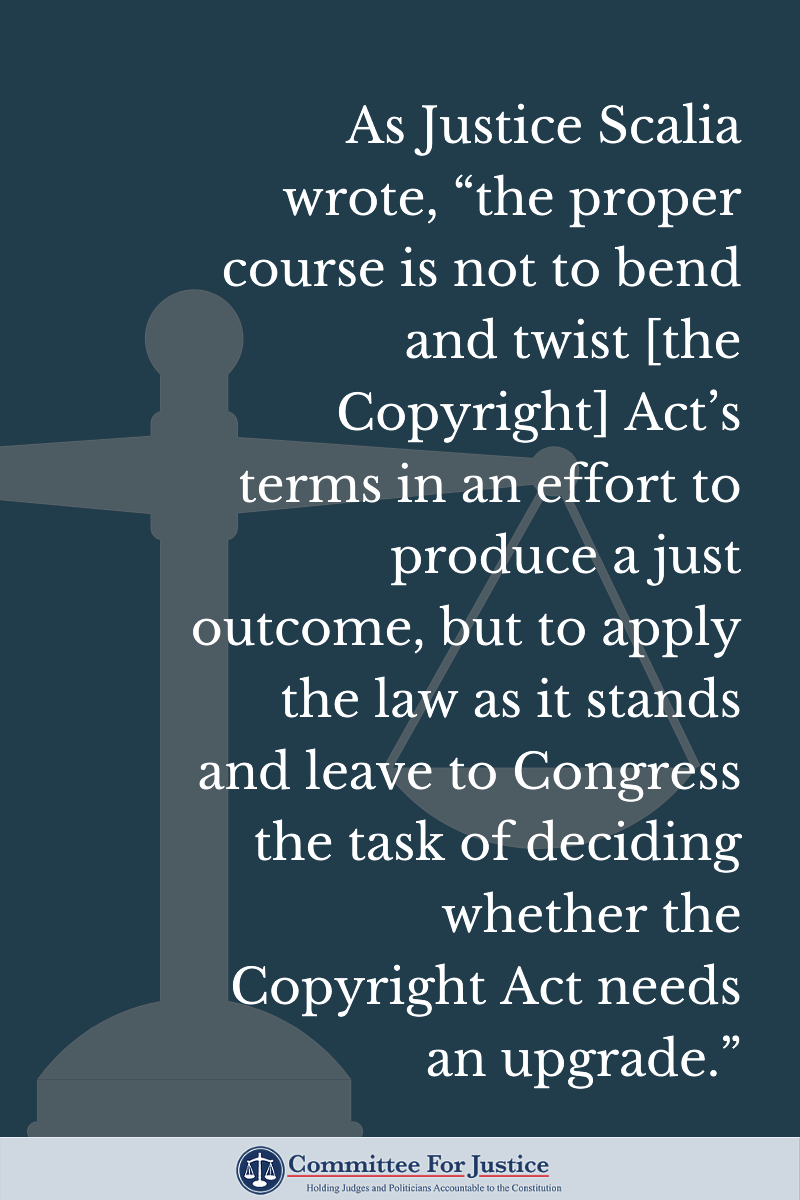
The Committee for Justice decided to get involved in this case because the Supreme Court's ruling is expected to set the standard for how thoroughly computer code is protected by copyright. If Google's copying of more than 11,000 lines of Oracle's Java code in building the Android operating system is allowed to stand, that protection will be weakened and the incentives for innovation in the software industry will be diminished.
More generally, a victory for Oracle is important for promoting both the rule of law, including a textualist reading of the Constitution and statutes, and the protection of property rights. Our
brief
reminds the Court that the strong protection of intellectual property in the Constitution and Copyright Act has helped to make the United States the world's most prosperous society and that intellectual property protection of new technologies is particularly vital.
In our
brief
, we point out to the Court that the text of the Copyright Act makes no mention of the exceptions Google is trying to create when it argues that 'declaring code' is unprotected and that its copying was necessary to ensure that the Android operating system would be interoperable with other systems.
Because the law is on Oracle's side, Google's arguments to the Court rely heavily on public policy arguments about interoperability and the like. We remind the Justices that the rule of law requires that such policy arguments be entertained, instead, across the street in Congress, which can amend the Copyright Act. Although arguments about textualism and the proper role of the courts may have a special appeal for the Court's conservative Justices, we hope they will help to persuade all the Justices given that this issue, copyright protection, cuts across ideological lines.
|
|
Related Work on Intellectual Property:
|
|
In this episode,
Ashley Baker
, director of public policy at the Committee for Justice, and
Neil Chilson
, senior research fellow for technology and innovation at the Charles Koch Institute, discuss the implications for data security under recently-enacted privacy laws.
Although data privacy regulations may shield your data from companies that seek to use it for commercial purposes, certain legal requirements found in these regulations can leave your sensitive information vulnerable to bad actors. Baker and Chilson discuss data security considerations for privacy laws, the importance of defining and addressing consumer harms, and why lawmakers should prioritize cybersecurity over data privacy.
|
|
The Securities and Exchange Commission’s proposed rule change regarding proxy advisory firms is a positive step towards implementing much-needed reforms. The rules governing the proxy system need to be clarified and modernized for the benefit of investors, public companies, and the U.S. financial services industry as a whole.
...Proxy advisory firms are not held to a fiduciary standard that would require them to demonstrate that their recommendations are in the best interest of shareholders and the corporation ...
The SEC’s proposal would let the market decide and
is consistent with our disclosure-based regulatory system...
|
For trade secrets law, 2019 was a formative year for both public knowledge and litigation trends. Due to extensive media coverage of Huawei’s alleged intellectual property theft and trade secrets disputes between large American companies including Uber and Waymo, the public has become more aware of the once-obscure area of property law.
At the same time, trade secrets misappropriation lawsuits are on the rise along with increasingly massive settlements and jury awards. One particular case,
Title Source v. HouseCanary
, underscores this trend and the factors that have led to it ... For similarly expansive trade secrets claims, this case could be the camel’s nose under the tent. The egregious damages could spur other questionable theories of misappropriation ... If this injustice is overturned, it will serve as a cautionary tale for those who may bring similar suits. It would also restore the proper role of the trade secrets protections that the past year has proved to be important.
|
|
|
|
Like what you see?
A tax-deductible donation will help us sustain our work.
|
|
|
Was this email forwarded to you?
Sign up now
to get updates in your inbox.
Note: If you are a current or new subscriber and would like to only receive emails only once per week, you can click
here
.
|
|
|
|
|
|
|
|