Furtwängler's brilliant 1949 Bruckner 8
Cleaned up and restored like never before!
| |
|
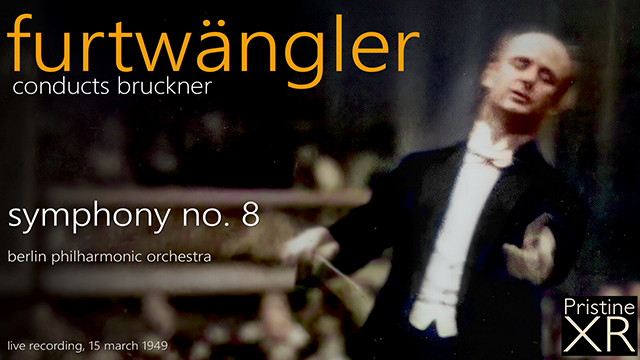
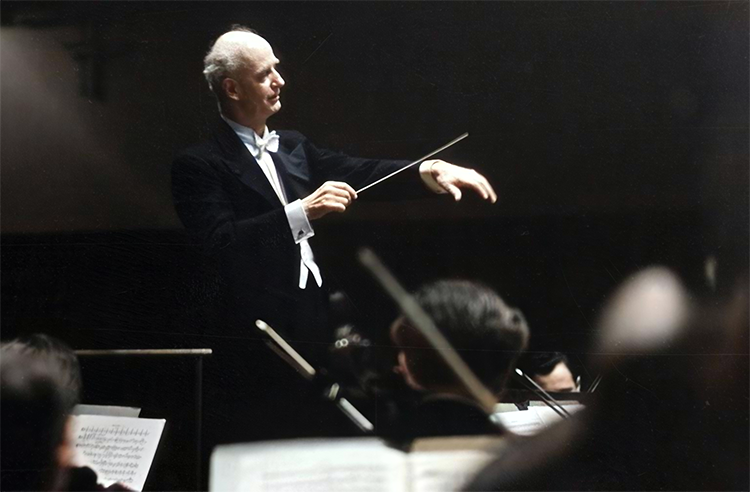
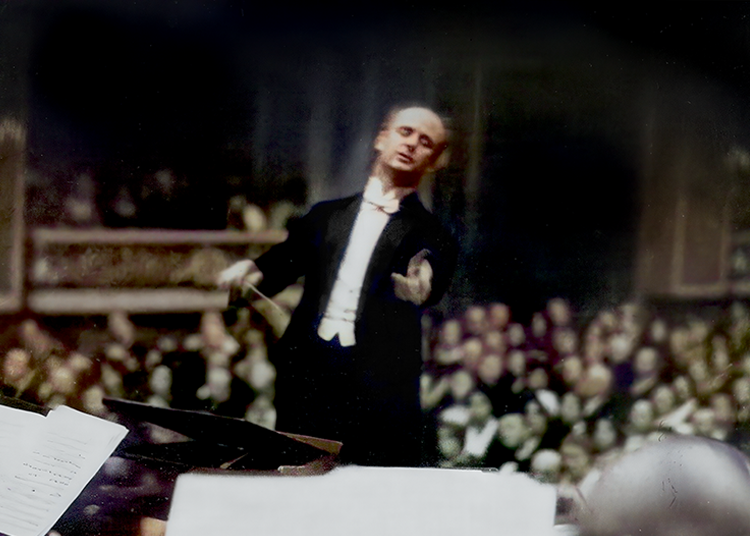
This week we bring you a major restoration of a very special recording. Of the four recordings known recordings of Furtwängler conducting Bruckner's Eighth Symphony, there are many who feel that the conductor's finest performance was that which was captured live in Berlin on 15th March 1949.
It has stiff competition from his 1944 Vienna Philharmonic recording, also a live performance, though one which appears to have taken place without an audience present, which this one certainly has.
Another Vienna recording from 1954 had had doubt cast upon it in the past - indeed this was still the case in 1990 when Gramophone's reviewer described it as being "of doubtful origin" - though I understand it to have been later authenticated.
This leaves the two Berlin Philharmonic recordings, made back to back a day apart, on the 14th and 15th March, 1949. Both were recorded live - first at the Gemeindehaus in Berlin-Dahlem without an audience, then the next night an RIAS recording, this time with an audience, at the Titania Palast which had replaced the Alte Philharmonie as the orchestra's home after its bombing in 1944.
| |
|
Something the 1990 Gramophone reviewer did get right - as has just about everyone else who has had to make judgement on these recordings - is that the audience present on the 15th March was a particularly noisy one.
John Ardoin, in his 1994 book "The Furtwängler Record", effectively rules the recording out as a result of its "inordinately high" audience noise.
However, Alan Sanders, the aforementioned Gramophone reviewer four years earlier, was not so easily distracted: "Yet through all the distractions Furtwängler shines at his most remarkable, inspirational best, more so I feel than in the earlier Vienna version."
He continues with detailed praise for the performance, despite the noises-off, ending: "Nevertheless, here is another superlative Bruckner Eighth. Sympathetic listeners will need their own internal filter system, and fill in detail from their own imagination, but such effort will be amply rewarded.”
It wasn't just the coughing that caused him alarm: "Also, at various points piston-engined aeroplanes drone over the Titania Palast", wrote Sanders - possibly the sound of the Berlin Air Lift, which was taking place at the time. Sanders also lamented the sound as "somewhat hard and edgy, and in climaxes it breaks up and distorts badly" - so it's even more surprising that he still felt able to write such a glowing recommendation of the recording.
Thirty-four years have passed since that particular release, during which time we have seen unimaginable advances in digital audio restoration technology. The ability to select and remove specific, individual sounds from a recording was something almost undreamed of in 1990. Today it can often be done in the click of a mouse.
The cough is a curious sound, or in many cases, melange of sounds, cutting across multiple frequencies and sometimes spread significantly across time. It may be entirely hidden behind the music, unheard despite its presence, it might peek out from behind the music at frequencies which are otherwise silent, and it can cut right across everything, apparently obliterating the music.
Yet all of these are regularly treatable, though not always: Where complex, rhythmical music is ongoing it is often impossible to separate hacking coughs from quick-fire notes - although sometimes enough of the cough can be removed without any musical disruption that the effect is akin to moving the perpetrator to the very back of the concert hall. But music has its long, slow notes and sequences as well, and from these it's now quite simple - usually - to select the quick explosion of a cough and leave the music in place, clean of the interruption. Of course there are also any number of instances that sit between these two extremes. No two coughs are the same, and the music is usually constantly changing.
Nevertheless, I reckon to have tackled - with various degrees of success - perhaps 95% of the coughs audible in the original recording here. This does of course leave a few brutal offenders in place, where there would have been too much damage done to the musical content when coughs were removed, but overall this Bruckner Eight no longer sounds like a doctor's waiting room during a bronchitis epidemic.
Noises like planes, cars, trucks and other combustion engines, captured through the walls, windows and doors of concert halls, are a very different proposition. Generally heard at very low frequencies, usually an engine is heard during acceleration, as a continuous rising tone, sometimes with harmonics rising in parallel.
Here the approach is different - you're not looking to erase the quick snap of a cough across a multitude of frequencies, but rather to remove a single "note" that's constantly rising. It is this quality - rarely found in music - of a long, low, continual portamento, which allows the unwanted noise to be easily spotted on a computer screen, selected (often using a mouse-controlled "paintbrush" tool, drawn over the thick line which represents the noise), and either reduced in volume or entirely removed.
As long as these unwanted engine "notes" aren't also being played at the same time by the orchestra, this is usually a simple operation of identification, selection, and removal. It's surprising how often there's not much music going on "down there", where the low-frequency sounds of engines lurk in symphonic recordings.
As for the "hard and edgy" sound Mr. Sanders suffered - well, this is something Pristine's XR remastering has been tackling with increasing success since 2007. If you take a listen to our online sample - the entire first movement of the symphony - on our website and here on our YouTube channel, you'll hear something very far from that description: a warm, rich sound, which only at a small handful of peaks starts to break up a little.
I've even managed to tame the distortion, to an extent. Perhaps one day it might be possible to entirely deal with sonic overload distortion - AI is already doing amazing work in the parallel world of restoring video - but for now our options are relatively limited. Yet it is possible to smooth out some of the worst distortion in older sound recordings, and I've been able to make reasonable inroads here too, with considerable benefits to the listener.
The results of this restoration work would have no doubt astonished the reviewers and writers of the 1990s. I hope they still have the power to do so today. It's a pretty astonishing recording!
Andrew Rose
| |
In case you missed them: 6 most recent releases | |
|
|
|
BJÖRLING, NILSSON
Puccini: Turandot (stereo, 1959)
| |
Stereo studio recording, 1959
Total duration: 1hr 54:30
La principessa Turandot - Birgit Nilsson
Calaf - Jussi Björling
Liù - Renata Tebaldi
Ping - Mario Sereni
Pang - Piero De Palma
Pong - Tommaso Frascati
Orchestra e Coro del Teatro dell'opera di Roma
conducted by Erich Leinsdorf
| | | |
|
|
|
TOSCANINI
Respighi: Roman Triptych (1949-53)
| |
Roman Festivals
Fountains of Rome
Pines of Rome
Studio recordings, 1949-1953
Total duration: 60:10
NBC Symphony Orchestra
conducted by Arturo Toscanini
| | | |
|
|
|
Studio recording, 1954
Total duration: 2hr 40:22
Norma - Maria Callas
Adalgisa - Ebe Stignani
Pollione - Mario Filippeschi
Oroveso - Nicola Rossi-Lemoni
Clotilde - Rina Cavallari
Flavio - Paolo Caroli
Chorus and Orchestra of Teatro alla Scala, Milan
conducted by Tullio Serafin
| | | |
|
|
ORMANDY and The Philadelphia Orchestra The Early Years ∙ Volume 5 (1938-40) | |
J. S. BACH
Brandenburg Concertos Nos. 2 & 3
“Herzliebster Jesu” from St. Matthew Passion
BEETHOVEN Symphony No. 5
BRAHMS Symphony No. 2
MOZART Symphony No. 40
SCHUBERT Symphony No. 8 "Unfinished"
Studio recordings, 1938-40
Total duration: 2hr 21:24
The Philadelphia Orchestra
conducted by Eugene Ormandy
| | | |
|
|
BLISS conducts Bliss (1955) | |
BLISS Violin Concerto
BLISS A Colour Symphony
Studio recordings, 1955
Total duration: 69:02
Alfredo Campoli, violin
London Philharmonic Orchestra
London Symphony Orchestra
conducted by Sir Arthur Bliss
| | | |
|
|
|
ANSERMET
Fauré Requiem, Orchestral Suites
(stereo, 1955/1961)
| |
FAURÉ Requiem
FAURÉ Pelléas et Mélisande - Suite
FAURÉ Masques et Bergamasques Suite
FAURÉ Pénélope - Prelude
Stereo studio recordings, 1955 & 1961
Total duration: 76:38
Suzanne Danco, soprano
Gérard Souzay, baritone
L’Union Chorale de la Tour de Peilz
Orchestre de la Suisse Romande
conducted by Ernest Ansermet
| | | |
|
Marking Horowitz's 35th anniversary
Save 15% on all our Horowitz this week
| |
|
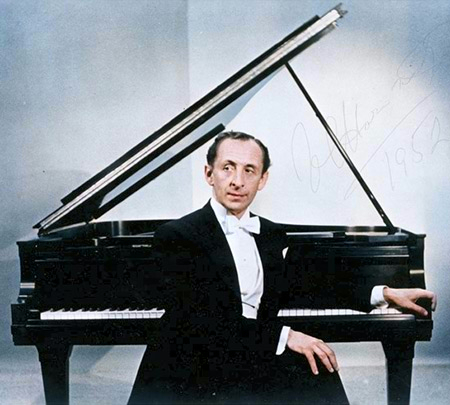
A few days ago we passed the 35th anniversary of the death of Vladimir Horowitz.
"Vladimir Samoylovich Horowitz (October 1, 1903 – November 5, 1989) was a Russian and American pianist. Considered one of the greatest pianists of all time, he was known for his virtuoso technique, timbre, and the public excitement engendered by his playing." - more
We have 8 releases featuring music played by Horowitz, and for this week there's a 15% discount on all of these recordings.
The discounts are now active and automatic - you'll see a reduction at the checkout on all qualifying items.
Offer runs until next Friday.
Pristine's Horowitz selection:
[NB. Prices indicated here are for the MP3 versions without this week's discount]
| |
|
|
HOROWITZ Live at Carnegie Hall, Volume 1 (1948) - PAKM071 - 320kbps Ambient Stereo MP3 | |
Concert of 2 February 1948
Music by Haydn, Schubert, Scriabin, Kabalevsky, Chopin, Scarlatti, Moszkowski, Schumann, Liszt-Horowitz
Total duration: 79:52 (CD) & 92:59 (Download, includes encores)
Vladimir Horowitz, piano
| | | |
|
|
|
HEIFETZ & HOROWITZ
Mozart, Korngold and Mussorgsky (1947)
| |
MUSSORGSKY Pictures at an Exhibition
MOZART Violin Concerto No. 5, K.219 'Turkish'
KORNGOLD Violin Concerto in D
Studio and Live recordings, 1947
Total duration: 77:27
Vladimir Horowitz, piano
Jascha Heifetz, violin
New York Philharmonic-Symphony Orchestra
Conducted by Efrem Kurtz
| | | |
|
|
TOSCANINI Brahms: The 1948 Cycle, Volume 1 (1948) | |
BRAHMS Piano Concerto No. 2
BRAHMS Symphony No. 1
BRAHMS Serenade No. 1
BRAHMS Tragic Overture
Live broadcast recordings, 1948
Total duration: 1hr 59:03
Vladimir Horowitz, piano
NBC Symphony Orchestra
conducted by Arturo Toscanini
| | | |
|
|
|
HOROWITZ & TOSCANINI
Tchaikovsky: Piano Concerto No. 1 (1941)
| |
TCHAIKOVSKY Piano Concerto No. 1
Recorded in 1941
Duration 29:48
Vladimir Horowitz, piano
NBC Symphony Orchestra
conducted by Arturo Toscanini
| | | |
|
|
|
FURTWÄNGLER
Bruckner: Symphony No. 8 (15 March 1949)
| |
BRUCKNER Symphony No. 8
Live recording, 1949
Total duration: 75:52
Berlin Philharmonic Orchestra
conducted by Wilhelm Furtwängler
| | | |
Furtwängler shines at his most remarkable, inspirational best | |
|
“There exist three live Furtwängler recordings of this symphony (plus another, 1954, version of doubtful origin). A 1944 recording in remarkably good sound with the Vienna Philharmonic Orchestra [Pristine PASC 260] was issued by Unicorn-Kanchana and DG (both nla) and preserves a spacious, noble performance. Then there is a recording originally issued in Germany by Electrola (nla) which comes from a performance which took place in Berlin on March 14th, 1949; and finally there is the performance we have here, which was played on the day after the Electrola version.
This remarkable reading reaches us under some handicap. The basic sound is somewhat hard and edgy, and in climaxes it breaks up and distorts badly. There must also have been a late winter virus epidemic in the city, and the affected members of the audience seem deliberately to have chosen the most rapt, quiet passages for their explosive coughs. Also, at various points piston-engined aeroplanes drone over the Titania Palast. [The Berlin airlift was still in progress, ending in May 1949-Ed.] Yet through all the distractions Furtwängler shines at his most remarkable, inspirational best, more so I feel than in the earlier Vienna version.
At the beginning of the work there is a strong and immediate feeling of mystery and tension, and the movement unfolds in dramatic, majestic fashion, superbly paced but excitingly subjective too, with marked fluctuations of pulse and tempo. No other conductor, surely, could respond so eagerly to detail and yet preserve the music's argument and sense of architecture so effectively. The Scherzo has a fast, urgent basic tempo, with middle sections by contrast painted in gentle, intimate pastel shades. The long Adagio has fewer idiosyncratic touches, and moves gently but firmly onwards, with climaxes majestically and triumphantly realized. There is a tremendous sense of power in the finale and contrasting episodes are now sharply, dramatically delineated. As to the complexities of the coda, well, they disappear into a foggy din. What a pity.
Nevertheless, here is another superlative Bruckner Eighth. Sympathetic listeners will need their own internal filter system, and fill in detail from their own imagination, but such effort will be amply rewarded.”
Alan Sanders, Gramophone, September 1990
This 34-year-old review pinpoints precisely what was right – and wrong – with this 75-year-old recording. On one hand the performance is rightly lauded as one of the finest interpretations of Bruckner’s 8th Symphony to be captured for posterity, with Furtwängler “at his most remarkable, inspirational best”.
The review also skewers the recording’s multitude of flaws: a particularly bronchial audience, brittle sound which veers into overload distortion during the loudest passages, all exacerbated at one point by the Berlin Air Lift going on outside the concert hall.
Happily, what was impossible 34 years ago is no longer necessarily untreatable today. The sound, no longer “hard and edgy” is full and warm, clear and vibrant. The distortions, whilst not totally cured, have at least been tamed considerably. Approximately 95 per cent of the coughing has been either eradicated or pushed back to the distant entrance lobby, and those pesky aeroplanes have largely flown off. And if the coda might remain a little misty at the edges, it is no longer a “foggy din”. With so many distractions no longer present, this “superlative Bruckner Eighth” is free to shine again.
Andrew Rose
| |
FANFARE AWARDS - WANTS LISTS 2024 | |
|
|
SCHURICHT Beethoven Symphonies Complete (Paris, 1957/8) | |
BEETHOVEN Symphonies 1-9
Studio recordings, 1957/8
Wilma Lipp, soprano
Marga Höffgen, contralto
Murray Dickie, tenor
Gottlob Frick, bass
Chorale Elisabeth Brasseur
Orchestre de la Société des Concerts du Conservatoire
conducted by Carl Schuricht
| | | |
Reviewer: James A. Altena
| |
"Fourth comes an integral series issued in parts: Pristine Audio’s releases of the complete 1957–58 set of Beethoven symphonies with Carl Schuricht and the Paris Conservatoire Orchestra, reviewed by me in Fanfare 47:2, 47:3, and 47:4. This cycle has long flown under the radar for two reasons: EMI’s foolish persistence in adhering to monaural rather than stereo recording (the latter applied only to the Ninth), and use of a French orchestra (and one regarded as second-tier at best to boot) rather than a major German, English, or American one. Also, Schuricht was then regarded by many as a good Kapellmeister but not a major podium figure, being then on the cusp of his ascent to greater fame in the last decade of his life. But in fact this remains after 66 years one of the finest overall Beethoven cycles ever recorded, with only the Ninth being a partial let-down. Schuricht’s gifts of spontaneity, energy, imagination, textual clarity, rhythmic incisiveness, and instrumental color are on display throughout, and the patented XR remastering process of Andrew Rose has added spaciousness and warmth to the clear mono originals " | |
|
|
|
LÉNER QUARTET
Dvořák & Smetana String Quartets - Dvořák & Brahms Piano Quintets (1926-38)
| |
DVOŘÁK String Quartet No. 10
DVOŘÁK String Quartet No. 12
DVOŘÁK Piano Quintet No. 2
BRAHMS Piano Quintet
SMETANA String Quartet No. 1, 'In My Life', 3rd mvt.
Studio recordings, 1926-1938
Total duration: 2hr 12:47
Léner String Quartet
Jenő Léner (violin I)
Josef Smilovits (violin II)
Sándor Róth (viola)
Imre Hartman (cello)
Olga Loeser-Lebert (piano)
| | | |
"My third historic reissue is on Pristine, another label that offers high-quality restoration. Having previously issued the first complete recording of the Beethoven string quartets, performed by the Léner String Quartet, Pristine has followed up with a beautiful collection of chamber music by Brahms, Dvořák, and Smetana." | |
Andrew Rose | Pristine Classical | www.pristineclassical.com | | | | |