HOW TO PROPERLY INSPECT, FIT AND ADJUST YOUR HARNESS BEFORE EACH USE. | |
Not only does OSHA require that employers provide PPE specific to their worksite hazards, it also requires employers train their employees on how to properly use the equipment. Correct size selection and fit of a harnesses is essential to ensure that the harness performs to the manufacturer's expectations. Training your employees on how to do this correctly is crucial to your fall protection program's effectiveness. This article will cover the basics of fall protection harness fitting instructions and steps for a successful effective fit. 3M Fall protection harness instructions and images are used for the purpose of this tutorial. Manufacturer donning instructions may vary. Please reference your specific manufacturer's instructions for further clarification. | |
|
PRIOR TO EACH USE
Before selecting a harness and donning it correctly, your fall protection program should require that all employees:
- Verify that the fall protection provided and the work area meet all criteria as specified by the manufacturer.
- Ensure that a rescue plan is in place.
- Inspect the harness for wear or issues with the integrity of the product.
- If the inspection reveals a defect, or if there is any doubt in the condition of the harness whatsoever, remove the product from service immediately and tag "DO NOT USE".
If your harness passes the visual inspection, proceed with using the harness. Prior to wearing the harness, remove all items from your pockets. Both in use and in the event of a fall, items within your pockets can become trapped between the straps and webbing and cause injury.
| |
|
Step 1 - Getting Started
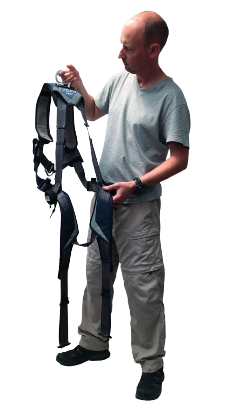
First, hold the harness by the back D-Ring and ensure that no straps are twisted.
| |
|
Step 2 - Shoulder Straps
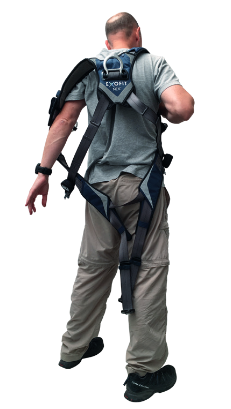
Slide harness over arms from the back and onto your shoulders. While doing so, make sure that straps are remaining untangled and are able to hang freely.
| |
|
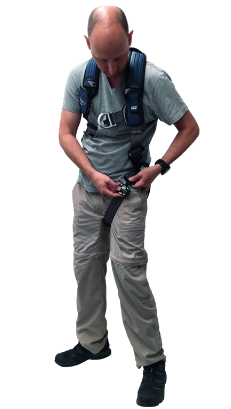
Step 3 - Leg Straps
With your hand, reach between your legs and grab the left leg strap. Pull the leg strap up between your legs and connect it with the left side buckle. Do the same on the right side for the right leg strap and buckle.
| |
|
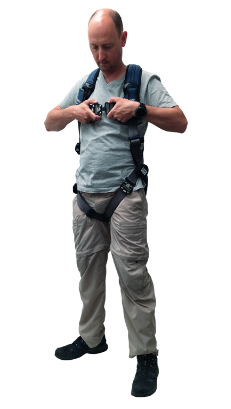
Step 4 - Chest Straps
Connect the chest strap buckle to the opposite side corresponding buckle and ensure it is centered on your chest. Buckle types vary. Tutorials on each are below.
| |
|
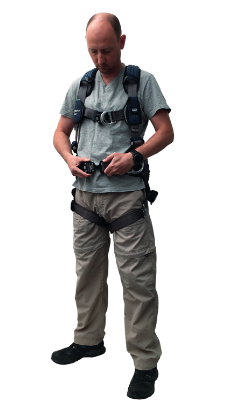
Step 5 - Waist Belt
(if present)
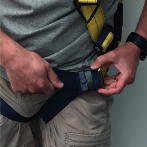
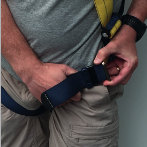
If the harness you are using has a waist belt, attach the wait strap to the opposite corresponding buckle and center to your mid section.
| |
|
Step 6 - Adjust Fit
Make adjustments to the fit of your straps to ensure a snug fit. Tips on how to do so properly are below.
| |
|
ADJUSTING THE FIT
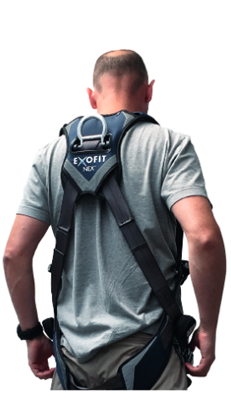
- Adjust the shoulder straps with the vertical torso adjusters. Each side should be adjusted to the same length. Tip: the chest strap should be centered on the lower chest, roughly 6 down from the top of your shoulder. This is also how you adjust the position of the front D-Ring.
- Next, center the back D-Ring between your shoulder blades.
- Readjust leg straps to achieve a snug fit. Note that at least 3 inches of webbing must extend beyond the buckle on the leg straps.
- When all adjustments have been made, be sure to stow webbing. Depending on the harness model, this can be accomplished by either sliding the plastic web-tidys to the ends or by tucking he loose webbing under the loops.
| |
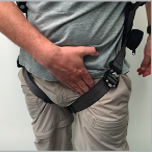
This image demonstrates leg straps that are too tight. If you cannot pass your hand under the leg step, you need to loosen the strap. | |
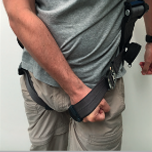
This image demonstrates leg straps that are too loose. If you can pass a fist under the leg strap, you need to tighten the strap. | |
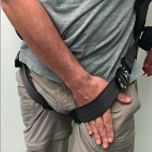
This image demonstrates a properly fitting leg strap. You should be able to just slip your hand under the leg strap when it is fitting correctly. | |
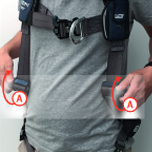
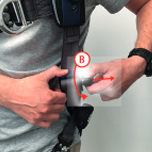
Tighten: Turn knob in direction A. | |
Loosen: Pull knob out and turn in direction B. | |
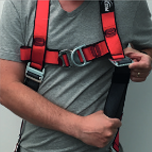
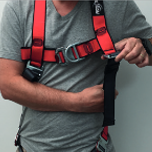
Tighten: Hold the buckle at 90° to the webbing and pull the free webbing. | |
Loosen: Hold the buckle at 90° to the fixed webbing and pull the buckle. | |
|
BUCKLE TYPES
Quick Connect Buckles (QC)
| |
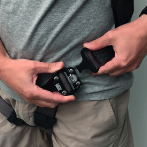
Attach: Insert male end into receptor until you hear a click. | |
Release: Press the side tabs on the buckle toward one another while pulling the male end. | |
|
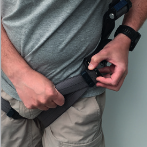
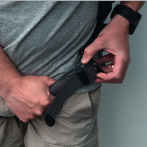
Tighten: Hold the buckle at 90°
to the webbing and pull
free webbing.
| |
Loosen: Hold the buckle at 90° to the webbing and pull the buckle. | |
Pass Through Buckles (PT) | |
Attach: Pass male buckle through female buckle. | |
Release: Pass male buckle through female buckle. | |
Tighten: Hold the buckle at 90° to the webbing and pull free webbing. | |
|
Loosen: Hold the buckle at 90° to the fixed
webbing and pull the buckle.
| |
|
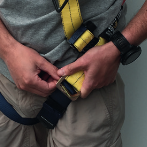
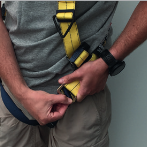
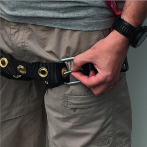
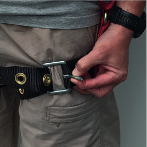
Attach: Pass webbing through buckle,
adjust to fit, then put tongue
through grommet. Secure web through keeper.
| |
|
Release: Pull on free end of webbing, then remove tongue from grommet, feed webbing
out of buckle.
| |
|
A correctly worn and adjusted harness will ensure that impact forces are effectively distributed throughout your body in the case of a fall. It will also proper provide support during a suspension and rescued period following a fall. Taking the time to learn these tips and practice these steps in the field truly is the difference between experiencing injury, or even worse, death.
Need help? The experts at Ark Safety are standing by to help you understand your specific used harness manufacturers/models and can assist you in training your team. Contact us today to schedule your tailored training today.
| |
COMMON MISTAKES TO AVOID IN 2025 TO IMPROVE YOUR SAFETY PROGRAM. | | |
|
|
There is something about the start of a new year. It brings a fresh slate, new opportunities and the potential to improve and build upon the previous year's goals. However, that is not always the outcome. Safety directors and management often struggle to understand why their safety initiatives remain ineffective and their statistics don't improve year after year, despite the best of intentions and investments into their safety program.
This article highlights the most common safety program mistakes and provides tips on how to overcome them. With these roadblocks out of the way, you will experience greater effectiveness to your overall program's success.
| |
|
Overlooking Near Misses
Near misses are a tremendous opportunity to learn and improve your work environment. Although OSHA does not require near misses to be reported or investigated, we recommend that a reporting and investigative process be followed in an attempt to prioritize job hazard analyses, and ultimately prevent a serious injury or worse from occurring down the road. The analysis among management and the safety committee creates an opportunity to gain insight on areas of weakness within your construction/production processes, possible replacement of inadequate or improperly worn PPE, and insight on where the same risk may be occurring elsewhere in you operations.
| |
|
Neglecting Maintenance And Delaying Inspections
Machines and equipment need regular maintenance and have inspection requirements. We understand that companies are hesitant to shut down machines because of lost productivity. However, regular maintenance and up-to-date inspections ensure that employees aren't exposed to health and safety hazards, working with out of date, damaged or malfunctioning equipment. Putting this off increases the chances of a safety incident that would have been otherwise entirely preventable. Not to mention, breakdowns of neglected equipment shut down operations for longer periods of time than regularly scheduled and anticipated maintenance.
| |
|
No Worker Involvement
Organizations often enforce safety policies and initiatives with little to no input from their workforce. Employee engagement throughout the formation of a corporately enforced safety program is key to its acceptance. Ways to involve employees in the safety program vary industry-to-industry, but the common thread to all successful strategies is making sure employee voices are heard. There needs to be open lines of communication in place to an approachable management team. One of the easiest ways to maintain open communication is to establish a safety committee. Members of the committee have a direct avenue to bring up safety concerns, provide feedback and be the eyes and ears for the program amongst their peers.
| |
|
Safety Program Budget Cuts
We understand. Your budget is spread thin to allocate for staffing, operations and endless other business expenses. For most businesses, no incidents or violations have happened so far and you've been flying under OSHA's radar. The true cost of non-compliance is not just found in fines, penalties and fees. It is also found in workers compensation costs/insurance premiums, legal expenses, business disruption, revenue loss, reputation damage, employee retention and the cost of correcting the hazard. You'll find that the cost of proactively investing in compliance is a minimal financial hardship compared to the extensive cost of non-compliance.
| |
|
Complacency
Complacent companies and management teams are sadly common. In some cases of complacency, companies have not experienced any major incidents and they have a false sense of security. Chances are these organizations have a large number of near misses and a tremendous amount of luck. Unfortunately, many devastating outcomes from unexpected accidents occur in companies with this mindset due to their neglect to make improvements. In other cases of complacency, some companies have a mindset that accidents are inevitable. That is simply not the case. Regardless of human error, the goal should always be zero incidents. It is achievable and is the responsibility of management to actively pursue that goal.
| |
|
Misguided Safety Incentives
You may be wondering how safety incentives might have a negative impact. After all, they are developed with the intent to encourage safe practices throughout your operations amongst your workforce. Rate-focused incentives for your workforce at large, such as the goal to beat injury-free records, often lead to covering up injuries rather than the reduction of injuries. In this example, mangers stop reporting incidents all in an attempt to attain the promised reward. Instead of offering rate-focused rewards, behavior based rewards are shown to be much more effective and engaging. Examples include being rewarded for wearing proper PPE, reporting hazards and reporting near misses.
| |
|
Not asking "Why?"
Statistics are a wonderful thing. But if you aren't looking at the big picture and asking yourself "why?", they aren't very meaningful. For example, if your annual injury rate dropped from 10 to 9, that's great news. Most safety directors would be pleased at the improvement without trying to understand what program changes, if any, caused the reduction of injuries. Was it a change in PPE being used? Are the same production processes continuing to result in injuries or are they seemingly unrelated? If you ignore the big picture and don't take a deeper dive, you will likely miss the connections, factors, and influences behind the numbers. The investigative knowledge will provide you with the opportunity to counter the "why" with effective changes to your program.
| |
|
Insufficient Training
It is extremely common for safety training to become a check box for management. It is often generic and insufficient at training employees on the hazards present to their specific job and worksite. In an attempt to simply gain compliance, employees are inadequately equipped with the knowledge they need to work safely. It is so important to financially invest in the development of company tailored training and take the time to properly train all employees at an engaging and comprehensive level.
| |
|
Lack of Top Leadership Involvement
Last and certainly not least, many organizations assume that safety is a production responsibility, not a top management responsibility. That could not be further from the truth. Unless safety leadership is initiated from the top level of leadership, a true culture of safety will never develop. The workforce is not only looking for management to lead by example, they are looking to them for corporately driven direction. Employees rely on the protection and oversight of their employers to be well versed in a job's specific safety challenges and the workplace standards associated with those risks. It's essential to start at the top with a visible, empowering leadership team that provides a strong narrative about where the safety program is and where it is going.
| |
With these common mistakes in mind and a plan to avoid making them, we're confident that your 2025 safety initiatives will be all the more successful. As always, we are here to help! Whether you have a safety program in need of some fresh eyes, are starting from ground zero, or anywhere in between, we are happy to come along side you and assist. After all, partnering with our customers is what we do best. Contact us today to engage our experts! | |
Follow us and join in on the #worksafer movement. You'll get to see our experts at work doing what we're passionate about - making your workplace a safer one. Click on the links in the email footer to get in on the action. Posting about your Ark Safety products and services? Tag us and use the hashtag #worksafer for an opportunity to see your photo in our feed. | | | | | |