|
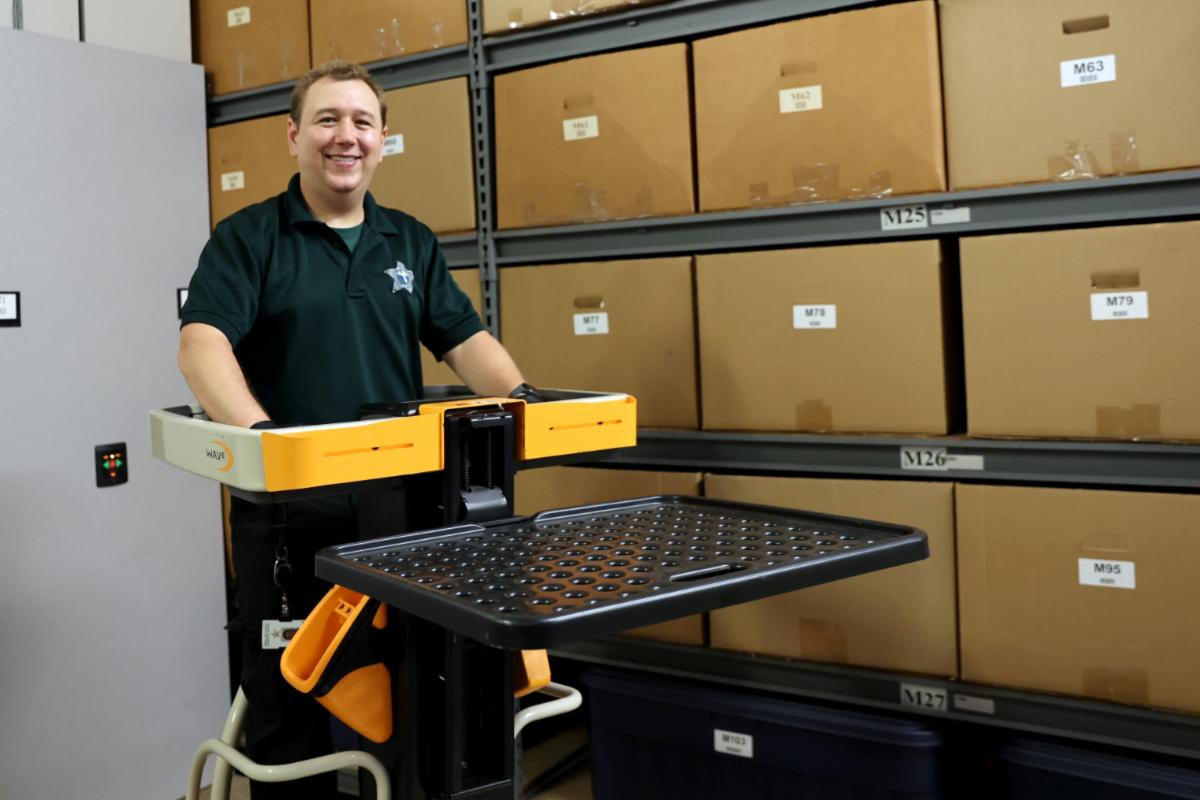
Shelves fill the warehouse in closely packed stacks that stretch to the ceiling, maximizing space but able to be moved with the touch of a button. Boxes on these shelves hold vital clues to solving major cases, from the shirt that a killer wore, to carefully preserved DNA samples. But they also have the wallet you left on a park bench, the entire contents of a homeless person’s shopping cart (minus the cart, which was returned to the store), and about 400 bicycles. This is the Pinellas County Sheriff's Office's Property and Evidence, and they have half a million items to preserve and protect.
“We are under the Support Services umbrella,” said Property and Evidence Supervisor Kerri Bowden. “That means our primary function is supporting law enforcement. Our job here is to store the evidence and property that comes in, in a way that maintains the integrity of the items, so they are ready for court one day or to return to their owner.” They store items not just for the sheriff's office, but also for most law enforcement agencies in the county.
Items arrive at Property and Evidence in a number of ways. If an item is involved in a crime – for example, a firearm that was used in a robbery – Forensics will first process it for fingerprints and DNA, and then the item will be securely stored. “Some items like DNA may have to be stored frozen,” Bowden said. “Others may need to be refrigerated or kept in a place with low humidity. We also have high security areas for things like drugs, guns, and valuables.” They don’t take living things, but they will store almost everything else. There’s a salad related to a poisoning case held in cold storage, dozens of gambling machines, and even a toilet. The toilet is tied to a case with a key question of whether a particular item could have been flushed down it, so the exact dimensions of the hole are important.
Other items are held for inmates. Clothing, most personal belongings, jewelry, and other smaller items are kept at the jail until the inmate is released, but the jail won’t accept weapons, sharp objects, or bulky items. Property and Evidence also takes found items, or things that are collected for safekeeping. If someone is in a car crash, for example, and is transported to the hospital, their personal property might go to Property and Evidence until a relative can pick it up. If you ever lose a wallet or anything else, after first contacting the place you lost it and your local law enforcement agency, you should check to see if it is at Property and Evidence. They get lots of bikes turned in after being stolen and later abandoned. Bowden highly recommends keeping a record of the serial numbers of valuables such as bikes and firearms so you can prove they are yours if they are ever lost or stolen.
Items aren’t just stored; they’re checked out for a variety of purposes too. “Items get checked out to process by forensics or the lab, or get checked out for court,” said Property and Evidence Supervisor Andy McEntegart. Some items are at Property and Evidence for just a few days, while others remain for more than 50 years. The oldest items are from a 1955 cold case homicide.
They follow state statute to determine how long items are held, but for criminal evidence, everything is kept not only until the case goes to court, but until the suspect has served their entire sentence. Sometimes evidence needs to be rechecked based on an appeal, new information, or new technology. “A deputy may submit an item like a backpack for safekeeping,” said McEntegart. “Later, a detective may determine that the item is actually evidence and needs to be processed.”
It is especially important to properly preserve anything with DNA. “We want to make sure that if it has DNA on it, the DNA remains viable to be tested one day at the lab,” Bowden said. “Even if they’ve already taken samples, we preserve it just in case.” Technology is always changing, and DNA testing is getting more sensitive. Labs can work with smaller samples, and genetic genealogy is opening up new avenues to find suspects in decades-old cold cases.
The work at Property and Evidence is organized and meticulous. “Everything has a digital footprint,” Bowden said. “We can maintain chain of custody of everything, so that at any given time we can see when the item was moved, and who handled the item.” All items get checked when they come in to make sure they were packaged correctly, and then when they're ready to go on a shelf someone else will check them a second time to make sure the right item is going in the right location. Items remain sealed except in very rare cases, such as when Forensics has to take a new swab or a detective has to physically examine an item.
The job also has its hazards – so much of what they handle could be dangerous. “A backpack might just be labeled as backpack with miscellaneous items but once they get into them there are sharps, narcotics, or weapons,” McEntegart said. “They're exposed to fentanyl and biological hazards – they’re around those things on a regular basis, daily.” They're always gloved when working with evidence, and wear an N95 mask when handling drugs.
Of course, what comes in must go out, eventually. Everything that can be released is returned to its owner, but that still leaves lots of items that are either unclaimed or unneeded. Check out a future issue of Inside the Star to learn what happens to items in Property and Evidence when they no longer have to be saved.
|