|
One of the best ways to reduce the risk of ignition on your property is to remove combustibles and dead vegetation within the first 5 feet of your home, deck, and accessory structures. Taking care to protect structures on your property, either by building or retrofitting them to the standard of the Wildland Urban Interface (WUI) Building Code, now referred to as the CBC Title 24, Part 7, or by keeping them maintained and repaired, helps to reduce your loss and also helps to reduce your neighbors’ loss. If your home or accessory structures are close to your neighbor’s (less than 10 feet), it is even more important to discuss ways to reduce the risk of ignition for both properties and work towards a more resilient community for all.
Research by NIST’s (National Institute of Standards and Technology) Wildland-Urban Interface Fire Group, CAL FIRE and IBHS (Insurance Institute for Building and Home Safety) formed a Hazard Mitigation Methodology (HMM) to study how fire spreads and how to protect structures and properties from ember and flame exposures in wildfires. The HMM describes how fire spreads and what communities can do to create resilience structures in the WUI.
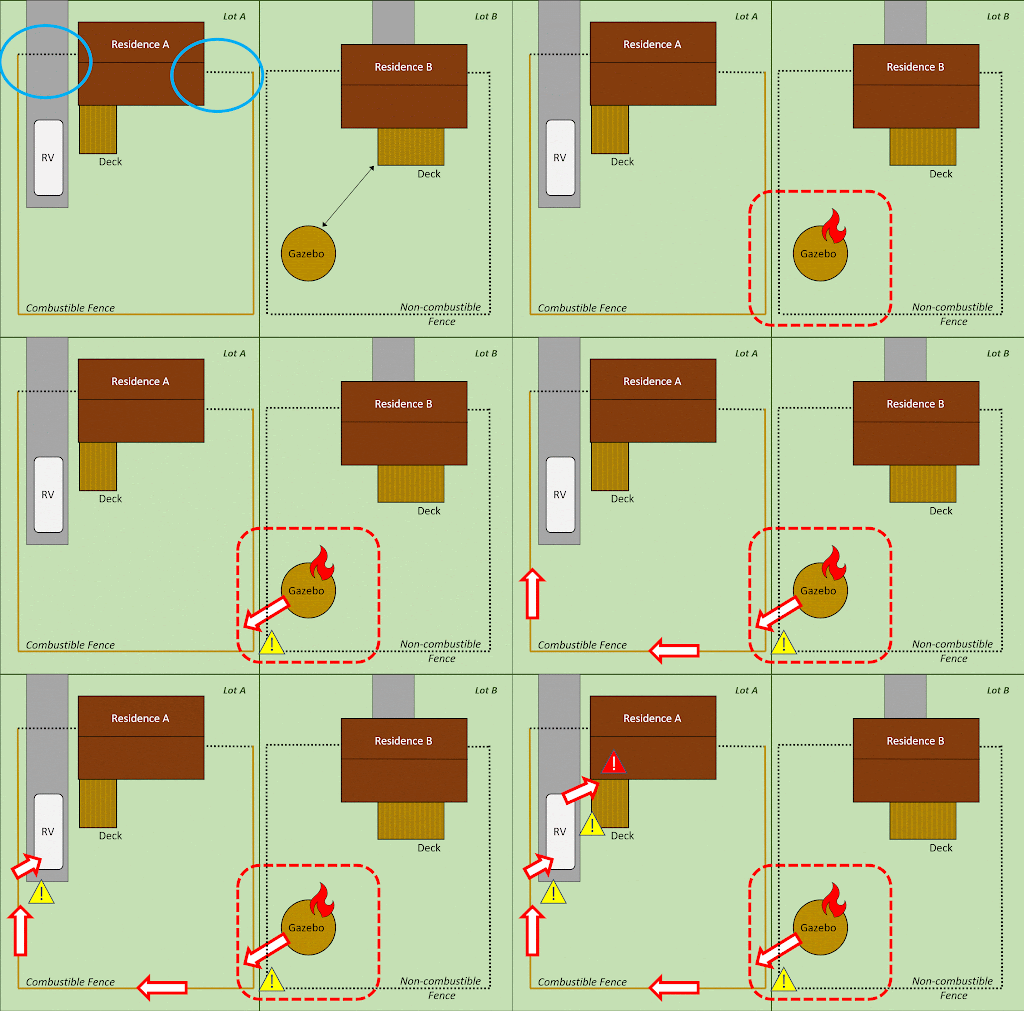
Fire Spread Pathways, one section in the Methodology, is important to feature here, as it illustrates the dozens of pathways fire can spread through communities. This is important in assessing where your home and accessory structures, fences and vehicles are located and what you can do to reduce risk.
For example, you may have replaced your fence with a noncombustible one and located a wooden structure in your backyard to be over 10-feet away from your home, but if the wooden structure ignites and is near your neighbor’s wood fence, it could spread along the fence to your neighbor’s home and put their home at risk. Please see the article on Fire Pathways by the National Institute of Standards and Technology to learn more.
|