|
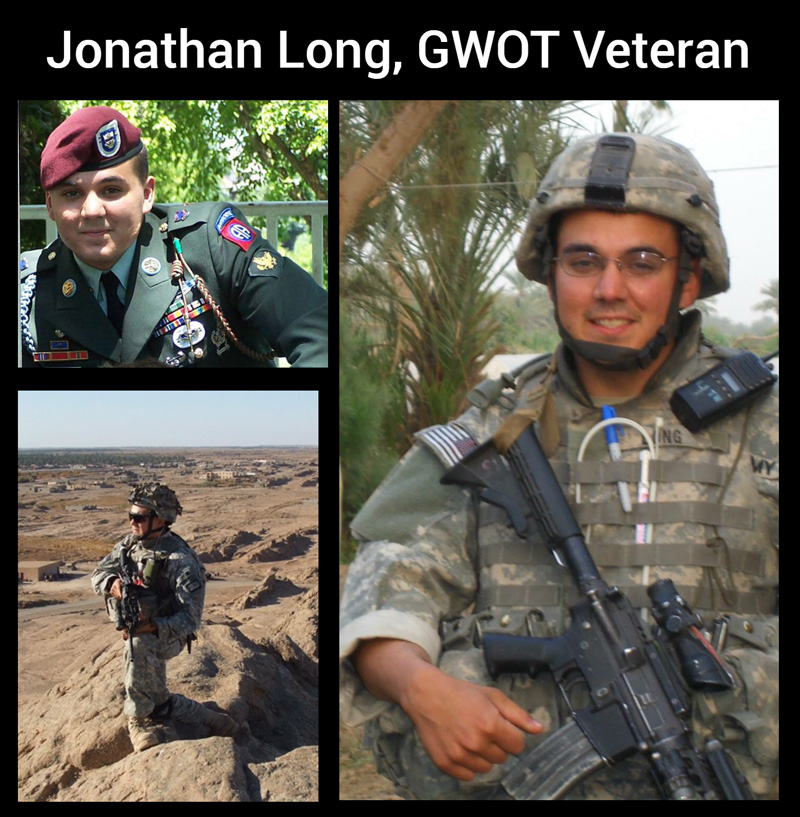
Proud of Our Army Veteran Son, Jonathan Long
I am taking this opportunity to boast about our son, Jonathan, the oldest of our eight children, and a Global War on Terror Army Veteran. Jonathan’s military career first began when he was seventeen years of age and he informed us that he signed up with the United States Marines out of the recruiting office in Medina, Ohio. Jonathan had high academic scores and was a candidate for one of the Service Academies. But after the war broke out after the attacks of 9/11, he couldn’t see himself sitting on the sidelines going through an academy when his fellow countrymen were already in the battle, fighting the Global War on Terror in Afghanistan, Iraq, and engagements around the world, tracking down threats to the homeland.
We had high hopes for Jonathan in this academic career, and wanted to see him become an officer. We visited the Naval Academy, which would have given him a pathway to the Marine Corp, but that appointment in our Congressional District went to another candidate. Congressman Sawyer’s office was prepared to provide Jonathan with another appointment to another Academy, but Jonathan chose to go to Ohio State University. The problem was that he had already signed papers with the U.S. Marines. We took a trip to Columbus to talk with the Naval Commander of the ROTC and asked if Jonathan’s enlistment could be transferred to the ROTC of Ohio State. The Commander said this was highly unusual and difficult, but he could provide the transfer if we could guarantee that Jonathan would follow through with his commitment in the military. I said, “There is no one who can stop him from doing that. He is determined to serve his country.” So, the transfer was provided and Jonathan was now an ROTC cadet at Ohio State University and an engineering major.
But what happened next took everybody by surprise. The Bush Administration was launching the 18 XRAY Program, a program that would recruit off the street highly intelligent recruits to help the military in its intelligence capacity. They needed linguists and people that could learn quickly. The war was in progress and the threat to the homeland was still very real.
So, Jonathan and his roommate, both engineering majors in the honors dorm at Ohio State University, went to a recruiter’s office in Columbus and signed up for the U.S. Army. His friend, Grant, signed three-year papers. Jonathan, because of being selected for Special Forces, signed six-year papers. This means he would be leaving Ohio State, suspending his collegiate pursuits, and leaving the ROTC, where had he finished, he would have been commissioned a Second Lieutenant. Instead, he opted to be an Army recruit and headed to Fort Benning for basic training.
His friend, Grant, headed to Fort Bragg. Now this is where it gets even more interesting. Jonathan was slated for Special Forces as a linguist/cryptology specialist. But after an injury at Fort Benning during Airborne training where he was injured during one of the parachute jumps, he was laid up to recover and his unit moved on. The Army said he could wait for the next group and be assigned to another Special Forces unit. Jonathan said, “No, just go ahead and assign me now.” That’s when you’re putting your future in the hands of the Army and God. They assigned him to a unit with the 82nd Airborne at Fort Bragg. Oddly enough, he was in the same eight-man unit as his roommate from Ohio State, and with another young man, Josh, a Baptist preacher’s son who became one of Jonathan’s best friends.
Within ten days, the unit was on its first deployment into Iraq. They were green and fighting a new type of warfare. The year was 2004. This would be the first of three deployments: Mosul, Iraq (ancient Nineva), overseeing the first elections after the fall of Sadam Hussain.
Second deployment was fighting the insurgency in Tal Afar.
Third deployment – Jonathan was part of one hundred select men from the 82nd Airborne, working with black ops and Special Forces, tracking down Abu Musab al- Zarqawi’s weapons stash and personnel after Special Forces had captured his laptop with all the connections across Iraq of weapons stashes and terrorist networks. Zarqawi had been killed in a targeted attack and his laptop was seized, which provided the information of the terrorist network. Jonathan’s special group under command directly from the Vice President of the United States, and six months before the Surge, was tasked with tracking down the personnel and destroying the weapons stashes. Over sixty air-assault missions were accomplished by the unit. They are credited with seizing more weapons that the entire U.S. Army did in the previous five years of the war. They are in line for a Presidential citation, still pending.
Jonathan served over two years in Iraq in three different deployments, but it was his third deployment about which he expressed real satisfaction that the unit had accomplished a significant goal in its operations. Had he continued in his Special Forces training as a cryptologist, he may never have been in combat action.
When Jonathan ended his service and we were finally able to take down the blue star in the window at our home, having prayed many prayers for our son during his deployments, his siblings waited with joyful expectation to see their older brother once again come home from the Army.
Let us take this opportunity to thank all our veterans for their service to our great country.
Sincerely,
Chris Long
|