Provoking Generosity

A resource for the Minnesota Conference UCC


June 2026

The Importance of Knowing Your Why


In my service to UCC Conferences in Massachusetts and Minnesota, I proudly wear the mantle of being the Queen of Why.


Why, the why? you ask. It all started when I was new to the role of Associate Conference Minister. There were lots of things I could do in that ministry but I started asking questions of what I should do. In a conversation about what was possible, a colleague shared a book with me that steered me to my purpose. The book was "The Elephant in the Boardroom" by Russell Crabtree that proposed that denominational structures were ineffective because they had lost a sense of purpose. Crabtree introduced the concept of knowing “the why” for denominational staff. Later I was helped by two videos that explain the importance of knowing your why. One video by Simon Sinek takes a “head” approach to understanding the concept. Another video by Christian comedian Michael Jr. takes a “heart” approach to understanding our why.


As a result of that book and many conversations about its proposals, I came to the “aha” in my ministry: I was called to be a provoker of purpose in our congregations and among its leaders. 


In my role as Generosity Officer in Minnesota, my call has shifted a bit but still has a sense of “the why” at its core. I am called to help people invest in The Minnesota Conference UCC mission to “equip a courageous church.”


In my experience, the churches that are the most animated in ministry are the ones who have a clear sense of their God-given mission and purpose. They have a shared ownership of the “why” of their existence and that “why”drives the “what” and “how” of their ministry. Churches that have a clear sense of their “why” are more likely to know “what” needs to be done to fulfill that “why.” Knowing “the why” equips them to tell the story of how that “why” is being lived and its impact on those partnering in and receiving their ministry. Having shared ownership of a church’s purpose and direction makes a huge difference for a church’s health and effectiveness and generosity. 


I wonder… does your church have a clear sense of why it exists? If it does, what stories can you tell, what impact can you share? 


If it does not have a clear sense of “the why,”what steps can be taken to gain that clarity? Watch these pages and Conference offerings for assistance with this vital question.


On the way with you,

Rev. Wendy Vander Hart, Generosity Officer MN Conference UCC

Together for Tomorrow: Planned Giving

by Rev. Andrew Warner, CFRE; President, Wisconsin Foundation UCC


The Together for Tomorrow - Planned Giving Seminar provides resources to help your congregation organize and implement a planned giving program. It introduces a set of skills and concepts, provides prompts for the development of your own policies and resources, and suggests practical timelines for initiating this effort. 


The tagline “Together for Tomorrow” captures an essential element of planned giving. A planned gift expresses the commitment of a donor to a mission or ministry - “our hearts are together in this effort” – and the hope in the future – “grateful for the past that shaped us, we look toward God’s tomorrow.” 


Learn more or register.

Download a flyer.


Dates: Synchronous Zoom Seminars: Wednesdays June 17 & July 15, 6:30 - 8:00 pm CT

Additional self-paced learning takes place between sessions.


Cost: Free for Michigan, Minnesota, and Wisconsin leaders. All others, $25/person.


Instructor: Rev. Andrew B. Warner serves as President of the Wisconsin Foundation UCC, a community foundation created by the Wisconsin Conference to help churches and agencies of the UCC in our state. In that role he leads the fundraising efforts of the conference, supports the planned giving efforts of local congregations, and teaches best practices for fundraising.

Fodder for Your Stewardship Team


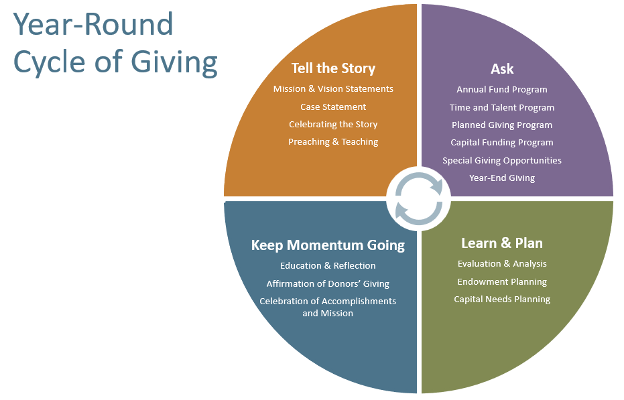
Most congregations—if they enlist pledges or promised support for the ministry of the church—exercise the process maybe once a year. However, there is another way.


The image you see above shows what a year-round cycle of giving could look like for a congregation. Though a circle has no end and no beginning, a stewardship committee might begin with the Tell the Story quadrant of the circle. It begins with the “the why” in the form of mission and vision statements, a great place for any church to ground its ministry. The second quadrant focuses on making an actual ask for support and in a variety of forms the congregation needs to invest in its mission and vision. The third quadrant encourages assessments and planning for the future. The last quadrant provides opportunities to share gratitude and celebration of generosity. In the Cultivating Generous Congregations seminar a whole segment of time in the workshop is spent unpacking each quadrant and its importance in practicing generosity over the course of each year.


In the absence of such a workshop, a Stewardship Committee might consider engaging the book "Embracing Stewardship, How to Put Stewardship at the Heart of Your Congregation’s Life," written by Charles R. Lane and Grace Duddy Pomroy. 


The authors represent two different generations of experience in generosity ministry and provide a roadmap for a congregation to deepen their understanding of themselves as stewards of God’s abundance.


A stewardship committee could discuss a chapter at a time to help further embody a year-round cycle of giving. The book covers eight pathways to enliven generosity beyond the annual campaign:


  • Talk about money when you aren’t asking for any
  • Conduct an excellent annual response program
  • Tell your congregation’s stewardship story to your congregation
  • Develop a plan for thanking
  • Expand the ways of giving to the congregation
  • Talk about stewardship all year
  • Reach new audiences
  • Talk about money in two distinct ways


Even if the Stewardship Committee experiments with one pathway that is new, that’s progress toward greater generosity. Give it a try and see what unfolds!

Save the Date: Narrative Budgets Workshop


August 26

REGISTER


A narrative budget translates the line items of a traditional budget into a story of how your congregation makes a difference in the world. It can be a helpful tool for a stewardship campaign or annual meeting. By telling the story of our congregations’ impact, we can inspire generosity in our donors. Rev. Chad Tanaka Pack of the Southern California Nevada Conference will lead the presentation. Register.

In Case You Missed It…


The Strengthen the Church (STC) Offering reflects the shared commitment of people across the United Church of Christ to cooperatively build up the UCC. Conferences and the national setting equally share the gifts given by members and friends through their local congregations. The funds raised support leadership development, new churches, youth ministry, and innovation in existing congregations. By your generosity to this offering, you build up the Body of Christ.


As God calls our congregations to be the church in new ways, your generosity will plant new churches, awaken new ideas in existing churches, and develop the spiritual life in our youth and young adults. 


The theme for 2026 is Sent Forth in Love. Participating in the offering helps foster connections with the wider church and create possibilities for the church of tomorrow. Typically this offering is received on Pentecost Sunday, but it is never too late to Strengthen the Church! You can find helpful materials here.

The Minnesota Conference UCC equips a courageous Church alive with Christ's transforming love. For more information, visit www.uccmn.org.