Q1 2023 Newsletter


IRS Reminder To Many Retirees: April 1 Is Last Day to Take Required Minimum Distribution From IRAs and 401(k)s

The Internal Revenue Service is reminding retirees who turned 72 during 2022 that, in most cases, Sunday, April 1, 2023, is the last day to begin receiving payments from Individual Retirement Arrangements (IRAs), 401(k)s and similar workplace retirement plans.


The payments, called required minimum distributions (RMDs), are normally made by the end of the year. But anyone who reached age 72 during 2022 is covered by a special rule that allows IRA account owners and participants in workplace retirement plans to wait until as late as April 1, 2023, to take their first RMD. In other words, in general, the special April 1 rule applies to IRA owners and other participants in these plans who were born after Dec. 31,1949.


Two payments in the same year

The April 1 RMD deadline only applies to the required distribution for the first year. For all later years, the RMD must be made by Dec. 31.


This means that taxpayers who receive their first required distribution (for 2022) in 2023, on or before April 1, must receive their second RMD (for 2023) by Dec. 31, 2023. Even though the first distribution is actually the required 2022 distribution, it’s taxable in 2023 and reported on the 2023 tax return - along with the regular 2023 distribution.


Types of retirement plans requiring RMDs

These required distribution rules apply to owners of traditional, SEP and SIMPLE IRAs while the original owner is alive. They also apply to participants in various workplace retirement plans, including 401(k), 403(b) and 457(b) plans. RMDs don’t apply to Roth IRAs.


Some can delay RMDs

Most participants who are still working for that employer can wait until April 1 of the year after they retire to start receiving these distributions, if their workplace plan allows. This RMD exception does not apply to 5% owners of the business sponsoring the retirement plan or to participants in SEP and SIMPLE IRA plans.


Employees of public schools and certain tax-exempt organizations with 403(b) plan accruals before 1987 should check with their employer, plan administrator or provider to see how to treat these accruals.


New age 73 rule starts in 2023

For those planning ahead, starting in 2023 retirees can wait until age 73 to begin receiving RMDs. Visit IRS.gov for more information on this and other changes affecting retirees and retirement-plan participants.


For more information on this, please visit www.IRS.gov.


SECURE 2.0 ACT OF 2022

MODIFIES RETIREMENT PLAN PROVISIONS 

In December, 2022, Congress passed the Consolidated Appropriations Act, 2023, which contains the Secure 2.0 ACT of 2022 (the ”Act”) and was signed into law by President Joe Biden. The Act includes several provisions related to retirement plans that:

1.   Expand participant coverage

2.   Help participants preserve income

3.   Simplify plan rules and provide administrative procedures


Below are a few key elements included in the Act. 


Increase in age for the beginning date of Required Minimum Distributions (RMD)

The required age for an RMD beginning date is increased under the following schedule for participants and spousal beneficiaries of a participant that died prior to reaching the RMD beginning date:

AGE

INDIVIDUALS IMPACTED

73

An individual who attains age 72 after 12/31/2022, and age 73 before 1/1/2033

75

An individual who attains age 74 after 12/31/2032

  • Effective date: Calendar years after December 31, 2022 
  • Applicable plans: 401(a), 401(k), 403(b), and 457(b) plans and traditional IRAs


Increased catch-up limits at age 60, 61, 62, and 63

Increases age based catch-up limits to the greater of $10,000 or 50 percent more than the regular age 50 catch-up amount in 2025 (as indexed for inflation) for participants who have reached ages 60, 61, 62 and 63.

·   Effective date: Calendar years beginning after December 31,2024  

·   Applicable plans: 401(k), 403(b), and governmental 457(b) but

cannot be used in addition to 457(b) special catch-up  


Age 50+ Catch-up contributions made only as Roth contributions for certain highly paid employees  

If a participant’s wages subject to FICA in the previous year paid by the employer sponsoring the plan were more than $145,000 (subject to annual cost of living adjustments in $5,000 increments), the participant may only contribute the Age 50+ Catch-up as a Roth contribution.

·   Effective date: Tax years after December 31, 2023

·   Applicable plans: 401(k), 403(b) or governmental 457(b) plan


Improving coverage for part-time and seasonal workers

Further reduces the minimum eligibility service requirements from three years (set forth in SECURE Act 1.0) to two years. Individuals will now be eligible as of the earlier of (1) one year of service, or (2) the completion of a 24-month period consisting of two consecutive 12-month periods with 500 hours of service and attainment of age 21 by the end of the calendar year. This reduction does not apply to employees subject to collective bargaining or nonresident aliens and the 12-month period beginning before January 1, 2023, is not taken into account.

·   Effective date: Plan years after December 31, 2024

·   Applicable plans: ERISA 401(k) and ERISA 403(b) plans


Increased dollar amount for a mandatory distribution (“Cashout”)

The dollar amount which a plan may authorize a cashout of a terminated participant’s vested account without the participant’s consent increases from $5,000 to $7,000.

·   Effective date: Distributions after December 31, 2023

·   Applicable plans: 401(a), 401(k), 403(b), and governmental 457(b)

plans


Eliminating unnecessary plan requirements related to unenrolled participants

Provided a participant has received a summary plan description and other documents related to plan eligibility, a plan is not required to provide disclosures or notices to employees who are eligible to participate but have not enrolled in the plan, other than an annual reminder notice of the participant’s eligibility to participate in the plan and applicable deadlines as well as any required documents upon a participant’s request.

·   Effective date: Plan years after December 31, 2022

·   Applicable plans: 401(a), 401(k), 403(b), and 457(b) plans


SENTINEL BABIES

Two members of our Sentinel Team have new additions, meet the new guys!

Eli Bass arrived

12/21/2022

son of Hailey Bass


Cooper Melancon arrived 2/28/2023

son of Kasey Melancon

LOGO REFRESH

Did you notice our refreshed logo? If our invoices and communications look a bit different, that is why!

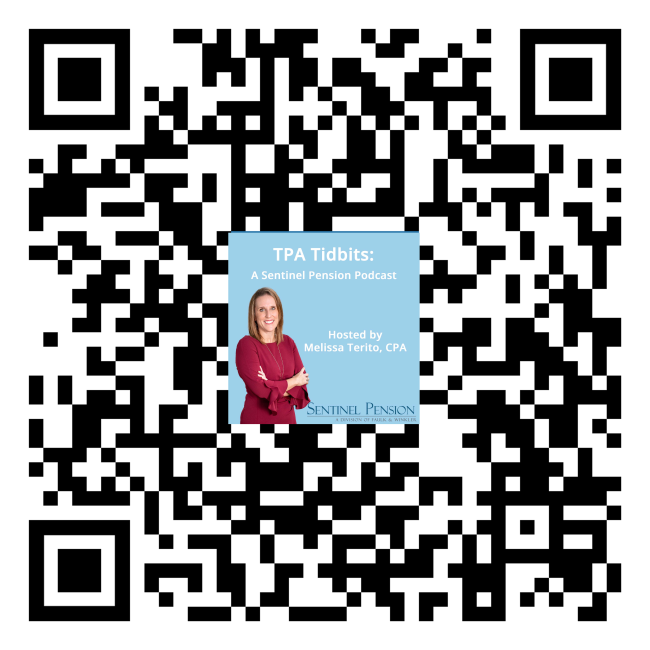
TPA TIDBITS PODCAST, HOSTED BY MELISSA

Our very own Melissa Terito hosts an industry podcast, where she speaks with other TPA professionals about what's happening in the retirement world and discusses key points we think are noteworthy. TPA Tidbits is a quick, informational podcast you can catch on-the-go. Check it on Apple Podcasts and Spotify. Catch our most recent podcast featuring Megan Crawford of Williams Benefit Consulting right here!


Facebook  Linkedin  
Visit our website