|
The third quarter came and went in what felt like the blink of an eye. It brought with it important reminders that markets rarely move in a straight line. When looking “under the hood” of the market, performance was very uneven. During the quarter, domestic U.S. large-cap equities ended up around 2% (S&P 500 Index) while U.S. small-cap equities retreated over 7% (Russell 2000 Index). Overseas markets were mixed with developed international investments up about 0.5% (MSCI ACWI Ex USA Index) while emerging markets were down almost 0.4% (MSCI EM Index). Energy stocks were among the strongest performers as geopolitical tensions in the Middle East pushed oil prices higher, while portions of the technology and broader growth complex experienced bouts of volatility. At the same time, rising interest rates created a challenging environment for fixed income as bonds were down about 3.5% for the quarter, illustrating once again the importance of diversification across asset classes and investment styles.
As we turn our attention to fall, the election is grabbing much of our attention now with midterm elections on November 3rd. All 435 seats in the U.S. House of Representatives and 35 U.S. Senate seats will be decided, creating the potential for a change in congressional control. With change comes volatility. Yet history offers a useful reminder that elections tend to create more uncertainty in the headlines than they do lasting changes in market direction. Please join us for our upcoming webinar, Elections & Markets, where we discuss the unique challenges that elections pose to equity and bond markets and the investing fundamentals that are so important to follow during these times.
Iran, Inflation and Interest Rates
The Federal Reserve returned to center stage in September. They raised the federal funds target range by 25 basis points to 3.75%-4.00%, its first interest rate increase since 2023, as policymakers try to combat inflation stemming from increased energy prices. The Fed is projecting core PCE inflation of 3.4% for the year while it currently stands at 3%. Remember, the Fed is still targeting 2.0% inflation over the long term. Higher inflation can be directly tied to the ongoing conflict in Iran. The June cease-fire agreement with Iran quickly fell apart in early July causing continued restrictions on the movement of oil out of the region. Now with strategic national reserves dipping down to all-time lows, the U.S. is running out of levers to pull to stem the rise in gas and diesel prices. The quarter ended with no meaningful agreement in place. The price of oil, and therefore gas, will continue to remain volatile as talks continue.
Volatility in the Bond Market
Speaking of raising rates, it isn’t just the Fed Funds rate being increased due to sticky inflation. Bond rates across the yield curve have been increasing in response to higher inflation, better-than-expected economic data, strong stock earnings, and increased borrowing from the world’s largest companies looking to raise capital for the ongoing AI buildout. There have been a lot of competing forces causing investors to sell bonds or at least demand a higher interest rate in order to hold those bonds. The headlines have been loud, but context always matters – the Bloomberg U.S. Aggregate Bond Index is down 2.9% year-to-date. Rising yields can be worrisome to investors, but volatility in any asset class is normal, and with the “Agg” index yielding near 5%, much of this price movement is being offset by the current yield. For more details on this topic, see our full post: “What’s Going On With the Bond Market?”
AI
It seems like you can’t separate the market and AI lately; the two topics go hand in hand as the world’s largest tech companies continue to drive the market forward with the strongest earnings gains and, in many cases, the best stock performance so far for the year. Semiconductors and energy are the two top-performing sectors YTD driven by the AI trend, and of course higher energy prices from the Iran conflict. From roaring stock prices to literal doomsday headlines, AI is giving us a little bit of everything this quarter. Large tech companies, federal and local governments, investors, and users of the technology are figuring out what and how exactly this new technology will be utilized going forward and what it’s impact to our economy will be.
Elections and Markets
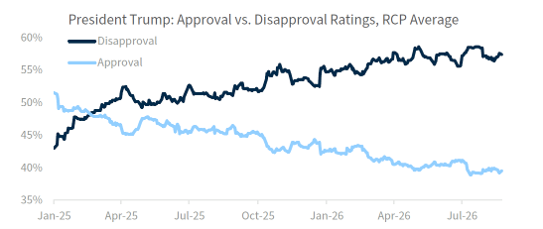
It’s rare that, in an election year, many of the headlines surround international conflicts rather than domestic issues, but that is where we find ourselves. Historically, midterm elections are difficult for the president’s party, and this year is unlikely to be an exception as the president’s approval rating has been steadily declining and is near historic lows.
|