|
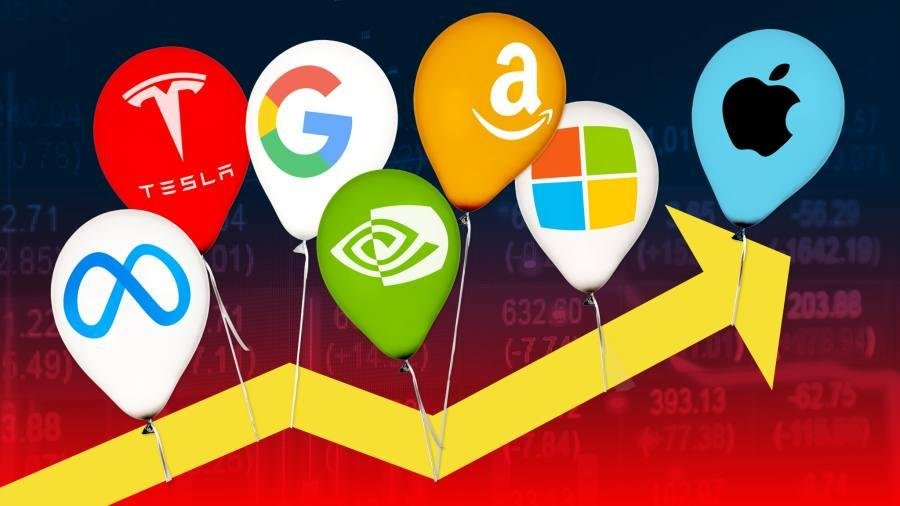
Returns in 2023, especially the NASDAQ, were largely driven by what has become known as the “Magnificent 7” technology and internet companies that comprise nearly 30% of the market capitalization of the S&P 500: Apple (up 48.2% for 2023), Microsoft (56.8%), Amazon (80.9%), Nvidia (238.9%), Google parent Alphabet (58.3%), Meta/Facebook (194.1%), and Tesla (101.7%).
After raising short-term interest rates four times in 2023, for a total of 1.0% through July, the Federal Reserve met twice during the fourth quarter, leaving rates unchanged. The Fed hiked its short-term lending rate from near zero beginning in March 2022 to the current range of 5.25% to 5.50%.
Long-term U.S. Treasury yields ticked up to levels not seen since before the 2008 Financial Crisis, hovering around 5.0% in October. With expectations for lower interest rates at some point in 2024, intermediate- and long-term yields reversed course and ended nearly where they started 2023. One-, two-, five-, 10-, and 30-year Treasury securities ended the year at 4.78%, 4.25%, 3.84%, 3.87%, and 4.02%, respectively, with no more than a 15 basis point change from the outset of 2023.
Consistent with the uptick in Treasury yields, the average rate for 30-year fixed-rate mortgages, as reported by Freddie Mac, rose to a high of 7.79% in October, a level not seen in more than 20 years. The average mortgage rate declined to 6.61% by year end.
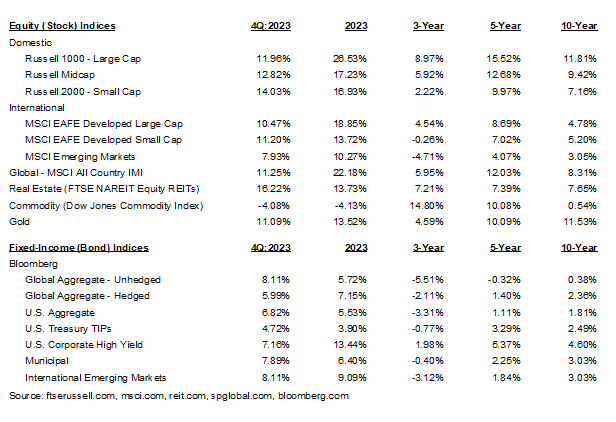
After mixed results for most the year, the fourth-quarter retreat in yields led bond indexes to close 2023 in positive territory. For the year, broad bond measures advanced by mid single-digits.
Below are rates of return for selected market indices for the fourth quarter of 2023, full-year 2023, and the three, five, and 10-year compound annual returns as of December 31, 2023.
|