New Year, New System, New Travel Coordinator! | |
|
Welcome to 2025! With the start of the New Year, maybe you’re trying to exercise more, reduce your stress levels, or save more money. The great thing about those common New Year’s resolutions is that participating in alternative mode usage can help you stick to them!
The Travel Reduction Program (TRP) isn’t just about reducing the amount of times you drive to work alone, it’s also about making you conscious of your decisions outside of work. Try walking or biking to a store or the library. Carpool with a friend to a great new hiking spot or café. If you’re visiting Phoenix or Tucson, avoid the stress of driving those crowded city streets and try parking your car in a safe space and using the local transit system to get around. The goal is to reduce our emissions and help make the air our families breathe cleaner and healthier.
Air Quality staff here at Pinal County are excited to welcome in the New Year and have some updates for you regarding changes that you will notice as we close in on 25 years of our Travel Reduction Program.
| |
|
We have a new Travel Reduction Coordinator, Natasha Sichling! Natasha is a native of Pinal County and grew up outside downtown Florence. She has worked with the county for almost one year and has been in this position since late October. She is passionate about bettering our environment and spends much of her free time outside running and hiking in the community.
Plan to hear from her often these next few months as she has many updates to share. If you were unaware, we are switching to a new survey system adapted from and supported by the Maricopa Association of Governments (MAG). Some of you may have sites in Pinal and Maricopa; hopefully, this will bring cohesiveness to your experience.
| |
|
We have also been working hard with the Pinal County Communications & Marketing Office to update our website. To provide a more supportive experience for our county's Transportation Coordinators (TC), we have added new resources and documents for your convenience. On our website, you will find items such as:
- A new handbook that explains what is expected of TCs and how the new system works
- Updated forms and documents for new employers: how to identify new TCs or Highest Ranking Local Officials (HRLO), applications for exemptions and variances, and many more resources
- Direct signup link for our quarterly newsletter - You'll notice this is not the PDF newsletter you probably received in the past! Upon signing up, our newsletter will automatically get sent to your email. If interested, anyone can sign up for this newsletter, even your friends or family.
| |
Pesky Pollutants We’re Working to Reduce | |
|
Clean air is critical for every person in every area of Pinal County, improving the health of residents, decreasing healthcare costs, and helping create communities that attract and retain business. Each year, Pinal County is required to report to the Arizona Department of Environmental Quality (ADEQ) the amount in tons of certain pollutants that major employers have reduced within Area A of Pinal County – that’s you! Those pollutants are carbon monoxide, nitrogen oxides, volatile organic compounds, and particulate matter. Over the course of this year, we will be going over all of those pollutants and how they affect us. At the end of discussing the pollutants, we will discuss how a combination of certain pollutants make up – ozone! This edition will look into carbon monoxide.
Most people associate carbon monoxide with the carbon monoxide alarms in their homes, especially if they have gas appliances or attached garages built after 2009. That’s a good association because most of us have those alarms to warn us of carbon monoxide poisoning. Carbon monoxide poisoning can happen if you are in your garage with your car running and your garage door shut—don’t do that.
What is carbon monoxide? It’s a colorless, odorless gas released when something is burned. According to the EPA, the greatest sources of CO to outdoor air are cars, trucks, and other vehicles or machinery with combustion engines.
High levels of carbon monoxide, like the ones that can cause brain damage and death, are not likely in an outdoor setting. There can be levels outdoors that can cause concern for people with certain types of heart disease. They are especially vulnerable to the effects of CO when exercising or under increased stress. In these situations, short-term exposure to elevated CO levels may result in reduced oxygen to the heart accompanied by chest pain known as angina.
| |
Travel Reduction News Around the Country | |
Man and Dog Riding Longhorn at A&M During Texas Game Removed from Campus | |
|
Sometimes, reducing your single occupancy vehicle (SOV) rate leads to resorting to unique methods. One man in Texas decided to make a statement at the November 30, 2024, game between the Texas Longhorns and the Texas A&M Aggies by riding into the game with a notably different form of transportation.
The man was on the back of a longhorn steer, accompanied by his cattle dog and another man riding a horse. Presumably, the cattle dog and horse were there to keep the steer in check.
Now, as to whether the statement being made was actually related to any desire for emissions reduction or if it was a statement that he wanted the Longhorns to win the game, we’ll never know. That’s one unique way to reduce your SOV miles! Read article
| |
UDOT to Build and Plan Nearly 60 Miles of New Paved Trails as Part of the Utah Trail Network | |
|
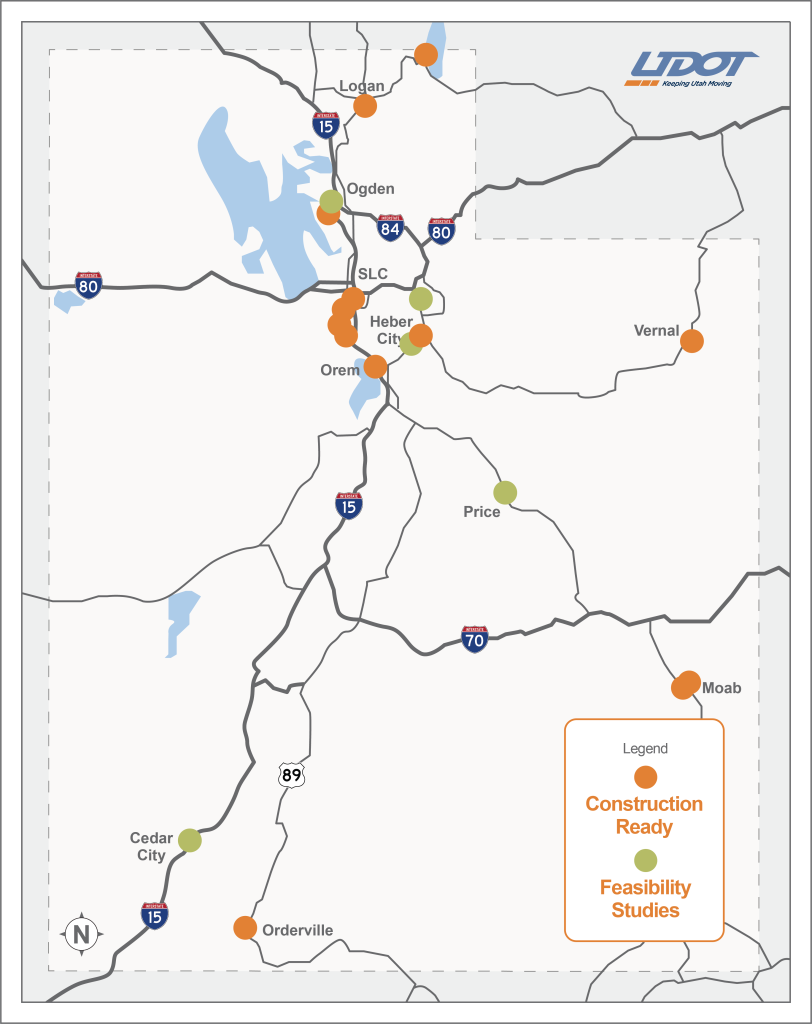
Utah is taking steps to increase access to forms of transportation other than driving. In 2022, Utah Governor Spencer Cox championed a vision for a connected trail network spanning the state, which would connect Utah citizens to the state's destinations and communities.
The Utah Department of Transportation worked with communities and partners across the state to determine which projects were viable and which needed further study. Thirteen construction-ready trails have been chosen, and 26.8 miles of trails and an underpass will be built to complete the 2050 North trial. The total cost of those projects is just over $93 million. Close to $2 million was also allocated to determine the feasibility of another 27.7 miles of trails and the paving of select existing trails. Read the article here and learn more about the Utah Trail Network.
Completing these projects will allow Utahans to commute to and from work and allow more people to experience trails. Paving the trails will also open access to those who use wheelchairs or assisted walking devices. Want to see a program like this in Arizona? Contact your elected officials and let them know!
| |
Accomplishments and Successes of Reducing Air Pollution from Transportation in the United States | |
|
At the close of World War II, the United States transportation environment went through many changes — there was economic growth, population growth, rapid suburbanization, and the closing of some public transit systems. These factors contributed to a substantial increase in vehicles in the United States. One result of this increase was air pollution.
In 1970, Congress passed the Clean Air Act and gave the newly formed EPA the authority to regulate pollution from stationary sources like power plants and industrial facilities, as well as mobile sources, including cars, trucks, and buses. There have been many successes from this act, such as:
- New passenger vehicles are 98-99% cleaner for most tailpipe pollutants compared to the 1960s.
- Cleaner fuels - lead has been eliminated, and sulfur levels are more than 90% lower than before regulation.
- Improved air quality - U.S. cities have much- improved air quality despite the ever-increasing population and increasing vehicle miles traveled.
- Standards have sparked technological innovation in industry.
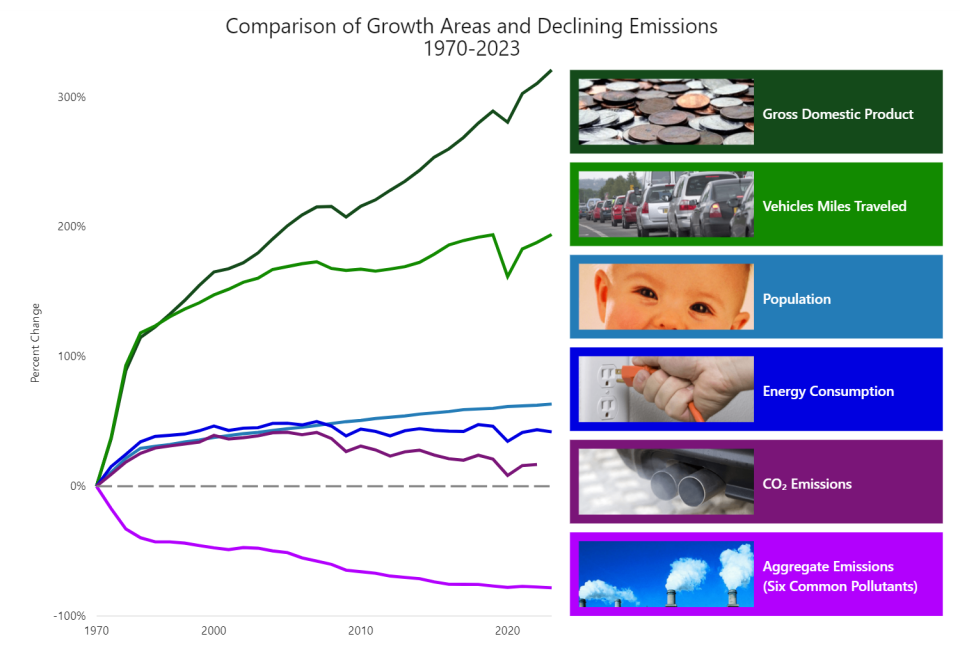
Since 1970, there has been growth in our country’s gross domestic product, the amount of vehicle miles that we travel, and our population. Over the same period of time, there has been a decrease in our energy consumption, CO2 emissions, and aggregate emissions of the six common pollutants.
The Pinal County travel reduction program has only been in existence since 2001; however, if you look at the graph, you can see that’s right around the dip in the CO2 emissions — we helped with that! In the coming years, as more employers in Area A are able to meet that 60% or less SOV rate, we hope to be able to contribute more to the national reduction of emissions. Read more here.
| |
Travel Reduction Doesn’t Mean Don’t Travel
Carpool to These Great Locations in Pinal County
| |
|
Don Donnelly’s D-Spur Ranch and Stable
- 15371 E Ojo Rd, Gold Canyon, AZ 85118
- Longhorn Cattle Drive through Arizona Desert - Jan. 19, Feb. 2, Feb. 16
- Semi-annual cattle roundups in November and February
| |
|
Rooster Cogburn Ostrich Ranch
- 17599 E Peak Ln Picacho, AZ 85141
- Open daily 9 a.m. – 5 p.m. - hours change May 1st
Arizona Zipline Adventures
- 35406 S. Mt. Lemmon Rd Oracle, AZ 85623
- Open Thursday -Sunday 8 a.m.- 5 p.m.
| |
|
Arizona Renaissance Festival
- 12601 US-60, Gold Canyon, AZ 85118
- Saturdays and Sundays (and Presidents Day) February 1 - March 30
A full list of Pinal County Attractions and Entertainment offerings is available here.
| |
Visit These Hiking Trails in Pinal County | |
Please note, there is a $7 entrance fee per vehicle at each of these locations - carpooling can save your group money! You can also save money by biking to these parks if they are close enough for you, the entrance fees are $3 per bicycle. | |
|
Peralta Regional Park
Managed by Pinal County
17975 E. Peralta Road Gold Canyon , AZ 85118
| |
|
San Tan Regional Park
Managed by Maricopa County
- 6533 W. Phillips Road Queen Creek, AZ 85144
| |
|
Picacho State Park
Managed by the State of Arizona
- 15520 Picacho Peak Rd, Picacho, AZ 85141
-
Upcoming event at Picacho Peak State Spark in conjunction with Pinal County Animal Care and Control, more information here.
| |
|
This newsletter may be shared as needed to keep your employees and driving-age students updated. Feel free to forward it to those who may have an interest.
To have Pinal County Air Quality alerts delivered directly to your email inbox, click the subscribe button.
| | | | |