|
Eisenhower Society Membership Appreciation
Reception
|
The Eisenhower Society is dedicated to promoting the extraordinary qualities of Dwight D. Eisenhower - five-star General, Supreme Commander of Allied Expeditionary Forces during WWII, 34th President of the United States, farmer, and citizen.
The Society is member-supported, and when we say that, we mean it. And when we say thank you to our members, we mean that too!
|
The membership support we receive is critical to advancing our mission. Members join for many reasons. But we all like Ike! To celebrate our members and of course Ike, we are hosting a membership appreciation event:
Sunday, March 27, 2022
2:00 pm to 4:00 pm
G.A.R. Hall
53 E. Middle Street
Gettysburg, PA
Meet other members and get to know our trustees. There will be a short program, “Major Eisenhower’s Neighborhood,” presented by Trustee Paul Shevchuk. It is a world premier!
Ruthmary McIlhenny
DDES Trustee
|
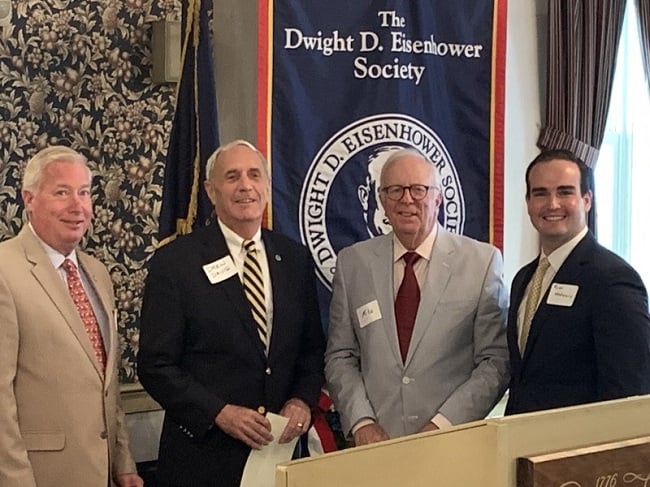
At the annual October meeting of the Dwight D. Eisenhower Society, President John Burt welcomed three new trustees to the board:
Major General Andrew B. Davis, USMC (Ret.) has had a distinguished career in both the military and private life. He is currently the CEO of the World War II Foundation.
Michael Hanson is a CPA who has owned and operated a bed and breakfast and is currently community manager of the Lake Heritage Property Owners Association. He serves as president of several organizations.
Ryan Woodward has served as a congressional staff person rising to legislative director. Currently he is the Government Relations Manager for the International Association of Fire Chiefs.
Thank you for agreeing to serve on the Board of Trustees of the Eisenhower Society!
|
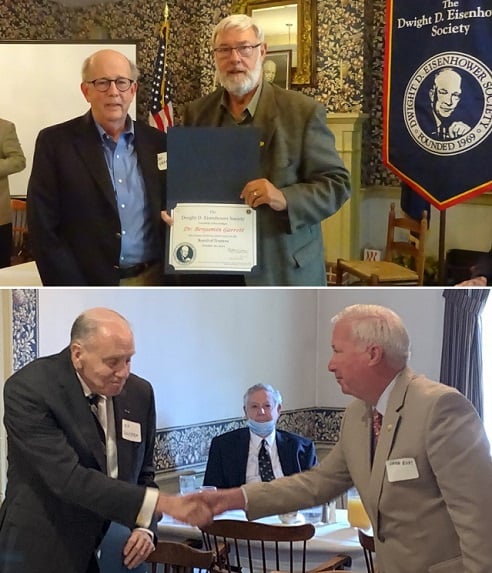
Dr. Benjamin Garrett and Lt. Gen. Harry E. Soyster recently stepped down as members of the Board of Trustees. Dr. Garrett served on the board of the Society since 2016. Lt. Gen. Soyster served as a trustee of the Society since 2014. Gentlemen, we appreciate your service to the Dwight D. Eisenhower Society! We look forward to your continued membership in the Society and we hope to see you at future events.
Carol Hegeman
DDES Executive Director
|
|
|
|
March 27:
Member Appreciation Reception
July 16:
Annual Picnic
October 15:
Eisenhower Birthday Commemoration
|
SO YOU THINK YOU KNOW IKE? |
As Ike assumed office in 1953, the winding down of the Korean War and Stalin's death produced a narrow opportunity for President Eisenhower to attempt an offer of peace to the new Russian regime. In Ike’s famous A Chance for Peace speech on April 16, 1953, he said in part, “We pay for a single fighter with a half-million bushels of wheat. We pay for a single destroyer with new homes that could have housed more than 8,000 people. This is not a way of life at all, in any true sense. Under the cloud of threatening war, it is humanity hanging from a(n) …..” Complete the sentence from the choices below:
A. Old olive branch
B. Cross of Iron
C. Pendulum in the wind
D. Scale of Justice
Scroll down to see the answer!
|
Ike on...
Society's Future
|
“As we peer into society’s future, we – you and I, and our government – must avoid the impulse to live only for today, plundering for our own ease and convenience the precious resources of tomorrow. We cannot mortgage the material assets of our grandchildren without risking the loss also of their political and spiritual heritage. We want democracy to survive for all generations to come, not to become the insolvent phantom of tomorrow.”
Dwight D. Eisenhower
Farewell Address
January 17, 1961
|
Answer to Ike Trivia:
Answer:
B. Cross of Iron
|
Submitted by:
Lt. Col. David W. Jones
DDES Trustee
|
|
|
|
|
New Eisenhower
Sculpture!
|
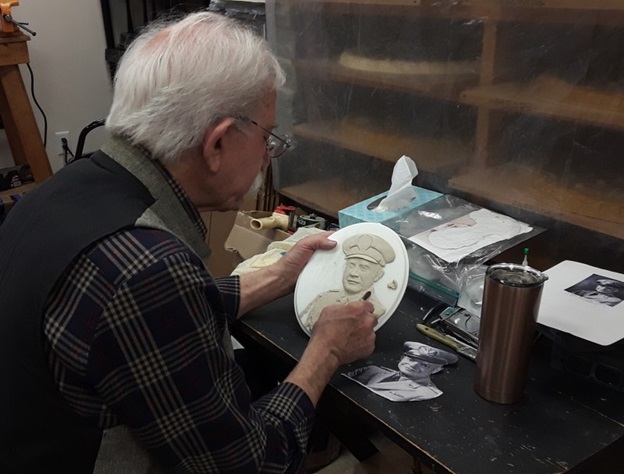
Gettysburg sculptor Gary Casteel is sculpting an 8” x 10” oval bas relief plaque of Dwight Eisenhower. Renowned for his Civil War sculptures as well as other commissions, Gary is sculpting this Eisenhower plaque as a fund raiser for the Eisenhower Society. Twenty percent of sales will be returned to the Society during the first year of release.
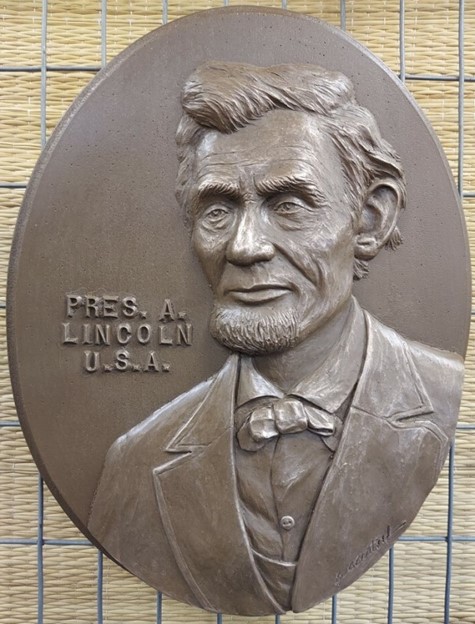
The sculpture is based on an official U. S. Army photograph of General Eisenhower. Gary begins the process by sculpting an oval plaque in clay. As the process continues, he applies more layers of clay to develop the relief. Once the clay bas relief is complete a rubber mold is produced over the original and then castings in bonded bronze are produced. It will look like bronze, but the cost and weight are greatly reduced. A hanger on the back allows the owner to display the plaque on a wall. A photograph of his President Lincoln bas relief gives an idea of what the finished product will resemble.
|
As with everything during the pandemic, material costs have risen. The cost of the Eisenhower plaque is $115.00 if it is purchased at Gary’s studio, 789 Baltimore Street in Gettysburg. The plaque can also be purchased and mailed via
The official release date for this sculpture is March 27, 2022 and it can be ordered then. To get an in-person look at this new sculpture, it will be displayed at the Eisenhower Society Member Appreciation Reception on Sunday, March 27.
Carol Hegeman
DDES Executive Director
|
Society Grant Program Supports Eisenhower Institute Students |
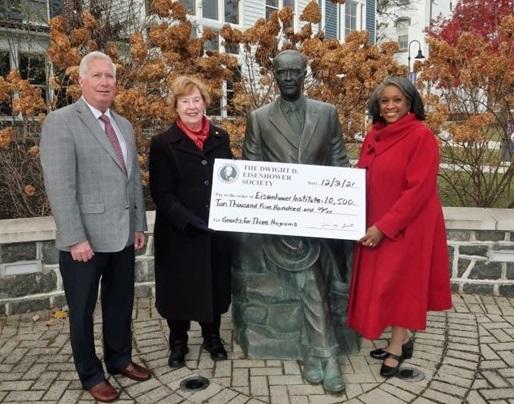
In December, President John Burt and Executive Director Carol Hegeman presented Tracie Potts, Executive Director of the Eisenhower Institute, with a $10,500 grant check. The funds will be used to support three programs.
Students participating in the Inside Civil Rights program will examine the topic of civil rights in America today. They will travel to Little Rock, Arkansas, to learn firsthand about the events surrounding the integration of Central High School and Eisenhower’s decision to send troops to Little Rock. Using this experience, students will have a context to compare, contrast and discuss the civil rights issues that remain today.
Students participating in the Washington Connections program will discuss how to take on the great challenges of our time. In his 1959 speech, “The Importance of Understanding” given at Gettysburg College’s Founders Day Convocation, Eisenhower said, “If through education—no matter how acquired—people develop understanding of basic issues, and so can distinguish between the common, long-term good of all, on the one hand, and convenient but shortsighted expediency on the other, they will support policies under which the nation will prosper.” Using Eisenhower’s words as a guide students will frame the role education will play in their personal lives.
Students participating in the Women in Leadership program will engage in decision making, networking, and mentoring as they reflect on lessons learned as they assume positions of leadership. These goals correspond to Eisenhower’s goal of maximizing human potential.
We wish the students our best as they learn about Eisenhower and participate in these programs.
Carol Hegeman
DDES Executive Director
|
|
|
|
Exciting Happenings at Eisenhower NHS!
|
At the beginning of January, Jana Friesen McCabe joined the team at Eisenhower NHS as the new site manager. Jana has more than 20 years of experience with the National Park Service, most recently serving as the Chief of Resource Education and Visitor Services at Monocacy National Battlefield.
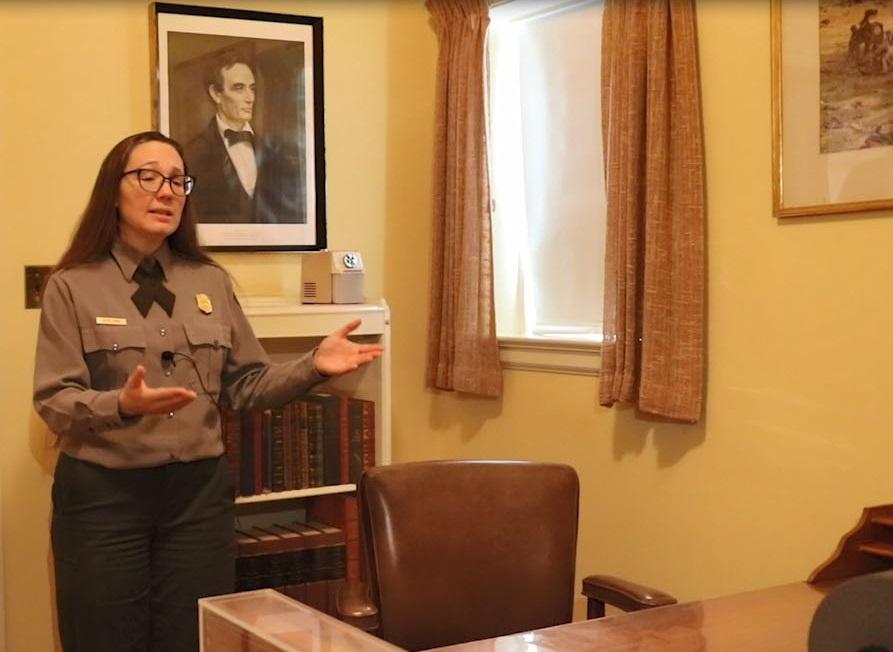
This winter park staff have created new virtual resources on our website, including an article on Eisenhower’s impact on the Civil Rights movement, as well as designing new webpages for many of our virtual programs from the past two years. Ranger Alyce Evans filmed a new virtual program on President Eisenhower and his appreciation for Abraham Lincoln, which debuted on our site Facebook page on President’s Day.
|
In January, Ranger Dan Vermilya participated in the Gettysburg National Military Park Winter Lecture series, speaking on Adams County natives who were killed in World War II and buried in the Gettysburg National Cemetery.
As we look ahead to the spring and summer, park staff are excited to debut new education programs, including a new Ike and the Men of D-Day program that features stories of D-Day casualties buried in the Gettysburg National Cemetery. The site is also offering a new Diplomacy at Gettysburg program, discussing Eisenhower using his farm to conduct Cold War diplomacy.
|
Planning is also underway for the year ahead, including hiring our Eisenhower Society summer interns, finalizing our house tour operations, creating our program schedule, as well as reviving our annual World War II weekend in September.
Jana Friesen McCabe
Site Manager
Eisenhower NHS
|
Trustee Spotlight:
Brig. General (Ret.)
Samuel K. Lessey, Jr.
|
Brigadier General (Ret.) Samuel K. Lessey serves as our Chairman and has since 2009. Chairman Lessey grew up in Chappaqua, NY and attended West Point from 1942-1945. Brig. Gen. Lessey was commissioned in the United States Army Air Corps, later the United States Air Force on September 18, 1947 and was assigned duty in Europe. Following his European duty, he graduated from Harvard Law School in 1951 and was assigned to the U.S. Naval Academy to teach Military Law. He would later complete a flying tour in Japan, earn an MBA from Harvard in 1956 and then seek employment on Wall Street. He held a director position with the National Aviation Corporation trust and was an officer of the investment banking firm Shearson, Hammill & Co. In his Reserve duties at this time, he led the effort to conduct a review of the entire management structure of the Air Force Reserve.
An honor for anyone, Chairman Lessey was appointed by President Reagan as Inspector General of the U.S. Synthetic Fuels Corporation from 1982 to 1986, and later as Director of the Selective Service System, where he served from 1987 to 1991. Following service in Washington, Brig Gen Lessey was appointed Civilian Aide to the Secretary of the Army for New Hampshire and was elected New Hampshire State President for the Association of the United States Army. He served on the Board of Directors of the National Stroke Association and as Chairman from 1994 to 2000.
In 2003, he was appointed to the Board of Visitors by President George W. Bush and served until 2009. Under Chairman Lessey’s devoted and steadfast leadership, the Eisenhower Society has provided over $500,000 to myriad grant projects, completed two strategic plans to ensure the continued viability of the society and welcomed many new distinguished members to the Society further expanding the great legacy of Dwight D. Eisenhower. Hail to our Chairman!
|
Lt. Col. David W. Jones
DDES Trustee
|
|
|
|
|
Looking Forward, Looking Back |
In March 1947, seventy-five years ago, the United States was still trying to cope with the aftermath of the Second World War. It was also faced with the beginning of a new conflict, far less violent but equally global in its reach and consequences—the Cold War. U.S. Army Chief of Staff Dwight D. Eisenhower was heavily involved in both endeavors.
Ike was in many ways a humble man, even a modest one, but there was little false modesty in him. Justifiably proud of his accomplishments during the war, he took pains to make sure that the historical record was accurate even before he composed his best-selling memoir, Crusade in Europe. On March 10 he wrote U.S. Army historian Forrest Pogue, then working on a history of Eisenhower’s wartime headquarters, to make sure that it was understood that he had not pushed for a hasty, ill-prepared assault across the English Channel in 1942 or 1943. He also gave his view on the claims that British Field Marshal Bernard Law Montgomery could have ended the European war quickly, in 1944, by launching a “long, slender thrust-line to Berlin.” Given the logistical realities of the campaign, the idea, Eisenhower patiently explained, was “fantastic”—and not in a good way. Monty’s plan to go “all the way forward into Germany across the Rhine would have been so stupid as to have warranted the relief of anyone who would have attempted it.”
Current problems loomed even larger. Relations between the United States and its former Soviet ally had slowly deteriorated in the year and a half since the end of the war. Eisenhower, who had worked in harmony with his Russian counterparts as he led American occupation forces in Germany, was puzzled by this growing estrangement. He would later wonder whether an unfortunate change in Soviet dictator Joseph Stalin’s previously friendly attitude toward America and the West (and toward him personally) had been caused by some unknown event in the late fall of 1945, or whether Stalin’s hand had been forced by hard-core Communist leaders within Russia determined to pursue their “doctrine of world revolution.” Eisenhower speculated that Stalin, confronted by adamant internal opposition, might well have “immediately taken the lead to become the greatest ‘hate’ of all” (letter to Henry M. Wilson, Oct. 30, 1947).
One of the most dangerous areas in 1947 was Greece, where a Communist-supported insurgency endangered that nation’s stability and threatened to expand the Soviet Empire into the Eastern Mediterranean. On March 12, following notification by the British government that it could no longer shoulder the burden of financial backing for Greece and Turkey, President Harry S. Truman proposed to Congress that the United States should support free peoples attempting to resist subversion or armed takeovers. General Eisenhower, as a member of the U.S. Joint Chiefs of Staff, backed this new Truman Doctrine. He advised his civilian superiors on the following day that an “extension of Soviet power into Greece . . . would place that power on a flank particularly dangerous to the Turks in that it would strengthen Soviet ability to cut off allied supply and assistance in event of war.”
Ike’s concerns were tempered to a certain extent by the fact that he was in the last year—or so he thought—of his active service. He and Mamie were already looking forward to a transition into a peaceful retirement, and they had started thinking about choosing a location for retirement. On March 24 he wrote a friend (Hal Mangum) that “The probabilities are certainly strong that Mamie and I will try to make our home in Texas. . . . and from my viewpoint Texas is heaven as compared to any of these eastern cities.”
The Eisenhowers would not move to Texas, and in the years to come Ike would be forced to deal with the problems that lay ahead. His dreams of a tranquil future were not to be.
Dr. Daun van Ee
DDES Trustee
|
As a child, Mamie Geneva Doud grew up in a household where family always celebrated holidays in a special way. Flowers, candles, and colorful decorations adorned their home. Her parents, John and Elivira Doud, made sure that birthdays left lasting memories for their children. “Always nostalgic about her youth,” Mamie grew up with “the feeling that making ornaments for birthdays, Christmas, Fourth of July and Thanksgiving meant much more to her than paper symbols of celebration,” wrote one biographer. “From her little-girl days, Mamie Eisenhower has done her share to make such celebrations bind closer family ties.”
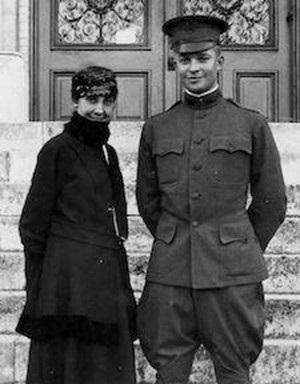
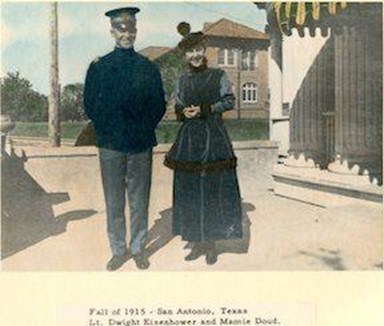
The Douds took the tradition with them whenever they escaped the cold of Colorado for the warmth of San Antonio, Texas. Mamie, now eighteen, wintered once again with her family at a private home they rented on McCullough Avenue in the Alamo City. The Douds had been doing so since 1910, with the exception of the winter of 1911-1912 when their oldest daughter Eleanor, died. Since 1915 marked Mamie’s debutante year, it was time for her to be introduced to the social elite of the city in the hopes of finding a worthy husband. Within weeks of their arrival she met by chance a handsome, young Army officer who immediately caught her eye. That meeting had the same impact on Second Lieutenant Dwight D. Eisenhower, who was about to make his rounds of the Infantry Post. He was so taken with Mamie that he asked her for a date that same evening. Mamie was unable to accommodate Eisenhower’s zeal since her social calendar that evening was already filled. Nevertheless, Ike persisted, refusing to give up.
|
Apparently, Ike also had an affinity for birthdays and holidays as well. On November 15, 1915, the day after Mamie’s nineteenth birthday, the couple went on their first date. On Christmas Day, after five weeks of dating, Ike gave Mamie a gift that not only shocked her, but her parents as well – a sterling silver heart-shaped jewelry box engraved with her monogram. Such a personal gift was inappropriate for a young lady at this stage of their relationship. Discord reigned in the Doud household for several hours before Mr. Doud defused the situation.
Then, on Valentine’s Day, 1916, Mamie accepted Ike’s West Point class ring, signifying their intention to marry. Mrs. Doud would not allow Mamie to wear the ring without first obtaining permission from her husband who was away at the time in Iowa. The couple would have to wait until John Doud returned to give his consent.
Meanwhile, tension along the U.S.-Mexican border intensified on March 9, 1916, when General Francisco “Pancho” Villa attacked the small town of Columbus, New Mexico, without warning. The result placed the entire 2,000 miles of the border from Brownsville, Texas, to San Diego, California, under the protection of the U.S. Army and local National Guard.
Threats to the border kept Ike from speaking with Mamie’s father. Whether he chose St. Patrick’s Day on purpose or it was simply fate, Ike went to the Doud home to ask for Mamie’s hand in marriage. The dining table at McCullough Avenue was still decorated with violets, green tapers and streamers of green tulle from a St. Patrick’s Day dinner that Mamie held for friends earlier in the month.
As their years together passed, the Eisenhower’s continued to celebrate special days. Mamie maintained those childhood traditions of decorating her many residences for the holidays. Her granddaughter Susan Eisenhower recalled that of all the holidays, Mamie paid extra attention to celebrating two in particular – “Saint Valentine’s Day and Saint Patrick’s Day as the anniversary of their engagement.”
Paul M. Shevchuk
DDES Trustee
|
|
|
|
|
"I hope and pray that the society will become
a perpetual living memorial to Ike"
Mamie Doud Eisenhower, December 14,1975
717-398-2349
|
|
|
|
|
|
|
|
|