|
June Edition Vol. III
06/15/2026 - 06/19/2026
| | |
Here are the latest opportunities to strengthen
your community and connect with the region.
| | |
|
Region 10 Tribal Caucus & EPA
Serving 271 Tribes in the Pacific Northwest
| | |
EPA's Webinar for Tribes: Lithium-ion Battery Response Guide
EPA is hosting a free webinar on its On-Scene Coordinator Lithium-Ion Battery Response Guide, published in October 2025.
This two-hour training will highlight key components of the guide and explore how the information can be applied to Tribal emergency response, environmental, and waste management programs.
During the second half of the webinar, participants will have the opportunity to begin developing an outline for a lithium-ion battery response guide tailored to their own community's needs and programs.
Topics will include:
• Lithium-ion battery response considerations and safety practices
• Emergency response planning and preparedness
• Waste management and disposal considerations
• Developing community-specific response procedures
While the webinar is designed for Tribal emergency responders and environmental professionals, all interested participants are welcome to attend.
Register:
https://usepa.zoomgov.com/meeting/register/Mp0rg0aMRUqrCC98mjxngw#/registration
Read the EPA On-Scene Coordinator Lithium-Ion Battery Response Guide:
https://response.epa.gov/sites/16141/files/EPA OSC Lithium-Ion Battery Response Guide.pdf
|
EPA Launches Superfund Solutions Initiative
EPA has announced the new Superfund Solutions Initiative, a nationwide effort to accelerate cleanup of contaminated sites and advance environmental and public health protections in communities across the country.
The initiative will focus on the more than 1,340 sites on EPA’s National Priorities List (NPL) and aims to speed up cleanup efforts by:
• Deploying science-based solutions
• Streamlining decision-making processes
• Reducing administrative barriers and delays
• Modernizing cleanup tools and technologies
• Strengthening partnerships among federal, state, Tribal, and local governments
According to EPA, the initiative is intended to help move contaminated sites through the cleanup process more efficiently while maintaining strong environmental and public health protections.
Learn more about the Superfund Solutions Initiative:
https://www.epa.gov/superfund/superfund-solutions-initiative
|
EPA's Harmful Algal Blooms, Hypoxia, and Nutrients Research Webinar Series: Benthic Toxin-Producing Cyanobacteria in Rivers and Streams of the United States
Benthic Toxin-Producing Cyanobacteria in Rivers and Streams of the United States | June 24, 2026 | 11:00 AM – 12:00 PM PT
EPA is hosting a free Harmful Algal Blooms (HABs), Hypoxia, and Nutrients Research Webinar Series to share the latest science, tools, and research related to nutrient pollution and its impacts on water quality. The series highlights emerging issues, monitoring and forecasting tools, prevention strategies, and response efforts related to harmful algal blooms and low-oxygen conditions in waterways.
This webinar will explore:
• Emerging harmful cyanobacterial blooms in rivers and streams
• Risks to ecosystems, wildlife, pets, and human health
• EPA research on cyanobacteria distribution and toxin production
• Monitoring methods and public health protection efforts
• Findings from recent EPA field studies and partnerships across the western United States
Harmful algal blooms are increasingly recognized as a significant water quality concern. Excess nutrients such as nitrogen and phosphorus can fuel algae growth, resulting in harmful blooms that can impact drinking water, recreation, aquatic life, and public health.
Learn more and register:
EPA Harmful Algal Blooms, Hypoxia, and Nutrients Research Webinar Series
This webinar series is particularly relevant for Tribal environmental programs, water quality staff, natural resource managers, and anyone working on watershed protection, aquatic ecosystems, or nutrient management.
|
EPA-Tribal Environmental Plan (ETEP) Writing Workshop Announcement & Registration
The Tribal Capacity program is pleased to announce that registration is now open for the upcoming EPA–Tribal Environmental Plan (ETEP) Writing Workshop. This virtual, three‑day workshop will be held August 25–27, 2026, and is designed to support Tribal environmental staff in developing, refining, or updating their ETEPs.
This workshop will feature 4‑hour sessions each day, combining instruction, examples, and guided writing time. Participants will also be asked to complete a brief pre‑workshop assignment to help prepare for the hands‑on components of the training. Registration for this workshop is free to participants.
The ETEP Writing Workshop provides an opportunity to strengthen strategic planning, enhance intergovernmental coordination, and support long‑term environmental program development. Please note that an approved ETEP is required for EPA GAP funding.
Participants will learn:
- What an EPA-Tribal Environmental Plan (ETEP) is
- How an ETEP is used
- The three required components of an ETEP:
- Tribal Priorities, EPA Priorities, and Regulated Entities
The workshop goal is for each participant to leave with a draft ETEP ready for Tribal leadership review before submitting to EPA.
Space is limited to 30 participants. Priority will be given to Tribes with an expired ETEP or one expiring by the end of FY2026. Selected registrants will receive follow-up instructions for the pre-workshop assignment.
Pre-Workshop Assignment:
Work with Tribal Leadership and the community to identify 5–10 Tribal Environmental Priorities with brief descriptions.
Examples:
- Tribal Priority: Water Quality – Ensure clean water availability through baseline assessments, education, and outreach.
- Tribal Priority: Waste Management – Develop and implement waste management policies that protect community health and the environment.
Deadline for registration is 5pm AK Time, June 26th, 2026.
To register, please use the following link: EPA Tribal Environmental Plan Workshop Registration Form.
| |
John's Hopkins Smoke Alarm Project: Free Smoke & Carbon Monoxide Alarm Program for Tribal Communities
The Johns Hopkins Smoke Alarm Project is seeking Tribal partners to help improve home safety by providing free smoke alarms, carbon monoxide (CO) alarms, training, and educational materials to Tribal communities.
The project is currently working with approximately 150 Tribal communities nationwide and is looking to connect with additional communities interested in reducing fire and carbon monoxide risks for Tribal households.
Participating communities will receive:
• Free smoke alarms and carbon monoxide alarms
• Free training for local partners and installers
• Educational materials for community outreach
• Technical support from the Johns Hopkins Smoke Alarm Project team
Tribes interested in learning more can schedule a brief 30-minute virtual meeting to discuss community needs and project participation.
Schedule a meeting |Learn more
This opportunity may be particularly valuable for communities working to improve housing safety, emergency preparedness, and public health outcomes.
| | What's Going on This Week | | Important things to look out for the week of June 15, 2026 - June 19, 2026 | |
Upcoming Webinars, Training, & Technical Assistance (click to see more)
June 22, 2026
Pacific Northwest Drought Early Warning System June Drought & Climate Outlook Webinar - 11am PT
June 23, 2026
ITEP's Indoor Air Quality Results Webinar: The Little Lungs, Big Futures Project - 11am PT
June 24, 2026
Dept. of WA of Ecology Coastal Training Program: Riparian and Wetland Plant Identification in Eastern WA (In-Person: Leavenworth, WA) - 9-4:30 PT
EPA's Water Cybersecurity Assessment Tool Training - 10am PT
EPA's Season Change and Indoor Air: Protecting Respiratory Health - 10am PT
ITEP Caring for Our Healthy Homes Office Hours - 10am PT
EPA's Harmful Algal Blooms, Hypoxia, and Nutrients Research Webinar Series: Benthic Toxin-Producing Cyanobacteria in Rivers and Streams of the United States - 11am PT
EPA's Webinar for Tribes: Lithium-ion Battery Response Guide - 11am PT
The National Association of Wetland Managers (NAWM) Members Webinar Series: Exploring the Economic Benefits of Wetland Ecosystems and Management Programs - 12pm PT
WA Dept. of Ecology's Safer Products for Washington Cycle 2 Webinar 3: Architectural Paints, Sealants, Caulks, & Adhesives, & Hard Surface Sealers- 12:30 PT
National Association of Wetland Managers (NAWM): Exploring the Economic Benefits of Wetland Ecosystems and Management Programs Webinar - 12-1:30 PT
Bureau of the Fiscal Service - ASAP.gov: How to Make an ASAP.gov Payment Request
June 25, 2026
EPA's Cybersecurity Procurement Checklist Tool Training
June 26, 2026
U.S. Geological Survey Species Management Research Program Webinar Series: Lost & Found: A Rapid Assessment Approach to Finding Undiscovered Populations of an Endangered Bumblebee - 11am PT
| |
Upcoming Funding & Grant Opportunities (click to see more)
June 19, 2026
University of Arizona Indigenous Resilience Center: 2026 RISE Mini Grant Program
June 25, 2026
The North American Wetlands Conservation Fund (NAWCA) Small Grants
June 30, 2026
Washington's Healthy Environment for All Tribal Capacity (HEAL) Grant
Washington's Workplace Safety for Workers Affected by Climate Change Grant
ALPAR Recycling Collection Event Mini-Grants (Alaska)
WA DOH Environmental Justice & Climate Change Grants for Tribes
July 01, 2026
Ocean Guardian School Grants (Open to Clallam & Jefferson Counties)
Environmental Regulatory Enhancement (ERE)
Native American Language Preservation and Maintenance
Native American Language Preservation and Maintenance-Esther Martinez Immersion
July 2, 2026
Alaska Center for Energy & Power (ACEP): Community Microgrid Assistance Partnership
Alaska Center for Energy & Power (ACEP): Community Microgrid Assistance Partnership
July 14, 2026
Indigenous Tomorrows Fund (ITF)
July 15, 2026
RCO Planning for Recreation Access Grant
July 21, 2026
AI3 Action Institute - Artificial Intelligence for American Indians
July 23, 2026
FEMA: Building Resilient Infrastructure and Communities
Funding Application Period: March 25, 2026 - July 23, 2026
Fiscal Year 2024 & 2025 Building Resilient Infrastructure & Communities (BRIC)
July 24, 2026
DOE: Unleashing Tribal Energy Development
DE-FOA-003548 Unleashing Tribal Energy Development Part 1
DE-FOA-003548 FA Notice of Funding Opportunity Part 2
July 28,2026
DOI Bureau of Reclamation WaterSMART Drought Response Program
Funding Application Period: March 5, 2026 - July 28, 2026
July 31, 2026
National Association of Tribal Historic Preservation Officers, Inc. (NATHPO) 2026 Protecting Native Places (PNP) Grant Program
August 1, 2026
National Center for Native Training & Technical Assistance (the Center)
National Sea Grant Law Center
August 02, 2026
Economic Advancement Grants for Local Empowerment (EAGLE)
August 26, 2026
Bureau of Reclamation: WaterSMART Desalination Construction Projects
September 01, 2026
World Wildlife Fund (WWF) National Household Wasted Food Prevention Project (NHWFPP)
September 8-9, 2026
Bureau of Reclamation: WaterSMART Enhancing Water Resources Projects
EPA's Multipurpose, Assessment, RLF, and Cleanup Grant Application Resources: FY 2027 Assessment, Revolving Loan Fund, and Cleanup Grant Competitions
EPA's 2027 Brownfields Job Training Grants
Zender's Healthy Environment Healthy Community Grant Program: Program
Information | Online Application |Application Guidelines | Scoring Matrix
Look for more grants at:
https://www.grants.gov/ & https://simpler.grants.gov/
| | |
Indigenous Agroforestry Network Gathering
June 24-26, 2026
Little Creek Casino Resort
Sheldon, WA
The Indigenous Agroforestry project and Indigenous Agroforestry Network support Indigenous-led agroforestry by fostering collaboration between Tribes, practitioners, and allied partners. Rooted in traditional land management practices, the project enhances access to resources and knowledge that bridge Indigenous stewardship with contemporary agroforestry.
Register here to join the 3rd annual Indigenous Agroforestry Network Gathering rooted at the intersection of land stewardship & relationship-building.
| | |
Get to Know your Region 10 RTOC Representatives:
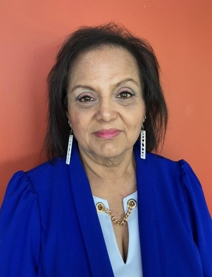
Ginny Guzman-Ramos
W. OR. & W. WA. NTOC
Lead Code Enforcement Officer
The Tulalip Tribes
What is your current role and organization?
I work for the Tulalip Tribes of Washington. My primary role is Code Enforcement Manager, I serve in the capacity as a Board of Director for Port Susan Camping Club, TERO (Tribal Employment Rights Office) Commissioner Chair, and the Director of the Indigenous Environmental Justice Team.
What is your role within the RTOC committee?
I am a rep. on the NTOC (National Tribal Operations Committee for Region 10), I sit on the advisory committee for RTOC.
What motivated you to join the committee?
I was invited to participate in a Town Hall meeting via ZOOM, I was impressed with the sincerity and of this team. Their desire to serve Indian Country and work with EPA sharing the stories of our ancestors and to make a brighter, healthier and safe environment for our people. I knew then that this is a team I want to be a part of.
What are you currently working on or most excited about?
Building a team with Tribe staff and County staff, to agree on an MOU that will adhere to our codes when establishing Environmental, Culturally Sensitive Land, and Protecting our Wetlands.
What impact do you hope the committee will have?
Making changes with other Tribes, Villages and Corporations as a team to hold EPA accountable to uphold the laws and promises as a trustee regarding Indian Country.
What's one accomplishment you're proud of?
Establishing a holistic team “Indigenous Environmental Justice team” that protects our health and safety for generations to come. (7+ years)
What do you do outside of work?
Enjoy my family. Provide Love, Laughter, and Memories that will tell stories for future generations. And above all Sing as if no one can hear me, Dance as if no one can see me, and tease until the tears flow from laughter.
A short quote: “What does being a part of RTOC mean to you?”
Agreeing to a compromise does not mean you have given up your individuality. It simply means you understand the situation.
Ginny Guzman-Ramos
Lead Code Enforcement Officer
The Tulalip Tribes
6406 Marine Drive NW
Tulalip, WA 98271
Phone: 907-822-5541
e-mail: gramos@tulaliptribes-nsn.gov
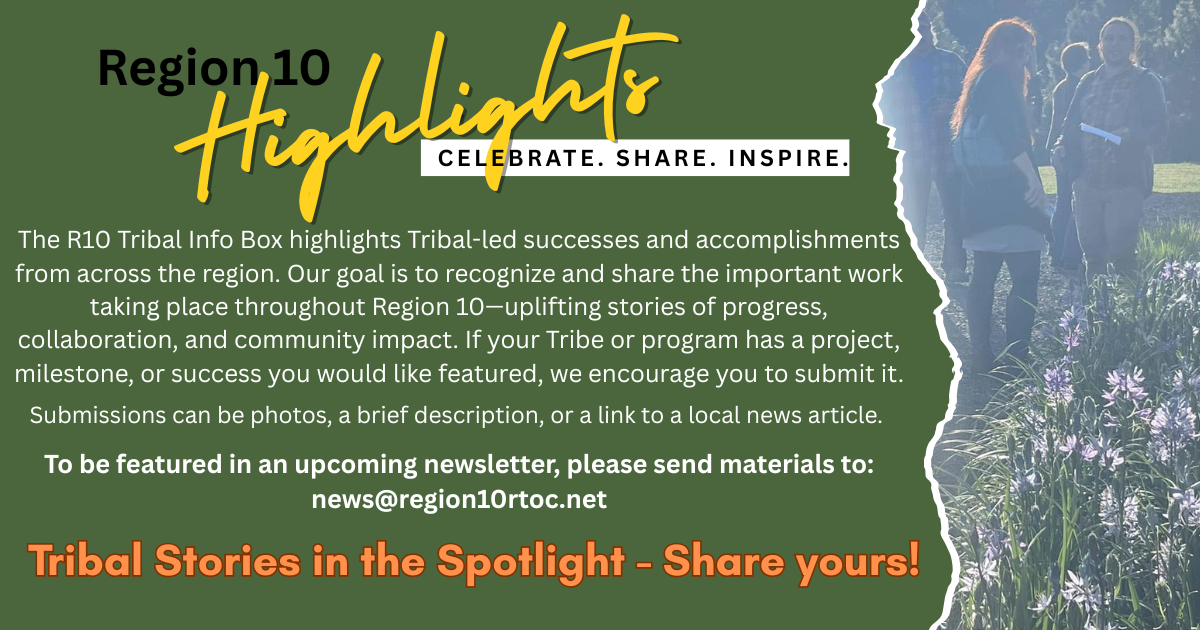
| Your Tribal work could be highlighted here in the R10 Tribal Info Box Newsletter—submit here: news@region10rtoc.net | |
Job Opportunity:
Alaska Tribal Climate Resilience Intern
Open Until Filled
The Native American Fish and Wildlife Society (NAFWS) is recruiting an Alaska Native undergraduate student majoring in physical sciences, biological/ecological sciences, natural resources, Arctic and Northern studies, or a related field to complete an internship.
The intern will receive an hourly rate between $17-$20 for an average of 15 hours of work per week for 10-16 weeks over the spring or summer semester period. The position is based at the Alaska Climate Adaptation and Science Center’s offices in Fairbanks, but remote work is possible depending on the location of the applicant.
| |
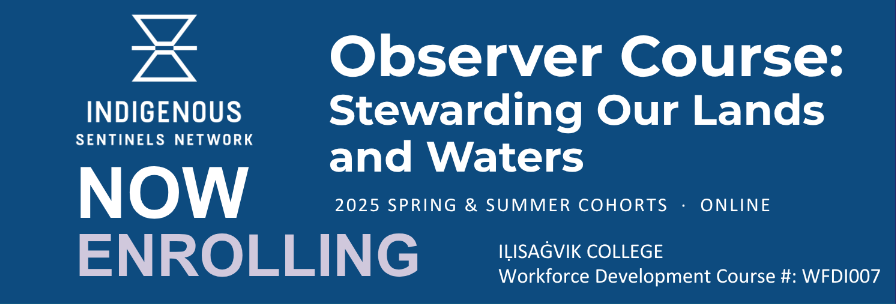
Summer Cohort 2 of the ISN Observer Course: Stewarding our Lands and Waters will take place from June 15 - 28. The online self-paced course includes 24 hours of class work and introduces observers to ISN tools and data management software and their purpose in supporting Tribal data sovereignty and community-driven monitoring.
Find out more by downloading the course flyer or emailing Hannah-Marie Ladd at hladd@aleut.com.
Enroll by emailing Louis Bonner at icbonner@aleut.com.
The BIA has announced that funding is available through the Division of Natural Resources for competitive, one-time project funding for Invasive Species in Fiscal Year 2026 (FY26). Applications must be submitted to the Alaska Regional Office by July 1st. Find out more in the detailed criteria and application process document. Applications can be emailed to rosalie.debenham@bia.gov and joshua.neuffer@bia.gov.
| | Monthly Recurring Meetings | | |
University of Oregon - PNW Tribal Climate Change Network Zoom Meetings
Every Third Wednesday of the Month from 10-11:30 Pacific
| |
Upcoming Conference Calls:
06/17/2026
07/15/2026
08/19/2026
09/16/2026
10/21/2026
11/18/2026
12/16/2026
Meeting Link
Meeting ID: 922 9124 2097
Password: 439196
|
| | |
ITEP's Caring for our Relatives - Office Hour
Every Fourth Wednesday of each Month from 10-11 Pacific
| |
Caring for our Relatives Program
Zoom Meetings
06/24/2026: Program Meeting
07/22/2026: Program Meeting
Meeting Registration
|
| | |
Indoor Air Quality Office Hour
Every Third Thursday of each Month from 11-12 Pacific
| |
ITEP, NTAA, EPA, & Tribes
This office hour is open for all things Indoor Air Quality related.
Staff will be available for questions and a lively discussion
Please join the fun!
Meeting ID: 659 096 3943
Password: AIAQTP
|
| | |
Tribal Brownfields Knowledge Circle
Tribal-only space, open exclusively to staff from Tribes, Native Villages and Tribal consortia to continue the conversations, sharing, and relationship-building that happens during gatherings.
| |
1:00–1:45 p.m. CT | 2:00 p.m. ET | 11:00 a.m. MT | 10:00 a.m. AKT
June 18th: In a Good Way Chat
July 16th: In a Good Way Chat
August: Gathering at TLEF
September 17th: In a Good Way Chat
October 15th: In a Good Way Chat
November 19th: In a Good Way Chat
December 17th: In a Good Way Chat
Learn more and join
|
Tribal Community Resilience Webinar Series
Monthly Topics on how Tribal Nations, Native Villages, & Pueblos are responding to resilience challenges across the U.S.
| |
July 2nd: Fish & Wildlife
August 6th: Emergency Preparedness
September 3rd: Food Security
Learn more and register
|
| | |
Tribal Data Monthly Drop-Ins
Every Thursday of the Month from 10-11:30 Pacific
| |
The Tribal Exchange Network Group (TXG) hosts Monthly Tribal Data Drop-In sessions, informal virtual gatherings where Tribal environmental professionals can connect, share knowledge, and build skills related to environmental data management. These sessions provide a space to ask questions, exchange resources, and learn from peers working in Tribal environmental programs across the country.
Sessions are held the third Thursday of each month from 10:00–11:30 AM Pacific Time and feature Tribal professionals and other experts sharing practical tips and real-world experiences with environmental data systems.
Learn more and register
|
| | Newsletters to Sign Up For | |
| How did you like this email? | | | | | | |