Region 10 Tribal Caucus & EPA | Serving 271 Tribes in the Pacific Northwest | | |
Welcome to the November 09 - November 20 edition of the
Region 10 Tribal Info Box!
This biweekly newsletter connects Tribal leaders, environmental professionals, and partners across Alaska, Idaho, Oregon, and Washington with important RTOC updates, EPA announcements, funding opportunities, Tribal consultations, trainings, and upcoming events.
Looking for more? Our "Quick Links" connect you to regularly updated opportunities, resources, and upcoming events throughout Region 10.
The landing pages are live and are updated regularly.
| | Click the links below to see what's currently happening, explore the latest updates from our partners, and discover upcoming events, opportunities, and resources to keep on your radar. | | |
In This Issue:
Explore the latest Region 10 RTOC election updates, upcoming Tribal-EPA meetings, and federal environmental announcements. Discover funding opportunities supporting Tribal climate resilience, energy development, and environmental programs, along with important public comment deadlines, trainings, and workshops. This edition also highlights Tribal environmental achievements, regional funding awards, and resources to keep Tribal communities informed and connected.
| |
Important Dates at a Glance
NOVEMBER 2026
Nov. 10 – Combatting Lead Workshop Hotel Reservation Deadline
Nov. 12 & 16 – EPA Discussions on Drones & Pesticide Applications
Nov. 18 – EPA Water Quality Standards Academy Accommodation Request Deadline
Nov. 20 – NIHB Climate Ready Tribes Grant Application Deadline
Nov. 23 – EPA Glyphosate Public Comment Deadline
Nov. 24 – EPA Virtual Water Quality Standards Academy Registration Deadline
Nov. 27 – Alaska NTOC Position 1 Nomination Deadline
Nov. 30 – Oregon DEQ CERTA Food Waste Grant Application Deadline
DECEMBER 2026
Dec. 1–2 – EPA Region 10 United RTOC Meetings
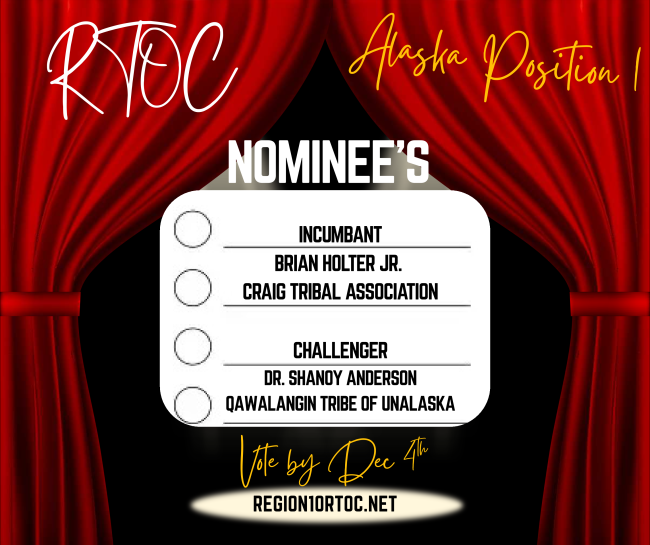
Dec. 4 – Alaska RTOC Position 1 Voting Deadline
Dec. 4 – DOE Tribal Energy Capacity Expansion Prize Submission Deadline
Dec. 7–11 & 14 – EPA Virtual Water Quality Standards Academy
Dec. 9–10 – Combatting Lead in Tribal Communities Workshop
Dec. 23 – Alaska NTOC Position 1 Voting Deadline
JANUARY 2027
Jan. 10 – ALPAR Awards Nomination Deadline
| | Urgent notices, program deadlines, regulatory updates, funding opportunities, environmental concerns and other time sensitive information to help Tribal programs stay prepared and connected. | |
EPA Public Discussions: Drones & Pesticide Applications
The U.S. Environmental Protection Agency's (EPA) Office of Pesticide Programs (OPP) is hosting public discussions with EPA regions, states, Tribes, and territories to discuss how EPA is currently addressing the use of drones for pesticide applications.
Representatives from EPA's Environmental Fate and Effects Division and Registration Division will engage with attendees during these virtual sessions.
Upcoming Sessions:
- November 12, 2026 | 12:00–12:30 PM Alaska / 1:00–1:30 PM Pacific
Join the November 12 Discussion
- November 16, 2026 | 12:00–12:30 PM Alaska / 1:00–1:30 PM Pacific
Join the November 16 Discussion
Participation: Open to interested Tribal representatives and other stakeholders.
| |
USDA Announces $472.5 Million in Food Purchases to Support Producers & Nutrition Programs
USDA Announcement | October 29, 2026
The U.S. Department of Agriculture (USDA) announced plans to purchase up to $472.5 million in domestically produced agricultural commodities to support American farmers, ranchers, and fishing industries while strengthening food assistance programs nationwide.
Through USDA's Agricultural Marketing Service (AMS), these purchases will help stabilize agricultural markets and supply food to charitable food networks and federal nutrition assistance programs.
Planned purchases include dairy products, poultry, pork, rice, lentils, chickpeas, hazelnuts, and seafood, among other commodities.
Pacific Northwest Connection
The announcement identifies Pacific Northwest pulse growers and the West Coast Pacific whiting fishing industry among the agricultural sectors expected to benefit. Planned purchases include:
- $29 million in lentils
- $37 million in split peas
- $22 million in hazelnuts
- $12 million in Pacific whiting
These investments may support regional agricultural and seafood supply chains while contributing to food assistance programs serving communities nationwide.
Learn More: USDA Agricultural Marketing Service
|
USDA Announces More Than $77 Million in Additional School Nutrition Funding, Including Region 10 Awards
USDA Announcement | October 30, 2026
The U.S. Department of Agriculture (USDA) announced more than $77 million in additional funding to strengthen school nutrition programs, support local agricultural producers, and improve school meal infrastructure nationwide.
The investments include more than $27 million in additional Patrick Leahy Farm to School Grants and $50 million in National School Lunch Program Equipment Assistance Grants. Total 2026 Farm to School funding now exceeds $47 million across 149 projects nationwide.
Region 10 Funding Highlights:
Several organizations across Alaska, Oregon, and Washington are among the latest Farm to School grant recipients, including:
- Alaska Food Policy Council (AK): $229,993
- Anchorage Soil and Water Conservation District (AK): $111,801
- Oregon Farm to School Network (OR): $478,454
- Living Well Kent Collaborative (WA): $499,376
- Federal Way School District #210 (WA): $401,451
Earlier 2026 awards also supported two Alaska projects with particular relevance to rural and Tribal communities:
-
Aleutian Pribilof Islands Association, Inc. — $158,289: Supporting access to Alaska-grown meats, dairy products, and produce for child nutrition programs in the Aleutian and Pribilof Islands.
-
Yupiit School District — $219,107: Addressing fresh produce access and food security challenges in remote Alaska communities.
These investments highlight opportunities to strengthen local food systems, expand agricultural education, and support food security efforts throughout Region 10.
Learn More:
| | Highlighting the work, initiatives, advocacy, accomplishments, and ongoing efforts of the Region 10 Tribal Operations Committee (RTOC) throughout Alaska, Idaho, Oregon, and Washington. Showcasing our commitment to strengthening Tribal-EPA partnerships, advancing Tribal environmental priorities, amplifying Tribal voices, and keeping our communities informed and engaged. | | |
It's STILL Election Season!
We encourage Tribal leaders and staff to consider serving or nominating an eligible representative who is passionate about protecting Tribal lands, waters, natural resources, and environmental priorities.
The Alaska NTOC Seat 1 is up for Re-Election.
This will be a 2-year term, as it's in the middle of an existing one.
Dear Tribal Leaders Letter | Nomination Form
Get your nominations in by NOVEMBER 27th!
Your Voice. Your Tribe. Your Region.
The Alaska RTOC Position 1 Election Ballots are out!
Cast your vote and send it in!
Voting Closes on DECEMBER 4th!
Submit by emailing your selection to ashley@region10rtoc.net.
Check out the RTOC & NTOC Elections Page for more information.
| |
SAVE THE DATE | DECEMBER 1-2, 2026
EPA Region 10's Bi-Annual
United RTOC Meeting
The Region 10 Tribal Operations Committee Consortium & EPA invite Tribal Representatives, Environmental Professionals, Partners, Tribal Staff, & Interested Members of the Public to attend the upcoming
United RTOC Meetings:
Date: Tuesday, December 1, 2026
Time: 8:00 AM Alaska | 9:00 AM Pacific | 10:00 AM Mountain
Location: Zoom | Register in Advance
Date: Wednesday, December 2, 2026
Time: 8:00 AM Alaska | 9:00 AM Pacific | 10:00 AM Mountain
Location: Zoom | Register in Advance
These meetings are open to all interested participants to provide an opportunity to observe discussions & engagement between Tribal representatives & EPA Region 10.
After registering, participants will receive a confirmation email containing information about joining the meeting.
To ensure productive discussions & allow the committee to complete its scheduled business, attendees are asked to observe the following guidelines:
- Registration is required to receive Zoom meeting access information.
- Follow the meeting agenda. Discussions will proceed according to the scheduled agenda to ensure all topics receive appropriate attention.
- Use the Zoom chat. Attendees may submit questions or comments in the chat throughout the meeting. These may be brought forward by meeting facilitators at an appropriate time, as the agenda allows.
The meeting agenda is currently being developed & will be shared once finalized.
We look forward to welcoming participants from across EPA Region 10 & continuing meaningful dialogue and collaboration.
Please share this invitation with Tribal leaders, staff, & others throughout Region 10 who may be interested in participating.
| |
New EPA Public Comment Opportunity: Proposed Air Quality Rule: National Ambient Air Quality Standards (NAAQS) & PM2.5
Public Comment Deadline: November 5, 2026
Docket ID: EPA-HQ-OAR-2024-0078
The U.S. Environmental Protection Agency (EPA) has announced an opportunity for Tribal governments, environmental professionals, and the public to provide input on proposed area designations under the 2024 revised National Ambient Air Quality Standards (NAAQS) for fine particulate matter (PM2.5).
EPA has notified 67 Tribes, along with all 50 states, the District of Columbia, and five territories, of its intended approach to determining whether areas meet federal air quality standards.
These designations are important for Tribal communities because they can influence air quality planning, pollution control requirements, and environmental protection efforts. Wildfire smoke, monitoring data, and local air quality conditions may also be relevant considerations.
Tribal governments and environmental departments are encouraged to review EPA's proposed designations, including information specific to their geographic areas, and consider submitting comments or additional technical information.
Review EPA's Proposed Designations | Submit Public Comments
| |
EPA Continues Scientific Review of Glyphosate
Public Comment Deadline: November 23, 2026
The U.S. Environmental Protection Agency (EPA) is continuing its scientific review of glyphosate, a widely used herbicide found in products such as Roundup.
EPA is reassessing available scientific evidence concerning potential human health effects, ecological risks, and protections for endangered species. As part of this process, EPA opened an opportunity for public feedback to identify additional peer-reviewed scientific studies for consideration in its updated human health assessment.
Tribal environmental professionals and pesticide program staff may be interested in following this review and its potential implications for pesticide management and environmental protection.
EPA Glyphosate Information | Read EPA's Announcement | View Docket & Submit Comments
Comments may be submitted through Regulations.gov under Docket ID EPA-HQ-OPP-2009-0361.
|
EPA Announces Plans to End 2005 Agricultural Air Compliance Agreement
EPA Announcement | October 30, 2026
The U.S. Environmental Protection Agency (EPA) announced it will discontinue development of air emissions estimation methodologies under the 2005 Animal Feeding Operations Air Compliance Agreement.
The agreement was established to study air emissions from livestock and poultry operations and develop methods for estimating emissions of pollutants such as ammonia, hydrogen sulfide, particulate matter, and volatile organic compounds.
Following a review of data collected through the National Air Emissions Monitoring Study (NAEMS), EPA determined that the information was too outdated and limited to support reliable emissions estimation methods reflecting current agricultural practices and technologies.
EPA plans to notify approximately 2,600 participating animal feeding operations, representing nearly 14,000 farms, and work toward terminating obligations under the agreement.
The announcement does not change existing Clean Air Act requirements. EPA indicated it will continue collaborating with agricultural producers, universities, and federal partners on approaches to understanding and reducing agricultural air emissions.
Learn More: EPA National Air Emissions Monitoring Study
| | Highlighting funding opportunities, grants, training programs, technical assistance, and resources available to Tribes and Tribal environmental professionals throughout Alaska, Idaho, Oregon, and Washington. Connecting Tribal communities with valuable opportunities to strengthen environmental programs, build capacity, support conservation efforts, and advance Tribal priorities across Region 10. | |
Employment Opportunity:
Environmental Program Air Quality Coordinator
Kootenai Tribe of Idaho | Bonners Ferry, ID
The Kootenai Tribe of Idaho is seeking a full-time Environmental Program Air Quality Coordinator to support the Tribe's air quality monitoring, environmental programs, grant management, and regulatory compliance efforts.
The position works under the direction of Tribal Council to help protect the environmental health of the Kootenai Indian Reservation, aboriginal territory, and surrounding community.
Position Details:
- Location: Bonners Ferry, Idaho
- Compensation: $35–$45/hour, depending on experience
- Benefits: Available after successful completion of a three-month probationary period
Interested in applying?
Applications are available at the Kootenai Tribal Headquarters, 100 Circle Drive, Bonners Ferry, ID 83805, or by emailing cralph@kootenai.org.
Qualified Indian applicants receive preference in accordance with the Kootenai Law and Order Code.
|
Climate Ready Tribes Grant — 2026–2027
Application Deadline: November 20, 2026, at 11:59 PM AK
Four awards anticipated
Agency: National Indian Health Board (NIHB), with support from the Centers for Disease Control and Prevention (CDC)
Funding Available: Up to $20,000 per award
Eligible Applicants: Tribes, Tribal health departments, and Tribal health care facilities with capacity and leadership roles in emergency preparedness, health surveillance, and public health outreach, subject to application requirements.
The Climate Ready Tribes Initiative supports Tribal communities in developing and implementing climate-informed health and environmental strategies that strengthen preparedness and resilience.
Projects may include climate and health action plans, integration of climate considerations into Tribal health and environmental services, and training staff to use climate and health monitoring tools such as CDC's Heat & Health Tracker, the NWS/CDC HeatRisk tool, and air quality monitors.
Tribal Relevance: This opportunity can help Tribal governments and health programs strengthen their capacity to address climate-related health threats, improve environmental health monitoring, and develop community-driven adaptation strategies that reflect Tribal priorities.
Important: The anticipated project period is December 1, 2026, through July 23, 2027. Applicants should review the full Request for Applications for eligibility, allowable activities, and submission requirements.
Questions: environmentalhealth@nihb.org | Download the Application
|
Oregon DEQ: CERTA Food Waste Processing Infrastructure Grants
The Oregon Department of Environmental Quality (DEQ) is accepting applications for its CERTA Food Waste Processing Infrastructure Grant Program, supporting projects that expand food waste processing, composting, and community food scrap collection throughout Oregon.
Funding Opportunities:
- Large-Scale Projects: Up to $2 million per award for eligible food waste processing infrastructure.
- Small-Scale Projects: $50,000–$249,999 for community composting, food waste collection, and local food production initiatives.
Tribal governments are eligible for the small-scale funding opportunity, and eligible Tribal composting facilities may qualify for large-scale funding.
Applications must be submitted through Oregon DEQ's WebGrants system.
View Grant Details & Eligibility Requirements | Apply Through WebGrants
Deadline: November 30, 2026, 5:00 PM PT.
|
Tribal Energy Capacity Expansion Prize — $6 Million Funding Opportunity
Application Deadline: December 4, 2026 (Phase 1 Submissions)
Agency: U.S. Department of Energy (DOE)
Funding Available: $6 million across a three-phase prize competition.
Eligible Applicants: Federally recognized Tribal entities and eligible multi-Tribe collaborative teams, including qualifying Alaska Native villages and regional and village corporations, subject to official competition rules.
The Tribal Energy Capacity Expansion Prize supports Tribal Nations in strengthening their capacity to participate in energy-related decision-making, planning, and project development.
The competition focuses on expanding Tribal expertise and organizational capabilities in areas such as energy permitting, workforce development, environmental compliance, and other activities that support Tribal energy priorities.
Tribal Relevance: Tribal governments, Tribal consortia, and eligible Alaska Native entities may benefit from opportunities to strengthen energy program capacity, build technical expertise, and increase Tribal participation in energy development and regulatory processes.
Important: This is a three-phase prize competition rather than a traditional grant program. Applicants should review the official competition rules, Phase 1 submission requirements, and award structure before applying.
View Prize Details & Apply
|
EPA Virtual Water Quality Standard (WQS) Academy - December 2026
Dates: December 7–11 & 14, 2026
Time: 8:30 AM–1:30 PM Pacific | 7:30 AM–12:30 PM Alaska
Format: Virtual | Six-Day Training
Host: U.S. Environmental Protection Agency (EPA)
Cost: Free
The EPA is offering its Virtual Water Quality Standards (WQS) Academy, a structured and interactive training designed for federal, state, Tribal, and local agency professionals, as well as private-sector participants involved in water quality management.
The Academy provides current information and practical guidance on developing and implementing water quality standards programs consistent with the Clean Water Act. Participants will explore the regulatory framework and approaches used to establish and protect designated water uses and water quality objectives.
Registration Deadline: November 24, 2026, or earlier if capacity is reached.
Special Accommodations Deadline: November 18, 2026
Registration: Free and open to the public.
Register for the Virtual WQS Academy
For registration assistance or accommodation requests, contact Rachel Buzzeo at rachel.buzzeo@tetratech.com or 703-385-1474.
| |
SAVE THE DATE!
EPA's Combatting Lead (Pb) in Tribal Communities: Exposure Pathways and Solutions
December 9, 2026 - December 10, 2026
Location: Indian Pueblo Cultural Center | Albuquerque, NM
Registration: FREE
The National Tribal Toxics Council, Zender Environmental Health, and the U.S. Environmental Protection Agency (EPA) are collaborating on a two-day workshop focused on lead (Pb) exposure in Tribal communities, its potential health effects, and practical strategies for prevention and remediation.
The workshop will explore unique Tribal exposure pathways, federal lead regulations, Tribal Treatment as a State (TAS) programs, lead remediation, and risk communication. Participants will also have opportunities to learn from Tribal case studies and lead testing demonstrations.
Hotel Information: Towneplace by Marriott Albuquerque Old Town, Holiday Inn and Suites Albuquerque Old Town.
Reservations must be made by November 10, 2026, to receive the conference rate.
Registration is free! Tribal environmental professionals and community partners interested in addressing lead exposure are encouraged to attend.
Combatting Lead (Pb) in Tribal Communities: Exposure Pathways & Solutions Workshop | National Tribal Toxics Council (NTTC), Zender Environmental, & EPA
|
ALPAR Awards — 2027 Nominations Now Open!
Nomination Deadline: January 10, 2027
Organization: Alaskans for Litter Prevention and Recycling (ALPAR)
Awards: Four $500 grants available through the Community Awards.
ALPAR is accepting nominations to recognize individuals, businesses, nonprofits, and Tribal entities making a difference through recycling, litter prevention, environmental education, and community service across Alaska.
Community Award Categories:
- Outstanding Education or Outreach
- New or Enhanced Recycling Program
- Litter Prevention Program
- Volunteerism or Service
Each of the four Community Award winners will receive a $500 grant for the nonprofit associated with their efforts.
ALPAR also recognizes businesses and leaders through its Board of Directors Awards for Outstanding Leadership and ALPAR Supporter of the Year.
Tribal Relevance: Tribal environmental programs, community organizations, and individuals involved in recycling, waste reduction, litter prevention, and environmental outreach are encouraged to nominate deserving community members and programs.
Questions: director@alparalaska.com | Submit an ALPAR Award Nomination
| | Highlighting programs, projects, events and successes from Tribes and partners throughout Washington, Oregon, Idaho & Alaska providing an opportunity to share knowledge, celebrate progress, and learn from one another. |
Region 10 RTOC Policy Corner:
Advocating for Tribal Voices & Environmental Protections
The Region 10 Tribal Operations Committee (RTOC) continues to advocate for Tribal interests through formal comments on federal environmental policies and initiatives.
With the support of RTOC Policy Advisor Rick Eichstaedt, the Tribal Caucus has recently provided comments addressing two important issues affecting Tribal governments and environmental programs.
| |
Region 10 RTOC's Continuing Our Commitment
These efforts reflect RTOC's ongoing commitment to ensuring that Tribal perspectives are represented in federal environmental policy discussions.
We appreciate the work of our Policy Advisor, Rick Eichstaedt, and the leadership of the Tribal Caucus in advancing these important issues.
The complete letters are attached to this newsletter for Tribal representatives, environmental professionals, and interested readers to review.
Past comments can be found on our website under "Tools for Tribes".
|
Nine Region 10 Tribal Entities Receive $11.5 Million in EPA Recycling Grants
Nine Tribal entities across Alaska, Idaho, and Washington were selected to receive a combined $11,563,595 through EPA's Solid Waste Infrastructure for Recycling (SWIFR) Grant Program.
The funding supports improvements to Tribal waste management systems, including household hazardous waste collection, composting infrastructure, recycling operations, workforce development, and technical assistance.
Award recipients include:
- Alaska: Kenaitze Indian Tribe, Kodiak Area Native Association, Kokhanok Village, Native Village of Nightmute, Newtok Village, and Tyonek Native Corporation.
- Idaho: Nez Perce Tribe.
- Washington: Makah Indian Tribe and Tribal Solid Waste Advisory Network.
These projects demonstrate continued Tribal leadership in strengthening environmental infrastructure, protecting natural resources, and developing sustainable waste management systems across Region 10.
Learn More: EPA Region 10 SWIFR Grant Awards
|
Region 10 Tribal Health Organization Receive Federal Epidemiology Funding
The Indian Health Service (IHS) announced $166.65 million over five years to strengthen Tribal Epidemiology Centers nationwide, supporting public health research, disease surveillance, prevention, and improved health data systems.
Three organizations serving Region 10 communities are among the recipients, with the following annual funding amounts:
- Alaska Native Tribal Health Consortium (AK): $3.1 million
- Northwest Portland Area Indian Health Board (OR): $3.5 million
- Seattle Indian Health Board (WA): $3.95 million
These investments support Tribal and urban Indian public health capacity, helping communities collect and analyze health information, identify emerging concerns, and develop community-informed public health strategies.
Learn More: IHS October 2026 Tribal Updates
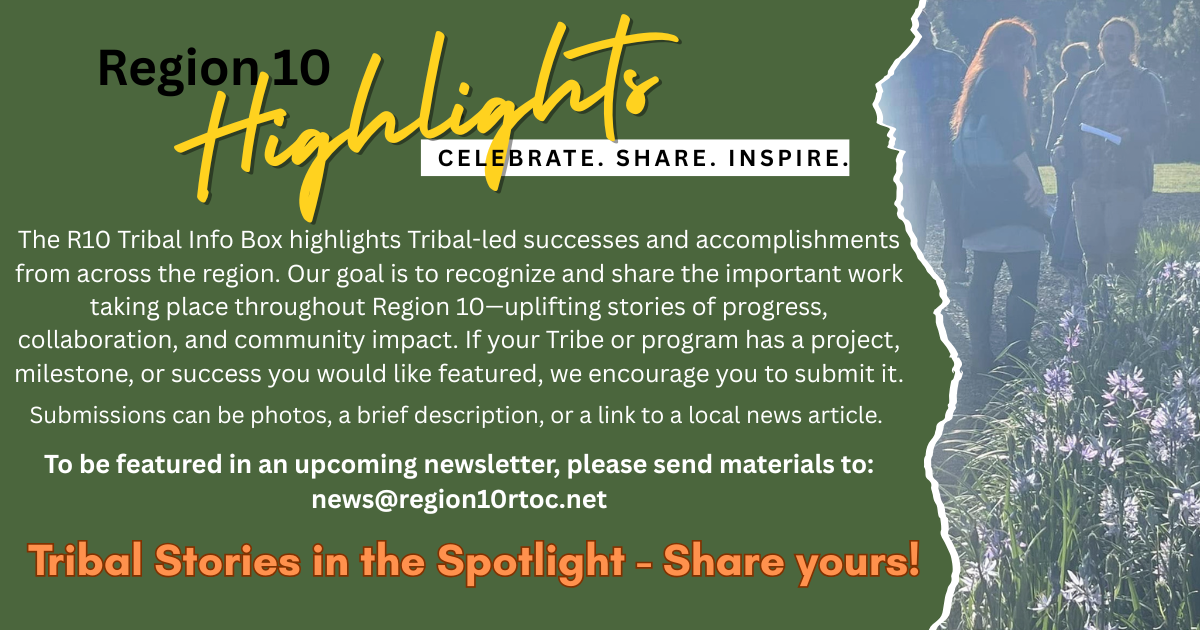
| | Your Tribal work could be highlighted here in the R10 Tribal Info Box Newsletter—submit here: news@region10rtoc.net | | |
Partner Newsletters
& Listservs
| Stay Informed. Stay Connected. Discover More. | | |
Looking for the latest Tribal environmental news, funding opportunities, training announcements, policy updates, and technical assistance resources?
Explore newsletters, email updates, and listservs from Tribal organizations, federal agencies, and environmental partners serving Region 10 and beyond. Subscribe to the topics that matter most to your Tribe or program and receive valuable information directly in your inbox.
| |
Tribal Pesticide Program Council (TPPC) - Fall 2026 Newsletter
The Fall 2026 edition of the Tribal Pesticide Program Council (TPPC) Newsletter features an in-depth examination of glyphosate, including its regulatory history, scientific research, potential health and ecological concerns, and ongoing EPA reviews.
Additional highlights include TPPC Executive Committee vacancies, upcoming pesticide-related meetings and training opportunities, and information about Tribal representation in national pesticide policy discussions.
View the newsletter: TTPC Newsletter Q3 2026
Visit: Tribal Pesticide Program Council
| |
Tribal Leadership & Regional Collaboration
News, policy updates, Tribal advocacy, and regional partnership opportunities.
| |
Environmental Training & Technical Assistance
Upcoming webinars, workshops, office hours, technical resources, and peer-learning opportunities.
| |
Climate, Energy & Natural Resources
Climate resilience, clean energy, fisheries, habitat restoration, and environmental research.
| |
Funding, Grants & Federal Updates
Grant announcements, federal program updates, funding deadlines, and opportunities for Tribal environmental programs.
| Choose the updates that matter to you and stay connected between editions of the R10 Tribal Info Box! | | A Little Fun Between the Updates! | | |
Take a few minutes to recharge, challenge your mind,
and enjoy a well-deserved break!
Explore seasonal word searches, crossword puzzles, and other activities that can be enjoyed individually or shared with coworkers, Tribal youth programs, community events, and environmental education activities.
| |
| How did you like this email? | | | | | | |