|
Dear Friends,
It is our pleasure to share with you the latest edition of the RA&A Lab briefing. This edition covers the upcoming launch of the James Webb Telescope, what we know - and don't know- about the mental health impact of technology, and what it takes to solve the water crisis.
Designed as the content incubator for RA&A, the Lab’s mission is to track the trends shaping the global economy and to identify the key levers of action that can help you drive impact on the issues that matter most. We hope you enjoy these insights on some of today's most important topics.
Kindest regards,
| |
|
Richard Attias
Executive Chairman
Richard Attias & Associates
| |
|
Elie Chachoua
Director
RA&A Lab
| |
|
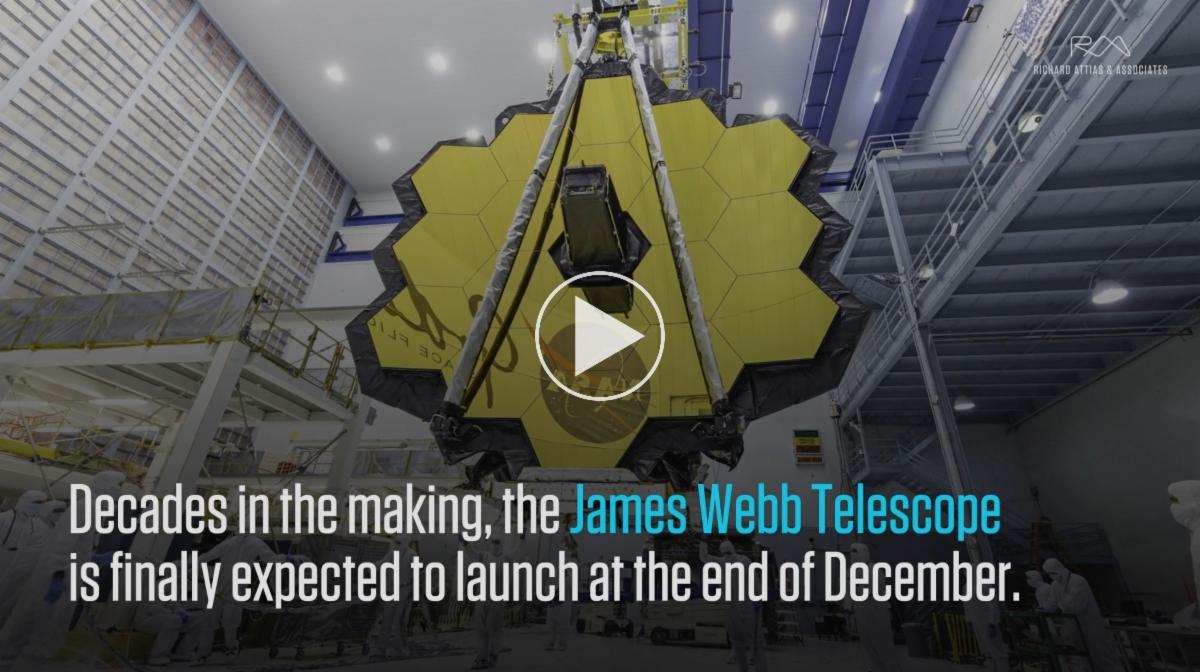
Good things come to those who wait, the saying goes. For scientists, the wait might soon be over. Decades in the making, the James Webb Telescope – the largest telescope ever built – is finally expected to launch.
The telescope is a massive undertaking and marks a step change in how we will explore the universe. Take its primary mirror, for example. At 6.5 meters, its diameter is more than twice that of Hubble’s, making its collection area more than 6 time bigger.
Importantly, the Webb telescope is specifically designed to scan the infrareds. This is critical in observing very distant objects, and thus in probing the beginnings of our universe. The Webb telescope could notably be able to see as early as 300 million years after the Big Bang – the time at which the first galaxies were formed. By comparison, telescopes like Hubble or the Chandra Deep Field can see up to around 1 billion years after the Big Bang.
Webb’s infrared spectral range also makes it particularly apt at scanning the atmospheres of exoplanets. Among those to be studied are the seven earth size planets orbiting the star Trappist-1, a red dwarf 40 light years away and whose solar system seems to be relatively free from asteroids’ impacts.
Performing such feats in space requires the telescope to operate in a very cold (and thus very dark) environment. This is necessary to avoid infrared pollution from heat sources and will be achieved by equipping the telescope with a very large sunshield (about the size of a tennis court) and sending the telescope more than 1.5 million km away from Earth where it can stay in earth’s shadow.
With such a powerful eye into the universe’s early days and a limited lifetime (between 5 to 10 years), competition to secure observation time will be fierce. Scientists who helped create the telescope will get guaranteed observation time (about 16% over the first three years), but the majority of the observation time will be open to general applications. Out of nearly 1,200 applications received, 266 general observation proposals were selected for the first year of operation. One-third of those projects will be led by women.
First, of course, the telescope has to launch and become fully operational. Getting to that stage will be no easy feat. Sending the largest telescope ever built so far away creates two important engineering challenges. The first is how to fold it so it can fit into a rocket. The second is to plan and test every step of the unfolding as carefully as possible since the observatory cannot be repaired once it launches. It also means that any perturbation to the satellite before launch, no matter how small, requires an entire battery of tests to ensure that the configuration the satellite launches in is the one that was intended. This is what happened last week when an unplanned release of a clamp band sent vibrations throughout the telescope and delaying the launch.
The new launch date is now planned for Dec 22nd. An early holidays present that will unfold over a month – the time it will take for the telescope to unwrap and reach its orbit.
| |
WELL BEING IN THE DIGITAL AGE | |
|
The release last month of internal documents detailing Instagram’s effect on the mental health of young teenage girls has brought the issue of digital wellbeing back to the forefront.
The concern is not new – researchers have been calling on tech companies to share data on the topic for years – but it is pressing. Mobile broadband penetration is now over 100% in the OECD, and the average time teens spend online is generally trending upwards. Between 2012 and 2015, for instance, the weekly average time spent on internet by 15-year-olds increased nearly 40% to reach 29 hours. By 2018, the figure had reached 35h - an average of 5h per day, 3.8h of which were spent outside of school. Meanwhile, an OECD survey suggests that adolescents using internet for 6+ hours/day are most likely to experience lower wellbeing.
Generally, researchers believe there are two main avenues through which technology impacts wellbeing. The first is around engagement — what do we use tech for, how often do we use it, and how does that usage substitute for healthy behaviors and activities, such as reading or going outside. The other concerns how technology is designed. Social media and the algorithms that underlie them, for example, are often accused of optimizing for our attention instead of for our wellbeing, which impacts our technology engagement.
The combination of those factors has led many to worry about possible negative effects, from mental health to internet addiction, as well declines in attention span and increases in political polarization. There are, of course, positive effects too. Action video games, for instance, have been shown to enhance attentional abilities and may also help improve an individual’s working memory. Therapists also use online gaming to treat mental health issues like depression or anxiety in teens and children.
The real question, therefore, is about the scale of the compound effect. At the moment, however, there is no conclusive evidence on this front. This is in part because assessing a causal link between technology (over)use and wellbeing presents a difficult technical problem – many of the studies produced so far measure correlation not causation, for example. It’s also in large part because most of the relevant data needed to study the possible causation resides in the private sector, which may not have the right incentives to rigorously study these impacts on their own. Researchers and legislators have called to release this data to independent third-party researchers but companies have not always been forthcoming with the information.
Stronger intervention might thus be necessary to secure the data needed for evidence-based policy-making. One way to do so could be to create secure, privacy-preserving ways for researchers to access companies’ data. Promoting corporate accountability and transparency will also be important. This could be done by requiring tech companies to disclose of the mental health externalities created by their products or activities or, at a minimum, an articulation of the steps that companies are taking to ensure that their products do no mental health harm.
In the meantime, policymakers are left to regulate in with limited evidence at hand. China, as part of a wave of tech regulation, has chosen the quantity-based approach, banning videogames on weekdays for under-18s (and limiting play to one hour daily on weekends). Some, like the proposed SAFE DATA Act in the U.S., focus on prohibiting companies from creating user interfaces that compel compulsive usage in users under 13.
Tech companies— some more publicly than others — have acknowledged digital wellbeing as something that needs to be actively cultivated. Google, for example, has toolkits, partnerships and research streams dedicated to the topic. But stewarding technology towards the common good is about making sure we design and develop systems that empower us to make healthy choices. This cannot be left to companies alone.
| |
|
As they meet to discuss the state of water, leaders at the World Water Congress face a stark reality: our current water regime is dangerously unsustainable. Today, an estimated 4 billion people suffer from seasonal water scarcity, while one-fourth of the global population lives in high water stress countries where more than 80% of the available supply is withdrawn every year. Under current trends, global demand is expected to outstrip supply by 40% by 2030.
Needless to say, allowing this to happen would have dramatic economic and human consequences. On the economic front, sectors ranging from agriculture to utilities, IT or real estate could be severely affected. This wide ranging exposure, which will permeate through many supply chains, could put up to 45% of economic growth at risk by 2050. On the human front, failure to address the impending water crisis would be the deathblow to SDG 6, which aims to ensure access to water and sanitation for all. It would also lead to important security issues, with water-related conflicts already on the rise and up to 700 million people to be displaced by water scarcity by 2030.
Agriculture will be instrumental in solving these challenges, as the sector accounts for 69% of global water use. Improving water management in rainfed lands and promoting water efficiency and re-use in irrigation will be particularly important. Annual investments in irrigation infrastructure, in fact, are expected to reach $213bn by 2050 (nearly double the 2020 levels).
Reducing food waste and changing diets will be two other key levers: the first is responsible for the squandering of 24% of freshwater resources used for crop production, while the second could help cut water use in food by 20%. Both would help water-scarce countries with net water trade deficit recoup some of the water lost in their food exports.
With demand expected to outstrip supply, wastewater management will also be critical. We currently dump nearly half of the world’s wastewater into the environment without adequate treatment. Wastewater reclamation and reuse thus represents an effective solution to reduce water stress. The idea has received growing support amongst urban residents. Few governments or corporations report on this aspect, however. According to a recent CDP report for instance, only 4.4% of companies set and report progress against water pollution reduction targets — compared to the 64% of companies that have reduced their water usage.
Estimates of how much it would cost to tackle the water crisis vary widely — from $7trn by 2030 to $22.6trn by 2050. What is clear is that the financial impact from water risks far outweighs the cost of addressing them - an average ratio of 5:1 at the corporate level, for example, though there are variations across industry and regions. In emerging markets and developing countries, investing in water infrastructure also creates more jobs per dollar spent than any other infrastructure sector.
Private sector participation in water infrastructure remains low, however. Investment in water infrastructure public-private partnerships (PPPs), for example, represents just 6% of total PPP investment despite water infrastructure PPPs making up more than 15% of all PPP projects over the last 30 years, according to World Bank data. Part of the challenge lies in how water is priced, and whether that price properly reflects the value water provides. In many instances, it is not. As of 2019, for instance, only 14% of the utilities tracked by the IBNET database generated enough revenues to recoup total economic costs of service while just 35% were able to cover operation and maintenance costs.
Financial innovation can help. Performance-based contracts, which tie remuneration to results, could be an effective way to attract private financing in water efficiency projects. Results can be substantial: using a contract of this kind, Ho Chi Min City was able to cut water leakages in half.
But perhaps the most promising play lies in the role that nature-based solutions and sustainable finance can play in monetizing the co-benefits between climate and water. Because preserving forests can help preserve the quality of a watershed, for instance, and because preserving forests store carbon, it is now possible to raise capital for water projects by repaying it through a combination of carbon offsets, avoided treatment costs, and watershed protection fees. This is precisely what the US local water utility Central Arkansas Water did last year when it issued the first certified green bond to protect forests and support clean drinking water. And there is room for growth: in 2020, only 10% of the money raised from climate-aligned bonds focused on water.
The good news is that we don’t need technological marvels or a extraterrestrial water sources to achieve SDG 6. The water problem is fundamentally a task of stewardship, equitable distribution and innovation. We have the technology and techniques available. The challenge is in leveraging capital and political will to the task.
| |
|
The past three days have seen no less than four historic acknowledgements of women leadership. In France, Josefine Baker became the first black woman to be inducted into the Panthéon, France’s mausoleum dedicated to its national heroes. An entertainer, french resistance agent and civil rights activist, Josephine Baker was an icon of the Jazz age.
In Barbados, president-elect Dame Sandra Mason oversaw the official emergence of her country as an independent republic. She was joined by fellow Barbadian women leaders Prime Minister Mia Amor Mottley and singer Rihanna , who was named national hero during the ceremony.
Honduras and Sweden, meanwhile, elected their first female head of state. Xiomara Castro, a previous first lady and a long-time political activist, was elected president after the ruling party conceded defeat in the face of her 20% lead in the polls. Ms. Castro ran on anti-corruption and equality campaign in a country that ranks 157th (out of 180) in Transparency International’s Corruption Perceptions Index. As for Magdalena Andersson, Sweden’s first female prime minister, political bartering over the budgeled to her being elected not once but twice in a span of a week.
The above examples add momentum to a record year in terms of women leaders in heads of state and ministerial positions. And indeed, the share of female participation in politics has been steadily increasing since 2010. At 26%, that share shows there is still a long way to go, but to see these leaders get their rightful place in the global limelight is a sign we are on the right track.
| |
|
Here are some of the things on the Lab's radar over the next few weeks:
-
Nov 30 - Dec 3: 12th WTO Ministerial conference
-
Dec 7-10: COP 22 of the Barcelona Convention for the Protection of the Marine Environment and the Coastal Region of the Mediterranean
-
Dec 16: Governing Council meeting of the European Central Bank on monetary policy
-
Dec 22: Launch of the James Webb Telescope
-
Jan 1: Start of a new year!
| |
Follow us on social media | | | | |