|
RBG Wealth Weekly
April 14, 2023
| | |
|
Ladies and gentlemen, the weekend! In this space each week, Greg and I share some of our favorite articles, notes, and graphics from the past week along with our commentary. Please feel free to provide feedback and forward along to others if you enjoy. We appreciate you taking the time to read.
If you are a client, we truly appreciate your business. If you are not a client, please click below to learn more about our firm and contact us.
| | |
Money Insights That Matter: SECURE Act 2.0
When you download our SECURE Act 2.0 webinar, you'll learn more about its impact and sweeping effect on retirement savers.
| | |
|
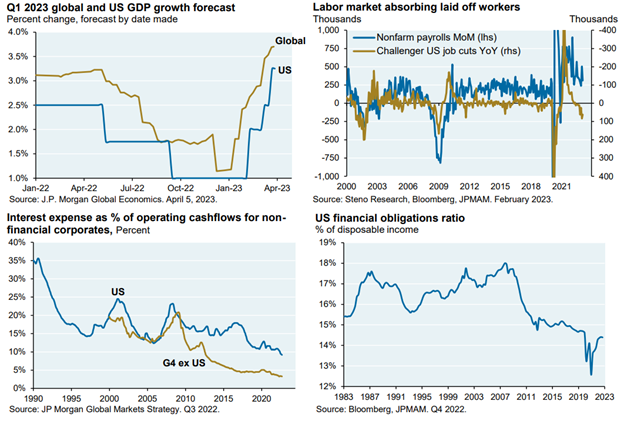
“First, a brief market and economic update. Contemporaneous US data look good:
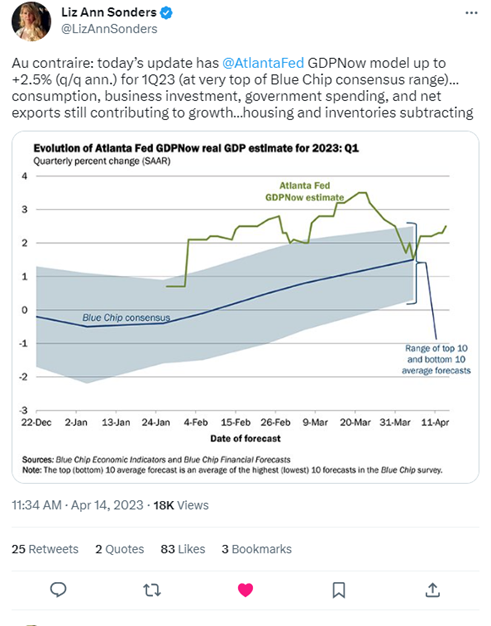
- Global GDP estimates for Q1 continue to rise, including the US where growth has been revised up to 3.3%. Q1 profit margins and earnings should be similarly resilient.
- Challenger job layoffs are picking up but the job market appears strong enough to absorb many of the newly unemployed. Wage growth and job openings still point to a very tight labor market, outside tech.
- Many US and global companies termed out their fixed rate debt and have the lowest interest expense to cash flow in decades. Some may not feel a material impact from rising interest rates until 2030.
- US household obligations (debt, leases, property taxes and rents) are still very low relative to disposable income, suggesting any slowdown or recession would be a modest one.
| | |
|
That said, we still see weakness in some important leading indicators:
- Falling new orders and rising inventories point to a manufacturing downturn later this year.
- Young unprofitable companies continue to suffer large cash flow losses; while the stock market has already repriced them, the economic impact of their spending contractions is ongoing.
- Lending standards are tightening in the US and Europe. There was a very large weekly decline in US banking system loans for the week ending March 29th, driven mostly by weakness in C&I and commercial real estate lending. Some comments I’ve seen describe it as ‘the large decline ever’, which is technically true but not when adjusted for inflation. During the 2001 and 2008 recessions, similar drawdowns took place multiple times when measured in real terms.
- The money supply is contracting everywhere but China.
Banking stresses in the US and Europe are moderating thanks to another round of Central Bank intervention and extraordinary aid. As we wrote in the 2023 Outlook, we do not expect a severe recession or a market correction below the lows of 2022. Even so, we believe there will be lower equity market levels at which to add risk sometime during the summer or fall of this year.”
Economic growth projections have steadily, moderately improved year-to-date, even though some traditionally reliable leading indicators are negative. While both current stock and bond market movements are singularly focused on Federal Reserve policy, the medium-term direction of markets will be driven by economic activities weighing on corporate earnings (quarterly season kicking off in earnest this week) and default rates.
| | |
|
“Here's Bloomberg's take on today's March CPI release: ‘data showed inflation moderated last month, but not enough to forestall the Federal Reserve from raising rates at least one more time this year.’
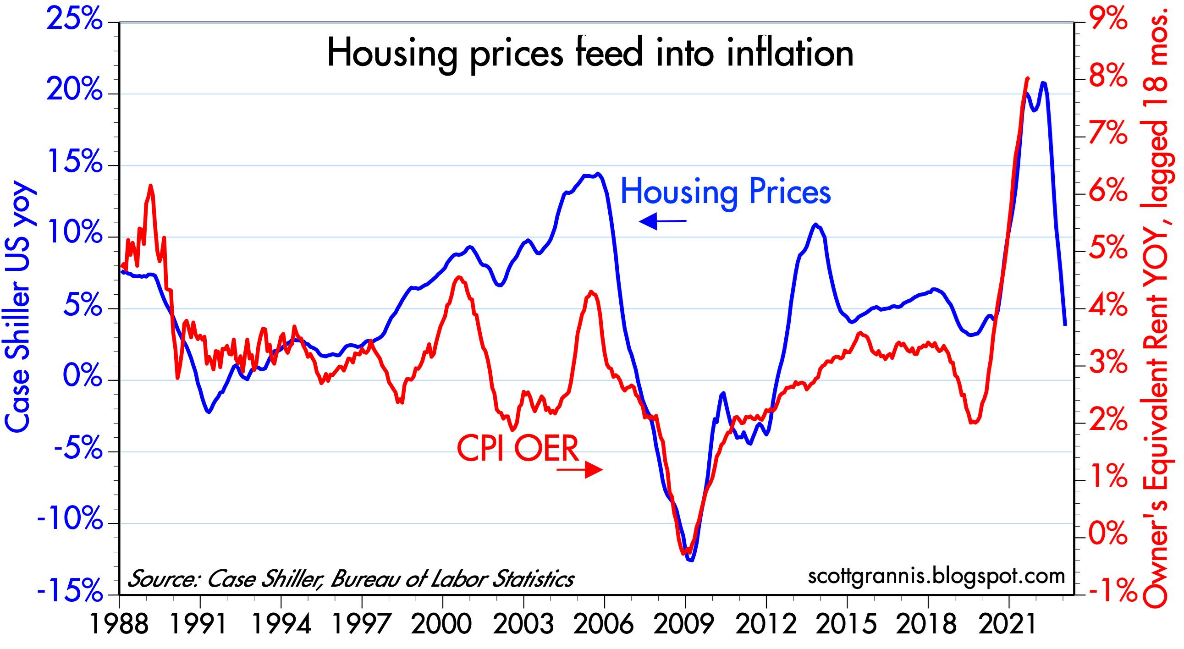
My take: There are only two things you need to know about inflation today: 1) without the Owners' Equivalent Rent component (which makes up about one-third of the CPI), the CPI would have declined at a -1.6% annualized rate in March, and 2) OER inflation has peaked and will almost surely decline significantly in coming months. In short, our national inflation nightmare is over. If the economists at the Fed can't understand this, they should be fired. There is absolutely no reason the Fed needs to raise rates further, and every reason they should begin cutting rates—beginning with the May 3rd FOMC meeting if not sooner…
| | |
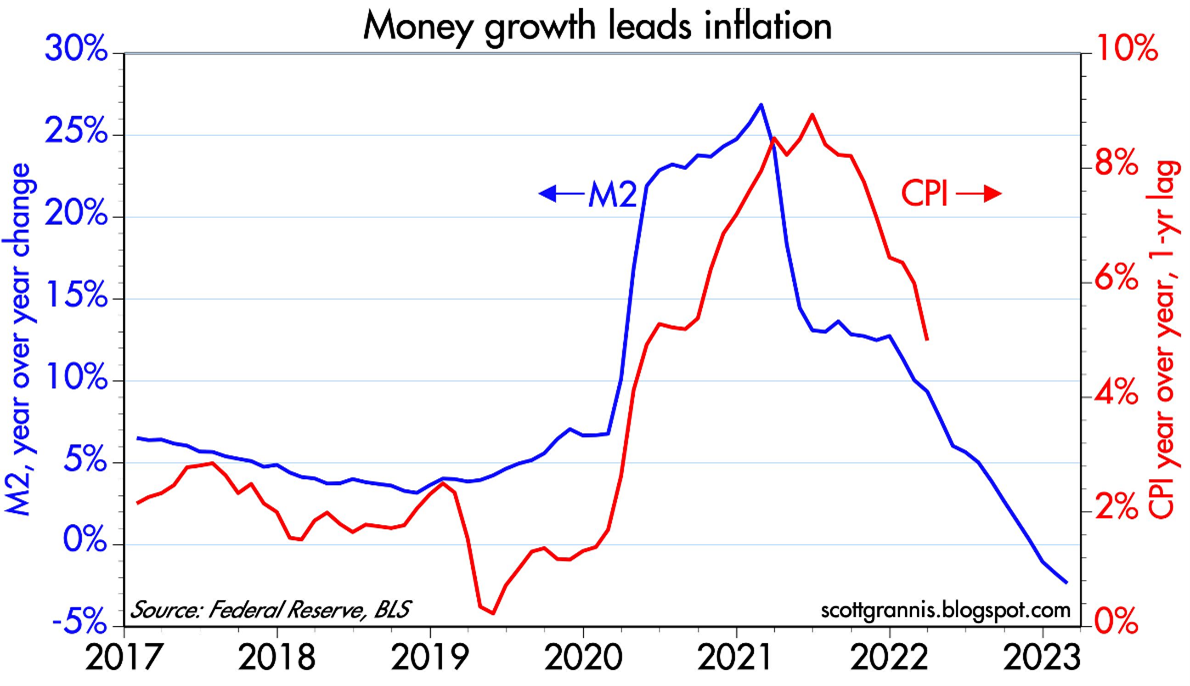
Growth in the M2 money supply foreshadows changes in the CPI by about one year. Given the behavior of M2 in the past year, the CPI is on track to fall to 2% or less by the end of this year, if not sooner. | | |
|
To paraphrase Wayne Gretsky, the Fed should be focused on where CPI is going, not on where it has been. It's on its way to zero, and that means the Fed should cut rates—and the sooner the better.”
All signs point to inflation subsiding. Housing, as measured by owners’ equivalent rent, operates on a serious lag, and is the major factor that is holding inflation data above target level. However, no one is sure if the Fed has gotten the memo or read it correctly.
| | |
|
“Lifestyle creep is when someone increases their spending after experiencing an increase in income. So that new raise quickly becomes a fancy new object or an expensive new habit, and, before you know it, your raise is gone.
For this reason, many personal finance experts will tell you to avoid lifestyle creep at all costs. However, I am not one of them. In fact, I believe that some lifestyle creep can be very satisfying. After all, what’s the point of working so hard if you can’t enjoy the fruits of your labor?
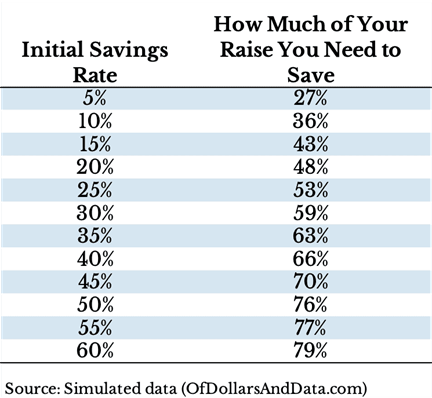
However, there is a limit to how much your spending can increase before it begins to affect your financial future. Where is that limit? Technically, it varies based on your savings rate (we’ll get into that later), but, for most people, the limit is around 50%. Once you spend more than 50% of your future raises, then you start delaying your retirement…
This analysis assumes that you require 25 times your annual spending to retire, your income grows at 3% a year, and your portfolio grows at 4% a year (all in inflation-adjusted terms):
|  | | |
|
Counter-intuitively the lower your initial savings rate, the more your lifestyle can creep without affecting your current retirement plan.
Why? Because those people who save less, by definition, spend more (for the same level of income). Therefore, when these low savers get a raise and decide to spend a portion of it, it affects their total spending less than a higher saver who got the same raise and spent the same percentage of it…
If we assume that the vast majority of savers have savings rates in the 10%-25% range, then the 50% limit is the correct solution based on my simulated data (see table above). And if your savings rate is currently below 10%, I can only assume that saving 50% (or more) of your future raises is in your best interest.
More importantly, saving 50% of your raises is easy to implement and remember. Half is for you and half is for future you (retirement).”
| | |
|
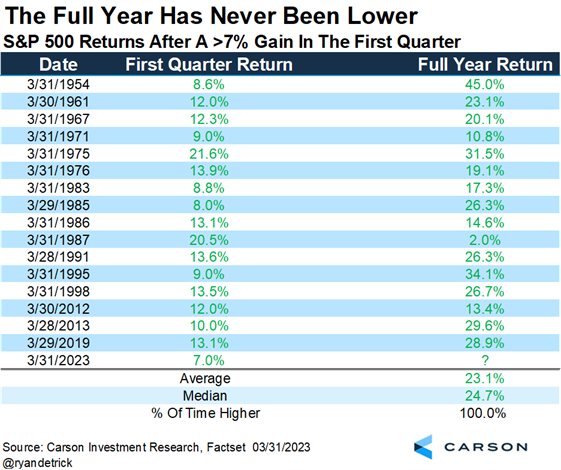
Knock on wood, but historically, when the S&P 500 gained more than 7% in the first quarter of the year, the full year has never been lower.
The full calendar year has been positive 16 out of 16 times while averaging +23.1%.
| | |
Thanks for reading. Have a great weekend! | | | |
Guidance for today. Growth for tomorrow. |
|
|
Tim Ellis, CPA/PFS, CFP®
CIO and Wealth Advisor
RBG Wealth Advisors
| | |
RBG Wealth Advisors LLC is a registered investment adviser. Information presented is for educational purposes only and does not intend to make an offer or solicitation for the sale or purchase of any specific securities, investments, or investment strategies. Investments involve risk and, unless otherwise stated, are not guaranteed. Be sure to first consult with a qualified financial adviser and/or tax professional before implementing any strategy discussed herein. Past performance is not indicative of future performance. | | | | | |