|
RBG Wealth Weekly
August 25, 2023
| | |
|
Ladies and gentlemen, the weekend! In this space each week, Greg and I share some of our favorite articles, notes, and graphics from the past week along with our commentary. Please feel free to provide feedback and forward along to others if you enjoy. We appreciate you taking the time to read.
If you are a client, we truly appreciate your business. If you are not a client, please click below to learn more about our firm and contact us.
| | |
|
“Most investors know that the effects of monetary policy (on the economy) operate with 'long and variable lags.' We've read a lot this year about a 'new era' of irrelevance around the inversion in the yield curve and/or the plunge in leading economic indicators. We do not think the economy (or the market) has passed the expiration date on those lags. Some consideration—or version—of that is likely a contributor to the recent pullback in stocks.
As July came to a close, the S&P 500 was less than 5% from its early-2022 record high. What changed?
- Treasury yields surged to their highest levels since the period before the Global Financial Crisis;
- Increased focus on the federal budget deficit, high debt levels and the elevating cost of servicing the debt;
- U.S. economic growth has surprised on the upside, while inflation remains sticky (bringing Federal Reserve rate hikes potentially back into the picture);
- Concerns about the ripple effect of China's weak economic growth;
- S&P 500 earnings did not surprise into positive growth territory and forward estimates have been trending lower;
- Investor sentiment had become a bit frothy alongside elevated valuations.
- Related to earnings, all of the appreciation in the stock market since last October came from multiple (P/E) expansion, with no aid from the denominator in the equation (earnings). Add the surge in yields into the mix and it was a recipe for a pullback—particularly among the most richly valued segments of the market.”
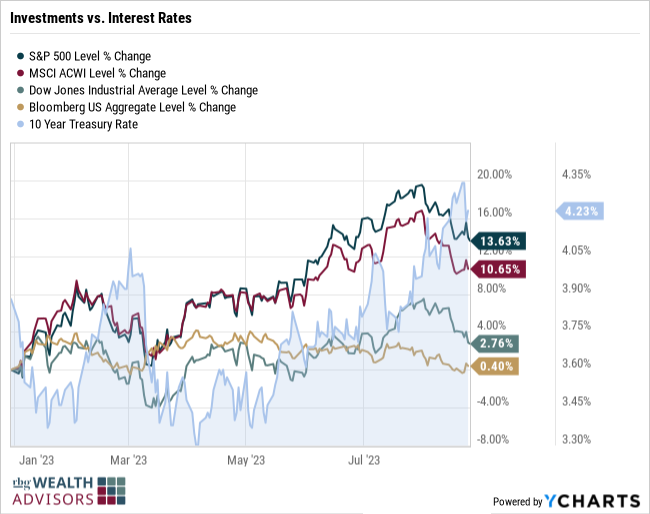
Liz Ann Sonders had a good long breakdown of the reasons for the August pullback in stock indexes (and bonds). They are all valid, although I think the first point outweighs the rest.
Even as stock market returns have been good-to-great year-to-date, we have now seen two separate 5%+ pullbacks. The first in March as interest rates spiked and fueled bank runs. The second in August as interest rates spiked again on upwardly revised economic growth figures and Federal Reserve officials’ hawkish comments.
|  | | |
|
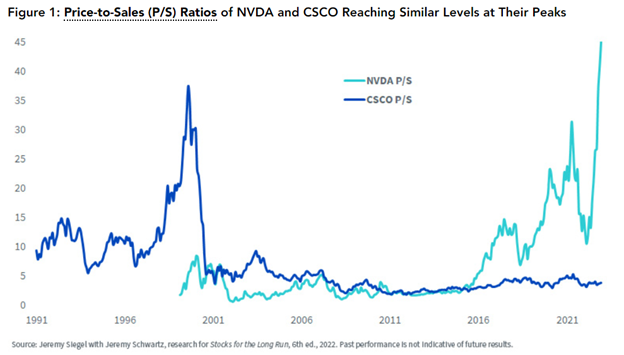
“Nvidia’s recent meteoric rise evokes memories of Cisco’s ascent during the dot-com era.
Both were tech behemoths powering significant technological shifts.
Both companies represented the heartbeats of transformative technological revolutions.
In the late ’90s and early 2000s, Cisco was more than just a tech giant; it was the backbone of the burgeoning internet. As the world began to realize the internet’s potential, Cisco’s routers and switches became indispensable, turning digital dreams into tangible realities. Its hardware served as critical infrastructure in the foundation of the modern internet.
Similarly, Nvidia, initially renowned for its prowess in graphics processing units (GPUs), has positioned itself at the forefront of another digital paradigm shift: artificial intelligence (AI)…
| | |
|
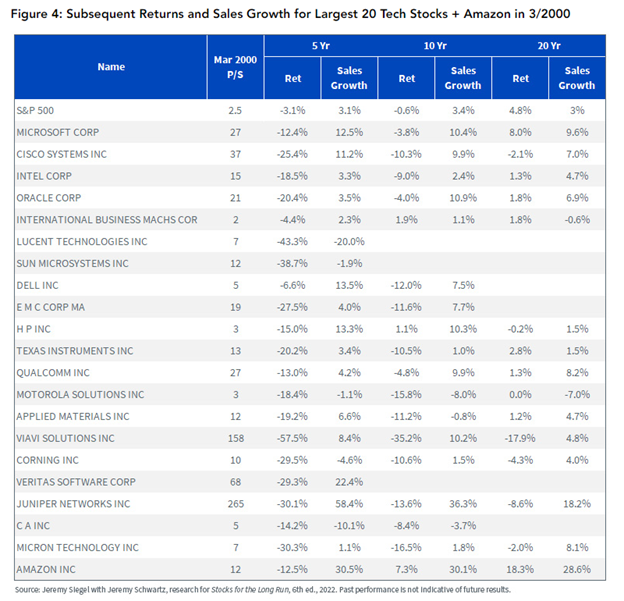
Even against the competition, though, Cisco’s status as a tech titan was undeniable, and it was even able to maintain an annual sales growth rate of 9.9% for the decade after it reached its peak P/S valuation in March 2000—almost triple the markets at 3.4%.
Over the next 22 years, Cisco’s sales growth slowed, and it currently stands at about 6.2% annually, which is still much higher than the market’s 4.2% and the Tech sector’s 5.4% annual sales growth.
However, despite strong growth and continued, albeit shrinking, market dominance, its stock has still not recovered to its early-2000 highs…
| | |
|
Only two companies from the largest 20 tech stocks in 2000 outperformed over the next 20 years: Microsoft and Amazon. Microsoft delivered nearly 10% sales growth a year for two decades, while Amazon delivered nearly 30% a year…
These narratives remind us that leading in innovation doesn’t guarantee perpetual success. For Nvidia, the task ahead is twofold: to fend off rising competitors and accurately anticipate the evolving market landscape. Remember, competitors can be other chip players like AMD, or they can be large companies venturing into designing their own customized chips. The market, in general, is not in favor of a single supplier of AI computational power.
For investors, it’s a reminder to stay grounded and look beyond the present hype to consider the long-term viability of success for a stock at such high valuations.”
It seems that Nvidia, especially in light of the last two quarters of earnings releases, has taken the crown as the FOMO stock for investors. Tesla, Bitcoin, and others come to mind as wearing it previously.
The growth numbers have been fantastic; however, it’s just flat-out hard to justify the growth required on a large cap stock trading at 40 times revenue (not earnings, but top-line revenues). The only stocks that have backed it up over the long term are Amazon and Microsoft, which both are very thankful to have diversified into the cloud market.
| | |
|
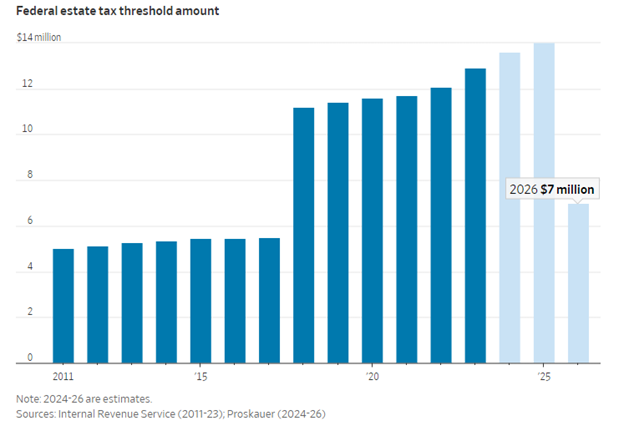
“The Trump tax cuts of 2017 temporarily doubled the base amount individuals could give away without paying estate taxes to $10 million. These cuts are due to expire in 2026, pushing wealthy Americans to move fast…
The $10 million figure in the Trump tax cuts of 2017 was indexed for inflation. For 2023, the combined gift- and estate-tax exemption is $12.92 million per individual, or $25.84 million per married couple. That is the amount you can give away during your life or at death tax-free.
Next year the exemption amount will likely be adjusted to $13.61 million, estimates Peter Tucci, an estate lawyer at Proskauer. For 2025, it could be $14 million per person, before dropping by half in 2026 to about $7 million.
| | |
|
That would mark the last year to make gifts to take advantage of the historically high amount before the cuts expire after Dec. 31, 2025, estate planners said.
If a couple transfers their full exemption amount of $28 million by 2025, before the law’s sunset, they would get $5.6 million in tax savings if they die in 2026, Tucci said. If they make the gifts to grandchildren, skipping a generation, there would be nearly $9 million in tax savings, he said.
The tax savings could be significantly larger over time. When money grows in these trusts, the appreciation is exempt from the transfer-tax system. So if the trust value goes up $100 million by the time of death, the family would save $40 million in estate taxes, at the current 40% rate.”
It takes some time to put some of these strategies in place. Families with total net worths in the range of $7M - $25M+ including business values, real estate, investments, etc. need to start planning for both the estate tax and income tax implications of the Tax Cuts & Jobs Act expiring.
Waiting to see the outcome of the next election cycle is going to put planning and execution into a very condensed window.
| | |
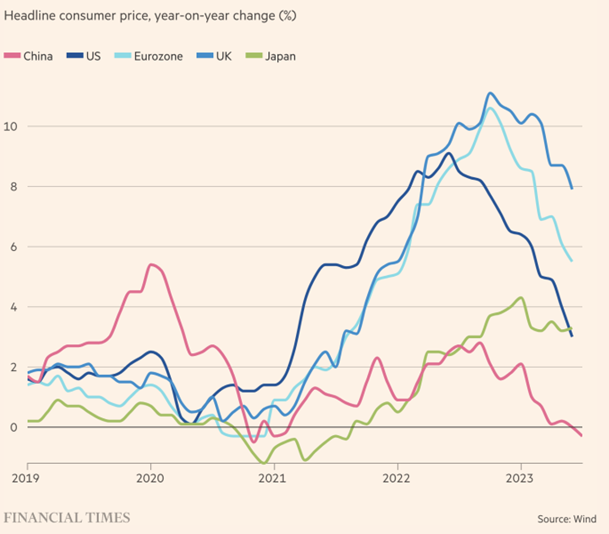
Weak Chinese consumer demand has tipped China into dreaded deflationary territory. | | |
Tweet (or maybe X) of the Week | |
Thanks for reading. Have a great weekend! | | | |
Guidance for today. Growth for tomorrow. |
|
|
Tim Ellis, CPA/PFS, CFP®
CIO and Wealth Advisor
RBG Wealth Advisors
| | |
RBG Wealth Advisors LLC is a registered investment adviser. Information presented is for educational purposes only and does not intend to make an offer or solicitation for the sale or purchase of any specific securities, investments, or investment strategies. Investments involve risk and, unless otherwise stated, are not guaranteed. Be sure to first consult with a qualified financial adviser and/or tax professional before implementing any strategy discussed herein. Past performance is not indicative of future performance. | | | | | |