|
RBG Wealth Weekly
July 28, 2023
| | |
|
Ladies and gentlemen, the weekend! In this space each week, Greg and I share some of our favorite articles, notes, and graphics from the past week along with our commentary. Please feel free to provide feedback and forward along to others if you enjoy. We appreciate you taking the time to read.
If you are a client, we truly appreciate your business. If you are not a client, please click below to learn more about our firm and contact us.
| | |
|
As we reach the halfway point of the year, it's a good time for investors to reflect on the events, trends, and developments that have shaped the market landscape so far.
Please see below a brief (15-20 minutes) video that recaps the first half of the year as well as key economic and investment trends emerging to impact markets.
| | |
|
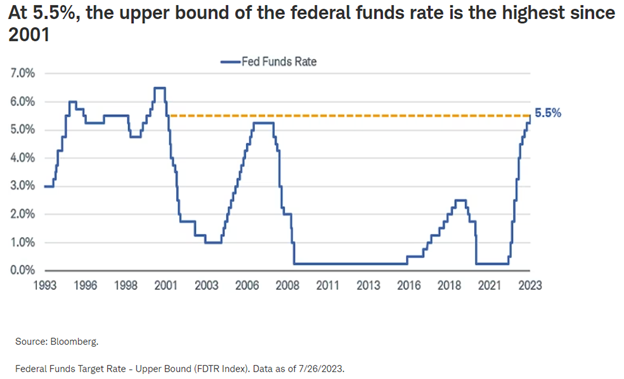
“As expected, the Federal Reserve raised the target range for the federal funds rate by 25 basis points, or a quarter percent, to 5.25% to 5.50%. It was a unanimous decision. The upper bound of the range now stands at the highest level since 2001. In addition, the Fed will continue to reduce its balance sheet (quantitative tightening) by allowing up to $95 billion per month in bonds to mature without reinvestment.
| | |
|
The Federal Open Market Committee (FOMC) made few modifications to its statement, except to upgrade its description of growth to "moderate" from "modest." However, it did retain the language that indicated job gains remain "robust" and inflation "elevated," even though inflation has fallen substantially over the past few months…
The big question facing the markets is: Does this hike represent the peak in the fed funds rate for the cycle, or are there more rate hikes ahead? That question remains unanswered. After the last FOMC meeting in June, Federal Reserve Chair Jerome Powell indicated that the committee believed it was "near its destination." Based on his comments after this meeting, the Fed doesn't seem clear on how far away it is from reaching its goal but does believe policy is currently "restrictive," or tight enough to slow growth and inflation. Nonetheless, Powell indicated that the Fed was prepared to be "patient and resolute" in reaching its inflation goal.”
After no change at their last meeting, the Federal Reserve’s FOMC decided to hike another 0.25% on Wednesday. It came as no surprise. Chair Powell had a verbal slip in June and called it a “skip” rather than a “pause”. The Fed has been telegraphing moves if not outright telling them to the Wall Street Journal.
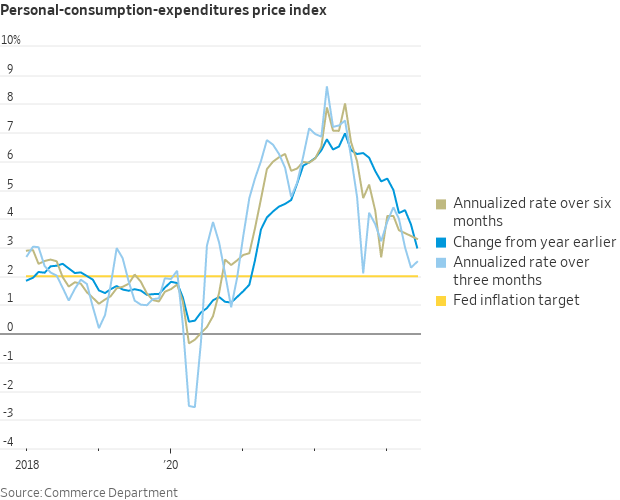
In my opinion, it’s unnecessary. Inflation measures have been rapidly falling at previous policy levels. See the Graph of the Week below.
| | |
|
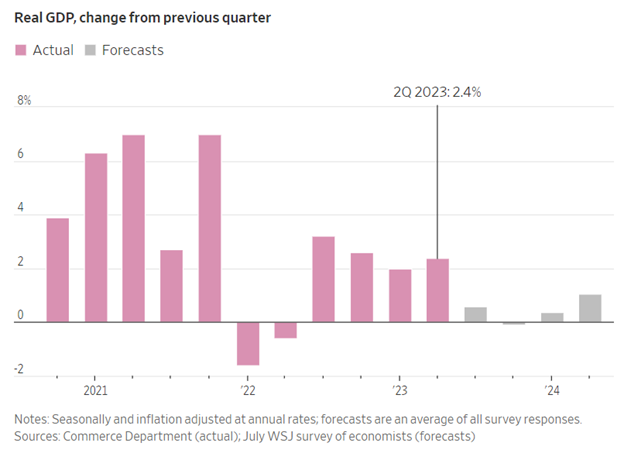
“Faster economic growth this spring raises the prospect of a longer postpandemic expansion despite the Federal Reserve pushing interest rates to a two-decade high.
Gross domestic product grew at a seasonally- and inflation-adjusted 2.4% annual rate in the second quarter, the Commerce Department said Thursday. That was faster than economists expected and above the 2% growth in the first three months of the year.
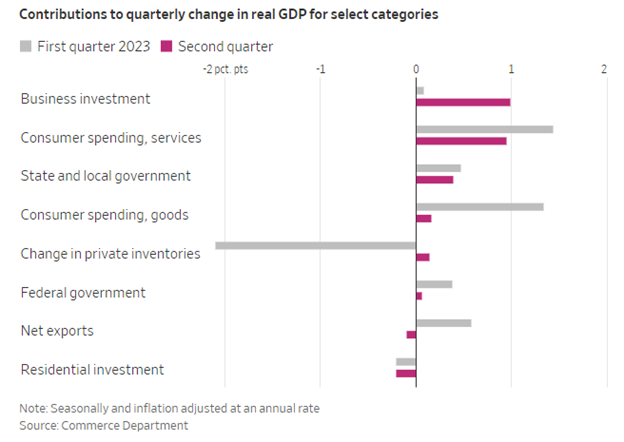
Consumer spending cooled but rose enough to drive overall growth alongside much stronger business investment in the second quarter. Those factors combined to buck economists’ earlier expectations that a downturn would start in the middle of this year due to higher interest rates.
As inflation falls from historic highs and the labor market remains strong, solid growth adds to the prospect of a soft landing—in which inflation returns close to the Federal Reserve’s 2% target without a recession.”
| | |
|
It was difficult not to like the latest U.S. GDP growth report. The growth rate of +2.4% easily beat consensus expectations of +1.8%. As far as composition, headline GDP was in line with “core GDP” growth of +2.3%, which strips out more volatile inventories, net trade, and government.
Consumer spending (especially goods) slowed but was still positive. Business investment picked up the slack with all three major categories of business investment higher: equipment, commercial construction, and intellectual property (e.g., research and development).
| | |
|
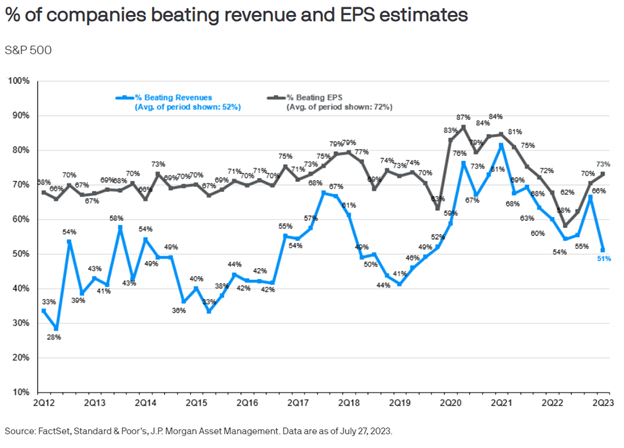
“We came into the year with a view that S&P 500 operating earnings would be flat-to-down in 2023, with the outturn dependent on whether the economy entered recession. However, with the second quarter earnings season underway, we are currently forecasting profit growth in the mid-single digits for the calendar year, particularly as results thus far have been better than expected. With 253 companies reporting (58.2% of market capitalization), our current estimate for 2Q23 S&P 500 operating earnings per share is $51.13. If realized, this would represent year-over-year earnings growth of 9.1%, but a quarter-over-quarter decline of 2.7%.
Thus far, an impressive 73% of companies have beaten earnings estimates while only 51% of companies have beaten revenue estimates as inflation has slowed. However, both earnings and revenue surprises have been positive, with earnings beating estimates by an average of nearly 5%. Meanwhile, and arguably most importantly, profit margins have only declined slightly, with our current estimate tracking 11.3% versus 11.6% in 1Q23.
| | |
|
This combination of resilient growth, better than expected profits and enthusiasm around artificial intelligence has led to a strong rally in U.S. equities so far this year. While we see room for this to continue in the near term, particularly as the breadth of the rally continues to increase, it is important to note that more than 90% of the S&P 500’s YTD gains have been driven by multiple expansion, rather than an improving outlook for corporate profits.”
An improvement in corporate earnings estimates has been the most underreported bullish component of this year’s stock market gains. As JPM notes above, 90% of the gains have been due to multiple expansion NOT dividends or earnings growth. Some of that was purely a turnaround from 2022’s multiple compression. However, if corporate earnings can continue to surprise to the upside, it will be supportive for the stock market at current levels and beyond.
| | |
|
The Fed's preferred inflation gauge, the personal consumption expenditures (PCE) price index, fell to 3.0% in June from one year earlier, which was down from 3.8% in May and the recent peak of 7.0% in June 2022.
Core PCE (excludes food and energy) was 4.1% year-over-year, which was down from 4.6% in May and the recent peak of 5.4 percent in February 2022.
Headline PCE at 3% was the lowest since March 2021. Its 3-month annualized rate is now 2.5% (barely above 2% target). Its 6-month annualized rate is 3.3%.
| | |
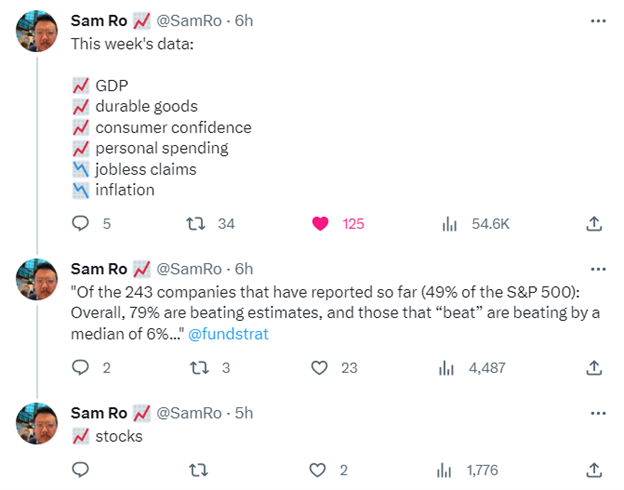
Tweet (or maybe X) of the Week | |
Thanks for reading. Have a great weekend! | | | |
Guidance for today. Growth for tomorrow. |
|
|
Tim Ellis, CPA/PFS, CFP®
CIO and Wealth Advisor
RBG Wealth Advisors
| | |
RBG Wealth Advisors LLC is a registered investment adviser. Information presented is for educational purposes only and does not intend to make an offer or solicitation for the sale or purchase of any specific securities, investments, or investment strategies. Investments involve risk and, unless otherwise stated, are not guaranteed. Be sure to first consult with a qualified financial adviser and/or tax professional before implementing any strategy discussed herein. Past performance is not indicative of future performance. | | | | | |